
Idea 1
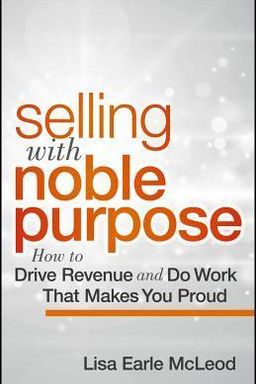
Selling with Noble Purpose: Transforming Sales Through Meaning
What if selling could be about more than just hitting revenue targets? What if every sales conversation became a moment of meaning—an opportunity to improve someone’s life? In Selling with Noble Purpose, consultant and author Lisa Earle McLeod argues that the world’s most effective salespeople are driven not by money but by purpose. Her core claim is revolutionary in its simplicity: sales organizations that focus on making a meaningful difference for customers consistently outperform those focused solely on financial metrics.
McLeod contends that pursuing purpose doesn’t mean abandoning profit—in fact, it’s the most reliable way to achieve it. Through stories from companies like Apple, Google, Pfizer, and Southwest Airlines, she demonstrates that organizations fuel extraordinary growth when they rally around what she calls a Noble Sales Purpose (NSP): a clear, emotional statement of how the company improves customers’ lives. This isn’t a marketing slogan. It’s a strategic mindset that touches every conversation, meeting, and decision.
The Heart of the Book: Profit as the Result, Not the Purpose
The book opens with a blunt diagnosis of what McLeod calls the “Great Sales Disconnect.” Many teams preach ‘focus on customer needs,’ yet internal conversations revolve around quotas, forecasts, and closing dates. This contradiction, she observes, drains enthusiasm and creativity. Salespeople who are reduced to numbers treat customers as numbers, and everyone loses. Her solution is a philosophical reordering of priorities: profit should be viewed as the test of a sales force’s effectiveness, not its purpose. Quotas belong, but beneath them must be a deeper North Star—the company’s reason for existing beyond money.
Why Purpose Works
McLeod dives into psychology and neuroscience to explain why purpose outperforms pressure. Drawing from Daniel Pink’s Drive, she shows that high performance arises not from carrot-and-stick incentives but from our intrinsic human craving for autonomy, mastery, and purpose. People naturally want to be part of something bigger; when salespeople believe their work genuinely improves customers’ lives, their frontal lobes light up—enhancing creativity, empathy, and problem-solving. This is the mindset difference between average performers and stars: top reps go into calls thinking about the customer’s transformation, not their own commission.
Stories That Prove the Case
McLeod’s arguments are brought to life through vivid examples. The CEO of Capital G Bank in Bermuda reframed his goal from “delivering shareholder value” to “helping people achieve financial success,” instantly galvanizing employees at every level. At Graham‑White Manufacturing, a century‑old train component maker, engineers rediscovered pride when they realized their work “helps make transportation safer, faster, and more reliable.” A simple change in language turned routine tasks into acts of public service. The same pattern repeats at CMIT Solutions (“We help small businesses succeed”) and getAbstract (“We turn employees into leaders”)—each company lifted morale and revenue once its leaders shifted from pushing products to pursuing impact.
The Manager’s Role in Reframing Sales
Because culture flows downhill, McLeod places special responsibility on sales leaders. A single question can transform an entire team: “How will this customer be different as a result of doing business with us?” When managers use that question in pipeline reviews, they trigger deeper thinking and connect every salesperson’s tactics to the NSP. Coaching becomes purposeful; morale rises; closing rates improve. It’s a simple but profound shift in internal dialogue. As Peter Drucker noted, “Profit is not the purpose of a business but the test of its validity.” McLeod extends this: driving revenue is not the purpose of sales, it’s the test of its effectiveness.
From Soul to System: How NSP Reshapes Organizations
In later chapters, the book moves from inspiration to implementation. McLeod shows how purpose-centric thinking transforms everything: CRM systems that once tracked transactions can be refitted to capture customer goals, marketing can reframe materials around impact instead of features, and even performance reviews can reward behaviors that embody purpose. She offers practical frameworks—the 6‑P model linking profit, process, products, promotion, and people under the hub of purpose; coaching templates; and story‑building methods that turn customer successes into cultural fuel. Each is designed to consolidate one truth: noble purpose is not fluff; it is architecture.
Why This Matters
Selling with Noble Purpose matters because it restores humanity to one of the most misunderstood professions. McLeod reminds us that salespeople are often seen as manipulative or insincere, but in reality, great salespeople are connectors, problem solvers, and carriers of hope. When sales leaders replace fear with purpose, every call becomes an opportunity to serve. In a world saturated with transactions, this approach offers transformation—for sellers, for customers, and for companies chasing growth without losing soul.