
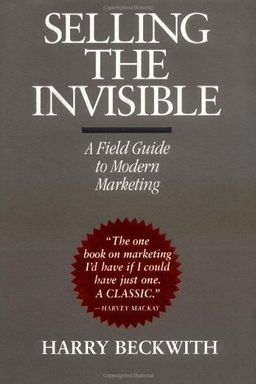
Selling the Invisible cover

Selling the Invisible

by Harry Beckwith

Selling the Invisible by Harry Beckwith demystifies service marketing in a growing service economy. The book offers actionable insights on branding, customer expectations, and innovation, helping service businesses stand out and thrive. Ideal for marketers and entrepreneurs aiming to master the art of selling the intangible.

Selling the Invisible: Making Promises Real in a Service Economy

Have you ever wondered why some companies thrive simply by how they treat you—while others lose your trust in seconds? In Selling the Invisible, Harry Beckwith argues that in today’s economy, most of what we buy isn’t a product at all—it’s a promise. Whether it’s a haircut, a legal consultation, or your car’s warranty, what you really purchase is the assurance that someone will deliver something you can’t see, test, or touch until after you’ve handed over your money.

Beckwith contends that selling services—the invisible—is fundamentally different from selling products. A tangible product can be photographed, displayed, and easily compared. A service exists only as a story, an experience, and a relationship. He insists that while many service providers think marketing means running ads or crafting clever slogans, true service marketing starts internally—with the service itself. If your reality is poor, no amount of advertising can save you. The heart of service marketing isn’t hype—it’s trust.

The Challenge of Intangibility

Services are invisible, Beckwith explains, and this invisibility makes customers feel anxious. When you buy a car, you can test-drive it and smell the leather seats; when you hire an architect, accountant, or yoga instructor, you can’t truly test their promise until you’ve risked your time and money. This uncertainty creates fear—and selling services means reducing that fear. Every act, from answering the phone to sending a proposal, becomes part of the service itself. Unlike a product company, a single bad experience with one employee can destroy a client’s entire perception of your brand.

A New Marketing Model for a Service Economy

Beckwith points out that while business schools and marketers still use models created for manufacturing economies, America long ago became a service economy—nearly 80% of its workforce delivers services. Even companies that seem to sell products—like Nike or Saturn—actually succeed on the strength of their service. Nike doesn’t manufacture shoes; it designs, markets, and inspires athletes. Saturn doesn’t just sell cars; it sells a no-hassle service experience.

In this new landscape, differentiation doesn’t come from materials or features. Products are copied overnight. What lasts are relationships, reliability, and the small details that build trust. Beckwith urges you to think like a service marketer, even if you sell products, because every product comes wrapped in invisible extras—support, delivery, responsiveness, and care.

Marketing Starts Inside

In Beckwith’s view, marketing isn’t a department—it’s the whole business. Every interaction, from a receptionist’s greeting to the wording on an invoice, tells your customers who you are. That means your marketing must start inside: with better people, processes, and follow-through. He borrows Guy Kawasaki’s advice from the computer industry—get better reality. Improve what you deliver so your marketing becomes easier, cheaper, and more credible. The best marketing is word of mouth that springs from genuine excellence.

Beckwith also warns that most companies overestimate their service quality. He humorously cites the “Lake Wobegon Effect” —everyone believes their service is above average. But when most services are mediocre, simply being “above average” means you may still stink. His remedy? Assume your service is bad. That mindset drives continual improvement and humility.

Why Small Details Create Big Impact

Throughout the book, Beckwith returns to the Butterfly Effect: small gestures can create enormous impacts. One story tells of a Minneapolis clerk named Roger Azzam who, noticing a customer’s problem, ran upstairs to fix a delayed repair personally. The client was so touched by Roger’s sincere effort that he ended up buying an expensive suit, tie, and slacks—more than $700 in sales triggered by one act of kindness. That small flap of a butterfly’s wings became a gust of profit.

In a service world, Beckwith argues, customers judge not perfection but how you respond to imperfection. “To err is an opportunity.” The way you handle mistakes defines your reputation far more than the absence of errors ever could. Roger’s humane, quick response turned an error into admiration—proof that empathy sells better than efficiency alone.

Simplify and Humanize

Beckwith concludes that selling services requires deep understanding of human behavior. People buy relationships before results; they crave appreciation more than rational analysis. Because we live in an overcommunicated, overstressed world, only simplicity cuts through the noise. The more you say, the less people hear. Your message should be focused, warm, and consistent. It should comfort as much as it persuades.

In the end, Beckwith invites you to stop thinking of marketing as manipulation and start thinking of it as empathy made visible. Selling the invisible isn’t about selling at all—it’s about reassuring, comforting, proving, and reminding your audience that promises, when made with integrity and delivered with care, can be seen and felt after all. His message is practical but philosophical: if you serve better, you’ll sell better. If you care more, you’ll earn more. The invisible becomes visible through trust, consistency, and heart.


Build Better Reality Before You Advertise

Beckwith’s first rule of service marketing is strikingly simple: before you sell anything, fix your service. Too many companies rush to create advertising campaigns while ignoring the quality of what they deliver. He calls this obsession with outward marketing the greatest misconception in business—the idea that getting your name out will solve your problems. In reality, it’s the fastest way to destroy a service company if your product disappoints new customers.

Get Better Reality

Great marketing isn’t magical; it rests on what Kawasaki termed “better reality.” You can’t rely on hype. Consider Delta Airlines: once a paragon of customer service, Delta lost its edge when it failed to innovate or communicate clearly. Even with strong service, Delta’s poor marketing brought it to near disaster. The lesson is twofold—outstanding service attracts customers, but smart marketing keeps them.

Assume Your Service Is Bad

Most companies assume their service is fine because complaints are rare. Beckwith flips that logic: if you aren’t hearing complaints, people may have stopped believing anything will change. Assume your service is bad—it forces you to improve and keeps you humble. Even average service can fail spectacularly in a world where customer expectations rise daily. You’re competing with Disney, Federal Express, and McDonald’s—benchmarks that make ordinary service look shabby.

Tiny Gestures, Huge Results

The Butterfly Effect metaphor recurs throughout the book. Roger the store clerk’s small act of empathy—fixing one man’s jacket personally—created loyalty and $740 in instant sales. Beckwith calls this “a butterfly named Roger.” The message: don’t just deliver efficiently, but care personally. A tiny action can trigger waves of positive response and free publicity. Be a Roger, he says: flap your wings.

“Big mistakes are big opportunities,” Beckwith writes. When you fix an error with compassion and speed, you not only recover credibility—you strengthen it. Customers forgive human error; they detest indifference.

Think Different, Not Just Better

Many organizations believe success lies in improving incrementally—doing last year’s work 15% better. Beckwith warns that this logic breeds mediocrity. The giants—McDonald’s, Federal Express, Citicorp—succeeded not by doing things slightly better, but radically differently. They redefined their industries rather than refining them. Don’t just think better; think different. Innovation begins by asking: “If this didn’t exist, how would I invent it today?”

Before chasing customers with ads or discounts, create a service so reliable and distinctive that your marketing becomes almost unnecessary. Better reality makes word of mouth your best campaign. Great marketing begins inside—with superior reality, humble self-assessment, and small acts of human decency that ripple outward.


Marketing Is Everyone’s Job

Beckwith insists that marketing is not a department—it’s the business itself. Every employee, from the CEO to the clerk who answers the phone, shapes how customers perceive your company. A rude CFO, he notes, can repel $50,000 in potential business even when everything else about the company shines. Treat every act as a marketing act. Your receptionist’s smile, your invoice design, your follow-up email—all are part of your marketing strategy.

End the Tunnel Vision

Most executives suffer from what strategist Theodore Levitt called “marketing myopia”—they focus on products rather than customers. Beckwith argues that service companies must replace internal obsession with external empathy. “Get out, climb out, have someone pull you out of the tunnel,” he writes. True marketers think beyond the firm’s walls and see the world through their clients’ eyes.

You’re All Marketers

Beckwith highlights Japanese companies that operate without formal marketing departments; everyone is responsible for delivering the message. In America, that translates into one mindset: don’t open a shop unless you know how to smile. Every employee is a marketer whose behavior speaks louder than any advertisement. Review every client touchpoint and ask: does this detail attract or alienate?

What Are You Really Selling?

A recurring theme is reframing your business definition. You’re not selling hamburgers; you’re selling experiences. McDonald’s proved this by focusing on speed and cleanliness, not burgers. Burger King bragged about better taste while missing the emotional mark. Likewise, lawyers don’t sell expertise—they sell peace of mind. Clients can’t judge legal skill, but they can tell whether their calls are returned and their concerns respected. Relationships, not credentials, win business.

Go Where Others Aren’t

Beckwith channels Sam Walton’s genius: “Go where they ain’t.” Wal-Mart conquered small towns that rivals ignored. McGladrey & Pullen grew by locating offices in secondary cities where Big Six accounting firms weren’t interested. Success often means avoiding crowded battles and finding fresh arenas—whether geographic, demographic, or conceptual. Hit ’em where they ain’t, and you can win without a fight.

Marketing is the air everyone breathes inside your organization. It’s not limited to ads or PR—it’s in how you pick up the phone, handle errors, and deliver promises. Every conversation is marketing. Every attitude sells or repels. The invisible becomes visible through each human touchpoint, and every employee is part of your brand’s heart.


Understanding How Prospects Think

To sell the invisible, Beckwith urges you to understand the psychology of your prospects—their fears, biases, and irrational tendencies. People don’t buy professional services logically; they buy emotionally and defensively. Their goal isn’t always to make the superior choice but to avoid making a bad one. For most buyers, risk reduction matters more than perfect results.

Fear and Familiarity

Beckwith likens every service prospect to a worried soul—someone buying sight unseen. Because services are invisible, prospects crave signals of safety. They choose familiarity over logic. For example, Visa cards offer more utility and flexibility than American Express, but millions pay extra for AmEx because it feels prestigious. The card isn’t rationally better—it simply feels safer to carry.

The Anchoring and Recency Effects

The first impression you create becomes an anchor customers rarely move beyond. Beckwith tells of a secretary named Joan who could never escape her original “assistant” label, even after being promoted. Likewise, prospects anchor to your earliest interactions—the first email or call—and judge you forever through that lens. He adds that last impressions matter as much: people remember how something ends more vividly than how it runs. Always leave clients with excellence.

Show Your Warts

Paradoxically, honesty sells better than perfection. Beckwith cites a study where a candidate’s reference letter noted, “Sometimes John can be difficult to get along with.” Interviewers rated John higher and more trustworthy because the criticism made the praise believable. Likewise, a sales manager who began his pitch by listing what his service didn’t cover saw conversion rise dramatically. Truth builds credibility; transparency creates trust.

Accentuate the Trivial

In markets where services look alike, small details become decisive. Prospects scrutinize the decor, the business card’s weight, and even a salesperson’s cologne. “The more similar the services, the more important the differences,” Beckwith writes. Manage these tiny signals—they communicate care and competence when the service itself can’t be seen.

Ultimately, prospects buy confidence, not capability. To reach them, design every interaction—from your first email to your final thank-you—to replace fear with familiarity. Be vividly human, visibly honest, and intentionally simple. The mind buys what the heart trusts.


The Power of Focus and Simplicity

Beckwith’s golden rule for communication: the more you say, the less people hear. In an overcommunicated world, only a simple, focused message can cut through. Borrowing from Al Ries and Jack Trout’s classic Positioning, Beckwith teaches that your service should mean one thing in your prospect’s mind. Domino’s owned “speed.” FedEx owned “overnight.” SAS owned “business traveler’s airline.” You must sacrifice breadth to gain power.

Fanatical Focus

Domino’s didn’t talk about price or quality—it obsessed about delivery. That fanatical focus built instant recognition and trust. Beckwith shows that narrowness creates strength: SAS, when it positioned itself around business travelers, paradoxically grew tourist traffic too. Focusing attracts the most profitable customers first, allowing you to serve others better afterward.

The Halo Effect

When you stand firmly for one thing, people assume many good things about you. This is the “Halo Effect.” For example, Long Island Bank emphasized being local. Without mentioning assets or services, customers began assuming it had better branches, more offerings, and stronger capital. Focus creates radiance—you shine broader by shining brighter.

Avoid the Deadly Middle

Lack of focus kills. Beckwith recounts Sears’s tumble from dominance when it tried to be everything—both “the softer side” and “the tool shop.” Without a singular concept, customers couldn’t describe Sears, and confused brands die. In contrast, Bill Clinton’s campaign thrived by hammering one message—“It’s the economy, stupid.” Repetition and narrow focus win hearts and votes alike.

Make It Simple, Make It Human

Every communication should feel like a conversation, not a brochure. Say one thing—and repeat it until people remember. Resist the urge to dazzle with adjectives; tell a story instead. Simplicity isn’t ignorance; it’s empathy. You aren’t talking to a crowd of critics—you’re talking to one distracted soul who just wants clarity.

Beckwith’s mantra—focus, simplicity, repetition—echoes through every marketing success story. Choose a message small enough to fit in the prospect’s memory. Say it memorably, vividly, and with warmth. Then say it again.


Pricing Psychology and Perceived Value

Pricing, Beckwith says, is not logical—it’s emotional. From “Ugly Cats $100 each” to Timberland raising prices to outsell cheaper rivals, he shows that higher prices often signal higher quality, while low prices destroy trust. People buy value they can imagine, not math they can calculate. If no one complains about your price, it’s too low; if everyone complains, it’s too high. About 20% price resistance means you’re priced right.

Avoid the Deadly Middle

Medium prices and medium messages fail. The low-cost provider promises savings; the premium provider promises excellence. The middle offers neither clarity nor power. Beckwith calls this the “Deadly Middle.” The same logic applies to positioning: customers can’t remember or admire average. Choose elite or budget—but never “pretty good.”

Charge for Knowing Where to Hammer

Beckwith’s “Carpenter Corollary to the Picasso Principle” captures the essence of pricing expertise. A carpenter fixes a squeaky floor with one nail and charges $45: $2 for hammering, $43 for knowing where to hammer. Like Picasso charging thousands for minutes of drawing, experience is the price’s invisible justification. Don’t bill by hours—bill by mastery.

“Don’t charge by the hour,” Beckwith urges. “Charge by the years.” People pay for knowledge—your ability to make the complicated simple and the invisible visible.

Beware the Low-Cost Trap

Low-cost positions look tempting but lead to burnout. Giants like Sears and J.C. Penney proved that cheapness kills loyalty. Cutting prices is easy for competitors and demoralizing for employees. You can’t inspire excellence by selling austerity. Beckwith points to studies showing that companies emphasizing differentiation consistently outperform cost-cutters in revenue and profitability. Price communicates dignity—never apologize for it.

Pricing is storytelling. It signals confidence, competence, and character. When you underprice your service, you don’t just reduce profit—you lower perceived worth. Charge boldly. People aren’t buying your time; they’re buying the peace of mind that you know how to hammer in the right place.


Branding the Invisible

Beckwith declares that almost nothing beats the power of a brand—especially for services. A brand is more than a symbol; it’s a warranty. It’s the emotional proof that you’ll keep your promises. In product marketing, a brand says “this works.” In service marketing, it says “this person won’t let me down.”

Names Matter

Beckwith skewers the trend of monogram naming (like DMM or ADC). People can’t remember initials—they remember stories and humanity. A name should carry personality, attitude, and promise. Use your own name if possible, like restaurateur LeAnn Chin; it creates celebrity and connection. He also advises testing “information per inch”—how much meaning your name communicates quickly. “NameLab,” for example, instantly conveys creativity and science in one word.

Integrity Is the Heart of the Brand

Services are promises, and the heart of every brand is integrity. A single lie obliterates years of effort. People will forgive mistakes but never betrayal. Brands grow when every act honors the promise. It’s not logos or slogans that sustain reputation—it’s consistency of behavior. Beckwith calls integrity “the heart of a service brand.” Without it, your trademark is just ink.

Brands Are Shortcuts

In today’s time-starved microwave world, brands simplify decisions. People don’t have hours to research; they buy reassurance. Beckwith humorously recalls a client paying $400,000 for a company whose only assets were its name and client list. In services, brands make invisible value visible—they transform promises into confidence.

Whether you’re a lawyer, designer, or consultant, build your brand by behaving like one. Invest in integrity, repetition, and humanity, until your name itself says “trust.” In an uncertain world, a trusted brand is the clearest guarantee money can buy.


Communicating and Selling the Invisible

Because services are unseen promises, communication must make them visible and comforting. Beckwith advises you to stop hyping and start humanizing. People don’t want clever slogans—they want warmth, proof, and hope. Every message should reduce fear and build familiarity.

Say One Thing—and Repeat It

Human brains process one message at a time. Beckwith calls this the “Cocktail Party Phenomenon”: you can only listen to one conversation meaningfully. Thus, a single clear message repeated often is far more effective than a grocery list of features. Like a favorite song, repetition builds familiarity until people hum your tune instinctively.

Prove It—Don’t Say It

Skip adjectives; show stories. Beckwith praises Gerry Spence, the lawyer who wins juries through vivid narratives. In business, stories prove credibility better than claims. Instead of insisting you’re “quality-driven,” share client testimonials or measurable results. “Don’t say it, prove it,” Beckwith urges. Show evidence—grades, scores, awards. Create facts that substitute for adjectives.

Visualize the Invisible

Customers believe what they can see. That’s why insurance companies use rocks, umbrellas, or towers as symbols of protection. Make your invisible promise tangible through design, decor, and demeanor. Everything visible—from your shoes to your business card—markets your service. Even scent and color can express reliability or warmth. “People hear what they see,” Beckwith writes.

Sell Hope, Not Perfection

In one of his most human chapters, Beckwith reminds you that people buy happiness or the hope of it. “In our factories we make perfume,” said Revlon’s founder. “In the stores we sell hope.” Services sell hope too—the hope that someone understands your need and can make your life easier. Ultimately, selling well means making people smile, not making them think.

Communication is empathy expressed aloud. Strip away jargon, keep it visual, make it positive, and end with hope. If your words make someone feel understood, you’ve already sold the invisible.


Keeping Clients Through Gratitude and Visibility

Beckwith ends where true marketing begins—with nurturing existing relationships. He observes that service providers always operate at a deficit. When a client hires you, she takes a risk—trusting your promise. You owe her from day one. Each mistake expands that deficit; each act of gratitude shrinks it. If you assume your relationship balance sheet is negative, you’ll treat every interaction as a chance to rebuild trust.

Managing Expectations

Don’t promise miracles. Most churn in services comes from inflated expectations. Collections agencies, for example, lose clients because they promise unrealistic recovery rates. A disappointed client doesn’t just leave—she tells others you lied. Managing expectations means promising honestly and delivering slightly more.

Gratitude Is Marketing

Every thank-you note is marketing. Every acknowledgment repairs the emotional account between you and your client. Beckwith advises saying thank you often and sincerely. “You can’t thank people enough,” he writes. Relationships fail not from lack of competence but lack of appreciation. Gratitude keeps your service human.

Advertise Your Successes

Clients rarely notice your brilliance—they notice your failures. Because services vanish once delivered, satisfaction fades quickly. A fixed pipe or a finished campaign disappears from memory. That’s why you must advertise successes humbly: remind clients what you achieved, show awards, share testimonials. Visibility sustains satisfaction. Out of sight is out of mind.

Beckwith’s closing message is simple but profound: relationships, not campaigns, sustain service businesses. Gratitude, honesty, and reminders of value keep clients believing. Marketing doesn’t end when you get the sale—it begins anew every day you deliver the promise. You hold customers by staying visible—and thankful.

Dig Deeper

Get personalized prompts to apply these lessons to your life and deepen your understanding.

Go Deeper

Get the Full Experience

Download Insight Books for AI-powered reflections, quizzes, and more.