
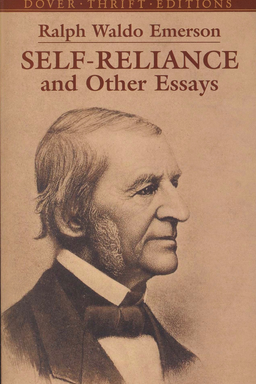
Self-Reliance cover

Self-Reliance

by Ralph Waldo Emerson

Self-Reliance by Ralph Waldo Emerson is a powerful manifesto advocating for individual thought and independence. It challenges societal conventions, urging readers to trust their instincts and embrace their unique potential, offering a pathway to personal freedom and fulfillment.

The Courage to Trust Yourself

When was the last time you ignored your own intuition because it didn’t align with what others expected? Ralph Waldo Emerson’s Self-Reliance opens with a challenge that feels as relevant now as it did in the 19th century: dare to trust yourself. Emerson contends that all true greatness—every act of genius, every spark of innovation, every moment of moral strength—comes from listening to your inner voice rather than conforming to external pressures. This essay isn’t just about individualism; it’s about rediscovering the divine spark within you and recognizing that authenticity is your highest form of power.

At its heart, Self-Reliance argues that conformity and fear of being misunderstood are the greatest barriers to human potential. Emerson insists that you must live from the inside out: follow your intuition, act on your convictions, and abandon the constant need for external validation. He criticizes society’s tendency to value consistency over originality, goodness over integrity, and institutions over the individual mind. Instead, he proposes that integrity—the alignment of your actions with your inner truth—is the only sacred law.

The Power of Inner Genius

Emerson begins with a striking claim: genius is not foreign or reserved for a select few. It is the courage to believe that what you think and feel deeply is true for all humanity. When Moses, Plato, and Milton spoke, they didn’t parrot tradition—they declared what they themselves believed. Similarly, Emerson argues that in every moment you dismiss your ideas as unworthy simply because they are yours, you betray the divine spark of originality inside you. Great works of art resonate with us because they articulate ideas we secretly recognized but lacked the courage to utter.

Why Society Fears Self-Reliance

According to Emerson, society is a “joint-stock company” in which individuals trade their liberty for security and acceptance. Conformity is rewarded while authenticity is punished. From early education to organized religion, systems are designed to standardize rather than liberate the human mind. To be truly self-reliant, you must resist the seductive comfort of belonging. As he puts it, “Whoso would be a man must be a nonconformist.”

Emerson doesn’t advocate selfishness or rebellion for its own sake—his self-reliance is moral, not narcissistic. It is the willingness to stand alone, guided by conscience, even when your truth offends others. It’s a call to live in correspondence with your own nature, not the borrowed voices of reputation or tradition.

The Grace of Being Misunderstood

One of Emerson’s most famous insights declares, “To be great is to be misunderstood.” He reminds us that the greatest minds—Socrates, Jesus, Galileo, Newton—were ridiculed for defying their time. If your actions provoke confusion or criticism, it’s not a sign you’re wrong; it may mean you’re right too soon. Emerson condemns the tendency to cling to past words or actions out of fear of inconsistency. A “foolish consistency,” he writes, is the “hobgoblin of little minds.” Growth requires change, and change means contradiction. Every day must be lived freshly, guided by the living truth within you, not the static echoes of your past self.

The Divinity Within and the Call to Action

Underlying Emerson’s argument is a profound spiritual belief: that the source of truth and virtue lies within each individual soul. We are, he claims, “organs of the divine activity.” When we act from intuition, we allow the universe itself to move through us. This is not mysticism for its own sake; it’s a philosophy of empowerment. You are not meant to imitate others or depend on systems for meaning. Instead, true fulfillment comes from acting as a conduit for that internal divine intelligence—acting honestly, boldly, and unapologetically in the present moment.

In this summary, you’ll discover how Emerson’s vision of self-reliance unfolds across several dimensions: rejecting conformity, embracing consistency as flexibility, rejecting false charity and dependence, redefining prayer and religion, and learning to live fully through one’s own insight. By the end, you’ll see how his essay isn’t merely a philosophical treatise but a radical manifesto for authentic living—a manifesto that continues to challenge the culture of dependence and imitation that shapes modern life.

Key takeaway: Emerson’s philosophy of self-reliance calls you to reclaim your own divine authority—to speak, act, and live as an originator rather than a copy, even when the world misunderstands you.


Trust Thyself and Reject Conformity

Emerson’s rallying cry, “Trust thyself,” is the cornerstone of his philosophy. He insists that every person possesses a unique genius—an inner light or instinct—that should guide their actions. Yet most of us ignore this spark because we fear society’s disapproval. From childhood, we’re trained to conform—to please teachers, obey customs, and adopt popular opinions. According to Emerson, this conformity kills creativity and moral courage.

The Nature of the Inner Voice

Your inner voice, Emerson writes, is not simply your opinion—it is divine intuition. When you trust yourself, you align with the universe’s creative energy. To ignore your intuition is to betray both your individuality and the universal spirit within you. He argues that you must act on your own ideas with “good-humored inflexibility,” even when the world resists. Eventually, those same ideas will be repeated by others and praised as wisdom—but by then, you’ll have missed your chance to lead.

Society as a “Joint-Stock Company”

Emerson’s metaphor of society as a joint-stock company captures its suffocating demand for conformity. Just as shareholders trade freedom for security, individuals sacrifice originality for social acceptance. He warns that to be part of society’s machine, you must surrender your authenticity—and with it, your vitality. The only escape is nonconformity: to think, act, and speak in harmony with your convictions, even if you stand alone.

Moral Courage in the Face of Opposition

Society punishes those who defy it with ridicule and isolation. Emerson acknowledges this but urges you to value truth above comfort. Authentic moral action often looks rude, reckless, or even cruel to others who live by convention. He calls this refusal to conform the ultimate form of respectability: living so honestly that you no longer apologize for your truth. Modern thinkers like Brené Brown and Viktor Frankl later echoed this idea, showing that authenticity and meaning always require courage in the face of pressure to conform.

Key takeaway: To trust yourself means to honor the divine intelligence within you, even at the cost of social approval. Conformity may bring acceptance, but only self-reliance brings freedom.


The Value of Nonconformity

To Emerson, conformity isn’t harmless—it’s a poison slowly draining human potential. He believed that life’s greatest burden is our obedience to collective opinion, which dulls moral courage and personal vision. “Whoso would be a man must be a nonconformist,” he writes, boldly framing individuality not as rebellion but as a sacred obligation. Every time you resist saying what you truly think, you surrender a piece of your soul to the crowd.

Breaking the Chains of Custom

Emerson rejects the notion of goodness defined by tradition or convenience. He challenges readers to question whether commonly accepted virtues—charity, politeness, even religious piety—are genuine or mere social theatre. True virtue, he says, comes from acting according to your inner light, not from performing the moral gestures others expect. If your honesty offends, so be it: “Your goodness must have some edge to it, or it is none.”

The Courage to Be Misunderstood

Being misunderstood is not a weakness but a badge of greatness. Emerson reminds you that history’s heroes—Jesus, Luther, Galileo—were all scorned before being revered. He mocks our obsession with consistency, calling it the “hobgoblin of little minds.” True humanity means being flexible and alive to the present. You must speak what you believe today, even if it contradicts what you said yesterday. Growth demands self-contradiction.

Individualism as Spiritual Freedom

For Emerson, nonconformity isn’t mere independence—it’s the recognition that God expresses Himself uniquely through every soul. To imitate another person’s beliefs is to silence your portion of the divine. You are meant to act as an originator, not an echo. Echoing others, he warns, traps you in mediocrity. To create and live authentically is the only form of spiritual worship worthy of the name.

Key takeaway: Nonconformity is not defiance for its own sake; it’s the practice of living faithfully to your own nature, the most sacred truth you can honor.


The Folly of False Charity

Emerson’s concept of self-reliance extends beyond independence of thought—it redefines how you should give, love, and serve others. He rejects acts of charity performed out of guilt or obligation, calling them “wicked dollars” given without spiritual affinity. True generosity, he argues, is rooted not in pity but in kinship with those who share your spirit and purpose. This is one of his most controversial ideas: that it’s better to withhold aid than to give dishonestly.

Charity Without Integrity

Emerson condemns what he sees as the sentimental philanthropy of his era—well-intentioned but motivated by appearances. He mocks those who donate to distant causes while ignoring their own moral contradictions at home. According to him, helping others without authenticity corrupts both giver and receiver. Compassion without self-honesty is hypocrisy dressed up as virtue.

The True Nature of Virtue

Virtue, for Emerson, must be spontaneous and rooted in divine inspiration. It cannot be transactional or habitual. The man of integrity acts rightly because it is his nature, not because society labels it good. When you act from this inner truth, every action—whether humble or heroic—rings with authenticity. In contrast, false virtue is an apology for an unlived life, a debt payment to society for not daring to be yourself.

Key takeaway: Only acts arising from genuine conviction are morally pure. Charity, like any virtue, must begin with self-honesty before it can bless others.


The Limits of Prayer and Religion

In one of the essay’s most radical turns, Emerson redefines prayer and religion as expressions of inner self-trust. He criticizes people who pray for specific favors or outcomes, calling such petitions “theft and meanness.” True prayer, he says, is joyful contemplation—the soul recognizing the divine order in the present. Once you are fully at one with God, there’s no need to beg; every action becomes a prayer.

Prayer as Action

For Emerson, the farmer kneeling to weed his field or the sailor rowing in rhythm with the sea are as prayerful as any saint. They transform labor into worship by acting in harmony with divine law. This strikingly modern notion dissolves the divide between the sacred and the secular: all authentic activity is holy when it expresses the divine within. Religion, then, is not a set of rituals or texts but a living conversation between self and spirit.

Rejecting Secondhand Faith

Emerson warns against the idolatry of tradition—the worship of creeds, scriptures, and saints as external authorities. “Is the acorn better than the oak?” he asks, arguing that revering the past blinds people to the divine vitality already blooming within themselves. Like the rose that lives perfectly in the moment, the self-reliant person lives in the eternal now, unashamed to outgrow the language of previous ages.

Key takeaway: Prayer and faith are not means to acquire blessings—they are expressions of inner harmony and unity with the divine.


The Problem of Imitation and Society’s Illusion of Progress

In the later sections of Self-Reliance, Emerson dismantles the myth that modern society represents progress. Technological advances, he argues, often weaken the spirit rather than strengthen it. Machines make life easier but dull our innate powers; civilization decorates the mind while impoverishing the soul. In his view, imitation—whether in education, art, or politics—reflects spiritual laziness.

The Decline of Authentic Manhood

Emerson laments that most people live as “parlor soldiers,” afraid to fight the rugged battle of existence. We depend on institutions, credentials, and circumstances instead of developing our own strength. True manhood—or personhood, in broader terms—means taking full responsibility for one’s own destiny without excuses. The man who acts from himself, he insists, “is the word made flesh.”

Society as a Wave, Not Progress

Society may appear to advance, but Emerson likens it to a wave—the water itself never moves forward. The individuals who compose a society rise and fall, but human nature remains unchanged. We substitute material convenience for inner growth. The self-reliant person sees through this illusion and invests only in the permanent source of power: character.

Key takeaway: Progress without self-development is illusion. True advancement happens only when you grow in integrity, not when society produces more comfort.


Isolation, Independence, and the Triumph of Principles

In the essay’s closing passages, Emerson calls for a kind of spiritual isolation—not loneliness, but sacred independence. True strength requires learning to live rooted within your own consciousness, untouched by the noise of public opinion. Solitude is the precondition for integrity. “We must go alone,” he insists, for only isolation births authenticity.

The Sanctity of Solitude

To live self-reliantly, you must guard your inner sanctuary. Emerson describes the soul as a silent church before the service begins—peaceful, intact, and complete. When the world’s “emphatic trifles” knock at your door—friends, duties, fears—he advises, “Stay at home in thine own heaven.” This does not mean withdrawal from life but mastery over one’s attention. He who centers himself becomes the calm within the storm of circumstance.

The Triumph of Principles

The essay concludes with Emerson’s most empowering line: “Nothing can bring you peace but yourself; nothing can bring you peace but the triumph of principles.” This means that true peace isn’t circumstantial—it arises when your actions align perfectly with your beliefs. Fortune, approval, or comfort can never replace that inner satisfaction. Only when you live from your deepest principles do you experience genuine freedom.

Key takeaway: Inner peace comes from integrity, not circumstances. The self-reliant life is one of solitude, strength, and spiritual alignment with one’s own truth.

Dig Deeper

Get personalized prompts to apply these lessons to your life and deepen your understanding.

Go Deeper

Get the Full Experience

Download Insight Books for AI-powered reflections, quizzes, and more.