
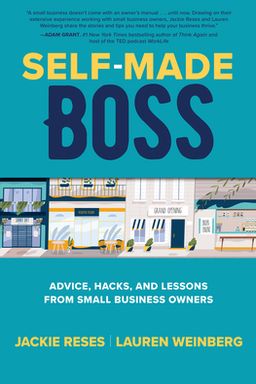
Self-Made Boss cover

Self-Made Boss

by Jackie Reses and Lauren Weinberg

Self-Made Boss is your comprehensive guide to launching a successful small business. Packed with practical advice, real-life case studies, and step-by-step instructions, this book equips you to transform your innovative idea into a thriving enterprise, navigating challenges with confidence.

Becoming a Self-Made Boss in a Human Way

How do you turn an idea into a thriving business—and yourself into the kind of leader people actually want to work for? In Self-Made Boss: Advice, Hacks, and Lessons from Small Business Owners, Jackie Reses and Lauren Weinberg argue that entrepreneurship is not about luck or brute force—it’s a deliberate process of learning, adapting, and leading with both strategy and care. They contend that successful small business owners build not just profitable enterprises but human systems—companies that reflect who they are, serve their communities, and grow sustainably through intention, relationship, and resilience.

This book serves as both a manual and a mirror for the modern entrepreneur. Drawing from hundreds of stories—from a New York restaurateur to a Palo Alto café owner—it translates the lived experiences of small business founders into practical, relatable guidance. The authors weave together advice about leadership, hiring, wellness, culture, and scaling into one cohesive philosophy: great businesses are built by self-aware leaders who value learning as much as doing.

The Entrepreneur’s Personal Journey

The foundation of becoming self-made is self-knowledge. The book invites you to start not with spreadsheets or marketing plans but with purpose. Why are you starting this business? Is it to pursue a passion, to create freedom, or to serve a community need? The stories in this collection—like that of Meenal Lele, who launched Lil Mixins after discovering a way to help prevent childhood allergies—show how purpose fuels persistence. Every “self-made boss” begins with a story that grounds them when times get tough.

But purpose needs discipline. You’ll quickly learn that time, stress, and decision-making will dominate your life. The best entrepreneurs balance instinct with planning. They create business plans that aren’t just investor documents but roadmaps for their own clarity. The transition from dream to strategy—described in the book’s early chapters—sets the foundation for how you will manage everything else: your operations, finances, and leadership style.

Leadership as Culture Creation

Reses and Weinberg emphasize that every small business is also a small community, and the culture you establish as a leader becomes your most powerful asset—or your biggest liability. As CEO coach Ron Beller warns, founders are always modeling behavior, whether they realize it or not. If you respond to mistakes with blame and ego, you’ll cultivate fear and silence. But if you embrace curiosity, reflection, and feedback, you’ll build an environment of learning and trust. The message is clear: your company’s information flow mirrors your emotional maturity.

This isn’t just inspirational fluff—it’s operational. Honest cultures streamline decision-making, reduce turnover, and allow teams to adapt faster to challenges. The authors encourage specific practices such as making clear agreements, seeing “no” as a negotiation, and checking your impulse to always be right. It’s leadership as emotional craftsmanship.

From Solo Act to Scalable Team

Every founder must eventually confront the question: when is it time to hire? The book walks you through this turning point with precision. Using examples like restaurant owner Marc Bash, who believes that “good employees attract good employees,” you see how hiring is both science and art. The goal isn’t just to fill roles but to find people who share your values and willingness to learn. Depending on your industry, you might recruit raw talent you can train or seasoned specialists who bring expertise you lack.

Hiring, the authors remind us, extends beyond the workspace. Many self-made bosses hire help at home—childcare, cleaning, or meal prep—not out of luxury but necessity. Time, not money, is your scarcest resource. Smart leaders reclaim time for strategy by outsourcing tasks that drain focus, whether that’s bookkeeping or tomato-sauce-making, as one couple did by hiring their son’s babysitter for errands. Scaling isn’t only about company size—it’s about intelligently redistributing your energy.

The Inner Game of Business

One of the book’s most distinct features is its insistence that leadership and well-being are inseparable. Megan Jones Bell of Google reinforces this point: leaders set the emotional tone of their companies. Mindfulness, sleep, nutrition, and presence are not soft perks—they are business strategies. Stress affects decision-making, creativity, and collaboration. By learning to “pause with purpose,” to create transition rituals between work and home, and to take mindful breaks, leaders increase both innovation and empathy. (This echoes ideas from leaders like Arianna Huffington, who argues that burnout is a financial liability, not a badge of honor.)

Lisa Kaye Solomon at Stanford expands this philosophy into creativity. She ties self-care to problem-solving: being grounded helps leaders stay curious instead of reactive. The book treats mindfulness not as retreats or meditation apps, but as a daily practice of awareness—listening to your employees, slowing down enough to understand your customers, and approaching every challenge as an experiment rather than a battle.

Building for Growth and Longevity

Eventually, most entrepreneurs must grow beyond themselves. Self-Made Boss introduces a pragmatic roadmap for scaling—deciding when to hire, how to structure roles, when to automate, and how to protect your culture during growth spurts. The advice ranges from the practical (use payroll automation and HR software) to the ethical (create diverse and inclusive workplaces). Alicia Burt reminds readers that diversity isn’t just moral but strategic—companies with more gender and ethnic diversity are significantly more profitable. True inclusion begins not in hiring quotas but in psychological safety.

All of these threads—leadership, culture, balance, scaling—culminate in the final chapters on transition. Every self-made boss eventually faces the same question Meenal Lele once faced at the start: what’s next? Reses and Weinberg insist on building businesses that can survive your absence, whether that means selling, franchising, or handing them to employees. True entrepreneurship, they suggest, isn’t about being indispensable; it’s about creating something that endures.

“Self-made” doesn’t mean self-isolated. Every great founder learns to delegate, listen, and grow, turning a personal dream into a shared enterprise. That, Reses and Weinberg conclude, is the real secret of being your own boss.


Hiring with Heart and Strategy

Marc Bash’s story in Self-Made Boss captures the heart of hiring in small business: finding people who care as much as you do. Between his New York restaurants, he’s hired over 250 people—yet only fired about eight. His secret? He recruits through human connection. “Good employees attract good employees,” he says, preferring character over résumés. Bash’s approach reminds every founder that skill can be trained, but attitude can’t.

Hire for Fit, Train for Skill

Marc’s “happy-go-lucky” philosophy flips the usual hiring rulebook. He looks less for culinary experience and more for kindness and willingness to learn. His reasoning is simple: in high-turnover industries like restaurants—where 70% of employees change jobs yearly—trust, not technical perfection, keeps a team afloat. One of his busboys became a manager after 20 years, proof that loyalty grows when people feel valued. For you, this means defining what personality fits your culture, then selecting for that above all else.

In industries that demand expertise—like accounting or software—you can’t ignore credentials. But even then, a mismatched personality or ego can corrupt your culture. As Ron Beller notes, “People look to you to see how to behave,” so your hires shape your company’s psychological DNA as much as its output.

Create Clear Job Definitions

Before you post a listing, clarify what you actually need. Aaron Zamost advises founders to “start by identifying the things only you can do,” then delegate the rest. This introspection helps prevent the all-too-common trap of hiring someone without clear goals—a setup for frustration on both sides. Borrow online job descriptions if needed, but make them yours. Define success metrics, timelines, and deliverables. As the book insists, no job is too small for clarity.

If you’re unsure about long-term needs, test roles through freelance or contract-to-hire arrangements. Platforms like Upwork or Fiverr allow you to “audition” candidates while testing what the business actually requires. Just remember: if you dictate how and when someone works, they’re likely an employee in the eyes of the IRS. The book’s discussion of freelance classification demystifies this crucial legal line, protecting small business owners from avoidable tax and liability issues.

The Right Time to Hire

Heidi Schriefer from Grindr offers one of the simplest hiring formulas in business books: you hire when the value a new person adds exceeds their cost. If you’re turning down work, missing opportunities, or burning out, it’s probably time to expand. But be honest—sometimes hiring too soon adds expenses without payoff. The book provides a practical checklist: can you still take vacations? Is quality slipping? Are customers waiting too long? Those are real hiring signals.

Diversity and Inclusion as a Growth Strategy

Alicia Burt’s insights elevate hiring from logistics to leadership. She argues that diversity isn’t cosmetic; it’s a profit driver. McKinsey data backs her up—companies with diverse teams outperform less diverse peers by up to 36%. But inclusion must precede numbers. “Employers make the mistake of hiring before they ensure they have an inclusive culture,” she warns. The takeaway? Build belonging before you build headcount. Normalize varied voices, recognize cultural holidays, and provide physical and spiritual supports (e.g., prayer spaces, lactation rooms). The goal is not tokenism, but thriving difference.

Ultimately, hiring like a self-made boss means balancing intuition with systems. Love your people, but document your process. Create pipelines that bring in talent reflective of your values and your community. When done right, each hire isn’t just an employee—it’s an investment in your company’s long-term character.


Leading with Integrity and Curiosity

Leadership, in Self-Made Boss, isn’t about authority—it’s about example. Ron Beller distills this into a single truth: if you own a business, you’re always on stage. People mirror the energy you project, so leading deliberately is your most strategic move. The book recasts leadership as modeling—of communication clarity, humility about mistakes, and resilience under stress. You don’t just manage a team—you shape a culture that outlasts any single task or product.

Owning Mistakes and Modeling Growth

The best leaders are curious learners, not critics. Beller urges founders to replace blame with inquiry. When errors occur, ask, “What can we learn?” instead of “Who’s at fault?” This simple pivot transforms fear into feedback. He calls out a toxic pattern typical to insecure bosses: prioritizing being right over being effective. Over time, nervous teams calibrate to that insecurity by hiding bad news—and that, Beller insists, is organizational death. Information, not ego, is your company’s blood supply.

To keep that blood flowing, encourage open disagreement without emotional penalties. It’s reminiscent of Ed Catmull’s approach at Pixar (in Creativity, Inc.), where “braintrust meetings” allow candid critique without fear. Leaders who valorize truth over comfort spur innovation precisely because teams trust that honesty isn’t punished.

Fix the Agreement, Not the Person

Beller warns that many small businesses operate with “sloppy agreements.” We say yes too fast, make vague promises, and avoid hard conversations. Great leaders don’t aim for harmony—they aim for clarity. Learn to use “no” as a negotiation tool, not an endpoint. If you can’t deliver, renegotiate upfront. It’s counterintuitive but liberating: decisive boundaries inspire more respect than polite ambiguity. This skill becomes essential when managing vendors, partners, and clients who’ll test your availability and endurance.

Focus on What You Can Control

Every entrepreneur battles uncertainty. The book reframes this anxiety through control: focus on what’s within reach. Hiring decisions, communication style, ethics—these are controllable levers. The market? Not so much. When you fixate on what’s outside your sphere, you drift from leadership to reaction. The authors echo Stoic thinkers (like Ryan Holiday in The Obstacle Is the Way): control effort, not outcome.

Beller’s leadership principles invite a mindset shift—from managing tasks to cultivating conditions for others to thrive. Speak truth. Listen deeply. Define agreements precisely. Then watch as your example propagates through every level of your company.


The Power of Mindfulness and Self-Care

Megan Jones Bell, once chief strategy officer at Headspace and now at Google, voices one of the book’s most practical truths: “So much comes down to how leaders are looking after themselves.” It’s a simple but radical notion for entrepreneurs who glorify hustle. The book reframes well-being as an organizational strategy: when you care for yourself, you stabilize your team’s emotional ecosystem. When you don’t, stress and reactivity ripple through your business like bad electricity.

Mindfulness as a Leadership Tool

Mindfulness here isn’t abstract spirituality—it’s the deliberate act of noticing thoughts and emotions without surrendering to them. Bell calls it “awareness plus acceptance.” Instead of suppressing frustration, observe it. That pause increases your agility to respond rather than react. Over time, this habit translates into better decision-making under pressure—a competitive advantage no productivity hack can match.

For small business owners prone to overstimulation, Bell prescribes short “pattern interrupters”: drives along scenic routes, pauses before returning home from work, or five minutes stretching between calls. These moments re-regulate the nervous system and prevent burnout. Research supports this: leaders with routine decompression practices report higher creativity and empathy—traits that strengthen team trust and innovation.

Creating a Culture that Cares

When you normalize breaks and humanity in your workflow, your employees follow suit. Less tension means fewer interpersonal explosions and better collaboration. Bell notes that calm leaders are “less reactive and more credible.” They de-escalate problems rather than multiply them. This ripple effect defines high-functioning teams: stability from the top down.

Mindfulness as Customer Insight

Lisa Kaye Solomon extends this concept to customer empathy. Her claim: introspection teaches better observation. When you understand your emotions, you can perceive others’ more clearly. She urges business owners to map their customers’ emotional journeys—where frustration spikes, where delight happens—and design around those points. “We learn faster when people can speak openly,” she reminds us, linking mindfulness to honest exploration within both employee and customer relationships.

Mindfulness also slows the pace of problem-solving, encouraging what Solomon calls the “experimental mindset.” Don’t rush to answers; sit with the question longer. It’s a countercultural lesson in a world that prizes speed. As she tells her Stanford students, “You will fail only if you hand me a solution in the first hour.” For self-made bosses, this advice is liberation: thoughtful slowness yields lasting innovation.


Scaling Wisely Without Losing Yourself

Scaling up sounds glamorous—more customers, staff, and revenue—but Self-Made Boss warns that growth can easily outpace sanity. The key is to expand with intention, keeping your founding values intact even as your footprint increases. Using restaurant, retail, and service examples, the book shows that sustainable scaling is less about speed and more about systems, delegation, and discipline.

Start with Self-Knowledge

When you’re doing everything yourself, you learn every role: customer service, accounting, marketing. This immersion gives you priceless clarity about what works and what doesn’t. The turning point comes when you’re overworked or turning down business opportunities—signals that it’s time to delegate. But don’t hire just because you’re tired; hire to move yourself into higher-value activities. The rule: never outsource your genius, only your grind.

Use Time as Your Barometer

Heidi Schriefer again provides a practical litmus test: when hiring gives you a “meaningful time refund,” you’re scaling correctly. If new employees free you from repetitive tasks to focus on growth or strategy, that’s a green light. If they add management weight without freeing bandwidth, you’re bloating, not scaling. The same logic applies to automation. Software like Gusto or Homebase can reclaim five to six hours per week of payroll drudgery—a compounding dividend of attention.

Protect Your Culture

Scaling threatens culture more than competition does. As new layers emerge, values can dilute. The authors quote examples like Bubbly Paws—the Minnesota dog-grooming company that surveys employee happiness biannually. Founder Keith Miller treats feedback as strategy: one worker’s complaint about recycling turned into an environmental initiative, boosting morale. The take-home lesson: culture is measured, not assumed. Make listening a procedure, not a virtue signal.

And when it’s time to part ways with bad hires, do it cleanly and kindly. Schriefer’s rule applies: ask yourself if you’d rehire this person knowing what you know now. If the answer wavers, start an honest conversation. Lack of fit is not failure—it’s maintenance of your ecosystem. Delayed action erodes trust faster than firing ever could.

When you scale with intention, the business becomes something greater than your own stamina—a system that works even when you step away. That’s the real freedom of entrepreneurship: not doing everything, but building something that runs because of everything you’ve done.


Designing Company Culture Like a Living System

Culture, Reses and Weinberg show, is not a slogan or HR perk—it’s a living organism that evolves with your actions. Whether you intend to create one or not, every business develops its own patterns of belief, communication, and behavior. The question isn’t if you’ll have a culture; it’s whether you’ll design it deliberately or let it default into chaos. The chapter’s blend of anecdotes—from REI’s outdoor mission to Bubbly Paws’ kindness-first policies—proves that culture is both a recruitment tool and a retention engine.

Authenticity Over Aspiration

Authentic cultures start with values that truly reflect their founders. Don’t claim transparency if you’re secretive; don’t promise “family” if you expect 24/7 availability. Employees smell dissonance instantly. The Pike Place Fish Market succeeds because its joy—literally throwing fish for fun—isn’t staged; it’s systemically embedded. Likewise, Ada’s Café in Palo Alto hires people with disabilities not as charity but as cultural expression: it celebrates competence and empathy. Your business’s everyday habits should tell the same story your mission statement tells on paper.

Values as Operating Code

Think of company values as operating instructions, not wall art. They determine how you treat customers, handle conflict, and allocate time. Millennials and Gen Z employees—today’s labor force majority—choose employers based on authenticity and purpose alignment. This means your stated values aren’t marketing fluff; they affect recruiting, revenue, and reputation. The REI example makes it vivid: its dedication to the outdoors flows through every level of operations, from product design to giving employees “Black Friday off to go outside.” That single consistent act reinforces trust internally and externally.

Culture as Retention Strategy

Keith Miller’s story at Pampered Pooch shows how culture saves money. His twice-yearly surveys identify pain points that might push employees away—tiny interventions with major ROI. In one case, merely providing anti-fatigue mats in grooming stations improved employee retention. The data is clear: turnover is expensive; listening is cheap. Culture is ultimately an economic asset disguised as empathy.

Self-made bosses who treat culture as a living system align policies, benefits, and communication under a common ethos. Done well, your culture becomes self-sustaining: senior employees induct new hires—no micromanagement required. It’s not a manual; it’s muscle memory.


Knowing When to Let Go

The book concludes with a truth most founders avoid: every business relationship, including your relationship to ownership, ends someday. Chapter 10, “Transitions,” demystifies exit planning as not failure but evolution. Whether you envision retirement, a sale, or employee ownership, your job is to build something that can thrive without you. This mindset makes you freer today, not just prepared tomorrow.

Preparing a Sellable Business

Michael Sutherland Brown of Teamshares advises: profitable companies with clear systems, growth potential, and digital presence have a 90% chance of selling. “Old economy” businesses—dependent on the owner’s personal labor—hover at 20%. The message: automate, delegate, and document everything. Make your business manageable by someone else, and investors will line up. Acme Smoked Fish, a Brooklyn family business now in its fourth generation, exemplifies this foresight. Their gradual modernization—upgrading equipment and governance—turned legacy into longevity.

Letting Go Gracefully

Dentist Harry Taub’s experience reminds founders that post-sale transitions can be emotionally taxing. Even with a lucrative deal, watching strangers alter your creation can sting. The authors suggest planning emotional as well as financial exits—knowing when to truly step aside avoids the “shadow boss” syndrome. Whether you sell, franchise, or pass the company to employees via an ESOP, clarity of goals matters. Do you want maximum profit, preservation of mission, or community impact? Each leads to different kinds of transitions.

Failure as a Responsible Ending

Sometimes, closure beats clinging. If your business can’t find buyers or sustainable financing, winding down with responsibility—paying taxes, settling debts, supporting staff—protects your legacy. Legal counsel can make this process humane and compliant. Judith McGee, a financial planner, reframes this with grace: “Don’t embed all your wealth in your company. Under-live your income and take distributions.” In other words, build your freedom alongside your business, not after it’s gone.

To be a self-made boss is to know both when to build and when to release. Legacy, at its best, is not ownership—it’s stewardship. Your greatest success might be letting your creation outgrow you.

Dig Deeper

Get personalized prompts to apply these lessons to your life and deepen your understanding.

Go Deeper

Get the Full Experience

Download Insight Books for AI-powered reflections, quizzes, and more.