
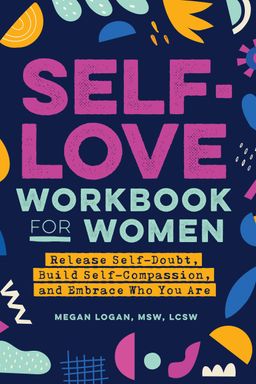
Self-Love Workbook for Women cover

Self-Love Workbook for Women

by Megan Logan

Self-Love Workbook for Women guides you on a transformative journey to embrace your true self. Through mindful exercises and insights, this book helps you release self-doubt, build self-compassion, and establish healthier relationships with yourself and others, leading to a fulfilling and empowered life.

The Transformative Power of Self-Love

When was the last time you treated yourself with the same kindness you extend to others? In Self-Love Workbook for Women, therapist and author Megan Logan invites you to ask not only that question but a deeper one: what would life look like if you truly loved yourself – unconditionally, imperfectly, and wholeheartedly?

Logan contends that self-love isn't a luxury or a buzzword. It’s a foundational set of emotional, spiritual, and behavioral practices that allow you to live authentically and intentionally. Self-love, she argues, isn’t about spa days or self-indulgence—it’s about self-respect, vulnerability, boundaries, and courage. Throughout the book, Logan uses her experience as a clinical social worker and therapist to guide women toward building compassion for themselves, releasing doubt, and cultivating fulfilling relationships.

Redefining Self-Love Beyond Stereotypes

Logan begins by dismantling the cultural myths surrounding self-love. In many families and societies, especially those shaped by achievement-focused messages (“Be all you can be!”), women grow up believing that worth must be earned. Logan challenges this, reminding readers that love of self is not narcissism or selfishness—it’s the radical act of honoring your own humanity. She frames self-love as a lifelong road trip: one filled with detours, potholes, and rest stops, but ultimately leading to wholeness.

Her analogy of fueling your journey with intentional practice captures the essence of the workbook. Each exercise, affirmation, and mindfulness technique adds a drop of fuel to keep you moving forward. The map isn’t about perfection—it’s about progress. Like Brené Brown’s work on vulnerability (see Daring Greatly), Logan stresses that showing up imperfectly is exactly where transformation occurs.

Why Women Struggle with Self-Love

One of Logan’s most compelling insights lies in her explanation of why women often put others first. Rooted in early survival roles and reinforced by societal expectations, women have been conditioned to nurture others at the expense of their own well-being. This self-sacrifice can lead to burnout, resentment, and feelings of emptiness. Logan exposes these patterns with empathy while offering exercises to unlearn them—by scheduling solo rituals, rewriting self-critical beliefs, and setting gentle boundaries.

“You can’t pour from an empty cup.” Logan reiterates this old adage as a truth women must reclaim—not because loving yourself makes you less giving, but because it makes your love sustainable.

A Structured Path Toward Healing

The workbook’s eight chapters create a clear emotional arc. First, Logan helps readers understand the meaning of self-love and the reasons it’s hard to practice. Then she leads a journey through self-compassion (inspired by Kristen Neff’s pioneering research), challenging self-doubt, building self-worth, and healing unhealthy relational patterns. The final chapters shift toward embracing authenticity and creating a personal legacy of love and meaning.

Each section blends theory with practice: writing love letters to yourself, observing “family myths” contributing to perfectionism, tracking daily affirmations, and practicing mindfulness in nature. Many exercises emphasize the body as a site of love rather than criticism—like writing a letter to your body, thanking your legs for carrying you or your stomach for its strength. Logan uses simple yet powerful tools to make psychological concepts tangible.

From Inner Work to Outer Relationships

Once readers learn self-compassion and self-worth, Logan moves into relationships. She reveals how loving yourself changes how you connect with others. When you respect your boundaries, you transform communication patterns and establish more reciprocal relationships based on trust and respect. Logan discusses how codependency and people-pleasing stem from insecurity, and she teaches scripts for assertiveness—from practicing saying “no” without guilt to asking directly for what you need.

Embracing Imperfection and Authenticity

The final chapters celebrate self-acceptance, encouraging women to embrace their quirks and “perfect imperfections.” One practical exercise includes listing your personal “recipe for self-worth” with ingredients like humor, authenticity, or creativity—transforming self-reflection into playful creativity. Logan’s closing message is deeply empowering: self-love is not a finish line but a lifelong evolution. The journey never ends because every stage of life will ask for deeper compassion and understanding.

Ultimately, Logan’s workbook equips you to become your own best therapist and cheerleader. Through stories, psychological insights, and artful exercises, she bridges professional therapy tools with day-to-day living. As Elisabeth Kübler-Ross’s quote in the final chapter reminds us, beautiful people “do not just happen”—they emerge from struggle, resilience, and unconditional self-acceptance.

Logan’s message is both urgent and timeless: in a world that profits from women’s insecurity, choosing self-love is a rebellious, revolutionary act. This workbook is both a mirror and a compass—reflecting who you already are and guiding you toward who you are becoming.


Releasing Self-Doubt and Inner Criticism

Megan Logan identifies self-doubt as one of women’s most persistent barriers to self-love. These critical voices often originate from childhood experiences, perfectionist cultural messages, or comparison habits reinforced by social media. She compares these negative thought loops to weeds that must be cleared before self-worth can grow.

Recognizing the Inner Critic

Logan encourages you to first observe your inner critic without judgment. Rather than fighting negative thoughts—an approach that paradoxically strengthens them—she teaches mindfulness techniques similar to Acceptance and Commitment Therapy (ACT). Let the thought appear (“I’m not good enough”) and visualize it floating away like a balloon while introducing a kinder alternative (“I’m learning every day”).

Exercises like the “Self-Doubt Thought Bubble” make this process interactive: you write down a self-doubting thought and then consciously reframe it into an empowering message. Logan’s approach transforms intangible emotions into visible patterns you can work with directly.

The Power of Reframing

Through “What-If Busters” and “Reframe Challenges,” Logan shows how shifting perspective can neutralize fear. For example, instead of “What if I fail?” you might say “What if I succeed?” or “What if I learn something valuable?” This reframing moves the narrative from catastrophic thinking to curiosity and growth.

Self-doubt, Logan explains, is never fully eliminated—it’s managed through awareness. Like meditation’s waves of thought, it will arise again, but each time you choose compassion over criticism, you weaken its grip.

Building Confidence through Embodiment

Physical posture matters. Logan teaches readers to inhale confidence and exhale self-doubt, using breathing techniques paired with affirmations. She also introduces the idea of “confident body markers”—standing tall, softening your eyes, unclenching your jaw—to cultivate psychological confidence through physiology (a concept supported by Amy Cuddy’s work on power poses).

She invites readers to take an “Affirming Walk,” repeating phrases such as “I’ve got this” and “I am prepared,” transforming movement into ritual affirmation. These actions teach that confidence isn’t a state you wait for—it’s something you generate actively through repeated, embodied practice.

Shifting Mindsets

By combining journaling, mindfulness, and physical awareness, Logan demonstrates that self-doubt thrives in silence but weakens when expressed. Drawing from cognitive-behavioral principles (similar to those in Marsha Linehan’s DBT framework referenced in the book’s bibliography), Logan turns self-defeating realism into hopeful realism: yes, failures occur, but they never define worth.

The ultimate goal isn’t to achieve unshakable confidence, but to comfort yourself through uncertainty—to be your own best cheerleader. Releasing self-doubt, Logan reminds readers, isn’t about erasing insecurity. It’s about learning to hold it gently and to keep walking forward regardless.


Building Self-Worth from the Inside Out

Once negative self-talk is addressed, Logan moves to rebuilding self-worth—the foundation upon which lasting self-love rests. She likens this process to constructing a house: it requires cleared ground, defined tools, and solid materials. Each tool represents a practice such as positive self-talk, recognizing gifts, and cultivating body acceptance.

The Self-Worth Garden

In one memorable metaphor, Logan invites you to “plant a self-worth garden,” choosing seeds like curiosity, compassion, authenticity, and humor. Body image exercises—like writing a love letter to your body—help nurture this garden by transforming criticism into gratitude.

“When we release self-doubt,” she writes, “we become free to fill up that space with self-worth.”

The Myth of External Approval

Logan dismantles eight myths about worth, including “I should love others more than myself” and “The mistakes I’ve made define my self-worth.” She encourages readers to rewrite these with truth-based affirmations: “My mistakes show growth”; “Loving myself helps me love others.” She also challenges media-driven beauty ideals through “Evaluating Beauty Messages,” reminding you that real beauty includes wrinkles, cellulite, and laughter lines—proofs of life lived fully.

The self-worth meter and tracker exercises allow readers to quantify progress and celebrate emotional wins, not just accomplishments—mirroring insights from Louise Hay’s You Can Heal Your Life, emphasizing daily affirmation as medicine for the inner critic.

Cultivating Joy and Authenticity

Logan also focuses on rediscovering joy through hobbies, childlike wonder, and creativity. Exercises like “Delighting in Simple Pleasures” and “Hobby Builder” remind women that playful experiences are not trivial—they’re essential for nurturing self-worth. Whether recalling chasing butterflies or spinning until dizzy, these memories reconnect you with your unconditioned self—the version untouched by perfectionism or shame.

By practicing gratitude, engaging with nature, and recognizing the body’s strength, women learn that self-worth arises from lived experience rather than achievement. It’s internal, renewable, and deeply human.

With this internal richness, the next chapters naturally extend outward—to relationships built on mutual respect and trust—but the foundation remains the same: knowing, without external proof, that “I am worthy of love and belonging.”


Healing Relationships through Self-Love

Logan’s sixth major theme explores the intersection of self-love and relationships. She argues that how you love yourself sets the pattern for how others will treat you. Quoting poet Rupi Kaur—“How you love yourself is how you teach others to love you”—she connects personal growth with relational health.

Recognizing Unhealthy Patterns

Using an “Unhealthy Relationships Checklist,” Logan helps you identify red flags like gaslighting, name-calling, control, or invisibility. These imbalances often form when self-respect erodes. Understanding them restores clarity and autonomy. Logan doesn’t judge these patterns; she invites awareness as the first act of healing.

Setting Boundaries and Finding Balance

Boundaries, according to Logan, are the backbone of self-love. They protect emotional energy and honor individuality. She introduces “Ten Signs You’d Benefit from Better Boundaries”—from resentment after overgiving to difficulty saying no—and provides scripts for assertive communication. Sample refusals (“Thanks, I won’t be able to make it”) encourage confidence without guilt.

Her practical exercises—“Say No Role Play” and “Four Steps to Asking for What You Want”—transform assertiveness from theory into everyday skill. Readers learn that saying no isn’t rejection; it’s relationship care. Like Sue Johnson’s work in Hold Me Tight, Logan emphasizes emotional honesty as the bridge to intimacy.

Breaking Codependency and People-Pleasing

Logan draws from Melody Beattie’s classic Codependent No More to explain how blurred boundaries can erode identity. Through reflective exercises, she helps readers explore whether they “help too much” or feel responsible for others’ happiness. By reframing care to include self-care, love becomes reciprocal rather than sacrificial.

Communication and Attachment Awareness

In a particularly insightful section, Logan describes communication styles—passive, aggressive, and assertive—and correlates them with trauma responses (fight, flight, freeze, or fawn). This psychological framing empowers readers to recognize that old defense mechanisms are survival tools, not flaws. Understanding attachment styles, adapted from Amir Levine and Rachel Heller’s Attached, deepens awareness of intimacy patterns—whether anxious, avoidant, or secure.

The integration of these ideas turns relationship analysis into healing. Logan’s goal is not to end relationships, but to reshape them through clarity, trust, and boundary integrity. As she writes, “Setting boundaries is a way to practice self-love.”


Embracing Authenticity and Imperfection

In the final chapter, Logan brings together all aspects of self-love into one liberating idea: full self-acceptance. To embrace who you are is to acknowledge your unique mix of strengths, flaws, quirks, and dreams without apology. It’s a culmination of self-compassion, self-worth, and boundary work—woven into a holistic practice of authenticity.

Knowing Your Gifts and Quirks

Exercises such as “My Unique Gifts” and “Love Your Quirks” help readers celebrate their individuality. Logan invites you to list five imperfections that make you special—reminding that quirks are the fingerprints of identity. This mirrors the concept of “wabi-sabi” in Japanese philosophy: beauty lies in imperfection, impermanence, and incompleteness.

Gratitude and Future Visualization

Logan uses gratitude as transformation: writing “A Gratitude Note to Myself” or reflecting on five things learned along the journey anchors joy in the present moment. She also encourages visualization—imagining your future, wiser self reaching back to thank you for your courage. This technique, shared by psychologists like Russ Harris (The Happiness Trap), connects mindfulness with long-term self-leadership.

By visualizing your future legacy, Logan invites reflection on value and purpose. The exercise “My Legacy” asks: what difference do you want to make? Through this lens, self-love becomes a ripple that impacts others—changing not only yourself but the world you inhabit.

Living Fully Outside the Comfort Zone

In the “Comfort Zone” and “Five Ways to Take Control” activities, Logan redefines growth as an ongoing loop of change, acceptance, and exploration. Whether choosing to change, tolerate, accept, or do nothing, these mindful decisions empower autonomy. Logan encourages women to step beyond fear and stretch into possibility—because fullness of life begins just outside the boundaries of comfort.

Her concluding assurance resonates as both gentle and revolutionary: embracing yourself doesn’t mean reaching perfection—it means recognizing that “beautiful people do not just happen.” Through resilience, compassion, and gratitude, you become one of them.

Dig Deeper

Get personalized prompts to apply these lessons to your life and deepen your understanding.

Go Deeper

Get the Full Experience

Download Insight Books for AI-powered reflections, quizzes, and more.