
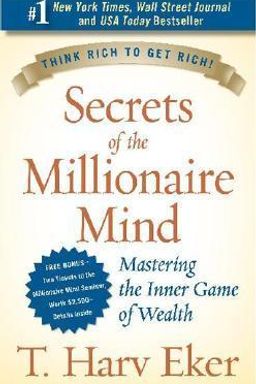
Secrets of the Millionaire Mind cover

Secrets of the Millionaire Mind

by T Harv Eker

Secrets of the Millionaire Mind reveals how childhood experiences shape our financial beliefs, influencing our wealth potential. T. Harv Eker provides practical insights and strategies to reprogram your mindset, adopt millionaire habits, and take control of your financial fate, ensuring lasting prosperity.

Mastering the Inner Game of Wealth

Have you ever wondered why some people seem destined for wealth while others work tirelessly yet remain stuck in financial struggle? In Secrets of the Millionaire Mind, T. Harv Eker tells readers that the difference lies not in luck, skill, or even opportunity — but in one crucial element he calls the Money Blueprint. This blueprint, buried deep in your subconscious, governs every financial decision you make and every outcome you create with money.

Eker argues that until you reprogram this inner script, no technique, strategy, or hustle will make you truly wealthy. In his words: “If your subconscious financial blueprint is not set for success, nothing you learn, know, or do will make much difference.” What makes his approach distinct from traditional financial advice is his focus on the inner game—the mental, emotional, and spiritual frameworks that shape financial behavior. He suggests that your outer results—your job, income, and wealth—are mere reflections of your inner beliefs about money, success, and self-worth.

Your Inner World Shapes Your Outer Wealth

Eker begins with a striking metaphor: if a tree bears bad fruit, you don’t fix the fruit; you fix the roots. Likewise, if your financial results leave you dissatisfied, you must address your internal “roots”—your subconscious thoughts and emotional patterns around wealth. He calls this collection of beliefs your Money Blueprint. Formed through childhood conditioning — statements you heard about money, examples you saw from parents, and emotional experiences you had involving money — this blueprint silently dictates whether you save or spend, build or blow opportunities, and approach wealth with confidence or fear.

Eker’s insight is that money problems are rarely external. They are symptoms of internal limitations. This is why lottery winners often end up broke and self-made millionaires frequently rebuild their wealth after losing it: one group lacks the internal thermostat set for prosperity; the other operates from a mental temperature calibrated to abundance.

The Dual Worlds of Wealth

He explains that we live in two worlds simultaneously — the inner and outer worlds. The outer game involves what most money books focus on: investing, marketing, business acumen, and management strategies. The inner game, however, concerns who you are: your beliefs, character, confidence, and sense of deservingness. According to Eker, the outer game can only grow to the extent the inner game does. He famously says: “Your income can grow only to the extent you do.”

Through firsthand stories — like his turnaround from a broke young man to a multimillionaire in two and a half years — Eker shows how changing his mindset, not his business type, created his breakthrough. He had tried and failed with multiple ventures until he realized the issue wasn’t the idea or market but his own “financial thermostat.” Once he committed to play the game to win, reconditioned his thoughts toward success, and handled fear differently, his results transformed.

How This Book Works

Eker divides his method into two parts: first, identifying and reprogramming your Money Blueprint; second, learning how rich people think and act differently through seventeen “Wealth Files.” Part I walks you through how your subconscious was programmed by verbal messages, role-modeling, and significant events around money. Part II outlines how the wealthy approach life—from responsibility and commitment to opportunity and continuous learning—so that you can install those mental files for success.

If you’ve ever read financial strategies, tried budgeting, or pursued ways to “get rich quick” without lasting results, Eker’s argument hits home: knowledge alone doesn’t work if your emotional and mental programming rejects success. His focus on consciousness and self-awareness makes this book not just about finance but about personal transformation. Eker parallels experts like Napoleon Hill (Think and Grow Rich) and Robert Kiyosaki (Rich Dad Poor Dad), but he simplifies psychology into accessible daily actions—declarations, journal exercises, and mental rewiring habits.

Ultimately, Secrets of the Millionaire Mind invites you to look inward and take full responsibility for your financial destiny. It’s not your job, your economy, or your luck — it’s your blueprint. By mastering the inner game, you become “the right person in the right place at the right time.” Eker’s premise is radical yet empowering: When you change your mind, you change your money.


Rewriting Your Money Blueprint

The first step toward wealth, Eker insists, is unlearning. Your current financial habits and emotions are not random; they are products of conditioning. He compares the subconscious to a computer loaded with old, buggy software that runs automatically until you install new programs. To rewrite your Money Blueprint, you must understand how it was installed—through three primary influences: verbal programming, modeling, and specific incidents.

Verbal Programming: The Words That Built Your Beliefs

What did you hear about money growing up? Phrases like “Money doesn’t grow on trees,” “Rich people are greedy,” or “We can’t afford it” plant emotional associations. They teach children that money equals stress, shame, or scarcity. Eker recounts one student, Stephen, whose mother repeatedly said rich people make their money off the sweat of the poor and that having more than enough makes you a pig. As an adult earning $800,000 per year, Stephen subconsciously sabotaged his wealth by losing or lending his money. Why? Because he feared disapproval and subconsciously aligned being rich with being bad. Within two years of reprogramming, he became a millionaire—by changing beliefs, not jobs.

Modeling: The Lessons You Saw, Not Heard

Children learn by imitation. If your parents lived paycheck to paycheck, you likely inherited their patterns. Eker reveals how he unknowingly replicated his father’s boom-and-bust business cycles as a builder—earning fortunes and losing them—until he replaced the old “yo-yo” model with stable strategies. Similarly, attendees who had Depression-era parents found themselves hoarding money or spending excessively, both reactions rooted in ancestral fear. Awareness breaks this generational chain.

Specific Incidents: Money as Emotion

Many people experienced formative emotional shocks around money that shaped lifelong avoidance or anxiety. Eker’s story of Josey, a nurse, is heartbreaking. At age eleven, she watched her father die from a heart attack during a money argument. Her mind linked wealth with pain—so as an adult, she spent all her earnings to eliminate that pain. Only once she redefined money as a tool for safety and prosperity did her life change dramatically. These incidents write emotional scripts, and rewriting them involves conscious awareness, understanding their origin, and disassociating from outdated messages.

Four Steps to Permanent Change

Eker outlines a repeatable process: Awareness (identify your beliefs), Understanding (learn where they came from), Disassociation (recognize that these thoughts are not you), and Reconditioning (replace them with supportive ideas). He integrates behavioral and cognitive techniques—like his daily “declarations” such as “My inner world creates my outer world”—to anchor new beliefs at both conscious and subconscious levels.

Ultimately, rewriting your Money Blueprint means taking back authorship of your story. You learn that your parents’ fears aren’t yours, your childhood experiences don’t define you, and your society’s scarcity messages don’t apply to your potential. Once you realize these patterns are programmable, you reclaim the freedom to design the mental architecture of wealth deliberately.


The Wealth Files: Seventeen Ways the Rich Think Differently

In Part II, Eker distills his findings into seventeen “Wealth Files”—mental codes distinguishing rich people from the poor and middle class. These are not mere attitudes but operating systems. Each file shifts how you perceive money, success, risk, and yourself.

Responsibility and Creation

Rich people believe “I create my life.” Poor people believe “Life happens to me.” Victims blame circumstances; creators take responsibility. Eker humorously calls blaming, justifying, and complaining “financial throat-slitting.” The moment you stop playing victim, you become the author of your outcomes. As he quotes: “There is no such thing as a really rich victim.” This echoes the teachings of authors like Viktor Frankl and Wayne Dyer on personal responsibility—freedom begins when you own your responses.

Playing to Win, Not to Survive

Poor people aim to “not lose.” The rich play to win. Eker contrasts middle-class comfort with wealthy ambition. He jokes that people who order cheap chicken every night are aiming small. His advice: if you shoot for the stars, you’ll at least hit the moon. Comfort is the enemy of growth; commitment to abundance is the pathway to wealth. This aligns with Tony Robbins’ principle of “massive action”—you get what you truly intend.

Commitment and Thinking Big

Rich people are committed to being rich; poor people merely “want” to be. Eker distinguishes wanting, choosing, and committing: wanting is wishful, choosing implies decision, but commitment demands total devotion—doing whatever it takes for as long as it takes. Commitment also entails thinking big: focusing on how to impact thousands rather than dozens. As thinker Buckminster Fuller says, “The purpose of life is to add value.” Rich people add massive value and therefore receive massive rewards.

Opportunity Orientation

Where poor people see risk, the rich see opportunity. They “ready, fire, aim”—acting first, refining later. This contrasts with paralysis by analysis. Eker recounts starting as a busboy at Mother Butler’s Pie Shop just to learn business from the inside—a move that led to his first million-dollar venture. Success, he insists, is born from entering “the corridor” of action, not standing outside and “getting ready.”

Each wealth file advances this consciousness. Later principles include admiring other rich people rather than resenting them, associating with successful peers, promoting oneself and one’s value, solving rather than avoiding problems, being an excellent receiver, and learning continuously. Together, they form a psychological toolkit that replaces scarcity thinking with empowerment, transforming how you play the game of wealth.


Expanding Your Responsibility and Power

To Eker, wealth begins when you stop blaming others for your life circumstances. Most people, he argues, leak power by believing life happens to them rather than through them. He identifies three markers of a victim mindset: blaming, justifying, and complaining. These behaviors feel temporarily soothing but drain your creativity and ability to act.

He tells participants bluntly: “Every time you blame, justify, or complain, you are slitting your financial throat.” This shock value jolts readers to see how self-defeating patterns perpetuate their reality. Eker’s thesis parallels Stoic philosophy: happiness and success emerge from responsibility, not control of events but mastery of interpretation and response.

Replacing Victimhood with Creation

When you shift from “poor me” to “I create my results,” your focus moves from problems to solutions. He challenges you to debrief daily: write one thing that went well, one that didn’t, and ask “How did I create each?” This act of reflection turns passivity into power. Like mindfulness practices taught by Eckhart Tolle (The Power of Now), this awareness dissolves emotional reactivity and transforms obstacles into choice points.

The Death of Excuses

Eker humorously mocks excuses around money: “Money’s not important,” “I don’t want to be greedy,” or “Rich people are snobs.” In his words, of course money isn’t everything—but it’s important in the areas in which it works. It buys freedom, not love. By reframing money as energy instead of morality, you stop using piety or insecurity to justify struggle.

Ultimately, responsibility is empowerment. You can be rich or you can be a victim, but you can’t be both. In every case, owning outcomes replaces fear with freedom, turning luck into law. This mindset acts as the foundation for every other principle in the book.


Think and Live in Abundance

Scarcity thinking tells you resources are limited and wealth is a zero-sum game. Abundance thinking declares there’s always enough. Eker sees the world as overflowing with opportunity and value—not fixed in finite supply. This distinction fuels his mantra: “Rich people think ‘both,’ poor people think ‘either/or.’”

Breaking the Either/Or Illusion

When faced with options—money or happiness, career or family—the poor choose one and suffer tension. Rich people ask, “How can I have both?” This reframing engages creativity. Eker shares examples from negotiating with suppliers (aiming for a deal where neither side loses) and buying his home below market value through persistence. Where most see trade-offs, abundance thinkers craft synergy.

Living Rich and Whole

Eker critiques the idea that being rich is unspiritual or superficial. He insists money magnifies character—it makes kind people kinder and jerks jerkier. Therefore, cultivating abundance within amplifies goodness, not greed. He reminds readers that both money and happiness are essential: “What’s the use of having your cake if you can’t eat it?” Financial freedom and fulfillment are complementary, not contradictory.

Expanding Your Perspective

Abundance thinking extends beyond finances. It’s about believing that life’s possibilities multiply with generosity. When you invest, donate, or collaborate, money circulates and grows. Eker’s example of a $5 bill changing hands to create $25 in value illustrates this energy of exchange. By seeing wealth as an expanding cycle rather than a limited pie, you step into the natural law of abundance described by Deepak Chopra (The Seven Spiritual Laws of Success): what you give increases.

Choosing “both” rewires your psychology from limitation to creativity. That single question—“How can I have both?”—becomes a cornerstone for abundance not only in money but in love, purpose, and time.


Manage Money Like the Wealthy

One of Eker’s most practical teachings is that wealth isn’t just about earning; it’s about managing. He insists that the habit of managing money is more important than the amount. Many people, he warns, think they don’t make enough to manage. His response: start with a single dollar. Managing that dollar signals readiness to the universe.

Money Management as a Spiritual Discipline

Eker frames money management as both financial and spiritual. The universe gives more only to those who handle what they already have wisely. He likens mismanagement to a child dropping ice cream—the kind parent does not give a triple scoop to someone who couldn’t handle one. Similarly, “Until you show you can handle what you’ve got, you won’t get any more.”

Six Key Accounts

Eker’s system divides every dollar into six accounts: 10% into your Financial Freedom Account (never to be spent, only invested), 10% into a Play Account for enjoyment, 10% into Long-Term Savings for Spending, 10% into Education, 50% into Necessities, and 10% into Giving. This practical method transforms chaos into clarity. Through stories like Emma, who began saving $1 a month and ended up out of debt with $10,000 invested within two years, he demonstrates the exponential effect of discipline.

Balancing Joy and Discipline

Eker emphasizes balance. Saving endlessly can strangle joy, while spending endlessly wrecks freedom. His “Play Account” exists to indulge yourself monthly—to convince your subconscious that wealth feels good, not restrictive. When both saving and playing are honored, you maintain harmony between responsibility and pleasure.

This tangible system blends personal empowerment with spiritual psychology. Whether you start with a penny or a paycheck, consistent management trains your identity to think like the wealthy. As Eker says, “Either you control money, or it will control you.”


Act in Spite of Fear and Grow Beyond Comfort

Fear, uncertainty, and discomfort stop more dreams than failure ever does. Eker argues that rich people act anyway. Poor people wait for fear to subside—a wait that never ends. He teaches that action is the bridge between the inner world of thought and the outer world of results. Courage isn’t absence of fear; it’s mastery in motion.

Taming the Cobra of Fear

Drawing from his Enlightened Warrior Training Camp, Eker explains that a true warrior “tames the cobra of fear.” This means acknowledging fear without letting it dictate choices. He recounts audiences breaking wooden arrows with their throats—not about danger but about commitment in spite of terror. Those who act wholeheartedly succeed; those who hesitate fail. The metaphor is visceral: success demands walking straight into resistance, not away.

From Comfort to Growth

Comfort kills progress. Growth requires stepping outside your “comfort zone” into your “wealth zone.” Eker reminds us that if life feels easy, it’s probably static. “If you are willing to do only what’s easy, life will be hard. But if you are willing to do what’s hard, life will be easy.” Every uncomfortable moment signals expansion. By practicing discomfort daily—speaking up, raising prices, initiating bold actions—you train your mind that uncertainty isn’t danger, but evolution.

Training the Mind

Eker separates you from your mind’s chatter. He calls the mind “the greatest soap-opera scriptwriter in history.” The antidote is conscious training—observing thoughts, canceling limiting ones, and replacing them with empowering declarations. This echoes modern cognitive behavioral techniques (as in David Burns’ Feeling Good): you become the observer rather than the actor of fear. Over time, you realize you can’t wait for fear to vanish; you must move while carrying it.

Fear will never disappear, but your relationship with it can change. Acting in spite of fear doesn’t just create wealth—it builds mastery, self-respect, and freedom. The real victory is courage itself.


Continuous Learning and Growth

Success isn’t static; it’s learned. Eker’s final wealth file insists that rich people never stop learning, while poor people think they already know. He calls “I know that” the three most dangerous words in English. The moment you stop learning, you stop expanding the capacity to earn and enjoy life.

Learning vs. Knowing

You don’t truly know what you don’t live. Eker uses humor and bluntness—“If you’re not really rich and happy, there’s something you don’t know.” He encourages humility and curiosity. As philosopher Eric Hoffer said, “The learners shall inherit the earth while the learned will be beautifully equipped to live in a world that no longer exists.” Continuous learning means upgrading your inner software as life evolves.

Investing in Yourself

Eker advises allocating 10% of your income into an Education Fund—reflecting Benjamin Franklin’s insight, “If you think education is expensive, try ignorance.” This lifelong learning approach spans financial education, mindset training, and professional development. Rich people, he notes, attend courses, hire coaches, and learn from mentors richer than themselves.

Being and Becoming

Eker reframes wealth as personal growth. You must become before you can have. He distinguishes the laws of success as BE, DO, HAVE rather than “have, do, be.” By becoming a level 10 person in character and capability, you attract level 10 results. This echoes Napoleon Hill’s idea that success is built from inner mastery first. Growth and wealth share one foundation—the evolution of self.

Every master was once a disaster. The rich aren’t born knowing—they learn relentlessly. Commit to constant growth, and you won’t just increase your income; you’ll expand who you are. The greatest wealth, Eker concludes, is the person you become.

Dig Deeper

Get personalized prompts to apply these lessons to your life and deepen your understanding.

Go Deeper

Get the Full Experience

Download Insight Books for AI-powered reflections, quizzes, and more.