
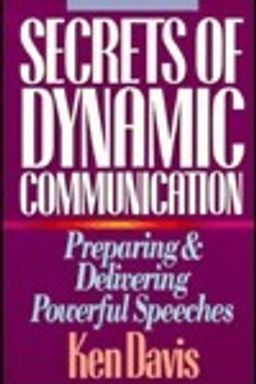
Secrets of Dynamic Communication cover

Secrets of Dynamic Communication

by Ken Davis

Unlock the power of effective communication with Ken Davis''s SCORRE-method. Learn how to focus your message, engage your audience, and deliver impactful speeches. Whether you''re new to public speaking or seeking to refine your skills, this book offers practical guidance to transform your presentations.

The Power of Focused Communication

What separates a forgettable presentation from one that transforms lives? In Secrets of Dynamic Communication, Ken Davis argues that the secret isn’t charisma or natural talent—it’s focus. He contends that anytime you communicate, whether to a crowd or a colleague, your success hinges on having a clear, singular objective and a structured way to hit it. His SCORRE Method serves as both the blueprint for clarity and the training ground for mastery.

Davis’ own life as a speaker provides the backdrop for his discoveries. Early in his career, he assumed enthusiasm was enough. But after years of study and helping others improve—pastors, business executives, teachers, and comedians alike—he realized that great communicators all share one quality: they are ruthlessly focused. His six-step SCORRE framework—Subject, Central Theme, Objective, Rationale, Resources, and Evaluation—transforms scattered thoughts into purposeful communication. It turns rambling into resonance.

Focus: The Essential Ingredient

Throughout the book, Davis hammers one conviction: focus isn’t optional—it’s the cornerstone of dynamic speaking. He likens unfocused communication to a reckless hunter spraying bullets into the woods, hoping to hit something. That’s how many of us speak: lots of noise, no target. To be effective, you must know your audience, your goal, and your destination. As Davis puts it, “If you can’t say it in five minutes, you can’t say it in fifty.” This is why every SCORRE-prepared talk revolves around one crystal-clear sentence—what he calls the objective sentence. It’s your bull’s-eye.

He shares the story of a student at his SCORRE Conference, terrified about delivering concise five-minute speeches. But as Davis reminded them, “If you can’t boil it down to five minutes, you don’t yet understand it yourself.” This focus discipline doesn’t constrain creativity—it amplifies it. Once your structure is tight, your personality, stories, and humor can shine without drifting off course.

Why Communication Matters Everywhere

Davis builds an important case beyond professional speaking. He insists that mastering this discipline enhances every area of life—from motivating a team to resolving conflict at home. “Communication is not about you,” he warns. “It’s about the people sitting in front of you.” Much like Michael Hyatt, who writes in the foreword about conquering his own fear of public speaking, Davis shows that preparation and purpose turn fear into confidence. Whether you’re leading a boardroom or teaching Sunday school, SCORRE helps you transform information into impact.

He illustrates this with stories from diverse contexts: ministry leaders who finally connect with their congregations; managers who learn to motivate rather than lecture; and comedians who turn laughs into life lessons. What they share is a newfound clarity that ripples through everything they do. (Compare this to Dale Carnegie’s Quick and Easy Way to Effective Speaking, which also emphasizes clarity and enthusiasm but lacks SCORRE’s structural rigor.)

The SCORRE Process—A Roadmap for Results

The rest of Davis’ book builds out the full SCORRE structure:

  • Subject: The broad topic or area of conversation.
  • Central Theme: A narrow slice of that subject that gives focus.
  • Objective: A one-sentence statement of what you aim to achieve and why.
  • Rationale: The logical points that lead the audience toward your objective.
  • Resources: The illustrations, stories, and humor that give color and life to your talk.
  • Evaluation: The self-critical lens to continually improve what and how you communicate.

These six steps take you from a blank page to a structured, powerful presentation. Imagine the confidence of stepping on stage with no doubt about what you’ll say next, fully knowing your words align with a single, memorable message.

“If you aim at nothing, you will hit nothing every time.”

—Ken Davis, Secrets of Dynamic Communication

From Entertainment to Transformation

Finally, Davis shows that being entertaining isn’t the goal of communication—it’s to change lives. Humor, stories, and personality are tools, not ends. The real art is knowing your purpose and using every word to lead people toward it. His combination of methodical structure and heartfelt authenticity creates a bridge between intellect and emotion, transforming speakers into communicators and audiences into participants.

Simply put, focus equals freedom. Once you’ve mastered focus through the SCORRE process, you’re free to be fully yourself—dynamic, confident, and clear. That’s the true secret of effective communication.


The SCORRE Framework: Building Clarity Step by Step

Ken Davis’s SCORRE system offers a step-by-step process for crafting every communication with precision. Each letter represents a specific function: Subject, Central Theme, Objective, Rationale, Resources, and Evaluation. These elements help you move from chaotic brainstorming to a speech designed with laser focus. The system works whether you’re writing a keynote or leading a meeting.

1. Subject and Central Theme

The subject is your broad area—like leadership or family. The central theme zooms in on a single aspect, such as “how to lead with empathy.” Without narrowing your focus, your message will lack energy. Davis compares this to channeling a stream of water: concentrated flow creates power; unfocused flow floods and destroys. Speakers must trim excess topics until they can capture their talk’s essence in a sentence.

2. The Objective Sentence: Hitting the Bull’s-Eye

The objective is the beating heart of the SCORRE method. It’s one clear sentence that defines what you want your audience to think, feel, or do—and how you’ll get them there. “Every person can learn to communicate clearly by applying the SCORRE framework.” That sentence becomes your guidepost. Davis insists every speech is either persuasive (motivating through 'should') or enabling (teaching through 'can'). The objective forces you to identify which direction your talk will take.

3. Rationale and Resources

Once you define your goal, you create your rationale—the main points that logically support it. These points should be concise, parallel in structure, and connected by a key word that keeps them unified (e.g., “principles,” “benefits,” or “reasons”). Well-structured rationale gives you confidence; you’ll never ramble because you know exactly how each idea leads back to your target. Then, you add resources—stories, humor, data—to make those rationale vivid and memorable.

“Resources are the lights that illuminate your message, not the message itself.”

They make your ideas shine without stealing focus from the core point.

4. Evaluation: The Discipline of Refinement

Great communicators never stop improving. Evaluation is SCORRE’s final step—a continual habit of asking: Does every element fit? Does it serve my objective? Did I connect emotionally? Davis compares evaluation to sculpting: just as artists chip away the excess rock to reveal form, communicators edit away distractions to reveal meaning. This constant refinement transforms competence into mastery.

Together, these six elements form a clear, repeatable process for any message’s lifecycle—from brainstorming to delivery. With SCORRE, clarity becomes your default setting.


Crafting Objectives That Drive Impact

Writing an objective sentence is the most challenging and rewarding part of speaking. According to Davis, you haven’t really prepared until you can express your entire purpose in one clear sentence. This exercise forces you to think instead of just talk—a discipline many communicators skip. As preacher J. H. Jowett wrote a century ago, “A sermon is not ready until its theme can be expressed in a sentence as clear as crystal.”

Persuasive vs. Enabling Objectives

Every objective falls into one of two categories: persuasive (“Every person should…”) or enabling (“Every person can…”). Persuasive objectives aim at belief or action; enabling objectives teach steps or principles. For instance, a persuasive example might be “Every parent should model patience at home because of the emotional growth it brings”; an enabling one could be “Every parent can nurture patience by practicing three daily habits.”

The Anatomy of an Objective Sentence

Davis breaks the objective sentence into four building blocks: proposition, interrogation, response, and key word. This formula ensures logical clarity:

  • Start with a clear proposition (e.g., “Every leader should…”).
  • Ask the right question—“how” for enabling, “why” for persuasive.
  • Provide a prepositional response beginning with “by” or “because of.”
  • Highlight a key word (a plural noun like “principles” or “benefits”) that unifies the rationale points.

In practice, a strong objective might read: “Every leader can inspire trust by applying three consistent habits.” The key word—habits—anchors both speaker and listener.

How Clarity Builds Confidence

Once you craft an objective, you experience immediate relief: you know where you’re going. Davis describes stepping onto a stage “with no doubt about what to say or how to get there.” That internal certainty radiates as confidence. The opposite—a vague purpose—creates tension for both speaker and audience. His advice echoes advice from presentation expert Nancy Duarte (Resonate): clarity breeds connection.

Crafting objectives might feel technical, but it’s transformative. A single focused sentence can change the trajectory of your entire message—and your audience’s attention.


Anchoring Messages with Rationale and Resources

Once your objective acts as the blueprint, your rationale provides its walls—the solid structure that holds the speech together. Every main point must tie back to your key word and directly support your objective. Without rationale, you risk wandering. With it, your audience can follow the logic from beginning to end.

Building Strong Rationale

Davis insists every rationale follow three rules: correspond to the key word, stay brief, and be parallel in form. Parallel wording makes ideas memorable. He illustrates this with his legendary message of three principles: “Live with nothing to prove, live with nothing to hide, live with nothing to lose.” Decades later, audiences still quote it because rhythm and structure etch it into memory. (Compare this mnemonic principle to Chip and Dan Heath’s “Sticky Ideas” framework in Made to Stick.)

Resources: The Art of Bringing Ideas to Life

After the hard logic comes creativity—the vivid resources that light up your talk. These include stories, examples, humor, data, and visuals. Davis likens them to Christmas lights on Denver’s City and County Building: the building’s structure doesn’t change, but the lights make it glow. Resources should illuminate the message, never distract from it. A funny story that doesn’t serve your point is a liability.

He warns against falling in love with your own illustrations. Speakers often tell a moving story that hijacks the message emotionally but leads nowhere. If your audience remembers the anecdote but not the point, you’ve failed. Similarly, overuse of tragic or graphic material can eclipse your objective. The question to repeat: “Does this serve the idea?”

By combining solid rationale and disciplined resource use, you achieve the magic formula of logic plus emotion. Your message becomes both believable and beautiful.


The Delivery: Making Your Body Talk

Even the most brilliantly written message can fall flat if delivered poorly. Davis devotes an entire section to body language and presence—skills that transform information into inspiration. “Appearances can be deceiving,” he notes, but in communication, they matter. Audiences read your energy through your eyes, gestures, and voice long before they internalize your words.

Your Voice and Presence

Davis teaches speakers to project confidence through voice modulation—using minimal, optimal, and maximal volume strategically. Many speakers stay monotone or too quiet, unintentionally signaling apathy. Instead, he suggests treating your voice as an instrument, warming up physically before speaking and varying volume to emphasize key points. This mirrors vocal techniques taught by professionals like Roger Love (Set Your Voice Free).

Eye Contact and Authentic Connection

Poor eye contact kills trust. Davis categorizes bad habits with memorable names: the Sweeper (who never focuses), the Shifter (who darts nervously), and the Dreamer (who stares into space). He urges communicators to “look until it hurts”—maintain eye contact with one person long enough to finish a thought. This transforms a crowd into a conversation. Even in dark auditoriums, visualizing specific friends can maintain this heartfelt connection.

Gestures and Movement

Gestures, posture, and movement should all reinforce—not compete with—your message. Davis humorously describes speaking quirks like “flippers,” “pocket lovers,” or “prisoners” (people who keep their hands locked). The fix? Record yourself and watch for distractions. Purposeful movement—changing position between points rather than random pacing—keeps energy high and shows intentionality. Standing tall, leaning slightly forward, and avoiding podium dependency communicates confidence and connection.

When your face, voice, and body all convey genuine conviction, your message gains power. Communication becomes not a performance but an act of presence.


Involving and Engaging Your Audience

Davis argues that true communication doesn’t happen until listeners respond. A talk isn’t complete when delivered—it’s complete when it lands. To make this happen, you must actively involve your audience’s minds, hearts, and even bodies.

Know Them Before You Speak

Before stepping on stage, learn who you’re addressing. What issues are on their minds? What’s their emotional state? Davis recalls having to change his planned humorous introduction after a previous speaker’s emotional story left the audience somber. Sensitivity to tone is part of respect; it turns a generic message into a personal one.

Engagement During Delivery

He suggests involving listeners in thinking and action. Ask rhetorical questions to engage curiosity (“Have you ever noticed...?”), use outlines that invite note-taking, and occasionally let audiences complete phrases mentally. These micro-engagements increase retention dramatically. (Educators often cite the same principle: people remember around 80% of what they do compared to 10% of what they only hear.)

Finally, provide an opportunity for action. Whether that’s reflection, a small practice, or a challenge, participation cements learning. As Davis puts it: “When you involve your audience, your talk stops being a performance and becomes an experience.”


Mastering Time, Environment, and Humor

Three often-overlooked factors can make or break a presentation: time management, environment, and humor. Davis offers practical advice that blends the professionalism of a stage veteran with the empathy of a teacher.

Managing Time and Preparation

If you’re constantly scrambling before each talk, you’re living in crisis management mode. Instead, Davis teaches speakers to stay one message ahead. He introduces four stages of preparation—Idea, Skeleton, Outline, and Fermentation. Letting talks “ferment” for at least a week lets new stories and insights surface naturally. This echoes Stephen Covey’s advice in The 7 Habits of Highly Effective People: “Sharpen the saw.” Preparation breeds power.

Controlling the Environment

Lighting, sound, and room setup drastically influence engagement. Davis recounts struggling to connect in a poorly lit gym, only to reignite the audience by restoring proper light. Simple rule: if people can’t see your eyes, they can’t trust you. Sound checks and visual backgrounds matter too—no bright windows or moving distractions. As he quips, “You can’t compete with a cat chasing a duck outside the window.”

Using Humor with Purpose

Humor, when used wisely, breaks tension and builds connection. Quoting Victor Borge—“Laughter is the shortest distance between two people”—Davis encourages humor that heals, not hurts. He distinguishes between high-risk jokes that demand laughter and low-risk humor rooted in real-life truth. Personal stories and gentle self-deprecation keep it safe. Humor, he concludes, is “a gentle way to acknowledge human frailty.”

Together, these disciplines—wise timing, controlled setting, and purposeful humor—make your message not only clearer but also memorable and human.


The Messenger: Logos, Ethos, and Pathos

Davis closes with a timeless insight borrowed from Aristotle: all effective communication balances logos (logic), ethos (credibility), and pathos (emotional connection). The first, logos, is satisfied through the SCORRE structure—it ensures that your talk “makes sense.” But reason alone can’t persuade. People align with those they trust and feel moved by.

Ethos: The Foundation of Trust

Ethos comes from authenticity. Listeners instantly detect whether you care or simply perform. Davis urges communicators to embody their messages—to live what they preach. Belief breeds passion, and passion is contagious. Think of how Zig Ziglar’s enthusiasm made even simple truths inspiring; ethos works the same way.

Pathos: Moving the Heart

Pathos is emotional intelligence on display. The best communicators use stories, tone, and empathy to connect feelings with ideas. Pathos doesn’t manipulate—it invites understanding. When people feel something, they’re ready to act. Davis likens this blend of emotion and logic to Jesus’ storytelling: parables educated the mind while awakening the heart.

When logos, ethos, and pathos converge, communication transcends information. It becomes transformation. That’s the ultimate goal of SCORRE: not to make you a better speaker, but to make your message unforgettable.

Dig Deeper

Get personalized prompts to apply these lessons to your life and deepen your understanding.

Go Deeper

Get the Full Experience

Download Insight Books for AI-powered reflections, quizzes, and more.