
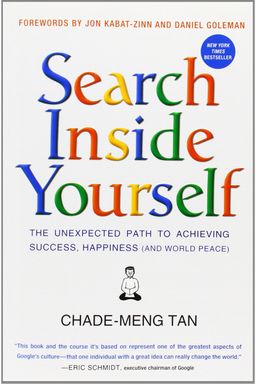
Search Inside Yourself cover

Search Inside Yourself

by Chade-Meng Tan

Search Inside Yourself reveals how emotional intelligence and mindfulness can be applied for personal and professional success. Through engaging practices and insights, Chade-Meng Tan guides you to enhance happiness, creativity, and productivity, leading to a fulfilling life.

The Science of Inner Peace and Success

What if achieving success and happiness required you to sit still rather than work harder? In Search Inside Yourself: The Unexpected Path to Achieving Success, Happiness (and World Peace), Google engineer Chade-Meng Tan suggests that true productivity and fulfillment stem from mastering your inner world. Rather than striving outward, Meng argues that the key to both success and happiness lies in cultivating emotional intelligence through mindfulness.

Tan’s central premise is simple but radical: emotional intelligence (EI)—the ability to understand and manage your emotions and those of others—is trainable, and mindfulness meditation is the most effective method for developing it. His journey began at Google, where he helped create a mindfulness-based curriculum for employees called Search Inside Yourself (SIY). It quickly became one of the company’s most popular internal courses because, as Tan discovered, these inner skills improved both professional performance and personal happiness.

From Meditation to Measurable Outcomes

Tan begins with a powerful question: can meditation make you better at your job? Drawing from psychology, neuroscience, and Buddhist wisdom, he reveals that meditation increases focus, emotional regulation, empathy, and adaptability—traits central to emotional intelligence. For example, research by pioneers like Richard Davidson and Jon Kabat-Zinn showed that eight weeks of mindfulness training lowered anxiety and increased positive brain activity and even improved immune function. Tan’s curriculum translates these scientific findings into accessible exercises that even skeptical engineers can practice at their desks.

The process unfolds in three stages: attention training, self-knowledge and self-mastery, and creating useful mental habits. First, attention training develops a calm, clear mind capable of perceiving emotions objectively. Next, self-knowledge allows you to notice emotional patterns without being swept up in them. Finally, deliberate habits—like wishing for others’ happiness—create interpersonal trust and collaboration. Together, these transform both personal and professional life.

Why Emotional Intelligence Matters

Tan cites Daniel Goleman’s landmark work Emotional Intelligence, showing that emotional skills often matter more than IQ in determining success. Studies of business leaders reveal that the most effective managers achieve results not through technical prowess but through empathy, optimism, and social intelligence. In one striking study, emotional competencies accounted for up to 80 percent of leadership effectiveness. Emotional intelligence, Tan argues, is not innate; it’s learned—just like any skill that can be strengthened through deliberate practice.

Tan brings these ideas down to earth through real stories from Google employees whose lives changed after taking SIY. One manager learned to pause before reacting, transforming workplace frustration into clear-headed decisions. Another employee discovered that mindfulness led to creative breakthroughs in engineering. These success stories demonstrate Tan’s point: mindfulness is not an abstract spiritual ideal but an applied mental technology that improves performance and relationships.

From Inner Calm to World Peace

Beyond professional success, Tan believes inner calm can scale globally. His audacious life goal is to contribute to world peace by spreading inner peace—what he describes as open-sourcing mindfulness. If enough people learn attention, empathy, and compassion, it can aggregate into societal harmony. He calls this approach “engineering for world peace,” turning the dreamy ideal of global harmony into a practical roadmap based on human psychology and neuroscience.

This first idea sets the foundation for the book’s larger journey: how mindfulness transforms emotion regulation, builds empathy, fosters leadership, and creates happiness that ripples outward. Tan’s message—rooted in science yet expressed with humor—is that inner growth is not a luxury; it’s an operating system upgrade for both your brain and your life.


Training Attention as a Superpower

Tan opens his program with attention training, describing attention as the foundation of all higher mental and emotional abilities. Without focused awareness, you cannot regulate emotions or understand others effectively. He teaches mindfulness meditation as a tool to sharpen attention and meta-attention—the ability to notice when your attention has wandered and gently bring it back.

The Mechanics of Mindful Focus

Using scientific studies, Tan shows that expert meditators, such as Tibetan monks, exhibit lower activation in the amygdala—the brain’s fear and stress center—when confronted with distressing stimuli. Neuroscientists like Julie Brefczynski-Lewis found that 10,000 hours of meditation can retrain the emotional brain to remain calm under pressure. Practicing mindfulness builds this ability to observe thoughts and emotions without being hijacked by them—a crucial skill for handling stressful work environments.

Mindfulness in Two Minutes

Tan doesn’t romanticize meditation as difficult or mystical. He teaches the two-minute mindfulness exercise: simply sit and focus on your breath or choose to ‘just be’ without agenda. This micro-practice is ideal for engineers, children, or anyone with limited patience. It also demonstrates a profound truth—that peace arises not from doing but from being. His humor makes the practice approachable (“two minutes is the attention span of a child and of an engineer”).

Attention as the Basis for Choice

Citing Viktor Frankl’s famous insight—“Between stimulus and response, there is a space”—Tan emphasizes that cultivating attention expands this space. When you can pause between impulse and reaction, you gain true freedom. Instead of reacting compulsively, you act consciously. This shift from compulsion to choice marks the beginning of emotional mastery and ultimately deeper happiness.

Attention training, he concludes, isn’t just about focus. It’s about transforming attention into insight—seeing emotions in fine detail, understanding their patterns, and ultimately using awareness as an emotional compass. Once you master attention, you’ve built the foundation for all other emotional intelligence skills.


Developing Self-Awareness and Confidence

In one of the book’s most vivid metaphors, Tan compares self-awareness to clarity—seeing the high-definition image of your inner world. He divides this awareness into two capabilities: emotional awareness, the ability to recognize feelings in real-time, and accurate self-assessment, the ability to know your limits and strengths with honesty. Together, these generate authentic self-confidence.

The Beggar’s Hidden Jewel

Tan opens with a parable about a beggar who unknowingly sits on a priceless jewel sewn into his pocket—a metaphor for how people ignore their inner potential. The lesson is that the treasures of confidence and peace lie within, accessible once you look inward mindfully. He humorously remarks, “You never know what you will find when you look within—there may be hidden treasures.”

From Self-Observation to Mastery

Using mindfulness as a mirror, Tan teaches techniques like the body scan, where you systematically bring attention to each part of your body. This practice reveals how every emotion has a physical correlate—tight chest for anxiety, shallow breath for anger—and recognizing these sensations gives you control before emotions take over. Emotional awareness, he shows, is the foundation for both self-control and interpersonal empathy.

All-Natural Confidence

Tan’s perspective on confidence differs from motivational clichés. True confidence isn’t loud or forced; it emerges organically from self-knowledge and self-acceptance. He cites Zen master Norman Fischer, who defines confidence as “the ability to be humble enough to recognize your limitations without self-blame.” Tan himself, a self-described shy engineer, demonstrates how mindfulness let him speak confidently at world events by balancing humility (“being small and irrelevant”) with courage (“being big as Mount Fuji”). This inner duality—small ego, big presence—is what he calls organic self-confidence.

In essence, self-awareness brings clarity that leads to self-confidence, freeing you from both arrogance and insecurity. When you see yourself clearly—strengths, weaknesses, and all—you become calm and capable of leading others. Tan’s formula: mindfulness → awareness → mastery → confidence.


Transforming Emotion into Choice

Tan likens emotions to a powerful horse that often runs wild, dragging its rider wherever it pleases. Emotional mastery, he says, means learning to ride the horse—to transform compulsion into choice. This transition defines self-regulation, one of emotional intelligence’s core domains.

From Compulsion to Self-Regulation

Self-regulation is often mistaken for suppression, but Tan clarifies that the goal isn’t to deny emotions. Instead, it’s to respond skillfully rather than react blindly. He cites stories of Gandhi’s composure and Buddhist wisdom on letting go: emotions arise beyond our control, but we can learn to release them instantly—“like writing on water.” A trained mind allows anger or fear to dissipate as soon as it surfaces.

The Practice of Letting Go

Tan outlines four practices for managing distress: noticing when you’re not in pain, not feeling bad about feeling bad (avoiding “meta-distress”), refusing to feed emotional monsters by replaying stories that sustain anger, and starting every thought with kindness and humor. These methods mirror modern cognitive behavioral therapy (CBT) techniques that reduce emotional rumination.

Five Steps on the Siberian North Railroad

To manage emotional triggers, Tan created the Siberian North Railroad (SBNRR): Stop, Breathe, Notice, Reflect, Respond. When provoked—say, by a careless comment—pause instead of reacting. Use breathing to calm physiology, observe feelings in the body, reflect on the situation’s history, then respond kindly and constructively. Tan’s students say this simple five-step meditation helped them navigate everything from traffic stress to workplace conflicts.

By repeatedly practicing SBNRR, the mind rewires itself for emotional freedom. Combining neuroscience and mindfulness, Tan shows that self-regulation is “upgraded recovery mode”—confidence rooted in stability. The result is freedom from emotional compulsion and the ability to face life’s storms with calm clarity.


Finding Motivation through Purpose and Flow

Why do you work? For pleasure, passion, or purpose? Tan draws on Zappos CEO Tony Hsieh’s framework of three types of happiness—pleasure, flow, and higher purpose—to explain lasting motivation. While pleasure fades quickly, purpose sustains deep fulfillment; flow, the state of being completely absorbed in meaningful activity, acts as the bridge between the two.

Aligning Work with Your Values

Tan urges readers to align their work with their values so that effort feels like play. He calls alignment “doing what you would do for fun and getting paid for it.” He references Daniel Pink’s “Drive,” noting that people are most motivated by autonomy, mastery, and purpose—not external rewards. This insight explains why Google’s culture of freedom and creativity breeds innovation—it activates the brain’s intrinsic motivation circuits.

Envisioning the Ideal Future

One of Tan’s most transformative exercises is envisioning your ideal future. He shares the story of Roz Savage, who wrote two versions of her obituary—one based on her current life and one based on her aspirations. The second version energized her so deeply that she left her corporate job to row solo across the Atlantic Ocean. Tan encourages readers to perform similar visualization exercises, imagining their most optimistic future and writing about it as if it has already happened.

Resilience Against Setbacks

Motivation requires resilience. Tan references psychologist Martin Seligman’s concept of learned optimism to explain how successful people recover quickly from failure. Optimists view setbacks as temporary and specific, not permanent or personal. He also cites Michael Jordan’s self-description as a “failure who succeeds” to illustrate that mastery grows through persistence. By combining mindfulness and optimism, you build emotional elasticity—the capacity to bounce back and keep moving toward your purpose.

Ultimately, motivation for Tan means aligning work with joy, resilience with meaning, and effort with engagement. When you envision a purpose bigger than yourself—and enjoy the process—you unlock sustainable success and happiness.


Cultivating Empathy and Connection

Empathy, Tan believes, is emotional intelligence made social. It’s not about agreement but understanding others deeply and seeing the world through their eyes. Neuroscience supports this: mirror neurons cause our brains to light up when we witness another’s pain, literally making us feel what they feel. This biological empathy forms the basis for compassion and trust.

The Brain Tango

Tan introduces the idea of an emotional tango—a physiological synchronization between people. Psychologist John Gottman found that couples who empathize have synchronized heart rates while conversing. Empathy is thus both mental and physiological. Through mindfulness and body awareness exercises like the body scan, you strengthen the insula, the brain region responsible for both self-awareness and empathy. The same circuits that let you feel your heartbeat help you sense others’ emotions.

The Practice of Loving Kindness

Tan combines two ancient practices—the Just Like Me reflection and Loving Kindness Meditation. Sitting quietly, imagine another person and think: “This person wishes to be happy, just like me.” Then offer silent wishes for their peace and well-being. This exercise trains the habit of spontaneous compassion. Students report feeling unexpectedly joyful simply from radiating goodwill, confirming that kindness benefits both giver and receiver.

Building Trust through Empathy

Empathy builds trust—the currency of all relationships and teams. Tan cites leadership consultant Patrick Lencioni, who identifies lack of trust as the root cause of organizational dysfunction. Vulnerability-based trust, where teammates feel safe admitting weakness, is created through genuine empathy. When you can listen without judgment and treat others as “just like me,” collaboration flourishes.

Tan’s conclusion about empathy is both scientific and spiritual: it’s not merely soft-heartedness but a practical tool for influence, leadership, and peace. When mindfulness meets kindness, empathy becomes a skill that can scale from personal relationships to global understanding.


Leading and Influencing with Compassion

The final part of Tan’s framework applies emotional intelligence outward—to leadership and influence. He believes true leadership combines effectiveness with compassion, echoing research showing that managers who express warmth outperform those who rely on cold authority. As Jim Kouzes and Barry Posner found, the best leaders display affection toward their teams, blending love with competence.

Compassion as the Highest Intelligence

Tan cites studies of Tibetan monks like Matthieu Ricard and Mingyur Rinpoche, whose brains register the highest levels of happiness while meditating on compassion. Compassion, he concludes, is both emotionally intelligent and neurologically blissful—it’s the brain’s most joyful state. Leaders who cultivate compassion energize teams and create cultures of trust.

Multiplying Goodness

To teach compassionate leadership, Tan introduces the Multiplying Goodness meditation. Picture yourself breathing in goodness and multiplying it tenfold in your heart, then exhaling it outward to the world. Repeat with others’ goodness. This visualization fosters three habits: seeing goodness in others, offering goodness freely, and believing in your power to transform. It’s a mental algorithm for positivity—training you to lead by example.

Influence through the Social Brain

Drawing from neuroscience, Tan uses David Rock’s SCARF model—Status, Certainty, Autonomy, Relatedness, and Fairness—to explain social motivation. The brain treats each domain like a survival need: threats trigger fear, rewards trigger cooperation. Compassionate leaders, therefore, enhance these domains by giving autonomy, recognizing fairness, and strengthening relatedness. When people feel safe and valued, influence happens naturally.

Tan ends with a story about psychologist Paul Ekman, whose lifelong anger vanished after ten minutes holding the Dalai Lama’s hand. Experiencing pure goodness recalibrated his entire emotional life. The takeaway? Influence rooted in compassion is transformative—it uplifts both leader and follower. Tan summarizes this ethos in his mantra: “Love them. Understand them. Forgive them. Grow with them.”

For Tan, compassion isn’t merely virtue—it’s strategy. To lead effectively and be loved at the same time, serve goodness. When compassion permeates your work and relationships, success and happiness follow—and world peace begins one brain at a time.

Dig Deeper

Get personalized prompts to apply these lessons to your life and deepen your understanding.

Go Deeper

Get the Full Experience

Download Insight Books for AI-powered reflections, quizzes, and more.