
Idea 1
The Mindset of Scarcity: Why Having Less Means Thinking Differently
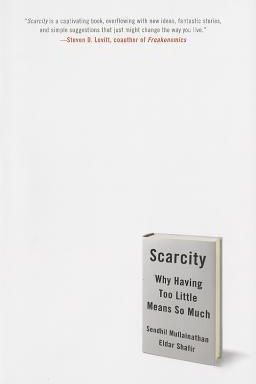
Have you ever felt that there simply wasn’t enough—enough time, money, or energy—to handle everything on your plate? In Scarcity: The True Cost of Not Having Enough, Sendhil Mullainathan and Eldar Shafir explore what really happens to our minds under the pressure of too little. They argue that scarcity—whether of money, time, calories, or companionship—is not just about lacking resources. It reshapes how we think, focus, and make decisions. It’s a universal psychological condition that affects rich and poor alike, but its effects can be especially destructive when scarcity is chronic.
Their central claim is that scarcity captures our attention. It forces us to focus on pressing needs, sharpening our short-term performance while blinding us to the bigger picture. This powerful tunnel vision creates what they call the scarcity mindset—a mental state that brings moments of clarity and productivity yet also leads to mistakes, forgetfulness, and self-defeating cycles. The irony, they explain, is that scarcity breeds more scarcity. Whether you’re missing a deadline or living paycheck to paycheck, the experience of having too little today often sets you up for even greater shortfall tomorrow.
Scarcity Captures the Mind
Mullainathan and Shafir open their argument with a fascinating example from psychology: the Minnesota Starvation Experiment during World War II. When volunteers were put on starvation diets, their minds became consumed by thoughts of food. They pored over cookbooks, watched others eat, and dreamed of recipes. Their focus on food became automatic, unconscious, and irresistible. That, the authors say, is what scarcity does—it hijacks the brain’s attention system. Whether it’s hunger, time pressure, or financial strain, the scarce resource becomes the center of our mental universe. Scarcity pulls focus toward itself.
This phenomenon extends far beyond extreme starvation. A person who’s short on time, for instance, can’t help but think about work during dinner with their family. A college student worried about tuition can’t focus on an exam. Busy or broke, we all experience this tunnel vision when scarcity takes hold. The mind’s bandwidth becomes limited. It can’t juggle multiple priorities at once, leading to neglect of things outside the tunnel—like long-term plans, relationships, or health.
The Focus Dividend—and Its Cost
Scarcity sharpens one’s focus, which can be a double-edged sword. In the short term, it creates what the authors call the focus dividend: the burst of efficiency many of us recognize before a deadline. Like Amanda Cohen, the chef on Iron Chef who created her signature dish under time pressure, people sometimes do their best work when resources are tight. Scarcity marshals attention, energy, and creativity toward what matters most—right now.
But focus comes with neglect. You might meet that deadline but forget your child’s game or skip the dentist appointment. This neglect spiral is known as tunneling—when you get stuck solving the urgent problem while ignoring the bigger picture. As scarcity pulls us deeper into its tunnel, we make decisions that alleviate short-term pain but create long-term costs. Payday loans solve today’s cash crunch yet lead to more debt tomorrow; multitasking saves time but causes errors. In every case, the tunnel narrows perception, trading foresight for momentary relief.
The Bandwidth Tax: How Scarcity Steals Cognitive Power
Beyond attention, scarcity taxes our bandwidth—the mental capacity we need for problem-solving, memory, and self-control. Through field experiments in India and New Jersey, Mullainathan and Shafir demonstrate that thinking about money problems can reduce cognitive performance by as much as losing an entire night’s sleep. For sugarcane farmers, cognitive test scores plummeted before harvest when money was tight, then rebounded after harvest when cash was plentiful. Poverty didn’t make people less intelligent; scarcity itself temporarily reduced their mental capacity.
This bandwidth tax affects self-control too. When your mind is overloaded by survival concerns, resisting temptation—whether food, spending, or distraction—becomes harder. Like a computer running too many programs, the mind under scarcity lags, crashes, and makes more mistakes. The poor person missing a payment, the busy professional missing a meeting, and the dieter breaking a fast are all struggling with the same mental tax: too little bandwidth left to make good choices.
Scarcity Creates More Scarcity
This mental depletion explains why scarcity often perpetuates itself. Mullainathan and Shafir tell the story of a market vendor in Chennai who could escape her daily debt cycle simply by saving five rupees a day. Yet the constant juggling of expenses, loans, and shocks made it nearly impossible for her to plan ahead. Every surprise expense pushed her back into debt. Similarly, busy professionals promise to get organized next week but stay caught in the same trap. Scarcity breeds more scarcity because it undermines the very mental faculties—planning, control, foresight—needed to escape it.
The poor, the busy, and the lonely all face different forms of scarcity, but their challenges share the same psychological pattern: tunneling on immediate needs, losing sight of long-term goals, and suffering a bandwidth drain that makes failure more likely. The cruel irony is that scarcity doesn’t simply result from poor choices—it produces them. Understanding this helps shift moral judgment away from blame and toward empathy—and smarter policy design.
Why This Matters
The implications of the scarcity mindset reach far beyond individual behavior. For those living in poverty, scarcity magnifies every setback, from missed loan payments to health problems, creating a trap that can last generations. But it also affects anyone struggling with too many commitments or deadlines. By recognizing the cognitive toll scarcity takes, we can design better environments—ones that reduce mental clutter, plan for failure, and free up bandwidth for what matters most. Mullainathan and Shafir describe it as giving people more “room to fail”—the slack that wealthier or less-busy people already have by default.
Ultimately, Scarcity challenges a fundamental assumption about human behavior: that people act irrationally because they are careless. The authors show instead that scarcity itself can make anyone less rational—less focused, less self-controlled, and less capable of seeing beyond the tunnel’s edge. Knowing this, we can stop blaming individuals for their shortfalls and start designing systems—from welfare programs to workplace schedules—that account for the psychology of having too little.