
Idea 1
Scaling a Business That Runs Itself
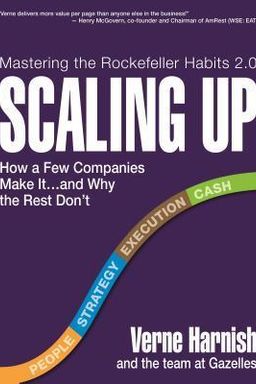
How do you turn a promising business into one that scales predictably without burning out its leaders? In Scaling Up: How a Few Companies Make It... and Why the Rest Don’t, Verne Harnish argues that growth requires more than ambition—it demands disciplined systems. The book expands his earlier Rockefeller Habits framework into an integrated playbook built around four critical decisions: People, Strategy, Execution, and Cash. Each is non‑negotiable; weakness in one eventually drags down the others.
Harnish’s central message is practical: if you want to scale, you must master a handful of rhythms, metrics, and one‑page tools that organize complexity. The process sounds mechanical, but it’s deeply human—about aligning people around clear priorities, building systems that accelerate instead of suffocate, and creating cash discipline so growth funds itself.
The Four Decisions: Your Non‑Negotiables
The four decisions—People, Strategy, Execution, and Cash—are the book’s backbone. People decisions determine whether you have A Players in every key role. Strategy choices define your core customers and the trade‑offs that protect profitability. Execution habits convert plans into visible, timely results. And Cash discipline ensures growth doesn’t starve your company. Each domain interacts with the others: mis‑hiring impairs execution; unclear strategy drains cash; bad cash visibility forces short‑term reactions that erode culture.
The diagnostic lens is simple: when you feel pain, ask which decision is breaking—people, strategy, execution, or cash—and fix that first. (Harnish likens this to Jim Collins’s flywheel: progress comes from cumulative, small improvements in the right direction.)
The 4D Framework and Predictable Leadership
To operationalize the four decisions, Harnish introduces the 4D Framework: Driver, Demands, Disciplines, and Decisions. The leader is the Driver, setting habits that free time for market‑facing work. The Demands balance people and productivity pressures. The Disciplines—priorities, data, and meeting rhythm—turn execution into muscle memory. And the Decisions themselves determine long‑term direction. Used together, these create an organization that acts predictably even as it grows.
Keap (formerly Infusionsoft) provides a vivid example: its founders used the Rockefeller Habits and One‑Page Plan in quarterly off‑sites to stay aligned even while negotiating major funding rounds. The framework helped them balance execution with strategic focus and cash management—a real‑world case of structure enabling scale.
Barriers and the Growth Paradox
Growth paradoxically creates friction. As companies expand, communication lines multiply, complexity surges, and informal systems collapse. Harnish identifies three recurring barriers: Leadership (founders failing to delegate and predict), Infrastructure (systems that lag behind headcount), and Marketing (failure to attract the right customers and talent). These barriers appear in distinct “Valleys of Death”—employee clusters like 8‑12, 40‑70, and 350‑500—when old structures no longer fit the company’s new size.
Alan Rudy’s Express‑Med shifted from constant firefighting to disciplined delegation once he installed daily huddles. Similarly, Jack Harrington used the same habits to scale from a $30M startup to leading Raytheon’s $750M division. The takeaway: every growth phase requires re‑training leaders to predict and delegate through process, not personality.
Growth Tools that Organize Complexity
Scaling Up condenses complexity into one‑page tools. The Function Accountability Chart (FACe) and Process Accountability Chart (PACe) clarify who owns results and processes. The One‑Page Strategic Plan (OPSP) integrates vision, goals, KPIs, and owners on one sheet. The Power of One and CASh tools quantify how small changes in pricing, expenses, or working‑capital days alter cash flow. Each tool enforces constraint and visibility—helping teams focus on what truly drives scale.
The philosophy is minimalist: make everything as simple as possible but not simpler. Instead of complex dashboards, leaders should track a few Critical Numbers weekly and use daily huddles to surface obstacles. Harnish calls these small, repeatable routines “the rhythms that set you free.”
Culture, Learning, and Cash Discipline
Underpinning the systems is culture. Managers act as coaches, unlocking strengths, removing friction, and connecting every role to the company’s Critical Number. Organizations like Zappos, Atlassian, and The Container Store treat onboarding and ongoing learning as strategic levers—turning their companies into “training companies” where predictability and energy sustain growth. On the financial side, firms that scale keep brutal cash transparency: daily visibility, modeled scenarios, and lean CCC cycles that fund growth internally.
The result is a disciplined but agile organization—a company powered by people who know their roles, driven by a strategy everyone can state in one sentence, guided by rhythms that create accountability, and protected by cash management that buys freedom. Scaling Up ultimately reframes growth not as heroism, but as routine excellence done obsessively well.