
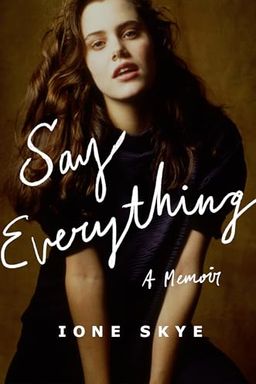
Say Everything cover

Say Everything

by Ione Skye

The performer who gained notice in the movie “Say Anything” shares details of her career and relationships.

Turning Longing Into A Life

Have you ever felt that a missing piece from your past keeps writing your present? In Say Everything, actor and artist Ione Skye argues that the ache you inherit—absent love, chaotic homes, old scripts about worth and beauty—can become raw material for a fully lived, honest life. Skye contends that the only way to stop reenacting the past is to tell the truth about it, set humane boundaries, and choose real intimacy over fantasy. But to do that, you have to acknowledge the forces that shaped you: family myths, the magnetic pull of fame, the electricity of first love, the thrill and terror of artistic exposure, and the compulsions that masquerade as devotion.

Across five decades—from a glass house in Connecticut to Wilton Place in Hollywood, from River’s Edge to Say Anything, from the Zappas’ creative compound to backstage with the Chili Peppers—Skye shows you how a person can move from hungry child to working artist to mother and partner, all while reprogramming the belief that love must be chased or saved. It’s a candid map of growing up in the blast radius of beauty, charisma, and addiction, then learning to stay, to forgive, and to begin again.

The Core Thread: Longing, Gaze, and Becoming

Skye’s core argument is simple but hard-won: longing without honesty becomes a life of performance; longing told truthfully becomes art—and a real relationship to others. As the daughter of 1960s folk icon Donovan and model Enid Karl, she enters the world as a beautiful symbol (named for the Isle of Skye where she was conceived), not a protected child. Her father disappears; her mother, magnetic and overwhelmed, marries volatile men. The message lands early: beauty gets you seen; caretaking keeps you safe; intensity equals love. You probably have your own versions of these rules. Skye shows how they work, and how to unlearn them.

What You’ll Explore in This Summary

First, you’ll walk through Skye’s formative years—the Ridgefield glass house, the move to Topanga, the sanctuary of Wilton Place—where fear, glamour, and freedom braided together. You’ll see how early scripts (be the good girl, the favorite, the saver) form under unpredictable adults (stepdad Carl’s rages; beloved Enid’s freezes). Then you’ll step into the awkward, kinetic orbit of famous fathers and friends—Marsha Hunt and Karis Jagger, the Zappas, River Phoenix—and watch how proximity to stardom shapes self-worth (compare to The Glass Castle, where longing similarly turns into drive).

Next, you’ll examine her artistic coming-of-age: emancipation at 15 to film River’s Edge; a kiss-and-not-quite romance with Keanu Reeves; Cameron Crowe’s tender precision on Say Anything; the mentorship (and quiet steel) of Polly Platt; and why the boom box scene still speaks to anyone who’s ever loved earnestly. You’ll also study the other major "school" in Skye’s life—the conservatory of high-voltage relationships: the sweetness and danger around Flea; the life-altering entanglement with Anthony Kiedis; grief for River Phoenix; and the way codependency disguises itself as rescue (here she explicitly cites Melody Beattie’s Codependent No More).

Then comes desire as identity work: her tender, complicated awakenings with women—Alice Temple, Jenny Shimizu, Ingrid Casares—and the parallel quake inside her nervous system (the Northridge earthquake literalizes the "mean reds" Truman Capote named). You’ll witness her first marriage to Adam Horovitz (Ad-Rock), how love and art entwine, why fantasy can’t feed a marriage, and the slow, honest grief of their long goodbye. Finally, you’ll enter the seasons of mothering Kate and Goldie, co-parenting with David Netto, returning to craft (comedy opens something new), and choosing slowness with musician Ben Lee—where consistency, not grand gestures, signals the true beginning.

Throughline

Skye’s memoir insists that you can keep the romance and lose the illusion: you can be porous to wonder without living in old stories.

Why This Matters To You

If you’ve ever worked in creative fields, loved someone with an addiction, grown up in chaos, or simply felt haunted by the life you thought you’d have, Skye’s pages are a mirror and a set of handrails. She doesn’t moralize. She narrates—with sensory detail and names you know—how a person learns to stop performing and start relating. And she invites you to try gentler experiments: let desire educate you, but let boundaries graduate you. Her story sits comfortably beside Patti Smith’s Just Kids (art as sanctuary), Demi Moore’s Inside Out (fame and family scars), and Glennon Doyle’s Untamed (reclaiming voice), yet it’s uniquely Hollywood-by-way-of-house-party, generous about everyone’s humanity.

In the pages ahead, you’ll see how small shifts—naming instead of numbing; choosing steadiness over spectacle—accumulate into a different ending. The memoir closes with a dream: she meets Adam on a cliff, says "good luck and goodbye," and feels relief. That’s the book’s promise to you: your story can stay beautiful and still let you go.


Childhood in the Blast Radius

Skye’s childhood is a case study in what she later calls the blast radius—when glamour, volatility, and parental absence explode at once and the child learns to read a room the way a storm-reader reads the sky. You see it first in Ridgefield, Connecticut, inside the literal glass box of her stepfather Carl’s modernist house. Carl is dazzling and dangerous: he gifts emeralds and German shepherds, tells tall tales about stealing for love, and terrorizes with sudden rages. Enid, the mother who once felt like a warm bed you can dive into, grows “frozen”—depressed, thinner, further away. Skye learns the first survival script: be the favorite, be beautiful, be good—then maybe the windows won’t shake.

Scripts Children Learn

1) Beauty buys safety. Carl endlessly praises Enid’s looks and tells young Ione she’s "deep and beautiful," a reincarnated soul who chose to be here. In fairytales, beauty is blessing; in Ridgefield, it’s currency. Skye absorbs it in her bones (you might recognize this one if you grew up praised for what you looked like or what you achieved rather than who you were).

2) Caretaking is love. With Enid receding, Skye tiptoes to her mother’s door, checks winter windows after the parakeets freeze, and learns to regulate everyone else to stay safe. When Carl pins her brother Dono beneath a beanbag, she freezes, then copies Enid’s dissociation. As she’ll later write about codependency, that’s how "rescue" training begins.

3) Fantasy fills the gaps. Without Donovan present—he’s the folk-legend father who won back his old love and left—Skye imagines a family portrait on the Isle of Skye, imagines India with her dad and the Beatles, imagines safety in fairy houses built from moss and fir. She names herself from the caravan where she was conceived. (This echoes Jeannette Walls’s star-naming ritual in The Glass Castle, where fantasy salves deprivation.)

From Glass House to Wilton Place

When Enid escapes Carl, Skye’s life opens like a screen door in summer. Topanga’s feral freedom gives way to a snug Craftsman in Hollywood’s foothills. Wilton Place becomes a crash pad for artists and neighbors, a place where kids play ball in the street and dinner is steaming chicken soup. Enid sells pot, reads bedtime mantras, and returns to herself. Skye and Dono raid her groovy sixties closet; happiness looks like mess and friends and bowls clattering in the sink.

But the earlier scripts don’t vanish. In second grade, a TV miniseries teaches Skye the word "bastard." She announces it cheerfully; classmates flinch. Later, at Catholic Immaculate Heart (the structure she craves), she falls under the spell of "the Aprils," a clique of rich, magnetic girls who weaponize cool. This is Skye’s first masterclass in social gaze: how the powerful tell you who you are. The Aprils expect complicity, even meanness (mocking a Jazzercise teacher; stealing a diamond stud while babysitting). Skye consents to be initiated—both into their world and, in a moonlit room, into the bewildering heat of desire for the queen bee, April. They experiment, then April shuts it down. The lesson lands: vulnerability makes you banishable. Hide your hunger.

Learning to Perform (and to Choose)

Across these years, Skye toggles between the safety of rules (nuns in slacks who say you’re uniquely worthy) and the intoxication of being chosen by the cool (the Aprils; later, Hancock Park mansions). She practices being the good girl and the pretty girl, then dares a new role: the truth-teller who opts out. When she tries to lose her virginity with polite Crew Sinclair in a caretaker’s cottage, her body whispers, "I’m so young," and the script changes mid-scene. It’s a small heroic act—listening to the body instead of the myth. Back home, a teenage body book teaches her another truth: her pleasure belongs to her (Skye’s ecstatic, self-authored discovery has the subversive delight of Judy Blume’s Forever re-read as adult instruction).

Signal Insight

When danger, glamour, and neglect coexist, kids often choose a role (favorite, caretaker, prize) to stay in orbit. Changing the role later requires naming the early deal.

Why This Part Matters To You

You might not have grown up with German shepherds and Hockney-esque glass walls, but you probably learned early bargains too: achieve and you’re safe; dazzle and you belong; fix others and you’ll be loved. Skye’s child-eye vignettes make those bargains visible. Seeing them is the hinge: later, when she’s face-to-face with addiction, fame, or April-like seductions, she can ask, "Am I choosing this—or replaying the old deal?" That’s how a blast radius becomes a story you can walk out of.


Fathers, Fame, and First Breaks

Skye grows up in a neighborhood where "famous father" is practically a demographic. Karis’s dad is Mick Jagger; Moon and Dweezil’s dad is Frank Zappa; Jason’s dad is Michael Nesmith of the Monkees. In that constellation, your worth can feel indexed to name-recognition. Skye’s father, Donovan, is both everywhere and nowhere—on records, in magazine spreads, in Enid’s stories—and never, ever at the breakfast table. He refers to her for years as "the girl" in letters via lawyers. At a Forum concert, he pats her friend Jason’s hair, assuming he’s "the girl," then walks away. The wound is not just absence; it’s misrecognition.

Meeting the Idol Within the Myth

As a teen, Skye watches Karis gradually fold a once-absent father into her life (Jerry Hall helps bridge Mick and Karis). It gives Skye hope. When she finally meets Donovan at 17—at a log cabin near Joshua Tree—he greets her strumming a blue cosmic guitar, singing about a boy who hung himself from a bell tower; Linda films; her half sisters flank him like matching bookends. The moment is surreal and a little evasive, like a dream you can’t quite pin. She reaches to have a conversation; he soliloquizes about Atlantis, Sappho, bohemian manifestos. Every 20 minutes someone "goes to the bathroom" to smoke hash. It’s not the father hug she craved, but it’s proof the myth has human pores. Years later in Ireland, with Ben and their daughter Goldie, she’ll discover the gentler truth: you can love a father as a mystery, not a flame to warm your hands by.

Auditioning for Being Seen (and Heard)

Against that backdrop, acting becomes both invitation and antidote. Dono hands her a script—River’s Edge—and Skye white-knuckles her way into the audition. Carrie Frazier (who cast Fast Times) sees "Meg Tilly energy" in her; Tim Hunter directs with literary tenderness; she earns the part of Clarissa. On set, Dennis Hopper arrives cleaned up, an elder echo of what addiction can resolve into; Crispin Glover vibrates at a frequency just shy of mania; Keanu Reeves smells like onions for their first kiss and like pecan pie the night she whispers "Can I come to your place after wrap?" He receives her desire with care, then stops when consent shifts—a memorable early lesson about "no" inside "yes."

The premiere of River’s Edge is that dream-come-true/please-don’t-end feeling: stunning cinematography by Frederick Elmes, a polarized crowd, an agent’s card pressed into her palm. In lights five feet high: IONE SKYE LEITCH. She debates dropping "Leitch" (the paternal brand), keeps it for recognition, then gradually reclaims "Skye" as a banner of early hope.

Say Anything, Say Everything

When Cameron Crowe and Polly Platt circle her for Say Anything, Skye stumbles in the first reading—too cool, too guarded. Crowe asks her to want it openly—a counterspell to every popularity economy she’s survived. John Cusack hesitates; he doesn’t want another teen movie. Crowe persuades him with the phrase "warrior for optimism." On set, László Kovács frames Diane Court with old-Hollywood warmth; Polly tells Skye gently to watch the snacking and slides her Playtex Secrets (a time-capsule detail about the body politics young actresses navigated). Madonna will later tease Tim Roth on Four Rooms, but here the mentor is Polly—the production designer who was rumored to have directed as much as Peter Bogdanovich on Paper Moon and The Last Picture Show (Skye’s aside on Pretty Baby reframes Polly’s critique of sexualizing girls).

The boom box scene nearly isn’t: Cusack resists; Fishbone plays in an early cut; then Cameron hears Peter Gabriel’s "In Your Eyes" on his wedding mixtape and fights to license it. Skye films Diane’s half of the scene in dawn light to "Child of the Moon" and "Buckets of Rain"—melancholy tracks that summon quiet discernment. She learns a new muscle: let the film’s music carry your truth without overperforming it.

Throughline

Acting offers Skye an honest gaze: lighting, timing, posture—tools Bobby Burton gives her—replace the slippery gaze of cliques and absent gods. She’s finally seen for what she brings, not for whom she belongs to.

Why This Part Matters To You

If you grew up negotiating someone else’s legend—family success, small-town myth, the stories told about you—Skye’s break reminds you that craft can be liberation. Work gives you a place to receive feedback from reality instead of fantasy. And it quietly re-parents you: mentors like Polly and Cameron say, "want this," and the child who learned not to need can finally nod.


Love, Addiction, and Codependency

Skye’s relationship with Anthony Kiedis—the "before" and "after" of her teens—shows you how devotion can morph into caretaking, and why "rescue" is the slipperiest role of all. The tale begins lightly: a lawn party on Wilton Place, Glen Campbell’s "Rhinestone Cowboy" faded into Beastie swagger, a fringed suede jacket on Dono’s balcony. It turns intense fast. Anthony talks like a beat poet about desert winds and cosmic energy; Skye, a sixteen-year-old with a savior’s heart and a history of regulating volatile men, leans in. Weeks later, she’s flying to Tucson to surprise him on tour, colliding with the bad-news math of rock and sex and heroin in a dressing room. He chooses her that night, and she imprints on the tenderness she knows is there.

From Romance to "Saving"

The first months offer the sweetness Skye aches for: Sam Cooke on a silent TV in a hotel, road fries, inside jokes about BO as aphrodisiac, a "warrior for optimism" version of Anthony who calls her his angel. Then the rhythm sets in: three-day disappearances, speedball lurks, her nightly circuits past Eat’n High Thai and Bonnie Brae, Bob Forrest in the backseat telling her, gently, "there’s nothing we can do." It’s the hardest sentence in the book. She keeps trying, of course—codes her love as protection, learns to spot the cops, hides foil in her pocket—until the logic collapses. If love equals saving, you will never rest. (Compare Melissa Febos’s Abandon Me on the narcotic of obsessive care.)

Skye’s body has its say: panic attacks, "mean reds" (Capote’s term she adopts), dreams of underpasses and explosions. She stops wanting to be alone; their bed becomes an altar where heroin means snuggly one night and demon the next. She tries to write a different chapter—inviting him to move in, attempting boundaries, then flouting them to "keep him safe" as he uses. After a scare, they both test for HIV. The doctor gives her the talk about a "life of some sort" if she’s positive. The relief of a negative result jolts them both—but only briefly.

A Line She Won’t Cross (and Almost Does)

One night Skye asks to try heroin. Anthony refuses: "Don’t ever ask me that again." It’s one of his best moments in the book: a man seeing he’s the cliff and turning her around. But the hunger for obliteration has been provoked—part libido, part wanting to understand the lover, part compulsion to match. Later, with Patty (Bob Forrest’s girlfriend), she snorts a tiny bit and floats through a warehouse party in absolute ease. She wakes the next day knowing: this isn’t for the living. Real life is hard. She is strong. She wants happiness. That thought becomes a reef she can swim back to when the undertow pulls.

Skye’s abortion—at seventeen, a quiet scene in a pink Beverly Hills office—becomes one of the memoir’s anchor points of clear self-care. A woman in the waiting room, there for a hysterectomy, leans across the divide with unjudging compassion. Skye chooses the future she can live—no secrecy here, just the steadiness of telling herself the truth.

Naming the Pattern

The pattern cracks for good when Skye reads Codependent No More on a plane to see Anthony on tour. Melody Beattie’s definition lands with surgical clarity: we call it "helping," but we’re soothing our fear of abandonment by controlling outcomes. The book becomes a mirror she can’t look away from. She hides it on a closet shelf back home—then keeps living by what it taught her: "You don’t have to take care of Anthony anymore. He’s not your job." Years later, after Hillel Slovak dies, after Anthony writes "Taste the Pain" on her bedroom floor, after the boom-and-bust cycles wear grooves in her soul, she will say the hard words: "I think we should break up." He doesn’t fight. He leaves a Deco lamp—"remember the beautiful times"—on her doorstep. She remembers the beautiful times; she chooses to forget the deal.

Practical Reframe

If love requires you to surveil, lie, or abandon your own safety plan, it isn’t love—it’s "job security" for your fear. Loving someone doesn’t make their rock bottom yours to manage.

Why This Part Matters To You

If you’ve ever been "the strong one" or the rescuer, Skye’s story is a field guide: tenderness doesn’t obligate you to suffer. And the most loving sentence you can learn—"there’s nothing we can do"—is not abandonment. It’s the doorway back to your life.


Desire, Fluidity, and Fallout

After the high-drama chapter of saving, Skye enters a different education: desire as a truth-teller. The trigger is as cinematic as it gets—an Echo Park party, a house like a ship from the Art Deco days, a figure in cuffed Levi’s and a white ribbed tank. Alice Temple—a BMX champion and model—looks like James Dean and radiates a quiet gravity. Skye feels walloped: does she want to be Alice or be with her? That question, which began in a moonlit Hancock Park bedroom with April, returns with adult force. And with it, a fuller self arrives.

Coming Out (And Compartmentalizing)

Skye pursues Alice while married to Adam Horovitz (Ad-Rock), the first great love she calls safe. The cognitive dissonance is immediate: Adam’s tenderness and humor sit right beside the oxygenated feelings with Alice. To make it livable, Skye compartmentalizes. She keeps Adam close for safety (daily check-ins), then slips into Silver Lake afternoons with Alice and friends where heroin is a social accessory (snorted from Visine bottles), and androgyny is a kind of absolution. She tells herself it’s a phase, an education, a nineties mood. But the heart knows the difference between spectacle and belonging.

The "education" widens: Ingrid Casares (Madonna’s ex), intimate sleepovers under immaculate sheets to William Orbit’s "Water from a Vine Leaf"; Jenny Shimizu (Calvin Klein icon, motorcycle mechanic), who asks, "Where don’t you want me to hurt you?" and becomes Skye’s "true initiation into the lesbian nation"; then Mai Lei, a kinetic skater-girl whose down-to-earth steadiness is a balm. Each woman teaches a new facet of want—and a harsher lesson: secrecy corrodes. Skye brings Mai Lei to the Case Study house pool; Adam returns unexpectedly and sees them. In the memoir’s most wrenching passage, he later hands her a letter from Kathleen Hanna and asks simply, "Should I write back?" Skye can’t honestly promise fidelity. She tells him yes. She watches herself lose him in real time.

Earthquake in the Body

Desire’s expansion coincides with the Northridge quake. It becomes metaphor and symptom: "Every intersection was about to explode." Skye can’t sleep. She fears aliens, gas stations, aftershocks. In a rare, startling moment of grace, she visits Mick Jagger and Carla Bruni after a sizable aftershock. Mick steadies the champagne bottle like a flight attendant. Nothing shatters. Back in Laurel Canyon, the mean reds return. The nervous system has its own timetable; it cannot be hustled into acceptance. Where fantasy once soothed (fairy houses, April, Hancock Park), honesty starts to do the heavier lifting.

Father-Daughter Dance, Finally

At her brother Dono’s wedding in Scotland, Skye’s father sings instead of speaking; he nods to Enid, who gives him Don Corleone stillness; Skye dances with Adam, aching for a cosmic rom-com do-over; then Astrella gently pushes Donovan toward her. He shuffles in; Adam steps away. They dance awkwardly. Later, in a chandeliered hallway, Adam says the sentence that makes you love him: "I hate your dad. I hate what he did to you." It’s an empathy that sees the child inside, not the scandal. It doesn’t change their ending, but it gives closure its right shape—sorrow plus witness.

Hard-Won Nuance

Skye never apologizes for desire; she apologizes for secrecy. The memoir doesn’t turn queerness into a detour; it treats it as the trail toward truer self—with accountability for the harm secrecy caused.

Why This Part Matters To You

If you’ve ever wrestled with a self emerging later than expected—sexuality, vocation, voice—Skye’s account gives you both permission and responsibility. You get to become. And you have to tell the truth about the becoming, especially to the people who love you.


Choosing Intimacy Over Fantasy

The memoir’s final movement is gentler, wiser, and more radical than any backstage anecdote: it’s about staying. Skye doesn’t tidy her career arc or romantic past; she right-sizes them and builds a durable present—motherhood, co-parenting, comedy, painting, and a marriage chosen for steadiness, not spectacle.

Motherhood as Reparenting

With designer David Netto, Skye has Kate. They don’t marry; they try; they live together; they don’t fit. The breakup is painful but adult. They co-parent with unusual grace (Skye notes she truly loves their daughter’s half-sister, Madelyn, as Liz, David’s wife, loves Kate in return). Mothering becomes a daily practice of what young Ione needed: bedtime recaps told backward so nothing gets lost, a refusal to abandon yourself in service of someone else’s spirals, whole friendships in place of cliques, craft in place of chase. Acting returns—Arrested Development opens her comedic valve; Zodiac gives her a Fincher-sized reminder that she’s an actor’s actor. She paints; she produces with Ben under "Weirder Together." She lives like the Wilton Place she loved: creative bodies in and out, bowls clattering, wisdom in the mess.

The Slow Beginning

Enter Ben Lee at the Marie Antoinette after-party. Not a thunderclap—at first just a bench conversation. A "pleasant" lake-like evening, not fireworks. He wants to take it slow, to see if what they feel survives time. Skye texts too much; he names the boundary; she tries a new script—two weeks of no contact (friend Tatiana’s coaching). Surprise: desire grows when steadiness governs it. At last, the fireworks and the lake coincide. With Ben, Skye practices everything she’s learned: no secrets, no rescues, and tenderness that includes accountability. They marry in India (she wryly notes the cringe of appropriation, a sign of the book’s present-tense ethics). On their wedding night, she conceives Goldie.

Sixteen faithful years later, Skye names the real miracle: intimacy that’s not a hostage situation. Her daughters, Kate and Goldie, are forthright mirrors. Kate, reading the draft, says, "Don’t play down that you were sixteen and he was an adult." Skye hears her. She states it clearly in the book’s final pages. That’s intimacy too: allowing your children to update your story.

Career Without the Hunger Games

Skye accepts she may never be a Hollywood power player. She also accepts that she doesn’t need to be. Curiosity, collaboration, and community replace the old economy of beauty and chase. Not caring obsessively becomes a performance enhancer. Offers come—Lena Dunham and Chloë Sevigny call; Alexi Wasser casts; podcasts and short films bloom. The child who learned to win safety through being a favorite now chooses rooms that are safe because truth circulates there. (In career literature, this reads like a humane sequel to Cal Newport’s So Good They Can’t Ignore You—only here, "so good" includes being good to yourself.)

Final Image

A recurring dream on the Amalfi cliffs becomes the book’s benediction. This time, she meets Adam, hugs him, says "good luck and goodbye," and wakes relieved. Letting go, for good, is the bravest way to keep what was beautiful.

Why This Part Matters To You

Skye’s ending isn’t a Hollywood montage; it’s an everyday ethic: pick rooms that want your truth; treat longing as weather; practice repair; let your kids update your wisdom; measure love by how free everyone feels inside it. If you’re ready to retire an old script—favorite, rescuer, prize—this is your proof that a new one holds.

Dig Deeper

Get personalized prompts to apply these lessons to your life and deepen your understanding.

Go Deeper

Get the Full Experience

Download Insight Books for AI-powered reflections, quizzes, and more.