
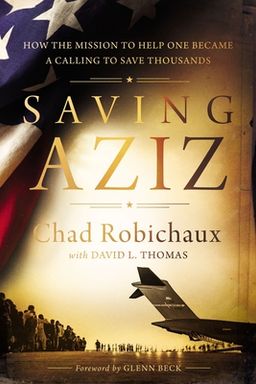
Saving Aziz cover

Saving Aziz

by Chad Robichaux with David L Thomas

Saving Aziz tells the remarkable story of a daring rescue mission that evolved into a monumental effort to save over 17,000 Afghan allies from Taliban control. Experience the transformative power of friendship, bravery, and humanitarian action as Chad Robichaux''s mission inspires global alliances and lifelong impacts.

Brotherhood, Duty, and the Fight for Honor

What would you do if a friend who once saved your life was suddenly trapped behind enemy lines? In Saving Aziz, former Force Recon Marine Chad Robichaux grapples with that question—and acts on it. When the U.S. abruptly withdrew from Afghanistan in 2021, Robichaux’s longtime Afghan interpreter and brother-in-arms, Aziz, was left behind in a country collapsing into Taliban control. That single relationship turned into a global rescue mission that would save more than 17,000 lives. This book chronicles that mission, but also poses a deeper challenge: What are we, as citizens and moral beings, willing to do when our leaders fail to act?

Robichaux contends that America’s withdrawal wasn’t just a political mistake—it was a moral failure. Yet he refuses to leave the story in despair. The heart of the book beats with hope, faith, courage, and the unbreakable bonds formed in the crucible of war. It’s a modern-day Band of Brothers story set against the chaos of Afghanistan’s fall but also a reminder that individual action can uphold national honor when institutions fall short.

A Brotherhood Forged in War

Chad and Aziz’s story begins not in the chaos of 2021 but in the early 2000s, when Chad first deployed to Afghanistan. There, amid missions in mountains and deserts, an unexpected friendship took root between the Marine and his Afghan interpreter. Aziz wasn’t just a translator; he fought alongside U.S. troops, saving Chad’s life multiple times while risking his own. To Afghans like Aziz, aiding the Americans was not simply about loyalty—it was about fighting for a vision of freedom in their homeland. To Chad, Aziz became family. Their story illustrates the kind of trust and mutual reliance only forged under fire—one that transcended flag and faith.

The Collapse and a Call of Conscience

When President Biden announced the full U.S. withdrawal from Afghanistan, Robichaux felt that same dread echoing through the veteran community. He’d seen the Taliban’s atrocities firsthand—women stoned, children executed, interpreters murdered for helping Americans. He knew what awaited Aziz. Bureaucracy had already trapped thousands in the broken Special Immigrant Visa system, a half-promise of safety turned death sentence by delay. And so, Chad decided: if the government wouldn’t act, he would. He reached out to fellow veterans, faith leaders, and media allies like Glenn Beck. Together they built an unlikely coalition—special operators, civilians, and donors—who refused to stand by. That coalition became Save Our Allies, the organization that would conduct one of the largest civilian rescue operations in history.

Faith as Compass and Fuel

Throughout the narrative, faith is as much a logistical guide as a moral one. Robichaux’s Christianity, tested by PTSD, near-suicide, and moral injury, becomes the framework for action. His moment of clarity on the flight to Afghanistan—when prayer transformed his fear into peace—anchored his entire mission. He frames his work as obedience to Isaiah 6:8: “Here I am. Send me.” This spiritual conviction allowed him to face the Taliban, international politics, and even his own trauma with renewed courage. For Chad, rescuing Aziz was not only about fulfilling a promise to a brother but also about living out divine duty—the kind that prioritizes doing right over being safe.

A People’s Redemption Story

Beyond a rescue memoir, Saving Aziz is about redemption—personal, national, and spiritual. On a personal level, the mission becomes the culmination of Chad’s long battle with PTSD and guilt, a return to purpose after years of despair. On a national level, it’s a story of citizens reclaiming America’s honor when politics abandoned it. And on a spiritual level, it’s a call for compassion that transcends cultural divides. The story challenges you to envision moral courage not as grand gestures of state, but as the faith-driven determination to save even one person.

Why This Story Matters Now

Robichaux’s account carries heavy implications for how nations measure honor and how veterans find peace. It asks if government failures absolve individual responsibility, and answers with a resounding no. As Glenn Beck writes in his foreword, this mission was a “modern-day Dunkirk” led not by generals but by ordinary citizens driven by conscience. The story forces readers—especially veterans, citizens, and people of faith—to consider their own thresholds for inaction. What does love of country or love of neighbor truly require when the price is risk?

In the chapters that follow, Chad takes you inside his years of combat with Aziz, the moral fallout after leaving Afghanistan, the chaotic race to save lives from Kabul, and the dangerous border missions in Tajikistan. He exposes the broken systems, celebrates courage in unlikely places, and reminds you that one act of loyalty can change history. Ultimately, Saving Aziz isn’t just a war memoir—it’s a roadmap for moral action, even when the institutions fail. It leaves you with a haunting but empowering truth: while governments retreat, individuals can still advance the cause of humanity.


From the Killing Pool to Compassion

Chad Robichaux’s transformation begins with a haunting visual—a Soviet-built Olympic pool turned execution ground by the Taliban. From this place he calls the “Killing Pool,” surrounded by bullet holes at head height, he discovers not just the brutality of Afghanistan’s history but the deeper purpose of his own service. That pool, once filled with water, now held memories of women and children executed for defying Taliban rule. It was here Chad’s mission shifted from vengeance to compassion.

The Awakening of Purpose

Originally, Chad’s motivation to deploy was fueled by patriotism and anger over 9/11. He wanted retribution. But Aziz, his interpreter and cultural guide, showed him a broader truth. Aziz introduced Chad to Afghan families terrified of the Taliban’s oppression—women banned from learning, children enslaved, locals punished for teaching English. It dawned on him that his mission was not simply to fight terrorists but to protect human dignity.

Visiting the Killing Pool with Aziz changed Chad forever. The bullet holes representing slaughtered children confronted him with evil’s human cost. That day, he says, moved him “from anger to empathy.” His new mission became preserving life rather than avenging death. This pivot mirrors the insight of writers like Viktor Frankl (Man’s Search for Meaning): that real purpose arises not from victory but from service and sacrifice.

Beyond Retribution

From that point forward, Robichaux’s operations were motivated by the desire to shield innocents. He witnessed atrocities—the rape of girls, beheadings, families forced to watch loved ones executed—and each horror deepened his resolve. “If I could prevent one girl from jumping off a rooftop rather than be raped,” he writes, “my time there was worth it.” Compassion became his combat strategy. He started to see every reconnaissance report as a moral act: each grid coordinate could save lives.

The Broader Lesson

This awakening extends to you, too. Modern life often numbs compassion with statistics and distance. But Chad’s story reveals how empathy is born from direct confrontation with suffering. Like many veterans and aid workers (see also Sebastian Junger’s Tribe), he discovers that true strength is community-driven, not ego-driven. His time at the Killing Pool didn’t just redefine his view of war—it redefined what it means to be human amid it.

The Pool becomes a metaphor for all of Afghanistan’s pain and a mirror for America’s soul. Standing before its bullet-scarred walls, Chad saw both the reason for his presence and the responsibility left behind. It became the first of many awakenings that would shape his ultimate act of rescue years later.


From PTSD to Purpose

When Chad returned home, the real battle began—not in Afghanistan but inside his own mind. Trauma followed him across the ocean, manifesting as severe PTSD, panic attacks, and suicidal despair. His story reflects a pattern experienced by countless veterans: the transition from structured purpose to chaotic disconnection. In Saving Aziz, this struggle is not an aside but the crucible that gives meaning to his later actions.

Losing Control

After years of high-adrenaline deployments, Chad’s life unraveled. The deaths of his Afghan teammates, the betrayal by insiders, and a near-fatal abduction broke his psychological defenses. Panic attacks left him gasping, his body reliving combat long after the war ended. His marriage crumbled; he contemplated suicide. The turning point came when his wife, Kathy, confronted him—asking why he could show discipline in battle but quit on his family at home. That question pierced through his despair and set him on the path to healing.

Faith, Forgiveness, and the Mighty Oaks

Chad sought help from counselor Steve Toth, whose guidance led him to rediscover faith. In surrendering his pain to God, he found peace similar to the serenity soldiers describe when rediscovering meaning after trauma. Out of his recovery was born the Mighty Oaks Foundation, an organization that helps veterans confront trauma through faith-based community. Since its inception, it has reached hundreds of thousands within the military and first responder community. By transforming personal suffering into service, Chad echoes the psychological model of post-traumatic growth: turning wounds into wisdom. (In the spirit of Viktor Frankl, he finds that meaning, not ease, is what heals.)

The Moral Continuum

Chad’s struggle with PTSD forms the moral backbone of the book. His inner healing mirrors the outer mission of saving Aziz. Both demand confronting fear, shame, and helplessness—and replacing them with purpose. By choosing faith and action over victimhood, Chad models resilience as a spiritual discipline. As he later tells fellow veterans, “In life, just like in combat, we aren’t meant to fight alone.”

In a world where many returnees feel forgotten or broken, his story reminds you that trauma can become a teacher. The move from pain to purpose doesn’t erase scars—it transforms them into maps for others. Through that transformation, Chad not only found redemption but also laid the groundwork for the greatest rescue operation of his life.


A System Too Broken to Save

The Special Immigrant Visa (SIV) program was designed as a lifeline for Afghans who risked everything to help the U.S.—but for Aziz, it became a bureaucratic prison. Chad recounts how their six-year navigation of this process exposed layers of inefficiency and political negligence. The tragedy isn’t abstract: behind every delayed form was a family marked for death.

The Maze of Red Tape

Despite laws dictating a nine-month turnaround, applications routinely dragged on for years. Aziz’s case was trapped in this administrative purgatory due to missing contract numbers—classified information linked to special operations. Every email to the embassy returned with the same hollow instruction: “Please provide additional documentation.” Meanwhile, the Taliban compiled lists of those who’d aided Americans. It was, as Chad put it, “a waiting room for execution.”

Political Missteps and the Cost of Policy

Robichaux condemns the decision to announce a withdrawal date without conditions as the moment diplomacy surrendered to chaos. Referring to the abandoned Bagram Air Base—the world’s most strategic logistics hub—he calls it “the single most reckless move in modern military history.” By leaving during Afghanistan’s fighting season and granting the Taliban control of the outer perimeter at Kabul airport, the U.S. invited disaster. The moral of this section is painfully clear: poor processes don’t just waste time—they cost lives.

Choosing to Act Anyway

Watching policy failure unfold, Chad realized bureaucracies cannot embody compassion. To rescue Aziz, he and his team had to build their own system from scratch—an operation guided not by politics but by conscience. In drawing sharp contrast between Washington’s paralysis and the courage of small teams on the ground, Robichaux offers a timeless lesson: systems often fail when humanity is removed from them.

This broken process is where Saving Aziz becomes more than a memoir—it’s an indictment. It forces you to see how misplaced priorities at national scale can endanger the very people who believed in America’s promises. Yet it also points toward redemption through direct compassion—the bureaucracy of love, if you will, where one man’s determination compensates for institutional collapse.


The Modern-Day Dunkirk

The core of Saving Aziz is not just Chad’s heroism but collective action—the citizens’ mobilization that filled the vacuum left by politics. Glenn Beck’s foreword describes this as “a modern-day Dunkirk,” where ordinary Americans stepped up as governments faltered. From military vets and pastors to private donors, their combined courage symbolized what government alone could not do: live up to America’s moral obligation.

Operation Save Our Allies

What started as a mission to rescue one interpreter quickly scaled into a multi-national humanitarian campaign. Teaming with veterans like Tim Kennedy, Nick Palmisciano, and intelligence expert Andy, Chad formed Task Force 6:8, named after Isaiah’s “Send me” verse. The group brought tactical discipline and faith-driven morale to chaotic Kabul. In ten days, they extracted over 12,000 people and coordinated flights for thousands more through UAE with Glenn Beck’s Nazarene Fund and Mercury One’s financing. This patchwork of private citizens became more agile than entire state bureaucracies.

Chaos at the Airport

The images from Kabul’s Hamid Karzai Airport—babies tossed over barbed wire, men clinging to planes—frame the emotional climax of the narrative. Amid this horror, the team built “ratlines,” hidden routes to sneak families past Taliban checkpoints into the airport. Aziz’s family made seven failed attempts before finally crossing through, aided by a courageous U.S. pararescue master sergeant. Their reunion at last—sealed by a simple text, “Brother, we are in”—captures both triumph and tragedy: every success shadowed by thousands left behind.

Faith in Action

Each night, Chad’s command center turned prayer into logistics. Their work combined spiritual synergy and special operations precision. They cataloged evacuees, sent encrypted coordinates, and matched proof-of-life photos—all while fielding pleas from desperate Afghans via WhatsApp. The motto was clear: “Every second matters.” That sense of urgency—of compassion weaponized through preparation—drove the mission long after exhaustion set in.

When Glenn Beck wrote, “They did what government would not,” he reframed patriotism as moral stewardship. This was not blind nationalism but active empathy. In this sense, the “Dunkirk” label fits perfectly. Like ordinary Britons who launched private boats to rescue soldiers, these Americans risked their lives to defend not borders but values. And their success redefined what service can mean in modern times.


Faith, Family, and the Power of Calling

Running parallel to the grand mission is a quieter, equally profound story: Chad’s struggle to balance his divine sense of duty with his love for his family. “The peace I felt about this operation,” he writes, “was the exact peace I needed.” That serenity, drawn from prayer and faith, allowed him to navigate both the battlefield and his home life without succumbing to fear.

Courage at Home

Before leaving for Tajikistan to continue rescue work, Chad faced opposition from his wife, Kathy, who feared losing him to war again. Their conversations—part tender, part tense—highlight how every soldier’s calling tests the family that waits. Yet they found unity through faith-based marriage principles (drawn also from Chad’s earlier book, Fight for Us). Instead of mutual understanding, they found mutual purpose: she loved him enough to worry; he loved her enough to go anyway.

Hearing the Call

His sense of providence runs throughout the narrative. Whether praying aboard planes or reciting Psalm 23 beside mountain rivers, Chad saw divine fingerprints in every detail—from red and orange ropes appearing “by chance” in Tajik stores to miraculous aid in remote border missions. His faith didn’t eliminate risk; it reframed it as obedience. The line between courage and calling became indistinguishable.

Why Duty Still Matters

In an era skeptical of sacrifice, Saving Aziz reasserts that duty and faith can coexist with compassion. Chad and Kathy’s story shows that personal peace isn’t found in choosing safety over significance but in aligning one’s heart with service. As in the book’s closing scene—when Aziz’s children play freely in an American yard—the reward of obedience is life renewed, both for those rescued and those who dared to rescue them.

By intertwining faith and action, Robichaux gives you a template for moral clarity in uncertain times: listen to the call, trust the peace, and move toward the need before you.


After the Rescue: Lessons on Leadership and Legacy

While Saving Aziz climaxes with a successful extraction, its final chapters focus on what comes next—the moral aftermath. Chad sees his mission not as over but evolving. He calls on readers to recognize the broader consequences of Afghanistan’s collapse and the enduring responsibility to those left behind.

The Cost of Silence

In reflecting on global politics, Robichaux warns against the seduction of “political correctness” replacing truth. He challenges leaders to name evil courageously, insisting that terror rooted in ideology must be confronted by moral conviction, not sanitized terminology. This echoes the prophetic tone of Bonhoeffer and Solzhenitsyn—moral witness against convenient lies. To Chad, the silence of good people is the soil from which atrocities grow.

The Ongoing Mission

Even after rescuing thousands, Save Our Allies continues to extract remaining Americans and interpreters from Afghanistan and now supports Ukrainian civilians amid war. In his view, service is a perpetual state, not a project with an endpoint. He measures success not in statistics but in each life restored to freedom. As he writes, “There is no victory in all of this—only doing the best we can as the mission continues.”

Leadership and Legacy

Leadership, in Chad’s definition, is moral courage under constraint. Governments enact policies, but leaders act when conscience commands. His team’s actions proved that integrity isn’t institutional—it’s individual. Their story testifies that honor can still be preserved even when nations falter, a truth resonant with both military and civilian readers.

As the book closes, it circles back to the personal: Chad’s reunion with Aziz in America. Freedom, after all, is not geopolitical—it’s relational. In holding his friend’s tearful embrace, Chad captures the enduring truth at the book’s heart: real victory lies in keeping one promise faithfully kept.

Dig Deeper

Get personalized prompts to apply these lessons to your life and deepen your understanding.

Go Deeper

Get the Full Experience

Download Insight Books for AI-powered reflections, quizzes, and more.