
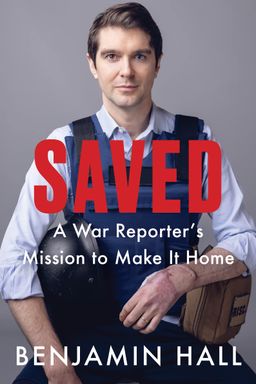
Saved cover

Saved

by Benjamin Hall

Saved is an exhilarating recount of Benjamin Hall''s journey from the brink of death in war-torn Ukraine to safety. It unveils the daring rescue mission, the resilience of the human spirit, and the global effort to bring a war reporter back home.

Saved: The Human Spirit Amid War and Survival

What happens when everything you know—your body, career, and sense of safety—is shattered in an instant? In Saved, war correspondent Benjamin Hall answers this question through an unflinching account of the day he was gravely injured while covering Russia’s 2022 invasion of Ukraine. More than a story of survival, this book explores how meaning, love, and resilience rise from devastation. Hall’s memoir blends vivid war reporting with profound introspection, inviting you to rethink what truly matters when life narrows to its most elemental truths.

The Journalist and His Inheritance

Before Ukraine, Hall had spent nearly two decades documenting conflict across Iraq, Syria, Somalia, and Afghanistan. His father’s survival of World War II in Manila profoundly shaped his worldview—imbuing him with reverence for courage and sacrifice. Yet while his father owed his life to U.S. soldiers who rescued him, Hall’s fate would later hinge on similar acts of valor in Ukraine. This inherited respect for bravery and service set the moral compass that guided Hall’s work, whether dodging sniper fire in Misrata or crossing rivers into war-torn Syria. But the book also reveals the vulnerability behind that professional stoicism: a growing unease about what this life of risk-taking meant for his family.

The Catalyst: Ukraine and Catastrophe

When Russia launched its full-scale invasion in February 2022, Hall was Fox News’s State Department correspondent in Washington, finally expecting a calmer career. Yet conscience and curiosity pulled him back to the frontlines. He flew to Ukraine to tell stories of ordinary citizens caught in extraordinary crises—only to become one himself. On March 14, while filming near Kyiv, his crew’s vehicle was struck by Russian artillery fire. Cameraman Pierre Zakrzewski and fixer Oleksandra “Sasha” Kuvshynova were killed. Hall, terribly injured, found himself hovering between life and death. Then, in the blackness, he heard the voice of his young daughter: “Daddy, you’ve got to get out of the car.” That imagined plea became his miracle, jolting him into motion and saving his life.

Rescue and Resurrection

The ensuing rescue, orchestrated by journalists, soldiers, and humanitarians, reads like a modern-day epic. Jen Griffin at Fox News, defense officials in the Pentagon, and heroic volunteers—including a mysterious operative codenamed “Seaspray”—worked across borders to extract Hall from Kyiv. The operation involved Ukraine’s special forces, the Polish prime minister’s diplomacy train, and a U.S. Black Hawk helicopter. Each chapter reveals how compassion, courage, and coordination can thrive amid chaos. What might have seemed “impossible” became an intricate symphony of selflessness—a testament to humanity at its best. As Hall reflects, these strangers became “the miracles here.”

Reconstruction of Body and Soul

Hall’s recovery spanned multiple hospitals—Kyiv, Germany’s Landstuhl Medical Center, and the U.S. Army’s Brooke Army Medical Center in Texas. There, military surgeons and therapists rebuilt his shattered body with prosthetics and skin grafts. Yet the greater struggle was rebuilding purpose. He wrestled with survivor’s guilt over Pierre and Sasha’s deaths, his new identity as an amputee, and the moral question of what war reporting had cost his family. Slowly, through excruciating therapy, humor, and prayer, he learned to “run toward life” instead of conflict. His wife Alicia and their three daughters became his compass, grounding him when pain and hallucinations blurred reality.

The Meaning of Being Saved

Ultimately, Saved is not just about physical survival but spiritual awakening. Hall learns that wonder and goodness persist—even on the darkest battlefield. His narrative echoes Viktor Frankl’s belief in finding meaning amid suffering and parallels Ernest Hemingway’s reflection that courage is grace under pressure. Hall’s version is distinctly modern: faith meets technology, war meets family. He ends where his father’s story began—with an American rescue and a rediscovered faith in kindness. “Everything I need or ever will need,” he writes, “is here.” In sharing his ordeal, Hall reminds you that resilience is not superhuman—it’s the decision to keep moving, one painful, extraordinary step at a time.


A Legacy of War and Storytelling

Benjamin Hall’s life was shaped by his family’s history long before he ever set foot in a war zone. His father survived the terrifying Battle of Manila as a twelve-year-old, rescuing his younger siblings as bombs leveled their city. Freed by American soldiers, he grew up with profound gratitude toward the United States and its military. That story—and the moral code it instilled—became the lens through which Hall understood duty, danger, and sacrifice. Yet instead of fighting wars, his mission was to witness and tell them.

Inherited Courage, Chosen Calling

Hall’s father’s influence manifested not through overt pressure but quiet example. Integrity, courage, and honor were family constants. When Hall first traveled to Iraq in 2007 as a wide-eyed twenty-something, he wasn’t following a thrill; he was fulfilling an inheritance. Like his father, he felt compelled to run toward humanity’s breaking points, where truth risked being buried beneath propaganda. What began as naive curiosity deepened into a vocation: to “give voice to the voiceless.”

Learning the Trade in Fire

Hall’s early experiences in Misrata, Libya (2011) and Syria (2012) forged his identity as a war correspondent. Alongside photographer Rick Findler, he learned that professionalism wasn’t about fearlessness—it was about respect for reality. In Misrata, he filmed a dying rebel, torn between horror and duty. Later, crouched with rebels under shellfire, he realized how quickly civilization’s thin veneer disintegrates. These moments blurred the line between observer and participant, birthing both ethical questions and personal addiction to the intensity of conflict.

The Mother’s Wanderlust

From his mother, Jenny, Hall inherited a different form of courage—the daring to explore. She raised Benjamin on a steady diet of travel and curiosity, whisking him through Africa, South America, and the Amazon. She showed him that wonder and human connection exist in every culture. Her death in 2017 didn’t end that lesson; it deepened it. Her joyful curiosity became the counterbalance to his father’s stoicism—a blend that would sustain him in Ukraine, balancing adventure with empathy.

Together, his parents’ influences forged the paradox at the heart of Saved: a man drawn to danger out of duty and wonder, ultimately discovering that the truest bravery is not in chasing war but in cherishing life after it.


Risk, Addiction, and the War Correspondent’s Paradox

Hall confesses that to cover war well, you must develop a complicated relationship with danger—you come to need it. “The paradox of covering war,” he writes, “is that, while the job exposes you to unimaginable horror, you also have to love doing it.” Like many correspondents before him (from Martha Gellhorn to Sebastian Junger), he confronts the uncomfortable truth that adrenaline and altruism often coexist. The profession demands empathy—but surviving it requires detachment.

The Seduction of the Frontline

From the moment his plane descended into Iraq’s war-torn skies in 2007, Hall was hooked. The danger, the stakes, and the immediacy of storytelling merged into a single intoxicating purpose. Standing amid collapsing buildings in Libya’s 2011 revolution, running across sniper-lined streets in Syria, or documenting ISIS atrocities, he often found clarity in chaos. Yet beneath the professionalism lay an unconscious addiction to risk: danger made him feel alive. That thrill, he admits, can blind reporters to their mortality and to the emotional costs their families bear.

Whatever It Takes: The Voodoo Pact

A vivid emblem of this obsession comes from Haiti, where Hall participated in a voodoo ceremony during which he vowed to reach the top of his profession “whatever it takes.” The eerie pact is half-serious, half-metaphor—an acknowledgment that ambition often exacts a spiritual price. Years later, he would reflect on whether that whispered promise demanded something in return. The superstition gives symbolic shape to the guilt many war reporters carry for surviving.

When Work Becomes Identity

War zones flattened Hall’s sense of self into one purpose: witness. “My job didn’t allow for much wiggle room,” he writes. “Show the world the brutal reality of war.” That moral clarity fueled him through years with Fox News, from Mogadishu to Mosul. But when he married Alicia and became a father, the paradox turned inward—how could someone devoted to human stories keep risking leaving his own family without a father? The tragedy in Ukraine would force that reckoning in the most brutal way imaginable.


Love, Family, and Finding a New Compass

Hall’s marriage to Alicia reshaped his moral geography. Before her, danger was a career hazard; after her, it became betrayal of a pact. Alicia, a successful entrepreneur and mother of three, never forbade his travels but hoped he’d “find balance.” Hall believed he could—until Ukraine. The book’s emotional center rests on this tension between vocation and devotion. Through Alicia’s calm strength and their children’s innocence, Hall discovers a deeper reason to survive: love itself becomes his new frontline.

Promises and Pullbacks

After their first child, Honor, was born, Hall promised to ease off from frontline work, even writing a book on ISIS from afar. But the calling never left. Each assignment—Mosul, Kabul, Syria—tempted him with purpose. He downplayed risks in calls home, assuring Alicia he was “nowhere near the front.” These small lies, born of protection, illustrate the impossible dual life of correspondents: half hero, half husband. The balance shattered when he accepted Fox’s assignment to Lviv in 2022, a city he believed was safe. There is no such thing as a distant war, he would learn.

Alicia’s Mirror

Alicia’s presence is the book’s quiet heartbeat. While Hall lay wounded in Kyiv, she orchestrated calls with executives, soothed their daughters, and faced each day with what she called “a strange sense of calm.” Her unflinching composure mirrors the stoicism of military spouses. Like Lee Woodruff caring for her husband CBS anchor Bob Woodruff after his injury in Iraq, Alicia embodies what modern heroism looks like at home: steadfast love as an act of war against despair.

Through her, Hall learns that survival isn’t measured in limbs or scars but in the bonds that hold when everything else falls apart.


The Day Everything Went Black

March 14, 2022, is the pivot on which Hall’s life turns. He, Pierre Zakrzewski, and Sasha Kuvshynova drove toward the destroyed village of Horenka to film Ukrainian defensive trenches. Expecting only ruins, they instead met calamity. The first explosion tore up the forest twenty feet ahead; a second hit beside the car. Then came silence and darkness. “Not just dark—black,” he recalls. “Deep, infinite blackness.” In that void, his daughter’s imagined voice pierced through: “Daddy, you’ve got to get out of the car.” Her words became a bridge between death and life.

Survival as Instinct and Miracle

Crawling out of the flaming wreck, Hall found his right leg gone and his body burning. Beside him, Pierre was alive but gravely injured. He recalls rolling to extinguish the fire, dragging himself through dirt, and—astonishingly—reaching for his phone to document the scene, still wired to report. Moments later, a Ukrainian special forces agent, codenamed Song, spotted him from a passing van. “We saved who we could save,” Song later said. The account reveals the razor-thin line between instinct and divine intervention—one act of noticing, one choice, one miracle.

The Human Cost

Pierre and Sasha did not survive. Their deaths weigh on every page that follows. Hall’s reverence for them turns the book from memoir into memorial. He reminds readers that journalists, often unseen, risk everything to illuminate truth. “They fought to make people’s lives better,” he writes. “Every day Pierre made me a better man.” By placing their sacrifice beside his survival, Hall reframes heroism—not as endurance alone but as witness to others’ light when your own fades.


The Chain of Angels: A Rescue Across Nations

Few rescues in modern journalism rival the complexity of Hall’s extraction from Kyiv. It was something between a military operation and a miracle. The chain began with Fox News’s Jennifer Griffin, who mobilized connections at the Pentagon, including spokesperson John Kirby and Defense Secretary Lloyd Austin. Griffin enlisted Sarah Verardo of the veterans’ group Save Our Allies, whose network of operatives and medics sprung into action. Their mission: get Hall out of Kyiv before Russian forces closed the city.

A Web of Heroes

Codenamed Seaspray, a seasoned special operations veteran coordinated the extraction with impossible finesse. Assisted by surgeon Dr. Rich Jadick and clandestine allies nicknamed Bo and Dave, he drove decrepit ambulances through war zones, evaded shoot-on-sight curfews, and negotiated passage via the Polish Prime Minister’s diplomatic train—the only safe exit. Each participant defied orders, bureaucracy, and fear. “If you don’t leave right now,” a contact warned, “you’re not going to make it.” But they went anyway.

Across the Bridge to Poland

Hall’s odyssey spanned an ambulance ride, a midnight hospital escape, the hush of the train where he lay beside world leaders, and a Black Hawk helicopter that finally carried him to safety. Reading these chapters feels cinematic, yet it’s grounded in real sacrifice. Seaspray refused armor to appear nonthreatening at checkpoints; Jadick risked his license performing field surgery; Polish and Ukrainian officials bent protocol to spirit one man out. The rescue illustrates what Hall later calls “the orchestration of goodness”—a symphony of courage proving that hope requires coordination as much as faith.


Rebuilding the Body, Rediscovering the Self

At Germany’s Landstuhl hospital and then the U.S. Army’s Brooke Army Medical Center (BAMC) in Texas, Hall underwent over twenty surgeries. He lost one leg, much of the other foot, and the use of one eye. But his memoir focuses less on loss than on reconstruction—physical and spiritual. With humor and humility, he describes learning to walk on prosthetics, enduring hallucinations induced by painkillers, and finding unlikely strength in ordinary acts: taking a shower, pressing a button, or laughing with his caregivers.

From Patient to Warrior

Hall dubs his care team “the miracles here.” Military doctors like Dr. Joe Alderete and Dr. Alicia Williams treated him with precision honed in Iraq and Afghanistan. Physical therapist Kelly Brown became his daily coach, coaxing him from bed to mat to walker. When Hall first stood upright on prosthetics—“I’m walking!” he shouted—his rehab ward erupted in applause. The community at BAMC, from leech-wielding surgeons to therapy dog Huckleberry, embodied the resilience they taught.

Faith Through Pain

Recovery plunged Hall into psychological darkness—hallucinations of entrapment, survivor’s guilt, and insomnia. Yet even in delirium, he found revelation. He saw his life “as if pieced back together by light.” Assisted by friends, Fox News colleagues, and even a phone call from President George W. Bush, he learned that vulnerability can coexist with strength. “I cried more out of happiness than despair,” he admits, rediscovering prayer and gratitude as the anchors of endurance.


A New Definition of Courage

By the time Hall returned to London—walking on prosthetics, held up by love—he no longer defined courage as running into fire. True valor, he realized, is accepting help, expressing pain, and celebrating survival. His homecoming scene captures this transformation: knocking on the family’s window as he once did, hearing his daughters squeal with joy, and handing his daughter Yellow Jumpsuit, the tiny hedgehog toy he had carried through every ordeal. “Then she hugged me,” he writes, “and said, ‘I love you, Daddy.’”

From Frontlines to Family Lines

Now, breakfast, bedtime stories, and neighborhood walks replace firefights. The adrenaline of war yields to the rhythms of ordinary life—what Hall calls “the truest peace.” He still dreams of running from enemies, but now interprets the chase as life’s persistence: the will to move, to keep going. Each stumble on his prosthetic leg is a metaphorical continuation of reporting—still bearing witness, but through gratitude instead of urgency.

Lessons for the Rest of Us

Hall’s closing reflection invites readers to reconsider heroism. It isn’t confined to battlefields—it lives in caregivers, spouses, and strangers who refuse indifference. “Everything I need or ever will need,” he concludes, “is here.” His survival becomes a lens for ours: a reminder that being human is a collective act. Facing loss—be it physical, emotional, or moral—you can choose, as he did, to let love outweigh fear and to find meaning not after tragedy but within it.

Dig Deeper

Get personalized prompts to apply these lessons to your life and deepen your understanding.

Go Deeper

Get the Full Experience

Download Insight Books for AI-powered reflections, quizzes, and more.