
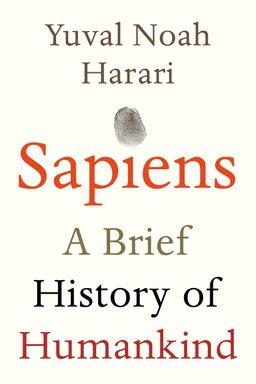
Sapiens cover

Sapiens

by Yuval Noah Harari

Sapiens explores the remarkable journey of humanity from primitive beginnings to global dominance. Uncover how cognitive, agricultural, and scientific revolutions transformed Homo sapiens, enabling us to build complex societies and become the planet''s most influential species.

Sapiens: How Fiction Made Humans Powerful

How can one biological species dominate the planet, reshape ecosystems, and create gods, empires, money, and machines? In Sapiens: A Brief History of Humankind, Yuval Noah Harari argues that humanity’s defining feature is not strength or intelligence, but imagination — the ability to believe and cooperate around shared fictions. From myth to money, religion to rights, every large-scale human enterprise rests on intersubjective realities that exist only in collective minds.

Harari’s story follows five major revolutions: the Cognitive Revolution, the Agricultural Revolution, the unification of humankind through imagined orders and universal religions, the Scientific and Industrial Revolutions, and the emerging Biotechnological Revolution. Across these transformations, biology remains largely stable — while culture, belief, and technology continually reinvent what it means to be human.

From animals to storytellers

About 70,000 years ago, Homo sapiens began using language not merely to describe reality but to invent it. Stories about tribal spirits or shared ancestors allowed strangers to cooperate far beyond the limits of face-to-face trust. This Cognitive Revolution created “imagined orders” — systems held together by mutual belief. If chimpanzees can coordinate in groups of fifty, myths let Sapiens build groups of thousands, ultimately leading to religion, kingdoms, and civilizations.

(Parenthetical note: Anthropologists like Robin Dunbar and Richard Dawkins support similar arguments — social cohesion scales only with symbolic or narrative scaffolding.)

The trap of agriculture

Twelve thousand years ago, the Agricultural Revolution transformed landscape and society — but not necessarily for the better. Farming increased food supply but reduced individual well-being. Wheat, rice, and maize “domesticated” humans by demanding constant labor and settling people into disease-prone villages. Harari calls this a “luxury trap”: every comfort demanded new toil. As populations grew, there was no returning to foraging. Evolutionarily, the species “succeeded,” but most farmers lived shorter, harder lives.

Imagined orders and social scale

Fiction scales cooperation beyond blood ties. Institutions like law, money, and the corporation are shared stories that coordinate billions. You cannot touch “Peugeot SA” or “the dollar,” but they move armies and economies. Money is the most universal fiction — pure trust in deferred exchange — while legal fictions like limited liability companies incentivize risk-taking and innovation. The power of these collective myths is double-edged: they enable mass cooperation yet often obscure inequality or ethical cost.

Religion, ideology, and unification

Religion extends the same principle through moral authority. Early animist and polytheistic systems suited small communities; monotheism introduced universal moral claims that could unify empires — but also fuel persecution. From Buddhism’s law-like dharma to humanism’s sanctity of human experience, Harari expands “religion” to include ideologies. Liberalism, socialism, and nationalism function like modern faiths, complete with rituals, martyrs, and doctrines. All answer an ancient human need: purpose through shared meaning.

Science, empires, and capitalism

Modern science’s power comes not from certainty but from ignorance — the admission that we do not know. The Scientific Revolution replaced revelation with measurement, leading to technologies that transformed war, medicine, and economy. Science married empire (as in Captain Cook’s voyages) and capitalism (as in the rise of venture-funded exploration). Trust in progress created credit systems: banks and investors funded futures that didn’t yet exist, fueling explosive growth. Yet this faith in endless growth turned expansion into a moral duty — capitalism as religion.

The biotechnological horizon

Now, humanity faces its most profound revolution: the power to redesign life itself. Genetic engineering, cyborg integration, and artificial intelligence mark a shift from natural selection to intelligent design. Harari calls this the “Gilgamesh Project” — the pursuit of immortality and perfection. But the question is no longer scientific feasibility; it’s moral direction. When we can engineer intelligence beyond ourselves, what do we want to become?

Harari’s central insight echoes through all epochs: humans rule the world because they live by imagination and organize through shared myth. The challenge now is whether imagination will serve wisdom — or destroy the fragile ecological and social fabric that myth once built.


The Cognitive Revolution

The Cognitive Revolution around 70,000 years ago transformed Homo sapiens from a clever ape into a planet-shaping storyteller. The new mental ability was not speech itself — other animals vocalize — but the power to invent and share fiction: concepts, myths, and entities that do not physically exist yet motivate real cooperation.

Fiction as a social technology

Earlier humans could warn “A lion’s near the river!” but not “The lion is our tribe’s guardian spirit.” That imaginative leap created shared beliefs and moral structures. Fiction became a tool for coordination: myths bind strangers, enabling groups to outscale the 150-person trust limit predicted by Robin Dunbar’s social-brain hypothesis. Shared stories allowed empires — not genes — to define cooperation.

Myths, art, and symbolic thinking

Archaeological sites like the Stadel lion-man (a human-animal hybrid carved 32,000 years ago) or the Chauvet cave murals show early humans imagining beyond direct perception. Fiction became ritual, religion, and art — a toolkit for meaning-making and identity. These fictions forged “imagined communities,” the glue that binds individuals into cultures capable of long-distance trade, migration, and conquest.

The enduring consequence

Every modern institution, from corporations to human rights, relies on the same capacity. The dollar, the nation, and the UN Charter are myths backed by collective trust. The Cognitive Revolution began history’s great inversion: biology stopped dictating destiny; imagination began doing so.


Agricultural Transformation

Around 12,000 years ago, the Agricultural Revolution began as humanity’s attempt to secure abundance — yet it created the first large-scale inequalities and ecological domination. Harari calls it “history’s biggest fraud.” Wheat and barley didn’t liberate humans; they enslaved them through labor, hierarchy, and dependence.

The luxury trap

Farming promised comfort but produced confinement. Each innovation — deeper plowing, bigger harvests — created more work and population growth that erased benefits. More children meant more fields; more fields demanded permanent settlement. Individual quality of life declined even as humanity multiplied. Health worsened, leisure vanished, and infectious disease flourished.

Domesticated lives

Agriculture reshaped both humans and animals. Goats, sheep, and chickens reproduced in unprecedented numbers but at the cost of immense suffering. Harari stresses an ethical paradox: evolutionary success (DNA replication) says nothing about happiness or freedom. (Note: This argument parallels modern concerns about industrial farming and sustainability.)

Farming laid the groundwork for writing, property, and government—but also for inequality, patriarchy, and environmental degradation. The “wheat bargain” secured survival but sacrificed autonomy, a pattern repeated throughout human history.


Fictions that Govern

Human cooperation scales through shared “imagined orders” — networks of belief that exist only in collective minds yet shape all institutions. Religion, nationalism, money, and corporations operate as powerful intersubjective realities rather than physical facts.

Money and trust

Money is the most successful fiction ever invented. It allows universal exchange because everyone trusts that others will accept it. From Sumerian barley tokens to digital balances, money demonstrates that belief can be more real than metal. You exchange labor for numbers precisely because others do the same — an infinite loop of trust.

Law and corporations

The corporation is another legal fiction. When a lawyer registered “Peugeot SA,” no tangible entity was created — yet law granted it ownership, agency, and longevity. Limited liability separated investors from ruin, unleashing waves of entrepreneurship. Such imagined entities organize factories, armies, and global trade with more durability than individual lives.

The double edge

Shared fictions enable human cooperation at unmatched scale, but they also mask exploitation and lock societies into hierarchies that seem “natural.” Mobilizing belief can fund cathedrals or conquests, liberate citizens or justify slavery. The power of myth is morally neutral; its outcomes depend on how you wield collective imagination.


Faith, Empires, and Ideologies

Religion, empire, and ideology are collaborative responses to humanity’s craving for meaning and order. They extend early myths into universal systems of moral law, binding billions under shared symbols and ethical visions.

From animism to monotheism

Animists saw spirits in every tree and river; polytheists organized those spirits into hierarchies of gods. Monotheism radicalized the idea: one truth, one moral law, one God for all. Universal religions could mobilize vast empires but also spark absolute intolerance. Missionary zeal created both the spread of compassion and the justification for crusades.

Natural-law religions

Around the first millennium BCE, a new type of faith appeared: ones that sought law, not deity. Buddhism, Jainism, Daoism, and Stoicism described impersonal truths of suffering or balance. Buddha’s insight — that craving causes suffering — framed salvation as a psychological technique, not divine favor. These “natural-law religions” treated ethics as scientific inquiry into the causes of happiness.

Humanism’s secular faiths

Modernity transferred sacred value from gods to humans. Liberal humanism sanctified the individual, socialism sanctified equality, and evolutionary humanism sanctified species improvement. Whether expressed in rights declarations or political movements, these ideologies behave like religions — complete with rituals, scriptures, and heresies. Recognizing their quasi-religious structure helps explain their endurance and fanaticism.

Faith and ideology together illustrate Harari’s principle: power comes from belief. Humans do not fight and die for material survival alone — they fight for stories they consider sacred.


Science, Empire, and Capitalism

The Scientific Revolution offered a new foundation for belief: the recognition of ignorance. Once humans admitted “we don’t know,” they could measure, test, and innovate. Science produced unprecedented explanatory and physical power — but always in alliance with economic and political systems that funded it.

The method and its paradox

Modern science operates through three commitments: (1) everything is questionable; (2) knowledge must be tested by observation and mathematics; (3) theories gain legitimacy by producing new powers. This pragmatism generated Newton’s physics, vaccines, and the atomic bomb alike — knowledge tied to use, not virtue.

Empire as sponsor

Exploration fused science with conquest. Captain Cook’s 18th‑century voyages combined astronomical research with colonial mapping. Empirical curiosity justified domination: collecting plants became claiming territories. Empire transformed science into both data collection and ideology, teaching Europe to see the world as laboratory and resource.

Capitalism and growth

Capitalism supplied science’s financial engine. Credit turned optimism into currency — the belief that future productivity justifies loans today. Joint‑stock companies like the Dutch East India Company pioneered risk‑sharing, while speculative bubbles revealed trust’s fragility. Over time, perpetual economic growth became a quasi-religious creed: the moral imperative to expand production and consumption forever.

The alliance among science, empire, and capital produced modern prosperity — and new forms of inequality, environmental strain, and ethical blindness. Faith in progress remains our most potent myth.


Industrial and Consumer Revolutions

The Industrial Revolution transformed energy, work, and desire. By converting fossil fuels into mechanical motion, humans escaped solar limits and redefined productivity. This abundance demanded an accompanying cultural shift: consumption became a civic virtue.

Energy and transformation

Steam, coal, oil, and electricity liberated human labor. Factories multiplied output exponentially, and the harnessing of chemistry (e.g., Haber’s ammonia synthesis) ended famines. But animals and ecosystems paid steep costs: industrial agriculture turned sentient beings into commodities, while resource exploitation destabilized the planet’s climate.

The culture of consumption

Industrial capacity outpaced need. To sustain profit and employment, societies manufactured desire. Advertising, fashion and brand ethics (“buying as self-expression”) ensured constant demand. The consumerist ethos turned shopping into identity and reinforced capitalism’s growth loop: production feeds consumption, which justifies expansion.

Ambivalent progress

Industrial society produced comfort and longevity, yet also alienation and environmental peril. Meaning itself became a scarce resource. The same creativity that fuels prosperity must now confront its ecological cost — the moral debt of abundance.


The Biotechnological Future

Humanity’s next chapter dismantles the boundary between biology and technology. Harari describes genetic engineering, cyborg enhancement, and artificial intelligence as forces ending natural evolution and inaugurating a new era of intelligent design.

Engineering life

Modern gene editing (CRISPR) enables direct rewriting of genomes, producing disease‑resistant livestock and synthetic microbes that make fuels and medicines. Projects to reconstruct mammoths or Neanderthals blur the line between revival and creation. These acts of design mark a decisive break from Darwinian randomness to deliberate choice.

Cyborgs and digital minds

Prosthetic interfaces like Jesse Sullivan’s thought‑controlled limbs or DARPA’s insect cyborgs demonstrate an emerging merger of biology and electronics. The rise of brain‑computer integration suggests a horizon of collective intelligence — or supersession of human consciousness by inorganic minds. Artificial intelligence, unlike earlier fictions, may no longer depend on belief to act; it will simply operate.

Ethical and existential frontiers

When humans can redesign species — including themselves — familiar frameworks of politics and morality collapse. Who gets to upgrade? Who defines “better”? Harari calls this the ultimate question of the Gilgamesh Project: the quest to conquer death and redefine life. As science accelerates beyond ethics, wisdom becomes the scarcest resource. The story ends not with Homo sapiens’ triumph, but with uncertainty about what will replace us.

Dig Deeper

Get personalized prompts to apply these lessons to your life and deepen your understanding.

Go Deeper

Get the Full Experience

Download Insight Books for AI-powered reflections, quizzes, and more.