
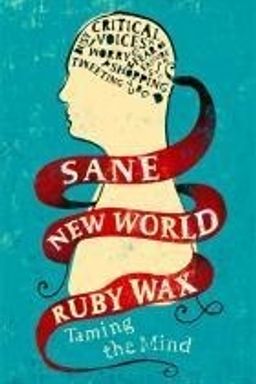
Sane New World cover

Sane New World

by Ruby Wax

In ''Sane New World,'' Ruby Wax offers a roadmap for handling the overwhelming stress of modern life. Through mindfulness, therapy, and an understanding of our brain''s wiring, learn how to replace anxiety and fear with healthier habits, leading to a more fulfilling life.

Understanding the Normal–Crazy Mind

Why do so many of us feel like we’re constantly running—but never quite arriving anywhere sane? In Sane New World, comedian and mental health advocate Ruby Wax uses her trademark humor to explore a question that touches nearly everyone: if we’re supposed to be the most evolved species on Earth, why are we all emotionally frazzled? Wax argues that modern life has simply outpaced our brains’ evolutionary wiring. We have technology, money, and opportunities that our ancestors never dreamed of—but our ancient alarm systems are still firing as if we’re being chased by sabre-toothed tigers.

Wax contends that our minds haven’t evolved to handle the barrage of twenty-first-century life—the endless notifications, social pressure, and busyness that keeps our thoughts ricocheting between guilt and ambition. We’re behaving like cavemen in designer jackets, running routines that worked for survival but destroy peace of mind. She sets out to write not just a memoir of her own depression, but a survival manual for the modern psyche—a user’s guide to the brain that blends neuroscience, psychology, and mindfulness-based therapy into something funny, practical, and compassionate.

Depression and the “Broken Brain”

Ruby opens with painful honesty. During a BBC interview about mental health, she was suffering so badly she couldn’t remove her sunglasses. She reflects on how depression carries a double cruelty: not only the crushing sadness but also shame. We minimize our suffering—“I’m not being carpet-bombed, so how dare I complain?”—and isolate ourselves. Depression feels like multiple abusive voices fighting in your head, as if “the devil had Tourette’s.” Wax compares the look of a depressed person to “the eyes of a dead shark”—a description that burns into your memory. But she also uses these stories to make you laugh, proving that comedy can coexist with tragedy.

She argues that depression isn’t moral weakness but a biological malfunction—no different from asthma or diabetes. To fight stigma, we must show mental illness for what it is: something that happens in the brain. (Like Oliver Sacks and Vilayanur Ramachandran, whom she references, she links psychiatric conditions to specific neuronal failures.) The “broken brain” metaphor becomes empowering rather than shameful once we understand how repair works.

Neuroscience as the New Enlightenment

Wax’s journey from showbiz to neuroscience is the heart of the book’s transformation. After burnout and hospitalization, she studied psychotherapy and then brain science at Oxford. She discovered that neuroscience, far from being cold or mechanical, offered deep hope. “We absolutely must have the instruction manual for this thing,” she says of the brain. She describes learning how neurons fire, how the limbic system floods us with emotional highs and lows, and how the prefrontal cortex—a relatively recent evolutionary innovation—can help us choose our reactions consciously. When activated properly, this inner CEO lets us self-regulate instead of being hijacked by stress or fear.

She uses humor to translate complicated science into vivid analogies: the brain as a “three-pound tofu engine” with three layers (lizard, squirrel, and monkey), each battling the other. Her neuroscience lessons reveal why we overreact, obsess, or spiral: because our reptilian alarm system never got the memo that the jungle was over. Stress floods us with adrenaline and cortisol, but unlike ancient man, we can’t “kill the traffic warden or eat a real estate agent,” so the chemicals stay stuck. She concludes that mindfulness may be the only way to regulate the chaos chemically and mentally.

Mindfulness as Mental Rewiring

The revelation in Wax’s life—and book—is that meditation and mindfulness can rewire the brain (a concept backed by her Oxford research in mindfulness-based cognitive therapy, or MBCT). We can change entrenched thought patterns through practice: neurons that fire together wire together. She introduces practical exercises like STOP (Stop, Think, Observe, Proceed) or RAIN (Recognize, Accept, Investigate, Non-identification) to help us detach from the storm of thoughts. The act of noticing, she argues, gives distance; it transforms emotions from oppressive “truths” into passing phenomena. When practiced, this self-regulation can dampen the amygdala’s alarm and turn up the rational prefrontal cortex.

Wax’s tone here is both irreverent and rigorously scientific. She explains studies linking mindfulness to reduced stress hormones, thicker brain tissue in critical regions, and improved immune response. Her practical message: you can learn to use your mind as a tool rather than be ruled by it. Comedians, CEOs, and students alike can soothe the “Wagnerian opera” of inner noise and experience calm. Though she mocks crystals and gurus, she ends up proving that self-awareness is the ultimate evolutionary upgrade.

The Larger Mission: From Stigma to Wisdom

Behind the jokes, Sane New World carries a moral message. Wax wants a revolution in how society treats mental illness and self-awareness. She envisions mental health “meeting places like AA,” where sufferers find “f--ed buddies” who truly understand, instead of being shunned. She compares the mental health movement to gay liberation: after people came out of shame, culture changed. Likewise, she urges us to “march to the White House screaming ‘WE ARE THE ONE IN FOUR AND PROUD.’” In other words, owning our madness is part of our humanity. Every person swings between “normal-mad” and “mad-mad”—this, paradoxically, is what “sane” really means.

From depression to dopamine addiction, from evolutionary biology to enlightenment, Wax’s journey redefines sanity not as the absence of madness but as coexistence with it. She ends on a note of optimism: because everything changes—cells, emotions, circumstances—suffering isn’t permanent. Mindfulness can help us ride that change consciously, converting survival into wisdom. When we master attention, compassion, and curiosity, we stop being hostages of the mind and become participants in life’s flow. This is not self-help fluff but hard-earned insight from someone who has lived both breakdown and breakthrough.


The Modern Madness of Busyness

Wax begins by diagnosing our collective mental illness: the cult of busyness. Modern humans, she says, worship activity like a deity. When asked how we are, we answer “busy” as proudly as if it were a title. But this endless motion keeps us from facing what’s inside. Our calendars become symptoms of avoidance—proof that our inner silence terrifies us. As she jokes, people congratulate her for being so busy she’s had two heart attacks, as if stress were an achievement.

From Survival Instinct to Schedule Obsession

Evolution gave us a drive to act—to hunt, flee, and secure safety. But now we use that instinct for email, shopping, and multitasking. Wax compares our modern frenzy to leaving too many windows open on a computer until it crashes. We may call it productivity, but psychologically it’s a digital version of panic. When nothing is urgent, we invent urgency: we overfill to-do lists and feel a rush only when crossing something off. This mania is our brain’s dopamine system misfiring—each completed task gives a chemical “hit,” prompting the next chase.

Consumerism as a False Cure

Wax skewers luxury obsessions as our modern therapy. Designer goods offer momentary respite but deepen emptiness. She jokes about Gucci tribes, refrigerator-sized bathrooms, and “Ugg boots that make you look like you’re walking in a beaver.” These absurdities reflect a deeper neurosis: we shop not for objects but for identity. Neuroscience supports this, she notes—dopamine spikes not at ownership but anticipation. The mall becomes our savannah; the hunt, not the prize, sustains desire. Yet the satisfaction evaporates quickly, leaving us restless for more.

The Cultural Taboo of Stillness

Why can’t we stop? Because stillness threatens our sense of purpose. As Wax writes, we stay in motion so we won’t see “that there might not be anything there.” To sit quietly feels like failure when busyness equals worth. She wittily contrasts Westerners manic with schedules to “the guy who fishes all day” and asks who is truly winning. The answer is uncomfortable: maybe the fisherman is saner than the mogul.

Wax uses her own example—compulsive list-making and anxiety over trivial tasks—to show how these behaviors connect to depression. The endless movement from one task to the next mirrors her “doing mode,” a state scientists identify as detrimental to happiness when unbalanced (echoing Jon Kabat-Zinn’s mindfulness teachings). To reclaim sanity, we must shift to a “being mode,” where experience matters more than outcome.

Reclaiming Space for Awareness

Awareness doesn’t mean quitting work or renunciation. Wax calls instead for intentional pauses—five-second exercises to “stop and notice.” It’s in those moments that life becomes vivid again. Like mindfulness teachers from Thích Nhất Hạnh to Daniel Siegel, she insists that attention gives value to existence. Each time you pause before reacting, you reclaim authorship of your mind from automatic habits. Wax’s humor makes this discipline feel achievable, not esoteric: you can start just by noticing your breath while doing dishes.

The takeaway is stark: we’re destroying our inner peace by racing against ourselves. True sanity begins not in finishing the to-do list but in noticing the compulsion to make it. Once you spot the cycle—wanting, achieving, craving again—you have the first glimmer of freedom. Wax’s comedic portrayal of shopping madness and work addiction becomes a mirror: funny but painful because it’s true.


The Brain Beneath the Madness

To understand why humans are chronically overstressed, Wax invites you to peek “under the hood.” Her humor never hides the science. The brain, she writes, is a three-layered masterpiece of evolution—a “lizard-squirrel-monkey” contraption. Its oldest part, the reptilian brainstem, controls basic survival urges: fight, flight, food, and sex. The limbic system adds emotions and bonding. Finally, the prefrontal cortex handles self-awareness and morality. The trouble? All three are still competing, turning our thoughts into internal warfare.

Outdated Alarm Systems

Our reptilian brain still thinks we’re on the savannah. It floods us with cortisol and adrenaline whenever we perceive threat—whether real or imagined. In ancient times, fear was useful: it helped you fight or run. In modern life, the threats are emails, mortgages, or rejection. Because we can’t physically act on these dangers, adrenaline accumulates, leading to chronic anxiety. Modern humans live in perpetual “red alert.” Wax compares it to “a car siren that drives you nuts” because we can’t switch it off.

Neurochemistry of Desire

Wax shines when explaining how our brain chemistry makes us perpetually dissatisfied. Dopamine, she says, is not the molecule of pleasure—it’s the molecule of wanting. We chase rewards (from shoes to praise), not because they make us happy but because the hunt triggers dopamine spikes. This is why addictions form: the reward fades, but the craving persists. She turns this insight into comedy gold, describing herself nearly jumping into traffic for a lamp that wasn’t even right. These obsessions reflect biochemical loops, not moral flaws.

Stress and Its Physical Toll

Stress hormones like cortisol damage memory, immunity, and even sexuality. As Wax notes, stress literally “burns out neurons in the hippocampus.” She gives vivid examples: studying too hard for exams then going blank, losing libido during crisis, or catching every virus after emotional strain. Science confirms this: chronic stress suppresses serotonin production, leading to depression. By mixing anecdotes with biology, she makes neuroscience feel human—an owner’s manual for your own suffering.

Memory and Perception: The Brain’s Trickery

Wax uses quirky case studies—Cotard’s syndrome (where someone believes they’re dead), Capgras’s delusion (believing loved ones are impostors), and prosopagnosia (face blindness)—to prove that consciousness is biological, not mystical. If a lesion can make you think your mother’s a clone, then depression is also a brain malfunction, not weakness. She concludes our reality itself is simulated: “We live in a virtual reality. You’re being run by the guy behind the curtain.” This realization, paradoxically, brings empathy: if we’re all illusions run by similar neurons, stigma becomes absurd.

By decoding the brain, Wax offers liberation rather than reduction. Knowing that emotions are biochemical helps you stop blaming yourself. When you understand the machinery of misery, you can learn to rewire it—which leads to her next domain: mindfulness as mental engineering.


Mindfulness: Taming the Wild Mind

Wax admits she was a skeptic. Meditation sounded too soft, too “Buddha-with-a-belly.” But at Oxford she discovered mindfulness as science, not mysticism. The practice trains attention—the most underrated human skill. You intentionally pay attention to the present moment without judgment. In doing so, you rebuild your brain’s circuits for calm, focus, and compassion. It is, she says, “a mental boot camp.”

The Two Modes of Mind

Wax describes two gears: the doing mode and the being mode. The doing mode is the brain’s problem-solving system—great for tasks but disastrous for emotions. When applied to sadness or insecurity, it spirals into rumination: “Why am I sad? I shouldn’t be sad!” The brain attacks itself trying to fix feelings. Mindfulness teaches you to shift into being mode—the state of directly experiencing without commentary. Watching a sunset, tasting chocolate, or feeling breath fall and rise—all are gateways to being. This mode interrupts the loop of worry and judgment.

Tools and Acronyms

Wax translates mindfulness into practical techniques. STOP means pause, notice where your mind is, pick an option (like focusing on breath or sound), then proceed. RAIN helps process emotion: Recognize, Accept, Investigate sensations, and Non-identify with the feeling. These acronyms aren’t spiritual slogans—they’re mental software updates. She backs them with neuroscience: recognizing an emotion activates the prefrontal cortex, which calms the amygdala’s panic signal.

Anchors and Attention

To handle racing thoughts, Wax recommends “anchors”—simple sensory experiences like feeling your feet, smelling a candle, or noticing sound. These ground you in the present. She used foot awareness to prevent stage fright during performances. When she focused on sensation, her panic drained, creativity flowed, and audiences responded calmly. Anchors are the bridge from chaos to clarity.

Compassion as Self-Regulation

Mindfulness is not just attention but kindness. You learn to treat yourself the way you’d comfort a friend instead of attacking your own suffering. Compassion releases oxytocin and suppresses shame—the true healing chemistry. Wax quotes the poet Rumi: “Be grateful for whoever comes, because each has been sent as a guide from beyond.” The message is that even negative emotions are visitors, not enemies.

Her case studies show that mindfulness transforms not only mental health but physiology. It strengthens regions for awareness and weakens circuits of anxiety. Harvard, UCLA, and Stanford studies confirm increased gray matter and reduced stress hormones after training. The lesson is simple: you can’t stop inner storms, but you can learn to sail through them. Wax humorously reframes mindfulness from asceticism to practicality—it’s how you “muscle up” emotionally to survive the twenty-first century.


Rewriting Habits and Thoughts

Wax integrates mindfulness with cognitive behavioral therapy (CBT), showing how both reshape mental patterns. CBT helps identify distortions—like catastrophizing, overgeneralization, and labeling yourself. Mindfulness adds the missing ingredient: awareness without rumination. As she jokes, traditional CBT can sometimes obsessively dissect thoughts, which risks reinforcing them. Mindfulness adds the pause button.

The CBT Spreadsheet

In one hilarious example, Wax analyzes her panic about being late for a nail appointment—the absurdity of risking traffic accidents for blue polish. Yet this self-awareness turns comedy into therapy: she rates her moods (“Panic 95”), lists physical symptoms (sweating, pounding heart), then reframes thoughts (“Blue nails are not a survival issue”). This exercise converts chaos into clarity. CBT trains perspective; mindfulness ensures you notice the mindset creating the chaos.

Red Cards and Emotional Intelligence

Wax applauds schools teaching children self-regulation using “traffic signals”—red for stress, yellow for moderation, green for calm. Imagine if boardrooms had such cards, she says; wars could be prevented by leaders admitting “I’m emotionally insane right now.” Recognizing emotional states prevents projection onto others. The red card metaphor captures emotional intelligence—knowing when your limbic system hijacks your reason and when to wait until the prefrontal cortex comes back online.

Neuroplasticity Meets Humor

Wax’s ultimate gift is reframing seriousness with levity. Change, she insists, is possible well into old age. She recounts experiments where rat pups licked by nurturing mothers had calmer genes—proof that affection rewires the brain. Similarly, humans can “lick” their thoughts into new shapes by practicing awareness and compassion. Her humor—imagining herself lectured by Freud about cigars and sausage casings—makes neuroplasticity memorable and human.

The point is revolutionary: our minds are editable. Genes are opening shots, not prison sentences. Self-awareness, repetition, and kindness literally remodel neurons. That’s not psychology—it’s biology with a sense of humor.


Wisdom, Curiosity, and Compassion

In Wax’s later chapters, joy comes not from success but from curiosity and kindness—mental muscles we must train. She argues that modern education killed curiosity by reducing learning to grades. True sanity is lifelong wonder, not competition. Happiness shrinks when the mind stops noticing novelty; neurons grow when you rediscover awe.

Becoming Compassionate Instead of Competitive

Wax contrasts the “survival of the fittest” mindset with what she calls “survival of the wisest.” Compassion doesn’t weaken you—it rewires your chemistry. When you act kindly, oxytocin rises, cortisol falls, and creativity flows. She reminds us that kindness spreads; it’s contagious through neural “Wi-Fi.” Even animals mirror calm through empathy circuits. In mindfulness training, compassion is not moral virtue but emotional intelligence—the way to regulate stress and connect authentically.

Curiosity as the Glue of Humanity

Curiosity, too, creates connection. Asking questions rather than performing expertise bridges alienation. Wax jokes that brilliance without curiosity equals idiocy. Listening mindfully transforms relationships and workplaces. In business, curiosity beats MBA jargon—it builds trust. By practicing attentive conversation, you replace ego battles with empathy. Science even confirms: novel experiences trigger neurogenesis—the birth of new neural pathways. Each moment of genuine interest quite literally enlarges your brain.

Letting Go Into Uncertainty

The book closes on impermanence: everything changes constantly, from quantum particles to thoughts. Our suffering arises from resisting that truth. If you learn to let go—of people, possessions, certainty—you gain peace. Life is not stable; the gift is noticing while we have it. Wax calls mindfulness “training for the unknown”—the practice of smiling, even to your body at death, and saying “thanks for the ride.” It’s comic and cosmic at once.

Throughout Sane New World, Wax builds a bridge between laughter and neuroscience, proving that comedy can illuminate consciousness. Her closing insight is profound: when we calm our reactivity and expand our compassion, we evolve not into smarter mammals but wiser ones. That, she says, is the next phase of human evolution.

Dig Deeper

Get personalized prompts to apply these lessons to your life and deepen your understanding.

Go Deeper

Get the Full Experience

Download Insight Books for AI-powered reflections, quizzes, and more.