
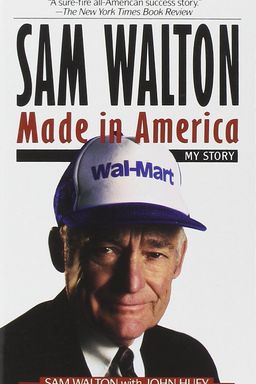
Sam Walton Made in America cover

Sam Walton Made in America

by Sam Walton with John Huey

Explore the remarkable journey of Sam Walton, the visionary founder of Walmart. Discover how his customer-first approach and innovative strategies transformed a humble variety store into a global retail empire. Gain insights into Walton''s leadership and the values that fueled Walmart''s success.

The Spirit of Enterprise and the Power of Partnership

How can a single person starting with one modest store transform retailing across an entire continent? In Sam Walton: Made in America, Wal-Mart’s founder Sam Walton argues that great enterprises are built not on grand capital, but on relentless curiosity, disciplined thrift, and an honest partnership with others. He contends that free enterprise flourishes when people channel ambition through service—when success for one fuels opportunity for many. His story is not simply about money or expansion, but about creating a culture where workers, customers, and owners all share the same mission: giving people value and respect.

Walton’s autobiography—written with journalist John Huey as he battled cancer—is as much a lesson in values as it is in business strategy. The book traces his journey from a Depression-era childhood in Missouri and Oklahoma, through retail apprenticeships at J.C. Penney and Ben Franklin, to the creation of Wal-Mart and its dizzying rise from one store in Arkansas to the world’s largest retailer. He encourages you to see business not as an empire of consumption but as a community of creativity, thrift, and shared stakes. His philosophy blends old-fashioned virtues with an insurgent mindset, showing how staying small in spirit—even as you grow big in scale—can protect both humility and innovation.

Growing Up with the Value of a Dollar

Walton’s formative years under the pressures of the Great Depression taught him what money meant. His father, honest but eternally haggling, traded farms, hogs, and wristwatches to keep food on the table; his mother built side businesses selling milk and ice cream. From this upbringing came his lifelong belief that every penny matters—not out of greed, but because waste meant disrespect for effort. ‘Every time Wal-Mart spends one dollar foolishly,’ he wrote, ‘it comes right out of our customers’ pockets.’ He connected thrift to empathy: care for the customer is an extension of caring for the one who earns a dollar slowly.

From Team Sports to Teamwork

In high school sports, Walton found the joy of leadership and persistence. He never lost a football game—an improbable but true legacy that fostered his future credo of ‘expect to win.’ More significant was his insight that winning depended less on talent than motivation. This idea later shaped his corporate style. He treated retail as a sport: practice every day, scout competitors, study plays from others, and keep the energy high. In You he sees a fellow competitor—the kind who gets up early, goes to work willingly, and plays both offense and defense by serving every customer.

The Core Argument: People First, Always

Walton’s central claim is that retailing success—and perhaps all organizational success—comes from creating partnerships where people believe in the mission as much as the founder does. He flipped the typical hierarchy: managers serve associates, who serve customers, who then reward everyone by returning again. This ‘servant leadership,’ later echoed by Robert Greenleaf and popularized in corporate culture, was Walton’s natural instinct. He built profit-sharing programs, encouraged open-door communication, and insisted executives visit stores weekly. If you take care of your associates, he said, they’ll take care of your customers—and the customers will take care of your profits.

Why This Story Matters

Beyond business strategy, Walton’s life illuminates the soul of entrepreneurship. He confronted setbacks—the eviction from his first successful store in Newport, the near collapse from debt, internal management conflicts—and turned them into lessons in resilience. His faith in change and experimentation mirrored innovators like Thomas Edison and Peter Drucker, who believed great management depends on curiosity more than control. Walton shows that resilience grows from simplicity: stay humble enough to listen, frugal enough to survive, generous enough to share success. These traits are timeless reminders that leadership isn’t wealth—it’s stewardship.

The Promise of Free Enterprise

Walton’s broader argument is philosophical. He saw capitalism not as a competition for capital but as a competition for service. ‘Preachers minister to souls, doctors to the sick—but merchants minister to living itself,’ he suggested. Proper business should raise quality of life for communities through honest work and fair prices. His final chapters turn almost civic: calling on you to see enterprise as social responsibility. Whether developing education programs, preserving thrift, or ensuring every worker has a decent stake, Walton’s view of commerce belongs to a moral lineage—the idea that industry, rightly practiced, is democracy’s partner.

What You’ll Learn in This Summary

The following sections explore Walton’s principles in practice: how he built Wal-Mart from a single Ben Franklin dime store; how his obsession with experimentation and information reshaped retail; how he created a company culture where managers lead by cheerleading, not command; and how he converted small-town spirit into global impact. Finally, you’ll discover his ten rules for success, his belief in giving back, and his essential challenge to modern leaders: stay small in soul, think big in service. His story isn’t just the tale of a businessman—it’s a blueprint for anyone who wants to build something enduring without losing sight of values.


Learning from Every Mistake

Walton’s life is a masterclass in using failure as fuel. His first major setback came when he lost his thriving Ben Franklin store in Newport, Arkansas after the landlord refused to renew his lease. He had built the best five-and-dime in the region—then watched it slip away because he neglected one line in a contract. That humiliation could have broken him, but instead it sparked the “Wal-Mart way”: always keep learning, always study what went wrong, and never stop experimenting. You can feel his pain in the story, but also his conviction that problems are challenges in disguise.

Turning Loss into Leadership

Moving to Bentonville meant starting from scratch. There, Walton rebuilt his business on lessons from Newport—buy smart, sell cheap, and lease cautiously. His next store was one of the first self-service dime stores in America, inspired by his habit of visiting competitors and copying what worked. (Like Benjamin Franklin’s curiosity, Walton’s motto became: “You can learn from everybody.”) Each failure turned into a field trip. He rode buses overnight to Minnesota to see store layouts, studied Sterling Stores’ metal fixtures, and introduced innovations that merchants in small towns had never seen.

Experiment as a Habit

Walton’s approach to experimentation was relentless. He tested pricing, displays, and partnerships until something clicked. He discovered that reducing markup—from 45% to 30%—sold triple the volume, proving his discount philosophy. He built every store around this insight: give customers a reason to travel for value. His “error some place” accounting method—writing ESP on mismatched ledgers—became a symbol of creativity under pressure. Rather than chasing perfection, he chased momentum. Mistakes weren’t threats but data points. (This mirrors psychologist Carol Dweck’s “growth mindset,” decades before she named it.)

The Courage to Swim Upstream

When big suppliers refused to support his discounting idea, Walton built his own supply network. He drove trailers overnight across state lines, bought directly from manufacturers, and bypassed middlemen. This maverick spirit later defined Wal-Mart’s purchasing power. He learned firsthand that innovation often begins as defiance. In his words, “We started out swimming upstream and that made us strong.” Instead of escaping competition, he created it. Failures thus became battles that sharpened the company’s instincts and stretched its capabilities.

A Lesson for You

When something goes wrong—whether you lose a job, miss an opportunity, or launch a project that flops—Walton’s lesson is clear: take ownership, not pity. Study everything. Apply what works somewhere else. Innovation often starts with loss because loss blows open doors you didn’t know existed. He claimed that the Newport debacle was the best thing that ever happened to him because it forced reinvention. Maybe your next great success, too, starts with a contract you forgot to read. The key is responding with curiosity instead of complaint.


Building Wal-Mart from the Ground Up

Walton’s creation of Wal-Mart in 1962 was not a single leap but the sum of twenty years of small experiments. The first discount store opened in Rogers, Arkansas when he was forty-four, after years running Ben Franklin franchises across four states. He called it “Wal-Mart”—a name scribbled on a flight card by his colleague Bob Bogle because it was short and cheap for signage. From day one, Walton’s formula was simple but radical: sell everything for less, focus on small towns, and make satisfaction sacred. Those principles became a revolution in retail.

The Small-Town Strategy

While national chains snubbed communities under 50,000 people, Walton saw opportunity in their neglect. He and his brother Bud saturated markets like Missouri and Arkansas, building rings of stores around cities so distribution stayed efficient and customers didn’t have to drive far. This “hub and spoke” expansion model was decades ahead of logistics theory. Instead of chasing glamour, he pursued locality. He reasoned that rural customers deserved urban prices—and would reward those who treated them with dignity.

Innovation from the Air and the Ground

Walton and Bud literally flew the route to success. Using their small planes, they scouted towns, watching from above to locate highways, traffic flow, and development potential. They’d land, shake hands with farmers, and buy land on the spot. His flying habit embodied flexibility: respond to opportunity before it grounded itself. On the ground, Wal-Mart’s stores looked modest—often remodeled Coke bottling plants—but their energy was fierce. Grand openings felt like carnivals: donkey rides, boatload sales, and barrels of Tide stacked high like pyramids.

Competing Against Giants

Walton’s competitors—Kmart, Target, Woolco—opened in prosperous suburbs. He raced the opposite direction. His company thrived on low rent and high loyalty. When Kmart finally entered his territory, Wal-Mart beat them by being faster, friendlier, and cheaper. He built distribution centers strategically within one-day drives to guarantee low costs. Like Henry Ford’s assembly line, Walton’s logistics made scale efficient without losing simplicity. His approach proved that size doesn’t require bureaucracy if you preserve urgency and experiment continuously.

Lessons for Builders

If you’re starting something new—whether a company or community project—Walton’s playbook is powerful. Think small to grow big. Serve the overlooked. Study competitors but act faster than they expect. Build systems that keep you close to customers even as you expand. His flying metaphor stands: view your world from above to see patterns, then land where others wouldn’t. Progress starts when you saturate what you already have before leaping elsewhere. In doing so, you transform isolation into opportunity.


Creating a Culture of Fun and Ownership

Walton believed that culture drives commerce. More than any system or slogan, it was his energy—the cheers, laughter, and daredevil spirit—that made Wal-Mart’s thousands of associates feel like owners. His Saturday morning meetings in Bentonville became legend: part business briefing, part pep rally. He led the Razorback cheer and even danced the hula on Wall Street after losing a bet. To outsiders it looked eccentric; to insiders it symbolized equality. Nobody at Wal-Mart was too important—or too serious—to join in the fun.

Servant Leadership in Action

Walton reversed hierarchy: executives served associates. Managers were told to spend weekends visiting stores, to lead cheers, and to keep communication open. Associates were shared real-time sales figures and profit margins—a shocking openness that built trust. In contrast to corporate secrecy, Wal-Mart practiced what modern psychology calls “collective efficacy”: belief in shared power. Walton’s model anticipated today’s participatory cultures at companies like Southwest Airlines and Patagonia, where enjoyment and empathy strengthen performance.

Partnership, Not Employment

In 1971, Walton launched a profit-sharing plan and stock ownership program. Every eligible employee received shares tied to company performance. As Wal-Mart’s performance soared, clerks and drivers became millionaires. Stories of truck drivers retiring with $700,000 in profit sharing proved that transparent reward can uplift ordinary lives. Walton viewed this as moral capitalism: “The way management treats associates is exactly how associates treat customers.” His people-first principle replaced unions with loyalty and purpose.

The Power of Recognition

Walton used praise like currency. He gave out pins, sang songs, and spotlighted employees by name. He believed that a short word of appreciation was worth more than a raise in retaining motivation. “Look for things to praise,” he said. “Let them know they’re important.” This human touch transformed store visits into celebrations of pride. The annual shareholder meeting became a festival honoring associates—the real shareholders in spirit.

Fun as a Competitive Advantage

Through joy and camaraderie, Wal-Mart increased productivity and cut turnover. Culture replaced bureaucracy; humor replaced fear. While scholars might call this “organizational citizenship behavior,” Walton simply called it fun. For you, the message is clear: sustained success requires sustained excitement. Build institutions people cheer for, not just work in. The laughter at Bentonville echoed Walton’s belief that optimism itself is a strategy: enthusiasm sells more than any advertisement ever could.


Making the Customer Number One

Walton’s creed was deceptively simple: give customers what they want. Yet he elevated that maxim into a full philosophy of service. He treated every shopper as the boss—the one who decides whether a store lives or dies. His goal wasn’t just low prices; it was respect: wide choices, guaranteed satisfaction, kindness, convenience, and honest value. He learned it in small towns where shopkeepers survived only by knowing every name and every need. That old-fashioned intimacy became the DNA of Wal-Mart’s global reach.

Thinking Like a Customer

Walton trained managers to walk their aisles asking, “If I were shopping here, what would I think?” This empathy drove decisions on layout, pricing, and communication. Associates practiced the “Ten-Foot Rule”: whenever a customer came within ten feet, greet them by eye contact and smile. Such rituals built loyalty stronger than advertising. His mantra “Satisfaction Guaranteed” wasn’t marketing—it was a moral contract. (Compare this to Peter Drucker’s insight that the purpose of business is to create a customer, not merely profit.)

Turning Competition into Cooperation

Walton viewed suppliers and competitors not as enemies but as teachers. He often visited rival stores, jotting notes and praising what they did well. Competitors learned to expect him wandering their aisles with a yellow pad. Meanwhile, he pioneered vendor partnerships where manufacturers shared data for efficiency. The collaboration with Procter & Gamble became historic—creating real-time inventory tracking and win-win cost savings. It proved that transparency and shared purpose made everyone stronger.

The Small Town as a Classroom

Critics accused Wal-Mart of killing small-town merchants. Walton countered that he’d saved towns by keeping prices fair and jobs local. He saw free enterprise as evolutionary: those who serve customers thrive; those who cling to nostalgia decline. His advice applies far beyond retail—adapt or fade. Each store should change before the customer demands it. “Business is driven by the customer who’s free to choose,” he said. Freedom, in commerce as in democracy, ensures progress.

Customer Obsession as a System

Walton institutionalized his values in systems—data sharing, feedback loops, and employee training that started with empathy. Managers were judged not only by profit but by how they treated complaints. “The customer is our boss,” he told them, “and if they don’t like the job we’re doing, they can fire us tomorrow.” For you as reader or entrepreneur, it’s a reminder that every enterprise, from shop to software, is built on humility. To serve first is to last longest.


Walton’s Ten Rules for Success

Late in life, Walton distilled his wisdom into ten simple but demanding rules. He called them not commandments but “things that worked for me.” They read like a blend of frontier grit and modern management—hard work, communication, appreciation, lean operations, and contrarian thinking. Each rule reflects a habit born of trial, from sweeping store floors to negotiating billion-dollar deals. The rules are timeless guides for anyone aiming to build success while staying human.

Rule Highlights

  • Commit to your business: Passion substitutes for perfection. Love your work enough to energize others.
  • Share profits with partners: Treat employees as co-owners. Money binds effort; trust multiplies it.
  • Motivate constantly: Competition and humor keep people alive. Walton made work a game everyone could win.
  • Communicate everything: Knowledge equals empowerment. Secrets breed suspicion; openness breeds loyalty.
  • Appreciate and celebrate: Praise sincerely and publicly. Fun is the fastest form of feedback.
  • Listen to everyone: The best ideas come from the floor, not the corner office.
  • Exceed expectations: Under-promise, over-deliver. Every surprise should delight the customer.
  • Control expenses: Efficiency is strategy. Walton’s frugality wasn’t stinginess—it was respect for customers.
  • Swim upstream: Challenge conventional wisdom. When others said small towns couldn’t support discounts, he proved they could.

Breaking Your Own Rules

Ironically, Walton’s last rule is to break rules—including his. He urged managers to challenge him. Innovation thrives on constructive disobedience: by going against tradition, you find better ways. He admired mavericks who questioned even his methods, recognizing that routine kills creativity. This humility closes the loop of his leadership: discipline without dogma. For you, it’s an invitation to apply these principles experimentally, customizing them to your own life, your own enterprise.


Thinking Small to Stay Great

By the time Wal-Mart became the world’s largest retailer, Walton worried that success itself might destroy the traits that made it successful. In his later years, he preached “thinking small”—acting as though each store were still a local shop competing for neighbor trust. He feared bureaucracy, arrogance, and distance from customers. “If we ever get carried away with being a $50 billion chain instead of one store in Blytheville,” he warned, “we’re finished.” This humility became Wal-Mart’s moral anchor.

The Discipline of Simplicity

Walton kept general office expenses below 2% of sales—a rule unchanged from when he had five stores. He used cheap furniture, flew coach, and avoided luxuries. Behind this austerity was a philosophy: complexity breeds waste; simplicity invites vigilance. In management, smaller thought means quicker action. He nurtured autonomy by pushing authority down to store departments and encouraging ideas from associates—proof that scale can coexist with freedom if decisions stay close to reality.

Communication as Glue

To keep the empire feeling like a family, Walton invested millions in communication—satellite links, reports, visits. He favored talking directly with store managers rather than analysts. Every Friday meeting reviewed individual store performance, reinforcing closeness across distance. This obsession with communication built unity while avoiding the trap of hierarchy. For Walton, “thinking small” meant staying personal at industrial scale—one handshake, one conversation, one idea at a time.

Adapting Without Losing Identity

As Wal-Mart expanded globally, Walton urged leaders to remain merchants, not bureaucrats. Self-congratulation, he argued, is deadlier than competition. Big companies decay when they forget how to hustle. His cure: keep challenging assumptions, control expenses, and celebrate every store’s individuality. Thinking small is not about size—it’s about mindset. For readers, it’s a lesson in personal scale: no matter how large your goals, your focus should stay narrow, human, and actionable.

Dig Deeper

Get personalized prompts to apply these lessons to your life and deepen your understanding.

Go Deeper

Get the Full Experience

Download Insight Books for AI-powered reflections, quizzes, and more.