
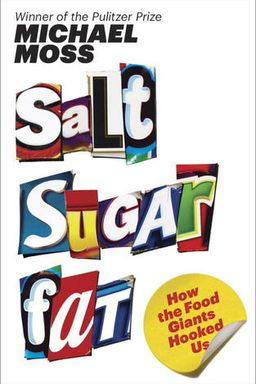
Salt Sugar Fat cover

Salt Sugar Fat

by Michael Moss

Salt Sugar Fat reveals how food giants manipulate our cravings with salt, sugar, and fat, leading to global health crises. Michael Moss uncovers the industry''s secrets, urging consumers to reclaim their health through informed choices and home-cooked meals.

How Industry Engineered Our Appetites

When you walk through a supermarket, you are not simply choosing among foods; you are navigating a system engineered to shape your appetite. This book exposes how food corporations—acting with the precision of chemical engineers and the cunning of marketers—use salt, sugar, and fat as powerful tools to capture what executives call “stomach share.” Through decades of research, optimization, and policy influence, these companies transformed basic ingredients into addictive commodities and meals into products of industrial design rather than culinary tradition.

The corporate architecture of craving

In 1999, eleven CEOs of food giants met secretly in Minneapolis to discuss rising obesity. The meeting symbolized an industry at a crossroads—and revealed its logic. Instead of reformulating their portfolios, companies defended their best-sellers by arguing that consumers demanded taste above all else. Executives like James Behnke (Pillsbury) and Michael Mudd (Kraft) recognized the moral peril; General Mills’ Stephen Sanger rejected collective restraint. Out of that tension grew a tacit agreement: tweak recipes for perception but protect the formulas that drive cravings.

The science of the “bliss point”

Howard Moskowitz, a sensory scientist turned consultant, gave industry its most powerful tool: the bliss point—the precise combination of ingredients that maximizes pleasure. Through statistical modeling, he discovered that foods elicit the greatest repeat consumption when they trigger reward pathways without quickly satiating you. This fusion of data and neuromarketing explains why drinks, yogurts, and snacks hit satisfying but not cloying notes. The insight institutionalized what marketers had intuitively known: pleasure could be engineered, replicated, and optimized.

Biology, marketing, and early conditioning

Children are born preferring sweetness and salt, but their environment teaches them how much is normal. Industry-funded research at Monell Chemical Senses Center confirmed that kids seek higher sugar concentrations than adults. Food firms used these results not to protect kids but to justify hyper-sweet formulations. Marketing then met biology: cartoon mascots, bright boxes, and sugary cereals ensured that tolerance for excess began young. (Note: Julie Mennella’s experiments show how infants exposed to sweet flavors early set a lasting preference.)

From convenience to dependency

Corporate ingenuity reframed household life. Figures like Charles Mortimer (General Foods) and Al Clausi (Tang inventor) sold “Convenience with a capital C” as progress. Instant pudding, cake mixes, and powdered drinks leveraged chemistry to free time—especially for working women—but they also habituated families to industrial taste and packaging. The “Betty Crocker” persona taught home cooks to trust boxes more than recipes. Convenience became a cultural virtue and prepared meals a default expectation.

The moral arc of marketing

From Coke’s global dominance to Kraft’s children’s snacks, marketing aligned emotional storytelling with physical conditioning. Coke’s Jeffrey Dunn detailed how the company pursued “per caps”—boosting daily consumption among heavy users and youth through ubiquitous placement and emotional branding (“within an arm’s reach of desire”). The same playbook powered Lunchables and Go-Gurt, turning convenience and fun into vectors for excess. When critics called out nutritional damage, companies retreated to language of choice and moderation, echoing the tobacco industry’s defenses.

Core takeaway

The industrial food era is built on a paradox: what feels like personal taste is largely a corporate algorithm designed to exploit biology, economics, and psychology. Recognizing that design is the first step to reclaiming choice.

Across the book, you see a single story: from lab to lobby, from grocery aisle to policy table, the modern food system transforms our innate preferences into reliable profit streams. Every part of its machinery—formulation, marketing, policymaking—serves that goal. Understanding this system equips you to decode how taste, convenience, and culture intertwine and to navigate your appetite with conscious control.


The Science of Bliss

Behind every irresistible chip or soda lies deliberate sensory engineering. Howard Moskowitz spearheaded the analytics of flavor pleasure, turning taste testing into mathematical optimization. He advanced from army ration experiments at Natick Labs to developing multimillion-dollar bestsellers like Prego Extra Chunky. His data revealed that while one universal formulation doesn’t exist, distinct consumer clusters share predictable pleasure points. Food companies learned to design for these segments rather than the average eater—thus converting diversity of taste into multipliers of profit.

Optimization as strategy

Moskowitz’s panels mapped ingredient ratios against liking scores. Statistical models predicted a “bliss range” where appeal and efficiency intersected—a slight cut in sugar or aroma could slash costs while retaining devotion. Cherry Vanilla Dr Pepper’s success came from sixty-one controlled formulas and machine-modeled consumer data. The outcome: fewer flavoring expenses, more loyalty. These findings became the operational DNA of processed-food R&D.

Craving, not merely liking

Moskowitz moved industry from measuring what people like to what they crave. Using his “Crave It!” methodology, he dissected how texture, aroma, and color interact to exceed satisfaction and foster compulsion. Food marketers quickly recognized that products optimized for craving—not balance—generate both emotional engagement and endless consumption. (Parenthetical note: This echoes psychologist Paul Rozin’s observations on “conditioned appetite.”)

Engineering across the senses

At Frito-Lay and Nestlé, scientists such as Alina Szczesniak and Adam Drewnowski advanced sensory science further: mouthfeel and fat rhythm matter as much as taste. Fat lacks a bliss point; people often like it more as concentration rises. Brain scans at Unilever revealed rapid activation in reward zones within 200 milliseconds of tasting creamy texture. Companies manipulate crunch, melt, or smoothness to reach these neural triggers. Salt crystals are milled or electrostatically charged to burst faster, enhancing instant gratification.

Key point

Food engineering merges chemistry, sensory psychology, and economics: maximize desire while minimizing cost.

When you marvel at a new “extra-crispy,” “vanilla blast,” or “limited edition” product, see the data behind it. It likely results from months of sensory mapping designed to hijack your reward circuits. Knowing this helps you treat impulse as environment—not personal failure—and reengage choice as awareness.


Salt, Sugar, Fat and the Corporate Machine

These three ingredients—salt, sugar, and fat—form the economic and sensory pillars of the processed-food empire. They serve specific technical, psychological, and financial functions that make reformulation difficult and collective restraint nearly impossible. You can trace their influence from raw commodity suppliers through to national health policy.

Salt: structural and sensory control

Salt’s role extends far beyond taste. It stabilizes dough, prevents flavor oxidation, controls microbial growth, and even masks chemical bitterness from preservatives. Only about 6% of your sodium comes from home use; most hides within processed foods. Cargill and similar firms innovate “fast-dissolving” or microstructured salts for optimal flavor release. Attempts to cut sodium face both chemistry problems and consumer backlash when perceived taste declines—hence the slow progress on health goals.

Sugar: the social and biological reinforcer

Sugar acts simultaneously as flavor enhancer, preservative, and behavioral trigger. Studies at Monell show children’s taste buds favor higher sweetness, and sugary drinks bypass fullness cues, leading to unchecked calorie intake. Industry uses crystalline fructose and other forms to manipulate stability and sweetness curves. Marketing wraps sugar in innocence—yogurts, juices, and cereals all present themselves as “healthy” though their compositions rival desserts.

Fat: the invisible indulgence

Fat provides texture and satiety illusions. Drewnowski’s research showed no saturation point; more often means better to consumers. Dairy policy and processed cheese innovation expanded fat delivery across the food supply: government stockpiles turned into commercial opportunity. Cheese shifted from artisanal food to stealth ingredient—on pizzas, sandwiches, snacks—making fat omnipresent yet rarely noticed.

Industrial truth

Salt, sugar, and fat are not flavor aids; they are corporate variables optimized for urge and shelf life.

Reformulating foods to healthier levels threatens profits because it alters flavor predictability and production stability. Each time public pressure mounts, companies respond with rhetoric of freedom or limited “better for you” lines—but rarely systemic change. Recognizing these substances as engineered levers reveals their dual identity: biological triggers and business armor.


From Convenience to Addiction

Convenience revolutionized American eating more than any single nutrient. After World War II, General Foods’ Charles Mortimer and his successors redefined cooking itself as an inefficient chore to be solved by technology. Instant pudding, boxed cake mixes, Tang, and frozen dinners symbolized modernity and gave women struggling to balance work and domestic life a sense of progress. Yet each step away from scratch cooking increased dependence on preformulated industrial foods rich in refined fat and sugar.

Cultural marketing and pedagogy

Education systems reinforced convenience as virtue. Corporate-created personas such as Betty Crocker entered school lesson plans, turning commercial loyalty into home economics. Housewives learned not only recipes but brand faith. Over decades, this built emotional trust that remains hard to break: packaged food equals care and efficiency. Marketing departments mastered fast iteration—new shapes, flavors, and “product news” kept groceries in constant flux, ensuring repeat visibility and sales.

Expansion of meal occasions

Products like Lunchables epitomize how packaging converts ordinary foods into new occasions. Bob Drane’s research showed kids wanted autonomy; parents wanted peace. The tray system offered both. Framed as “a treat for mom, power for kids,” Lunchables normalized preassembled eating and blurred the snack–meal line. Nutritional reformulation failed because reducing fat or adding fruit hurt taste, raising costs and losing sales—an economic reality Drane himself later regretted.

From habit to reliance

Each convenience leap reduced physical skill and sensory calibration. Taste buds dull, cooking seems complex, and dependence grows. Companies exploited this by selling “more convenient health”: low-fat, fortified, or 100-calorie variants that maintained processed dependence under a wellness gloss (analogous to “light” cigarettes). Convenience captured both identity and palate.

The lesson isn’t nostalgia for home cooking but awareness that convenience is a business model, not a neutral fact. By questioning why a product must exist, you reclaim agency in a marketplace designed around frictionless overconsumption.


Marketing to the Vulnerable

Children, teenagers, and low-income communities consistently bear the brunt of food manipulation. Since the 1970s, when the Federal Trade Commission tried to limit “kidvid” advertising, industry resistance has transformed regulation into self-policing that rewards subtle exploitation rather than restriction. The biological sensitivity of youth—strong cravings for sugar, limited cognitive defenses—makes them ideal targets. The ethical implications extend from Saturday-morning cereal ads to today’s influencer-driven digital promotions.

Lessons from the kidvid wars

When consumer advocates like Jean Mayer and Michael Pertschuk exposed cereal sugar loads, FTC found itself depicted as anti-family bureaucracy. The resulting political backlash crippled direct oversight. Companies responded by rebranding (“Honey” instead of “Sugar”) while maintaining sweetness levels. Later, they turned to sponsorships, school contracts, and sports tie-ins where regulatory attention was weaker. By the 2000s, digital advertising and packaging games expanded the reach inside children’s private time.

Heavy users and corporate calculus

Coca-Cola’s internal strategies show how marketing to the most susceptible few delivers disproportionate profit. Heavy users—daily or multi-daily drinkers—drive the bulk of revenue. Advertising nurtures them by saturating emotional moments: sports, family gatherings, and holidays. When Jeffrey Dunn proposed moderation in schools or developing nations, executives resisted, prioritizing “per cap” growth. Ethical awareness collided with business imperatives, and Dunn resigned.

Strategic insight

Advertising doesn’t merely reflect desire—it creates and calibrates it, especially where consumers lack defenses or alternatives.

Understanding these tactics helps you protect your household by reducing exposure, advocating for child-specific ad limits, and recognizing emotional framing in everyday campaigns. Marketing power feeds on invisibility; awareness is its antidote.


Tobacco Logic and Policy Conflict

When Philip Morris acquired General Foods and Kraft, it didn’t just expand its portfolio—it imported the worldview of addiction economics. Executives like Geoffrey Bible told food managers, “We don’t create demand; we excavate it.” That dictum became the unifying philosophy of late-20th-century food marketing: identify vulnerabilities and monetize them quickly. The crossover spawned fast follower strategies—observing competitors’ hits, replicating trends, and scaling faster than regulators could respond.

Institutionalized duality

Internal culture shifts merged tobacco’s tolerance for controversy with food’s consumer-friendly facade. Managers were encouraged to chase whatever sold, health headlines be damned. Lunchables’ indulgent versions or Oreo’s extravagant variants exemplify this “speed over conscience” mentality. Even Kraft’s modest 2003 anti-obesity initiative—led by Michael Mudd and John Ruff to limit sugar, salt, and fat—withered under shareholder pressure. Wall Street demanded growth; moral reform proved temporary.

Government complicity through checkoffs

Meanwhile, national policy reinforced consumption. USDA’s “checkoff” programs—publicly administered, industry-funded promotion boards for beef and dairy—used taxpayer-supported campaigns (“Got Milk?”, “Beef: It’s What’s for Dinner”) to increase sale of high-fat foods. Paradoxically, the same agency publishes dietary guidelines urging saturated fat reduction. Supreme Court rulings labeled this “government speech,” shielding conflicts from challenge. The result is a feedback loop where public health objectives coexist uneasily with commodity economics.

The broader paradox

Corporate and governmental systems often promote and discourage the same behaviors simultaneously—selling indulgence while preaching moderation.

Recognizing tobacco’s strategic echoes in food clarifies why meaningful reform rarely emerges from voluntary pledges or dual-mandate institutions. The system protects itself—from liability, from transparency, and from meaningful restraint.


Health, Inequality, and Consumer Agency

Processed food’s consequences converge most harshly at the intersection of biology and economy. In neighborhoods with poor access to fresh produce, industrial snacks and sodas become default calories. School routes lined with corner stores turn into arteries of daily exposure. The case of Strawberry Mansion in Philadelphia shows how cheap, omnipresent junk outcompetes fresh food on both price and time convenience. Social inequity thus becomes dietary destiny.

Corporate duality

Multinationals like Nestlé illustrate modern cognitive dissonance: they invest heavily in nutrition science while selling high-sodium frozen foods and sugary drinks. They also market medical nutrition to treat conditions born of their consumer products—a full profit loop from cause to cure. The segmentation of virtue and vice within one brand reflects capitalism’s compartmental thinking: every caloric problem is a revenue opportunity.

Paths for change

Real empowerment starts small but scales through awareness and policy. You can interrupt the engineered cycle by reading whole-package nutrition labels, planning purchases, and reducing processed dependencies gradually. Communities can build alternative supply lines—farm stands, co-ops, school programs—that insert choice back into constrained environments. Policy must recognize access as health infrastructure, not lifestyle preference.

Citizen power

Consumer behavior changes culture only when paired with community action that redefines what “normal eating” looks like.

By understanding how systems engineer appetite you can design counter-systems of intention—slower meals, transparent labeling, and local supply resilience. The same ingenuity that created convenience culture can be reclaimed to build health literacy and equality.

Dig Deeper

Get personalized prompts to apply these lessons to your life and deepen your understanding.

Go Deeper

Get the Full Experience

Download Insight Books for AI-powered reflections, quizzes, and more.