
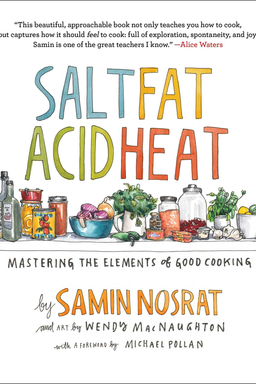
Salt, Fat, Acid, Heat cover

Salt, Fat, Acid, Heat

by Samin Nosrat

Salt, Fat, Acid, Heat redefines cooking by focusing on fundamental principles rather than recipes. Samin Nosrat reveals how mastering these elements transforms ordinary meals into extraordinary culinary experiences, empowering home cooks to innovate and create delicious dishes with confidence.

Cooking by Compass: Salt, Fat, Acid, and Heat

How can you move beyond recipes and learn to cook intuitively? In Salt, Fat, Acid, Heat, chef-teacher Samin Nosrat argues that every great dish is built from mastering four universal elements: salt, fat, acid, and heat. Rather than memorizing formulas, Nosrat teaches you to use these elements as a compass—to orient yourself in the kitchen and make informed, instinctive choices. Her message is liberating: when you understand how these forces interact, you can cook anything and make it delicious.

This framework reflects Nosrat’s years at Chez Panisse under Alice Waters, in Tuscan kitchens with Benedetta Vitali, and alongside artisans like butcher Dario Cecchini. Each lesson in the book stems from these experiences: seasoning meat in Italy, tasting olive oils during harvest, learning to balance acids in French-style dressings, and respecting heat in open-fire cooking.

The Four Elements as a Framework

Nosrat calls these elements the “cardinal directions of cooking.” You learn to ask four questions whenever you approach a dish: When will I salt? Which fat will carry flavor? What acid will balance richness? What kind of heat will transform the ingredients? The framework is flexible but disciplined. It’s both a map and a method: by mastering the underlying principles, you replace uncertainty with intuition.

A Cook’s Compass, Not a Code

Nosrat’s goal isn’t to give you more recipes but to give you judgment. She argues that good cooking lies not in precision alone but in responsive observation—learning how food reacts to salt, fat, acid, and heat. You taste, adjust, and taste again. A squeeze of lemon at the end might wake up an entire meal, just as early salting changes a roast from dry to tender.

Guiding Principle

Salt enhances flavor; fat carries and transforms it; acid balances and brightens it; heat unlocks everything through transformation. Every decision in cooking traces back to these four.

Salt as Control and Confidence

Salt determines whether food tastes flat or vibrant. Nosrat emphasizes when you salt—early for meat and beans, just before serving for freshness—and understanding how types of salt differ (Diamond Crystal vs. Morton, kosher vs. finishing salts). More than quantity, timing defines success. Pre-salting allows diffusion; it seasons “from within,” turning simple chicken into something deeply flavorful. The science—osmosis, diffusion—serves the art: seasoning food so every bite feels alive.

Fat as Flavor Builder

Fat shapes texture, aroma, and mouthfeel. From olive oil in Tuscany to butter in France and ghee in India, fat defines cuisines. Quality and type determine impact: neutral oils for frying, fruity oils for finishing, butter browned for nuttiness. Nosrat classifies how fat influences texture—crispy, creamy, flaky, tender, or light—and teaches strategic layering: cook with one fat, finish with another. A tomato sauce made with rancid oil fails not because the recipe is wrong but because the fat sabotages flavor.

Acid as Balance and Spark

If salt awakens flavor, acid brings it into harmony. Vinegars, citrus, wines, and fermented foods add contrast and complexity. Nosrat shows how tiny doses of acid—“a capful of vinegar” in carrot soup—can make flavors pop. She distinguishes between “cooking acids” (added early to develop depth) and “finishing acids” (added late for brightness). Learning when to use each prevents dullness and introduces delight.

Heat as Transformation

Heat is the invisible element you sense through experience. It governs every transformation—raw to cooked, soft to crisp, pale to golden brown. Nosrat explains the chemistry: Maillard reactions for savory complexity, caramelization for sweetness. More importantly, she teaches how to read heat—through sound, smell, and texture—not just through gadgets. Gentle or intense, dry or moist, heat creates structure and contrast in food.

Putting It Together

Once you internalize these elements, you can balance an entire menu: rich main courses with bright sides, salty fundamentals with cooling acids, crisp textures beside creamy ones. Every culture, Nosrat argues, unconsciously masters these balances. Japanese cuisine relies on precise heat control; Southern American food depends on salt and acid (pickles, hot sauce); Mediterranean dishes celebrate fat and freshness. The framework unites them under a single vocabulary.

At its heart, Salt, Fat, Acid, Heat teaches the intuition behind great cooking. Nosrat replaces fear with curiosity, giving you the tools to experiment and trust your palate. When you think in elements rather than instructions, you cook fluidly—guided by taste, balance, and joy rather than by recipes alone.


Mastering Salt

Salt is Nosrat’s starting point because it’s the simplest and most transformative tool a cook has. She calls it the “magic rock” that can bring depth to anything. Her lesson is to understand how and when salt works—where flavor begins to bloom and where timing dictates outcome. You can’t fix flatness later if you’ve failed to build seasoning early.

Understanding Types and Strengths

Not all salts are created equal. Diamond Crystal kosher salt, Morton kosher salt, table salt, sea salt—each measures differently by volume. Knowing your salt’s grain size, density, and dissolving pace is essential. A tablespoon of Morton can be twice as salty as the same measure of Diamond Crystal. Nosrat urges cooks to measure by feel, not volume—use your hands, learn by taste.

Timing Is Everything

Seasoning early allows salt to diffuse into food. Meats and dense proteins benefit most, while delicate fish or vegetables can be salted closer to cooking time. Salt draws moisture out initially, then reabsorbs it with flavor. This process transforms both taste and texture. For soups and beans, seasoning the cooking water ensures even, internal flavor.

Tasting as Feedback

Nosrat replaces measurement with the “taste, adjust, taste” loop. A spoonful test—adding a pinch to one bite—reveals whether an entire pot needs more seasoning. This practice shifts control from formula to feedback. Over time, your palate becomes the ultimate sensor, a skill every professional cook cultivates instinctively.

Lesson of the Hand

Keep a bowl of salt near your prep station—grasp with fingers, feel the grains, and learn how your own hand measures. Over time, precision comes from muscle memory, not measuring spoons.

Salt is both a science and a sensibility. You must respect chemistry—diffusion, osmosis—but rely on constant tasting. Mastering salt turns you from a follower of recipes into a maker of flavor.


Fats That Define and Transform

Fat shapes how food feels, smells, and satisfies. Nosrat teaches you to see fat as a medium, ingredient, and flavor amplifier. Its cultural identity—olive oil in the Mediterranean, butter in France, ghee in India—defines entire cuisines. Fat gives texture and continuity, binding ingredients and carrying aromatic molecules that water never could.

Fat and Flavor Chemistry

Fat absorbs flavor compounds and coats the tongue, making tastes linger. It also expands the cooking temperature range, enabling Maillard browning and caramelization. Fry onions in olive oil instead of boiling them in water, and their flavor doubles in depth. For richer complexity, combine different fats—like cooking in neutral oil for heat stability and finishing with fragrant butter for nuance.

Texture Control

Fat underwrites every desired texture: flakiness from cold butter, crispness from hot oil, tenderness from gelatin-rich stock. Nosrat organizes these results into five categories—crispy, creamy, flaky, tender, and light—and shows how each stems from a controlled use of temperature and fat phase. Cold fat trapped in pastry releases steam that forms layers; whipped fat traps air for lightness.

Choosing and Layering

A good cook chooses fat deliberately, like picking wine for a meal. Use fruity olive oil for vegetables, clarified butter for high-heat sautéing, and rendered duck fat for roasting. Nosrat also introduces layering: add fat at multiple stages—start for structure, finish for flavor. This technique adds mouthfeel and coherence, turning even simple pastas or soups into complex compositions.

Quality Above All

At Chez Panisse, rancid oil disqualified entire batches of tomato sauce. Fat is not neutral—it’s an ingredient that either elevates or ruins everything it touches.

Once you know your fats and respect their temperature and quality, you gain creative control. Fat becomes your painter’s medium: shaping color, contrast, and structure on your plate.


The Role of Acid and Balance

Acid is the balancing note—the brightness that keeps richness or sweetness in check. Nosrat teaches cooks to taste for acid just as they taste for salt. It’s not limited to lemon juice or vinegar; it includes tomatoes, yogurt, wine, fermented foods, and tangy dairy. Once you learn to recognize it, acid becomes your secret for awakening flavor.

Understanding Where Acid Comes From

Each cuisine has its own acids: vinegar and wine in Europe, citrus and tamarind in tropical regions, fermented vegetables and dairy across Asia. Nosrat classifies them into broad categories—vinegars, citrus, and cultured products—and encourages layering multiple acids for nuanced complexity. Yogurt with lemon; vinegar balanced with a touch of wine.

Timing: Cooking vs. Finishing Acid

Add acid early in cooking when you want subtle blending—braising with wine, stewing with tomatoes—or late for freshness. A drop of lemon juice or capful of vinegar at serving can make a soup or stew snap into focus. Nosrat repeats that a little acid late is the most powerful form of adjustment you can make.

Chemistry of Brightness

Acid also changes texture and color—preserving vivid purples while dulling greens if mistimed. It firms vegetables, coagulates egg whites, and affects protein behavior in custards and sauces. Understanding these effects prevents culinary accidents while opening creative avenues.

At Chez Panisse

A chef once added a capful of vinegar to carrot soup. The dull, sweet liquid came alive instantly—a demonstration of how one drop of acid can transform flavor structure.

Recognizing when food feels flat and responding with acid builds instinctive confidence. You stop seasoning by fear and start seasoning by ear—listening for harmony rather than obedience to rules.


Heat: The Element of Transformation

Heat is the engine that makes every other element come alive. Nosrat calls it the “transformative element.” It changes the chemistry of food, creating flavor and texture where none existed. Mastering heat means paying attention with all your senses, not just following recipes or thermometers.

Understanding Heat Types

Different foods demand different intensities and techniques. Gentle heat—simmering, poaching, braising—softens fibers and retains moisture. Intense heat—searing, roasting, grilling—creates browning, crust, and contrast. Often, great cooking layers both: sear for flavor, then braise for tenderness. The ultimate goal is balance—surface and interior reaching doneness together.

Learning to Sense, Not Guess

Use all your senses. The sizzle indicates moisture evaporation; the aroma shifts as sugars caramelize; the sound quiets when water is gone. Visual cues like color and texture matter more than time clocks. Nosrat introduces the idea of carryover cooking: residual heat keeps cooking food after it leaves the pan, so resting is part of timing.

Science Behind Transformation

Understanding chemical reactions—Maillard browning, caramelization, gelatin conversion—transforms technique from mystery to mastery. You begin predicting outcomes instead of reacting to them. This makes heat not just a mechanism but a form of creative control. (Note: Like Harold McGee’s On Food and Cooking, Nosrat integrates culinary science into sensory intuition.)

From Sensory Training

Nosrat recalls working with Enzo the pizzaiolo who judged wood-fire heat by hand and color, not instruments—proof that deep understanding comes through practice, not equipment.

Heat teaches you patience and attention. It’s the difference between cooking to temperature and cooking by feel—and once internalized, it frees you to improvise fearlessly.


Layering the Four Elements

Once you’ve learned to see salt, fat, acid, and heat as individual dimensions, Nosrat’s next lesson is to layer them. Layering means applying each at the right stage and intensity to create depth and coherence. In practice, seasoning begins early and continues in stages, transforming a sequence of steps into harmony on the plate.

Building Flavor in Layers

Every recipe—from Bright Cabbage Slaw to Tuscan Bean Soup—illustrates this layering cycle. Salt draws moisture and seasons from within; fat carries flavor during cooking; acids sharpen and balance near the end; heat creates transformation throughout. Layering across time and technique ensures each bite holds contrast and life.

Practical Mantra: Season Early, Finish Boldly

In vinaigrettes, you might macerate shallots in vinegar (acid), then whisk in salt, and finally emulsify oil (fat). In soups, you brown aromatics in fat (heat and fat), simmer beans (acid), and finish with grated cheese (salt) and olive oil. Early seasoning anchors flavor; finishing touches define memory. Tasting “in context” is crucial—like testing salad dressing on a leaf, not on a spoon.

Rescue and Adjustment

Layering is forgiving because it allows for correction. Dull dish? Add acid or salt. Too sharp? Add fat. Too thin? Use heat to reduce or whisk in butter for body. Understanding interplay replaces panic with precision.

The Cook’s Equation

Flavor emerges not from abundance but proportion—each element balancing the next. True mastery lies in adjusting dynamically, not adding more of everything.

Layering makes any cuisine accessible. You don’t memorize recipes anymore—you follow the logic of elements. This act transforms day-to-day cooking into an art of orchestration.


Improvisation and Menu Balance

After internalizing the four elements, Nosrat’s final call is to cook by principle, not by prescription. Improvisation becomes natural because you understand how food behaves under salt, fat, acid, and heat. Recipes turn from commandments into starting points. You plan meals as compositions instead of sequences.

Anchoring a Menu

Every good menu begins with an anchor—a well-seasoned protein, a key cooking method like roasting, or a fresh market ingredient. Once the anchor is chosen, balance everything around it: rich mains with bright sides, acidic salads with creamy desserts. Chez Panisse’s menus evolved this way, guided by season and contrast.

Balance and Restraint

Nosrat urges cooks to practice restraint. Not every dish should shout; allow quiet counterpoints. Layer salt, fat, and acid intentionally but count their cumulative effect—anchovies, olives, and cheese contribute as much salt as crystals do. A squeeze of lemon or drizzle of oil near the end often finishes the story without cluttering it.

Improvising Templates

Once you’ve memorized reliable frameworks—a vinaigrette ratio, a pasta sauce family, a braising base—you can vary ingredients freely. Change one variable at a time: swap citrus for vinegar, adjust fat type, or shift heat level. The guiding question is always “what does it need?” rather than “what does the recipe demand?”

Final Practice

Taste constantly. A pinch of salt or a dash of acid teaches faster than any rule. Your palate is the compass that keeps you oriented in endless variation.

In the end, cooking with principles instead of recipes is freedom. Nosrat’s framework assures that even improvisation has structure—a balance between instinct and understanding that turns everyday cooking into intuitive craft.


From Kitchen Practice to Mastery

Nosrat closes by grounding theory in real kitchen practice—stocks, soups, pasta, braises, vegetables, and doughs. Each domain applies her principles through repetition and sensory learning. Learning to cook vegetables six ways, to build stable emulsions, or to bake with cold butter are case studies in understanding the four elements in context.

Stocks and Soups

Stocks train patience and clarity: simmer without boiling, salt correctly, layer aromatics. In soups, acid finishes (vinegar, lemon) sharpen sweetness while fat adds silkiness. The trio—brothy, chunky, smooth—illustrates how texture and flavor interplay through salt, fat, acid, and heat.

Pasta Families and Braising

Nosrat distills pasta sauces into five archetypes—cheese, tomato, vegetable, meat, shellfish—each emphasizing salt balance and emulsified fat. Braises follow the same idea: brown meat (heat and fat), simmer with acid and aromatics, finish with salt and rest. Across cuisines, time becomes flavor.

Vegetables and Baking

The six vegetable methods—blanch, sauté, steam-sauté, roast, long-cook, grill—show how heat variation defines texture. Acid wakes up sweetness; salt builds depth. In pastry, cold butter interacts with flour to trap steam and form layers—precision with temperature rather than seasoning. Butter-and-flour doughs extend the four-element logic into baking: keep fat solid (heat control), season lightly with salt, and balance sweetness with acidity from cultured dairy or fruit.

Repetition as Teacher

Cooking mastery doesn’t come from memorizing methods but repeating them until sensory cues replace instructions. Each dish—whether soup or tart—teaches you to listen again to salt, fat, acid, and heat in a different register.

Nosrat transforms simple acts into deeper discipline. Through observation and iteration, anyone can move from recipe-reader to intuitive cook. Mastering process, not perfection, is the ultimate takeaway.

Dig Deeper

Get personalized prompts to apply these lessons to your life and deepen your understanding.

Go Deeper

Get the Full Experience

Download Insight Books for AI-powered reflections, quizzes, and more.