
Idea 1
Salt and the Shape of Civilization
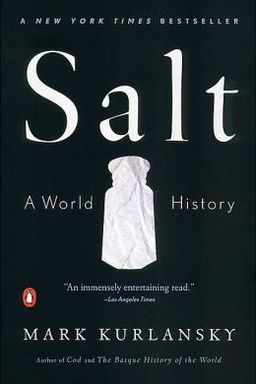
You live because your body needs salt. That simple truth—sodium and chloride ions sustaining nerve impulses, muscles, and fluid balance—anchors Mark Kurlansky’s central claim: salt is both a chemical necessity and a social metaphor. Across centuries, salt has shaped human biology, myth, economy, and political power. It has built empires, funded wars, and inflamed revolutions. In Salt: A World History, Kurlansky turns a white crystal into a prism through which you read the story of civilization itself.
You can follow salt’s influence from biology to belief, from ritual to industry. The book unfolds salt as life-giver, preservative, currency, and weapon. It shows how the need to prevent decay—the biochemical fact that bacteria do not thrive in high-saline environments—translated into metaphors of permanence, loyalty, and purity. When people made covenants of salt or offered salt in ritual, they enacted physical science as moral symbolism.
From necessity to symbol
Cultures first valued salt because it kept food safe in climates where heat and humidity made spoilage immediate. But as salt preserved flesh, it also preserved promises. From the Torah’s “covenant of salt” to Japanese salt purifications and Egyptian mummification with natron, preservation became sacred metaphor. Ernest Jones, the psychoanalyst, saw salt’s bodily associations—sweat, tears, semen—as sources of its mystique. The pink rock salt of Cardona, leaching ancient brine, becomes one of Kurlansky’s physical symbols for how a mineral can embody permanence, fertility, and decay at once.
Engineering and empire
From ancient brine wells to modern mines, salt technologies mirrored political structures. In China, Li Bing’s bamboo pipes and percussion drilling made brine extraction legible to the state, enabling monopolies and sparking the Yan tie lun debates about ethics vs. profit. In Rome, the Via Salaria moved salt inland and the salarium (salt pay) defined soldier compensation. Venice and Genoa converted salt subsidies into maritime dominance, while French administrators turned salt taxation—the gabelle—into a hated emblem of privilege.
Salt routes built early globalization: Phoenician ports exchanged salted fish and purple dye; Saharan caravans hauled massive cones of Taghaza salt; Atlantic islands like Turks and Caicos provisioned the Newfoundland cod fishery. Where salt moved, civilization followed. Its portability as preserved protein—cod, herring, ham—fed armies and navies, connecting discrete coasts into market systems.
Conflict, labor, and industrial transformation
Because salt preserved life, control of salt meant control of welfare. In the American Revolution, British blockades strangled colonial salt supplies; in the Civil War, Union forces bombarded Confederate saltworks; and in India, Gandhi’s Dandi march dramatized resistance to imperial monopoly. These stories show that small, tangible injustices—salt taxes and bans—ignite large moral transformations. Salt taxation was the simplest gauge of oppression because everyone needed it daily.
Industrial chemistry later fractured the meaning of salt. Humphry Davy’s electrolysis revealed sodium and chlorine as elemental substances, repurposing salt from preservative to feedstock for bleaches, soda ash, and industrial acids. The environmental consequences—Leblanc fumes, Lake Onondaga pollution—remind you how scientific triumphs alter ecological balance. Salt thus becomes an illustration of progress with a toxic shadow.
Taste and identity
Salt also defines identity through cuisine. Parma’s prosciutto, Sichuan’s soy sauce, Collioure’s anchovies, and Iceland’s boiled seawater tell regional tales of adaptation. Salted taste is cultural memory—what preserved ancestors’ food becomes today’s delicacy. Yet innovation disrupted this continuity: canning (Appert) and freezing (Birdseye) freed food preservation from salt, relegating it to flavor rather than survival. Salt’s industrial abundance turned it into heritage, a luxury to rediscover in fleur de sel and bottarga.
From abundance to cost and conscience
Finally, modern consolidation—Morton, Cargill, Salt Union—made salt ubiquitous but detached from local labor. Cheshire’s subsidence craters, Kanawha’s slave-driven saltworks, and Syracuse’s polluted lake mark the moral geography of production. Artisanal heirs like Guérande now sell ethics as well as flavor. Kurlansky invites you to see salt not just as a taste but as a story of human enterprise, exploitation, belief, invention, and resilience.
Insight
To understand salt is to understand how necessity shapes morality. You see human survival crystallized into ritual, empire, and industrialization—the smallest mineral revealing the largest pattern of human history.