
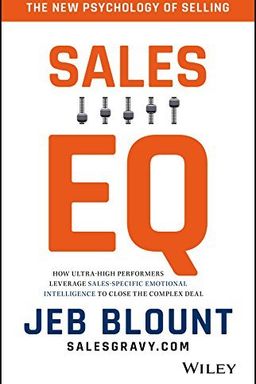
Sales EQ cover

Sales EQ

by Jeb Blount

Sales EQ reveals how mastering emotional intelligence propels sales success. Discover strategies to sync with customers'' emotions, employ empathy, and creatively disrupt expectations to close complex deals and build lasting client trust.

Sales EQ: The Power of Emotional Intelligence in Selling

How do top salespeople consistently outperform peers selling nearly identical products? In Sales EQ, Jeb Blount argues that the answer lies not in better pitches, technology, or even experience, but in a rare mastery of sales-specific emotional intelligence—what he calls Sales EQ. Emotional intelligence, blended with rational process and sales acumen, enables what Blount calls ultra-high performers (UHPs) to influence decisions, shape buying behavior, and close deals others lose.

Blount contends that while technology and data dominate modern selling, the human element remains the ultimate differentiator. He emphasizes that people buy emotionally and justify logically. Selling today is not about dumping information or deploying slick insights; it’s about connecting, listening, and managing emotions—your own and your buyer’s. By mastering Sales EQ, salespeople escape the epidemic of mediocrity that plagues modern sales teams and enter the echelon of UHPs who thrive even in hypercompetitive markets.

The Emotional Core of Sales

Blount opens with an unforgettable story—the “Mysterious Brown Bag.” A young rep named Art, struggling to defend his higher price, learns directly from his mentor Joe that the key isn’t arguing logic but reframing emotion. Joe places two loaves of bread—one cheap, one crafted by the client’s own bakery—on the table and asks, “What’s the difference?” When the bakery owner passionately describes his own bread’s superior quality, Joe simply says, “That’s exactly what we’re trying to tell you. We’re the Colaizzi bread of truck leasing.” The sale closes instantly, because Joe shifted the buyer’s emotional frame. Every other concept in the book flows from this lesson: people must feel before they think.

A Perfect Storm of Modern Selling

We live in what Blount calls a “perfect sales storm.” Buyers are more informed, have more choices, and face overwhelming noise. Classic techniques—product dumping, insight selling, solution pitches—fall flat because stakeholders crave something rarer: authentic human connection. Many salespeople, distracted by tech or fear, have lost the ability to connect interpersonally. The result: stalled pipelines, high turnover, and buyer fatigue. Against this backdrop, emotional intelligence isn’t soft—it’s survival.

The Four Intelligences of Ultra-High Performers

Blount identifies four intelligences that define elite salespeople: IQ (innate smarts), AQ (acquired knowledge), TQ (technological adaptability), and EQ (emotional intelligence). IQ and TQ enable logical process, but EQ drives influence—the ability to read, regulate, and align emotions. UHPs, he argues, are polymaths of people: intellectually sharp yet deeply empathetic. Their mastery of Sales EQ helps them manage disruptive emotions—fear, impatience, arrogance—that derail average reps.

The Human Decision Process

Building on cognitive psychology (notably Daniel Kahneman’s work in Thinking, Fast and Slow), Blount explains that buyers operate with two systems: the fast, emotional limbic brain and the slow, rational neocortex. Effective salespeople align their process to these emotional realities, asking not just “What’s the data?” but “What does this stakeholder feel?” He describes five subconscious buyer questions that define every sale: Do I like you? Do you listen to me? Do you make me feel important? Do you get me and my problems? Do I trust and believe you? When customers answer yes, deals accelerate; when the answer is no, they stall indefinitely.

Why Sales EQ Matters Now

In an era dominated by automation, artificial intelligence, and CRM dashboards, emotional intelligence has become the new competitive edge. As Blount puts it, “Salespeople aren’t being replaced by technology, they’re being replaced by salespeople who use technology better—but who also connect better.” The rep who listens deeply, reads microemotions, and navigates egos will outperform armies of script-followers.

Throughout Sales EQ, Blount unpacks frameworks—like the Dual Process Discovery model and Five-Step Objection Turnaround—that transform conversations from robotic to relational. He shows how empathy, self-control, and drive generate trust, engagement, and loyalty in every interaction. Ultimately, he argues that emotional connection is the last frontier of sales advantage. By mastering your own emotions and skillfully influencing those of others, you gain not only customers—but unshakable confidence, purpose, and success.


Emotion Outweighs Logic in Buying Decisions

Blount dismantles one of the biggest illusions in sales—the belief that people buy based on logic and reason. Through research and story, he shows that emotion drives every buying decision. Logic surfaces later, only to justify choices buyers have already made emotionally. This helps explain why prospects cling to bad vendors or pay more for identical products—they go with who they feel understands them.

The Irrational Buyer

One of Blount’s most vivid stories recounts his two-year pursuit of a massive account—a deal so significant he called it life-changing. Despite competitors with flashier presentations, private jets, and corporate retreats, he won the contract because stakeholders “felt like [his] team was more like them.” That gut-level connection outweighed every logical factor. In behavioral economics terms, the buyers’ similarity bias overpowered cost, quality, and statistical advantage.

How Emotion Shapes Perception

From the liquor store study (where French music boosted French wine sales) to the Coke vs. Pepsi brain scans (where branding overruled taste), emotion determines what people perceive as truth. Blount relates these findings directly to sales: you don’t win deals based on your features—you win by shaping how buyers feel when they engage with you. A confident, empathetic presence activates trust hormones like oxytocin; fear or arrogance triggers cortisol and pushes buyers away.

Approach Buyers the Way They Buy

Most salespeople start with logic—presenting products, data, and value propositions—while buyers begin with emotion. Thus, both parties are out of sync. Ultra-high performers flip this rhythm by connecting emotionally first (likability, empathy, curiosity) and introducing rational justification later. This alignment is the essence of Sales EQ.

“People buy for their reasons, not yours. And their reasons are always emotional.”

Understanding this law reshapes your entire approach to selling: it’s not about convincing, but about connecting and translating feelings into action. The sales professional who can recognize fear, navigate ego, and infuse safety and trust will always outperform those bound to logic alone.


The Four Cornerstones of Sales EQ

At the heart of Blount’s philosophy are four pillars that define sales-specific emotional intelligence: Empathy, Self-Awareness, Self-Control, and Sales Drive. He argues that ultra-high performers balance these abilities simultaneously—a discipline he calls Dual Process: managing your own emotions while reading and responding to your buyer’s.

Empathy: Stepping Into Their Shoes

Empathy, the foundation of EQ, is not softness—it’s strategic. Ultra-high performers like Shell, a high-end jewelry salesperson Blount profiles, use empathy to ease buyer anxiety and build trust. When engaged couples came to her store, Shell would “let the heat off” the groom, recommending rings that fit their budget and preserving his dignity. Instead of forcing a sale, she gained lifelong clients and referrals. Empathy, Blount writes, is “the meta-skill of the 21st century.”

Self-Awareness and Self-Control

Blount insists that awareness of your emotional triggers—impatience, fear, the need for significance—is the key to mastering them. He explores why smart salespeople blow deals (ego, frustration, insecurity) and teaches techniques to “push pause” before responding. From fighting defensiveness to resisting the urge to pitch too soon, emotional equilibrium turns chaos into clarity. Self-control, he argues, is the true meta-skill of top performers.

Sales Drive: The Momentum Marker

Drive is the internal engine behind persistence. Pulling insights from psychologists like Angela Duckworth and Christopher Croner, Blount shows that grit and optimism outperform talent. UHPs persist because they’ve developed what he calls an internal locus of control—the belief that you own your outcomes. Their drive is sustained through physical fitness, self-talk, and disciplined optimism, not chance motivation. When setbacks strike, they ask not “Why me?” but “What can I learn?”

Together, these four pillars form the psychology of sales mastery. Without empathy, you can’t connect; without awareness, you repeat mistakes; without control, you sabotage deals; without drive, you quit too soon. Balancing all four, Blount argues, is what turns ordinary salespeople into emotional athletes of influence.


Mastering the Art of Listening

Listening, Blount declares, is the most underrated and underdeveloped skill in sales. When salespeople pitch too early, they rob buyers of their story—and themselves of opportunity. In contrast, ultra-high performers use listening as a weapon of connection and differentiation.

Why We Fail to Listen

Blount notes that we spend 95% of our mental time thinking about ourselves—our ideas, our products, our goals. True listening requires you to suppress this ego loop. The brain resists it because listening offers no instant dopamine hit; talking does. Breaking this pattern requires discipline, empathy, and faith that silence equals control, not weakness.

The Four Principles of Effective Conversations

  • People respond in kind – Your emotions are contagious. Approach with warmth, you’ll get warmth back.
  • People communicate in stories – Real insights are buried in narratives, not bullet points. Encourage storytelling through curiosity.
  • Questions control the flow – Whoever asks the questions controls the conversation.
  • Listening builds connection – The more attentively you listen, the faster trust grows.

The Self-Disclosure Loop

Blount references fascinating neuroscience: talking about ourselves triggers dopamine—literally a “brain crack” reward. When sellers listen sincerely, they activate what researchers Jason Mitchell and Diana Tamir call the self-disclosure loop. The longer stakeholders talk, the more they reveal (and the more pleasurable it becomes). Through patience and well-timed silence, UHPs prompt buyers to unconsciously disclose critical information—the kind that’s impossible to extract through interrogation.

“The secret to influence is not what you say; it’s what you hear.”

By practicing active listening—eye contact, nodding, summarizing, pausing—you prove you care. You make your buyer feel seen, understood, and significant. And no one ever complains about a salesperson who listens.


The Five Questions Every Buyer Asks

Every buyer you meet—consciously or not—is evaluating you through five questions that determine whether they’ll engage, buy, or disappear. Blount calls these “The Five Questions That Matter Most in Sales.”

1. Do I Like You?

First impressions are emotional lightning bolts. Likability triggers trust. Through ten tactical behaviors—smiling, posture, eye contact, grooming, language, tone, enthusiasm—Blount teaches the gateway to emotional connection. When prospects like you, they listen. When they don’t, they build walls you can’t breach.

2. Do You Listen to Me?

Listening, as explored earlier, is the ultimate relationship builder. When prospects feel heard, they drop their defenses. Silence and genuine curiosity speak louder than any pitch deck ever could.

3. Do You Make Me Feel Important?

Drawing from psychology, Blount identifies the need for significance as humanity’s deepest craving. He recounts stories—like handcrafting stakeholder dossiers or remembering personal details—that transform indifference into loyalty. Compliments, attentiveness, and gratitude trigger powerful reciprocity instincts (Robert Cialdini’s Influence is a clear parallel here).

4. Do You Get Me and My Problems?

This question defines differentiation in the “me-too” era. Blount cites a client selling software whose materials mimicked rivals. Once they began speaking the client’s own language—not their marketing jargon—their pitches became magnetic. Understanding equals empathy; empathy equals credibility.

5. Do I Trust and Believe You?

Trust is earned drop by drop, lost in buckets. Blount adapts Stephen Covey’s idea of the “emotional bank account”: every kept promise, attentive follow-up, and timely reply is a deposit. Late calls, broken commitments, inattentive behavior—withdrawals. When your account goes negative, the deal dies.

Together, these five emotional checkpoints form the DNA of influence. Answer them all with yes, and buying becomes the natural next step.


Connecting, Questioning, and Emotional Control

Blount’s middle chapters turn from psychology to execution frameworks: how to structure conversations that amplify empathy and credibility. Three anchors—connecting, questioning, and emotional control—transform awkward sales calls into engaging human dialogues.

Connecting through Style and Story

Connection begins with mirroring. Blount’s Four Stakeholder Personas—Director, Analyzer, Socializer/Energizer, and Consensus Builder—mirror well-known DISC archetypes (Dominant, Conscientious, Influential, Steady). The UHP flexes their style accordingly. With Directors, be concise and confident; with Analyzers, meticulous and factual; with Socializers, energetic and relational; with Consensus Builders, patient and collaborative. Matching tone and tempo earns subconscious trust.

Sales Is a Language of Questions

Discovery, Blount says, is “the heart and soul of sales.” Ultra-high performers don’t interrogate—they converse. He retools the SPIN and DISCOVER models into what he calls the Dual Process Discovery Framework. It’s conversational, not linear: begin with easy, open-ended questions, deepen with empathy, and guide toward emotional awareness. When a prospect sees their own problem more clearly through your questions, you’ve already won.

Emotional Control amid Pressure

Finally, Blount stresses that sales breakdowns stem not from bad technique but from bad emotional management. Fear of rejection, need for approval, impatience under silence—these kill credibility. UHPs master physiological hacks: posture, slower speech, breathing, and “positive visualization.” They learn to push pause between stimulus and response. The moment you control yourself, you regain control of the conversation.

“You cannot be delusional and successful at the same time.”

When empathy meets discipline, questioning meets patience, and confidence meets restraint, connection flourishes—and with it, influence.


Trust, Gratitude, and the Human Edge

In the book’s closing chapters, Blount widens his lens. He reminds readers that gratitude, empathy, and trust aren’t just tactics—they’re identity choices. His story of meeting an elderly Japanese man at the site of the Amache internment camp illustrates this truth vividly.

The man, once imprisoned there as a child, shares how his family didn’t choose bitterness but gratitude—they focused on rebuilding, not revenge. Listening to his story, Blount learns that genuine empathy makes strangers into instant friends. The lesson applies to sales and life: “No one ever complains about people who listen.”

Building Trust Brick by Brick

Trust doesn’t rest on intentions; it rests on consistency. Blount invokes Covey’s “emotional bank account”: small deposits—showing up, keeping promises, listening fully—accumulate credibility. Each broken promise, each sloppy email or missed deadline, drains that trust until none remains. In sales, little things make all the difference. You are always on stage, observed, evaluated, remembered.

Gratitude as a Performance Multiplier

Through years of working with UHPs, Blount found one shared habit—intense gratitude. Grateful salespeople are happier, healthier, and more magnetic. Gratitude neutralizes entitlement and cynicism (themes similar to those in Shawn Achor’s The Happiness Advantage) and sustains optimism through rejection. You can’t be bitter and curious at the same time, he observes.

Sales EQ ends where it began—with humanity. Emotional intelligence, Blount insists, is not a soft skill but a hard advantage. In a world awash with automation, your empathy, curiosity, and gratitude are what make you unforgettable. Master them, and you don’t just sell more—you lead better, listen deeper, and live wiser.

Dig Deeper

Get personalized prompts to apply these lessons to your life and deepen your understanding.

Go Deeper

Get the Full Experience

Download Insight Books for AI-powered reflections, quizzes, and more.