
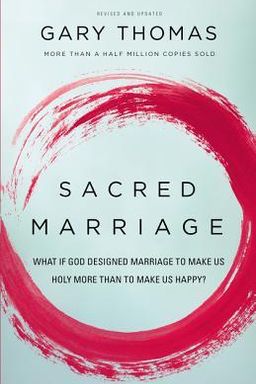
Sacred Marriage cover

Sacred Marriage

by Gary L Thomas

Sacred Marriage by Gary L Thomas offers a profound exploration of marriage as a spiritual journey. It challenges the conventional pursuit of happiness, emphasizing holiness and personal growth through love, sacrifice, and perseverance. Discover how to transform your relationship into a deeper, faith-centered union.

Marriage as a Sacred Journey Toward God

What if God’s purpose for marriage wasn’t primarily to make you happy—but to make you holy? That single question drives Gary Thomas’s Devotions for a Sacred Marriage: A Year of Weekly Devotions for Couples. Across fifty-two reflections, Thomas invites couples to reimagine marriage not as a destination of romantic fulfillment but as a divine classroom where everyday joys and frustrations become opportunities for spiritual growth. Rather than a self-help manual, the book is a yearlong conversation about how marriage shapes the soul, trains character, and draws spouses into deeper reverence for God.

Thomas centers his argument on the idea that every marriage—whether blissful or burdensome—has been designed by God to refine two imperfect people into Christlike maturity. He begins by challenging the reader’s motivations: Are you a spouse-centered person, reacting to your partner’s behavior, or a God-centered spouse, loving from reverence for God? From this premise, he unfolds a theology of marriage built on service, forgiveness, perseverance, and spiritual discipline. Marriage, he insists, is meant to function as a crucible for holiness; its difficulties aren’t inconveniences but invitations to transformation.

Marriage as Spiritual Formation

According to Thomas, marriage trains the heart in virtues that can’t be learned in isolation: patience, humility, mercy, and sacrifice. He compares life together to a divine apprenticeship in love. Just as an athlete practices to master a skill, spouses practice holiness through the mundane—the silence after a quarrel, the effort to forgive, or the shared labor of raising children. Each moment, however ordinary, becomes part of the grand curriculum of sanctification. Drawing from Scripture and examples like Paul’s letters, Thomas argues that holiness, not happiness, is the ultimate measure of a sacred marriage. Yet he’s careful to note that holiness often leads to authentic joy—the kind not dependent on fluctuating emotions but rooted in service and gratitude.

The Devotional Approach

Instead of daily readings, Thomas structures the book as fifty‑two weekly meditations. He explains that sacred reflection should be deliberate and deep, not rushed. Each devotion integrates Scripture, storytelling, and real‑life application. Whether describing a husband’s self‑deprecating humor about giving up Pepsi for Lent or a wife’s struggle to understand her husband’s spiritual leadership, Thomas turns commonplace marital tensions into spiritual parables. The effect is disarming—the reader follows relatable stories that end with unexpected theological insight rather than formulaic marriage advice.

Holiness Through Everyday Love

Throughout the book, Thomas revisits three intertwined themes: reverence for God, redemptive love toward one’s spouse, and the discipline of spiritual awareness. To love well, he explains, is to view your partner as God’s beloved son or daughter—someone entrusted, not possessed. To act with mercy, even after betrayal or neglect, is to participate in divine compassion. And to persevere through conflict is to live out the gospel of grace. Every chapter reminds readers that the married life, when viewed rightly, mirrors the transformative love between Christ and the church.

Why This Perspective Matters

In a culture that equates love with comfort and escape, Thomas’s vision feels countercultural yet freeing. By shifting focus from self‑fulfillment to spiritual formation, he rescues marriage from unrealistic expectations. Couples discover that seasons of disappointment or distance do not signal failure; they signal God’s ongoing work. Ultimately, Devotions for a Sacred Marriage is a yearlong invitation to reframe how you see your spouse—not as the source of all happiness but as the fellow pilgrim God uses to make you more like Christ. Through prayer, forgiveness, gratitude, and worship, Thomas suggests, marriage can become one of life’s most sacred paths toward holiness.


Becoming a God‑Centered Spouse

Thomas begins his devotional journey by contrasting two kinds of marriages: one oriented around the spouse and one centered on God. Using a story about a broken car’s computer chip, he explains that many couples treat symptoms—communication problems, waning romance—without addressing the deeper issue: motivation. Just as a faulty control module can misfire an entire vehicle, a self‑centered motivation can cripple a marriage. The only cure, he argues, is to replace the core system—your inner orientation—from spouse-centeredness to God-centered love.

Reverence as the Root of Love

A God‑centered spouse loves not as a reaction but as an act of worship. Whether your partner responds with gratitude or coldness, you continue in patience because you are serving God through that love. Thomas reminds readers that Paul’s call to “perfect holiness out of reverence for God” demands consistency regardless of the other person’s behavior. Jealousy, resentment, or bitterness cannot coexist with a holy fear of God. “Someone else’s sin,” Thomas writes, “never licenses my own.”

The Difference Between Divine and Conditional Love

Many marriages operate on a system of emotional reciprocity: “You treat me well, I respond in kind.” Thomas calls this spouse‑centered living—a fragile arrangement that collapses when one partner fails. In contrast, divine love draws strength from God’s unchanging worthiness. Real holiness means responding in goodness even when your spouse does not deserve it. The model is Christ himself, whose love was unconditional and redemptive. This doesn’t mean enabling abuse or sin, he clarifies; it means that your character and conduct must reflect your devotion to God, not your spouse’s performance.

Living as Worship

Thomas challenges couples to measure every interaction—every word, every gesture—against one standard: Does this honor God? That focus turns even ordinary moments—making dinner, listening attentively, forgiving again—into acts of worship. The transformation he envisions starts not in spectacular gestures but in daily obedience. In this way, becoming a God‑centered spouse changes marriage from a contract of mutual satisfaction into a covenant of mutual sanctification.


Seeing Your Spouse as God’s Son or Daughter

In one of his most affecting devotions, Thomas describes a revelation that reshaped his view of his wife: she is not just Lisa, his spouse—she is God’s daughter. That insight electrified his conscience. Imagining how fiercely he protects his own children, he realized that God must feel no less passionate about the woman he married. Mistreating her, even through sarcasm or neglect, would offend her heavenly Father. This metaphor—God as Father‑in‑Law—becomes one of Thomas’s signature teachings.

The Father‑in‑Law Principle

If you want to stay on good terms with a human father‑in‑law, you treat his son or daughter with care; how much more should that be true with the Almighty? By envisioning God as personally invested in the well‑being of your mate, Thomas heightens moral accountability. Every moment of harshness or disregard is now an act performed under divine observation. A husband who demeans his wife, or a wife who belittles her husband, isn’t merely damaging a relationship but insulting the Creator who loves that person infinitely.

Empathy Through Parenthood

When Thomas became a father, the principle deepened. He writes that seeing someone show tenderness to one of his children fills him with affection toward that person—just as his rage ignites when someone harms them. Translating that emotion heavenward, he realized that loving Lisa generously must bring immense delight to God. The same truth holds for every couple: to love your spouse is to win the smile of their Heavenly Father.

A Sacred Trust

Marriage, therefore, becomes a stewardship. You are caring for someone infinitely valuable to God. This spiritual viewpoint transforms correction into compassion and patience into worship. Before speaking sharply or withholding affection, Thomas urges, ask: Would I want my son or daughter to be treated that way? That question alone can revolutionize a household. In his view, holiness blooms when we see in our spouse not a possession to manage, but a divine son or daughter entrusted to our care.


Loving with Mercy Instead of Judgment

Few devotions capture Thomas’s theology of grace like “Love Mercy.” Reflecting on Micah 6:8, he shows that true mercy must be actively loved, not reluctantly obeyed. Marriage, he insists, constantly confronts us with our partner’s flaws—but what we do with those flaws defines our intimacy. Judgment may make us feel morally superior, but it always kills closeness. Mercy draws us together because it mirrors the heart of God.

Falling in Love with Mercy

Thomas recalls counseling a couple reeling from the husband’s sin. To the tearful, humiliated man, he admitted, “You’ve done awful things.” But he quickly added that if others saw only his own worst moments on film, they might reject him too. Every spouse is a sinner married to a sinner. Therefore, our only hope is mercy. To love mercy means cherishing the entire concept—that God forgives us endlessly, and that we should delight in showing the same generosity. He quotes a husband who left a note for his wife after she wrecked their new car: “Remember—it’s you I love, not the car.” That, Thomas says, is mercy in action.

The Freedom of Forgiveness

Mercy doesn’t excuse sin; it releases us from the tyranny of revenge. Bitterness is bondage, while forgiveness is freedom. Echoing James 2:13, “Mercy triumphs over judgment,” Thomas reminds couples that judgment heralds spiritual poverty, while mercy rebuilds emotional intimacy. In practice, this means replacing mental scorecards—who apologized last, who worked harder—with a determination to forgive lavishly, simply because God does. In a home where mercy reigns, love becomes less fragile and far more divine.


Practicing Joy and Perseverance in Long Love

“Sometimes it’s a good idea to stay at a thing,” says the jazz legend Buddy Rich in a story Thomas recounts. The same, he argues, is gloriously true of marriage. In an era of serial relationships and instant gratification, Thomas celebrates the spiritual mystery of enduring affection—the way love matures and sweetens through decades of shared suffering, laughter, and forgiveness. Perseverance, he insists, is itself a form of worship.

The Beauty of Staying

Thomas cites research showing that most couples report higher happiness after thirty‑plus years together. Early romance is exciting but shallow; only tested love achieves depth. Like an old pair of hands folded perfectly together, long‑term marriage creates rhythm and unity that newcomers can’t fake. Ironically, he notes, many people abandon relationships just before these deeper joys emerge. “There is no perfect soul mate,” he writes—only two sinners learning mercy over time.

The Spiritual Discipline of Perseverance

Enduring love is not passive but active faith—a decision to keep walking even through emotional winters. Just as roots strengthen beneath frozen soil, love grows subterranean endurance when couples choose to remain faithful. Thomas cautions against confusing contentment with stagnation: perseverance thrives when couples continue to enjoy, serve, and rediscover each other. Staying, like worship, becomes an offering—a sacrifice that yields spiritual fruit only time can ripen.


Marriage as the Daily Practice of Love

Borrowing from the Scottish theologian Henry Drummond, Thomas calls love “the greatest thing in the world” and describes marriage as earth’s most practical school for learning it. Passion may begin love, but practice perfects it. In early infatuation, we love effortlessly; in marriage, we love purposefully. Thomas reframes every chore, conversation, and act of forgiveness as an exercise in strengthening the muscle of love.

Practice Over Emotion

Feelings, Thomas reminds us, are fickle. When affection fades, many people panic, assuming something’s broken. In truth, the loss of excitement is God’s invitation to learn mature love—one shaped by commitment and service rather than adrenaline. Like an athlete or pianist, lovers develop skill through repetition. Each day’s small sacrifices—biting back a cruel word, making coffee for your spouse, offering prayer instead of criticism—form the daily workout of holiness.

Growth Through Struggle

To complain about the frustrations of marriage, Thomas writes, is like an athlete complaining about soreness. The strain reveals that growth is happening. “Don’t grudge the hand that molds the image within you,” he paraphrases Drummond. Our spouse’s failures become tools of formation, shaping compassion, humility, and strength. In this sense, marriage doesn’t obstruct holiness—it accelerates it. Love practiced daily, even clumsily, becomes the richest spiritual training imaginable.


Kindness and Mercy as Everyday Ministry

Thomas closes many devotions with a theme simple enough to overlook but radical in practice: kindness. Quoting 1 Corinthians 13—“Love is kind”—he calls kindness the quiet power that keeps intimacy alive when romance ebbs. Drawing on psychologist John Gottman’s research that lasting marriages thrive on “a deep friendship,” Thomas shows that small, consistent acts of grace outweigh grand gestures. Real love is built not on passion but on patience.

The Sacred Habit of Gentleness

Simple courtesies—a warm smile, an unsolicited cup of tea, a word of thanks—carry spiritual force because they mirror Christ’s gentleness. Thomas contrasts this with the self-centered pride that turns homes toxic. He observes that “most couples don’t fall out of love; they fall out of repentance.” When both partners stop confessing selfishness, kindness evaporates and resentment fills the vacuum.

Transforming the Climate at Home

Reigniting kindness transforms a household into what Thomas calls an “oasis of sanity” amid a cynical world. Every home that chooses forgiveness over accusation becomes a beacon in its community, reminding others of what divine love looks like. The reward is twofold: a happier partnership and a life that bears witness to God’s kindness. Marriage, ultimately, is not about maintaining the spark of romance but about cultivating the flame of daily grace.

Dig Deeper

Get personalized prompts to apply these lessons to your life and deepen your understanding.

Go Deeper

Get the Full Experience

Download Insight Books for AI-powered reflections, quizzes, and more.