
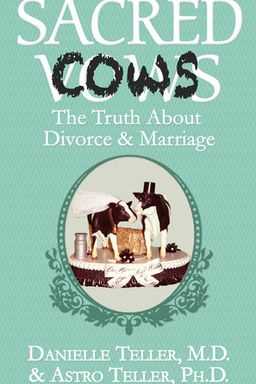
Sacred Cows cover

Sacred Cows

by Danielle Teller and Astro Teller

Sacred Cows exposes the myths surrounding marriage and divorce, challenging societal norms that stigmatize divorce. By dismantling these sacred cows, authors Danielle and Astro Teller empower readers to make informed, guilt-free decisions aligned with their personal happiness and growth.

Tipping the Sacred Cows of Marriage and Divorce

Have you ever felt the weight of societal expectations about marriage and divorce—the silent pressure that whispers you’re a failure if your relationship ends? In Sacred Cows: The Truth About Divorce and Marriage, Danielle Teller, M.D., and Astro Teller, Ph.D., invite you to step into the pasture of cultural beliefs and tip over some remarkably stubborn illusions. Their core argument is that our society clings to false, guilt-inducing assumptions—what they call “Sacred Cows”—that make people in unhappy marriages feel ashamed, defective, or morally wrong for considering divorce. They contend that without questioning these cultural myths, we risk staying trapped in unhealthy relationships and fostering needless suffering, all to maintain appearances of success.

This book offers no marriage-saving formulas or step-by-step happy-ever-after plans. Instead, it teaches you how to think critically about the moral and emotional conditioning that surrounds marriage. Each chapter introduces a different Cow—the Holy Cow, the Expert Cow, the Selfish Cow, the Defective Cow, the Innocent Victim Cow, the One True Cow, and finally the Other Cow. Together, these archetypes highlight how society manipulates fear, shame, and guilt to maintain traditional views of marriage as sacred no matter the cost.

Why These Ideas Matter

Consider this: divorce ranks as the second most stressful life event, just behind the death of a spouse. That statistic, cited from the Holmes and Rahe Stress Scale, underscores how culturally charged the topic is. To be divorced isn’t merely emotional—it’s political and moral. Teller and Teller argue that a truly compassionate society would let couples make decisions about staying together or parting without imposing guilt-laden narratives. They frame divorce not as failure, but as an honest acknowledgment that happiness and compatibility can change over time.

The Core Thesis

At its heart, Sacred Cows asserts that no one should be bullied by cultural expectations into preserving a marriage that’s beyond repair. The authors propose using humor and logic to dismantle myths like “divorce ruins children” or “you’re selfish if you want out.” They aren’t crusading for divorce; rather, they advocate for clarity—for divorcing and married individuals alike—to understand when societal pressures masquerade as moral truths. In a witty, conversational tone punctuated by research and anecdotes, they expose how experts, therapists, and self-help gurus often perpetuate these Cows for profit, power, or validation.

What You’ll Learn from Each Cow

  • The Holy Cow insists that marriage is inherently good, and divorce is always bad—ignoring individual happiness.
  • The Expert Cow hides behind authority and self-help slogans, pushing formulaic fixes without scientific proof.
  • The Selfish Cow equates morality with martyrdom, claiming that leaving a marriage is selfish while staying is noble.
  • The Defective Cow shames those unhappy in marriage as emotionally or sexually flawed.
  • The Innocent Victim Cow weaponizes concern for children, arguing that parental unhappiness should be endured for their sake.
  • The One True Cow preaches romantic idealism before marriage but cynicism afterward, forbidding dreams of true love beyond wedlock.
  • The Other Cow condemns anyone who leaves a marriage to be with someone new—though society romanticizes the same story in movies.

Each Cow mirrors cultural hypocrisy, exposing how we often protect social stability over personal truth. For example, the Holy Cow’s mantra—“Till death do us part”—asks people to pledge eternal love, a promise intellectually indefensible yet socially sacred. The Expert Cow hides in therapy offices and bestselling guides, claiming scientific authority without real proof. And the Selfish Cow shames those who pursue happiness even when staying married harms everyone involved.

A Compassionate Approach

Teller and Teller use humor (“That’s just grazy talk”) to defuse guilt and invite honest reflection. They argue that questioning these Cows isn’t about promoting divorce—it’s about allowing people to evaluate their lives authentically. Their message: marriage can be wonderful, and divorce can be tragic, but pretending every marriage should last forever is neither moral nor logical. Once you understand these Cows, you’re freer to support yourself and others with empathy rather than judgment.

Key Challenge from the Authors

“The Sacred Cows that haunt you aren’t of your making and they aren’t your problem. Work through your marriage with compassion for yourself, your spouse, and your children.”

Ultimately, Sacred Cows is a wake-up call for self-awareness. It encourages you to rethink every assumption—about commitment, love, morality, therapy, and happiness—and to recognize that staying or leaving are both valid choices when guided by truth rather than guilt. This freedom to choose thoughtfully, the authors suggest, is not just emotionally healthy—it’s an act of courage.


The Holy Cow: Divorce as Failure?

The Holy Cow is the moral enforcer of marriage—a self-righteous voice declaring that divorce equals failure and that married people are inherently better. Teller and Teller open by quoting philosopher Margaret Mead: “I beg your pardon; I have had three marriages and none of them was a failure.” That defiance frames the chapter’s challenge to the cultural stigma equating divorce with moral weakness.

The Myth of Eternal Commitment

At weddings, couples pledge undying love—an emotional promise treated as a binding contract. But the authors ask: how could anyone logically promise to feel the same way twenty years later? You wouldn’t sign an employment contract guaranteeing lifelong enthusiasm for a job regardless of change. Yet society demands identical loyalty from spouses. This paradox reveals how marriage vows are infused with denial and wishful thinking. Psychiatrist Esther Perel notes that writing what happens if love ends “is unfathomable,” exposing the taboo around discussing failure at weddings.

Commitment vs. Happiness

The Holy Cow insists that commitment should override happiness. Staying together until death is “success,” even if both partners are miserable. Teller and Teller dismantle this by asking readers to imagine Jennifer and Amir discovering they’re not legally married after ten years. Would their love disappear instantly? Of course not—their bond isn’t validated by paperwork. Likewise, being legally married doesn’t salvage a broken emotional connection.

Politics, Religion, and Social Fear

The Holy Cow’s influence extends beyond individual couples into national policy. The authors critique federal initiatives—like the Bush-era “Healthy Marriage” programs allocating $750 million—to “save” marriage as a cure for poverty. These efforts equate marital status with personal virtue, ignoring the scientific truth that correlation isn’t causation. For example, Sweden’s low marriage rate coexists with far greater social stability and happiness than Libya, which has one of the world’s highest marriage rates. The Holy Cow conflates social order with moral rectitude, weaponizing guilt to maintain conformity.

Tipping the Cow

“Divorce is painful, yes—but pain alone doesn’t mean a choice is wrong. You wouldn’t tell someone to stay addicted to heroin just because withdrawal hurts.”

The authors argue that breaking commitments can be noble when done with integrity. Staying married to feel virtuous helps neither partners nor children. Political and religious systems often invoke marriage as social glue, but such reasoning masks fear of change. True morality, they conclude, lies not in preserving vows at any cost, but in facing truth with compassion.


The Expert Cow: False Authority in Counseling

The Expert Cow wears the mask of authority. She hides in therapists’ offices and bestselling self-help books promising to “save your marriage.” According to Teller and Teller, this Cow exploits desperation by peddling one-size-fits-all solutions without scientific evidence. She preys on vulnerable couples who hope experts can fix problems of love and compatibility—topics too complex for standardized treatment.

The Mirage of Science

The authors dissect marriage counseling research and show there’s no credible proof it prevents divorce. Meta-analyses reveal improvements on something called the Dyadic Adjustment Scale—a fancy way to measure how “distressed” couples feel—but not long-term benefits or saved marriages. In other words, therapy might make you temporarily feel better, but it doesn’t guarantee happiness or permanence.

The Marriage Fairy Thought Experiment

Teller and Teller introduce the “Marriage Fairy,” a playful exercise encouraging couples to articulate their true desires before seeking therapy. Do you wish to rekindle passion—or quietly hope your spouse falls in love with someone else? Unless both partners understand what they want, therapy is misdirected effort. The example of Antoine and Justine shows how formulaic therapy fails when applied without considering emotional reality: when Antoine declares he’s no longer in love, the counselor keeps pushing “empathetic listening” exercises instead of acknowledging that love cannot be conjured by technique.

Experts and Gurus

The chapter critiques celebrity psychologists like John Gottman, whose claim to predict divorce with 91% accuracy captivated media and readers. Teller and Teller expose flaws like “overfitting”—finding correlations that don’t replicate. They explain that Gottman’s studies never tested real-world predictions, making his methods pseudoscientific. The same experts who claim to foresee and fix divorces fail basic standards of scientific proof (a “soft fact,” not a “hard fact,” as the authors quip).

“Marriage counselors aren’t gods. Neither are marriage gurus. Their data wouldn’t survive the FDA’s laughter test if therapy were a drug.”

Empowerment Against Expertise

Rather than submitting blindly to experts, couples should trust their own instincts—the book’s new “MOO Scale” humorously mirrors scientific questionnaires by asking one simple thing: are you happy? That single question predicts marital quality better than elaborate tests. The Expert Cow thrives on making people doubt their perceptions; tipping her means reclaiming confidence in your own judgment.


The Selfish Cow: Who Owns Happiness?

The Selfish Cow is bold, loud, and moralistic. She declares that staying married is selfless while divorcing is selfish. Teller and Teller argue that this binary thinking distorts ethics and breeds guilt. The chapter examines why human beings equate sacrifice with virtue—even when staying married hurts everyone.

Is Seeking Happiness Immoral?

Using humor and hypothetical scenarios, the authors dismantle the idea that divorce motives are selfish. In one case, Ayelet stays married for comfort rather than love; in another, Bob endures misery to avoid guilt. Through these vignettes, we see that selfishness and selflessness are situational—not moral absolutes. Philosopher Blaise Pascal’s observation that “all men seek happiness” frames the argument: staying in a bad marriage isn’t noble—it can be an act of fear.

The Oxygen Mask Metaphor

Borrowing an analogy from airplanes, the authors remind you to “put on your own oxygen mask first.” You can’t help your children or spouse if you’re emotionally suffocating. The Selfish Cow twists responsibility by insisting that seeking personal happiness is indulgent. Ironically, self-neglect breeds more misery for everyone. In many self-help books, taking care of yourself inside a marriage is praised—but taking care of yourself by leaving leads to shame. That contradiction exposes the Cow’s hypocrisy.

Hard Work vs. Masochism

Society repeats the mantra “marriage is hard work.” Teller and Teller poke fun at this cliché by interviewing the Cow herself: “If your marriage is unhappy, keep working harder!” The authors compare this logic to circular absurdity—effort without reward isn’t virtuous; it’s masochistic. Real hard work makes sense only when it yields joy, growth, or intimacy. As one individual in the book writes, “Our burdens are lighter because we share them.” Happiness, not endurance, should be the standard.

Avoiding Pain vs. Finding Joy

Drawing from Freud, Teller and Teller explain that many stay married to avoid the pain of change rather than to pursue happiness. Fear masquerades as morality; guilt substitutes for courage. Tipping the Selfish Cow means recognizing that self-care isn’t selfish. Sometimes, leaving is the bravest, most giving act one can make—especially when staying perpetuates harm.


The Defective Cow: Shame and Sexual Stereotypes

This Cow loves to whisper that unhappy spouses are broken—flawed psychologically, sexually, or spiritually. Teller and Teller call her “a master of disguise.” She creates fear and shame, particularly around intimacy and desire, claiming only defective people lose interest in their partners. By mocking this idea, the authors liberate readers from guilt tied to cultural myths about sex and marriage.

The Lost Libido Myth

Society often claims married women lose sexual interest due to fatigue or hormones. Yet, as Teller and Teller humorously note, sometimes “she’s just not that into him.” Admitting loss of attraction threatens social ideals, so culture medicalizes desire with pills and therapies. They introduce “Barbara,” who loves everything about life except sex with her husband. Rather than accepting that love and attraction can fade, Barbara is told she must be defective. The absurdity of this diagnosis exposes the Defective Cow’s cruelty.

When Marriage Becomes a Business

The book critiques authors like Lori Gottlieb who advise “settling for Mr. Good Enough,” framing marriage as a pragmatic partnership. If marriage is mainly an economic or logistical contract, Teller and Teller ask why anyone should expect passionate sex. This contradiction—society preaches realism but demands romance—creates impossible expectations. Anthropologist Helen Fisher’s studies suggest only a minority experience lifelong passion, making it irrational to shame those who don’t.

Old-Fashioned Morality

To keep marriages intact, the Defective Cow teams up with conservative experts who praise “institutional marriages” focused on duty over happiness. By redefining success as endurance, modern culture revives outdated ethics once designed for economic survival. Teller and Teller argue that now marriage is a choice, not an obligation; labeling unhappiness as defectiveness denies that freedom.

“If you are no longer in love, that’s not a diagnosis. It’s a truth.”

Recognizing that attraction may fade isn’t failure—it’s honesty. The authors invite readers to replace shame with clarity and humor, reminding everyone that “Perfectly Normal in New England” might describe more of us than we think.


The Innocent Victim Cow: Divorce and Children

The Innocent Victim Cow tugs most effectively at the heartstrings. She insists that divorce damages children irreparably. Teller and Teller tackle this emotionally charged myth with empathy and evidence, showing that while divorce can cause short-term distress, most children adapt—and many thrive when freed from household conflict.

Separating Emotion from Evidence

The authors don’t deny that children suffer when families change. But they expose how fear-based propaganda exaggerates harm. They review Paul Amato’s meta-analyses often cited as proof of divorce’s devastation, revealing that most studies found no significant difference in long-term outcomes between children of divorced and intact households. When differences appear, they’re statistically tiny—about one quarter of one standard deviation, akin to half an inch of height.

Understanding Bias

Researchers distort findings through selection bias: divorced families differ socially and economically from intact ones. Comparing them is like comparing hockey players in Canada vs. Mexico—it ignores context. Professor Philip Cohen humorously tells the authors, “Anyone who says they’re controlling for selection is not. We don’t measure the things causing both divorce and kids’ problems.” This exposes how flawed studies translate into moral condemnation.

Real Stories of Healing

Personal accounts in Sacred Cows deflate the stereotype of broken children. A father from Denver describes how divorce strengthened his bond with his daughters, giving them “more downtime, more intimacy.” A college student laments that her parents stayed married too long “for the kids,” creating deception and guilt that hurt more than the eventual split. These examples reframe family restructuring as potential growth instead of tragedy.

“There are lots of reasons to think hard before divorcing—but guilt about disadvantaging children should not be one of them.”

Teller and Teller conclude that genuine harm comes not from divorce but from dishonesty and prolonged conflict. Emotional authenticity, not performance, best nurtures kids. The Innocent Victim Cow falls easily when confronted with compassion plus logic.


The One True Cow: The Myth of Soulmates

The One True Cow is two-faced: she romanticizes love before marriage and cynically denounces it afterward. According to Teller and Teller, this Cow persuades society to worship ‘true love’ until it threatens the stability of marriage—then she calls it delusion. Rooted in fairy tales and Hollywood plots, this Cow perpetuates emotional whiplash that confuses generations about love’s meaning.

Plato’s Lost Halves

The authors trace the myth to Plato’s story of humans sliced in two by Zeus, destined to search eternally for their other halves. Modern culture echoes this yearning for completion but condemns it once vows are spoken. Using Barbie and her Island Prince as a humorous parable, Teller and Teller show how stories glorify risking everything for love—but if Barbie had arrived after the prince’s wedding, she’d be shamed instead of celebrated. Thus, true love is championed before “I do,” forbidden after.

Love as Feeling or Behavior?

When passion fades, society redefines love as duty, patience, and kindness. But that shift—though noble—contradicts our innate longing for vitality. Self-help authors like Gottman describe “friendship” and “fondness” instead of passion because formulas can’t create love. As Teller and Teller quip, intimacy exercises may build craftsmanship, but “craftsmanship is not art.” Separating love from emotion sanitizes relationships but kills their magic.

Hypocrisy and Cultural Whiplash

The One True Cow’s hypocrisy fuels confusion. Before marriage, she urges bravery—“Follow your heart!” After marriage, she demands resignation—“Forget true love; it’s a myth.” This manipulation ensures social order: fewer divorces, more conformity. Yet teller and Teller argue for honesty: admit that some marriages lose love, and let people seek authenticity without shame. In the end, they remind us that society’s moral consistency should not depend on marital status.


The Other Cow: Love After Divorce and Social Judgment

The Other Cow gossips, judges, and moralizes about anyone leaving a marriage for someone else. She conflates adultery with immorality and uses it to shame divorce. Teller and Teller examine how this Cow weaponizes jealousy and hypocrisy, portraying those who seek new love as villains even though society celebrates identical behavior in romantic movies.

Affairs vs. Authenticity

The authors clarify that their issue isn’t adultery—it’s the assumption that divorce triggered by new love is always wrong. Through “Jose’s thought experiment,” readers test their biases. Most approve his divorce when no new partner exists, but condemn him once there’s a coffee shop woman involved. This emotional inconsistency exposes how the Cow manipulates moral discomfort to maintain control.

Letters and Double Standards

The chapter features two letters from “Arnold” to friends Ann and Jeff, one judged, one absolved. His hypocrisy illustrates society’s selective morality: women who stray are shamed as destroyers, while men are excused as seekers of truth. Teller and Teller reveal how guilt often masquerades as moral advice—the friend’s compassion evaporates when empathy conflicts with convention.

Hollywood Hypocrisy

Movies like Sleepless in Seattle glorify leaving an engagement for “true love.” Yet if Annie had been married, we’d call her immoral instead of romantic. This double standard shows how society prizes narrative stability over honesty. Teller and Teller argue that condemning divorce for new love isn’t moral—it’s possessive.

“You can condemn adultery without condemning divorce. Morality isn’t a fence that traps you—it’s a compass that helps you walk free.”

By separating moral judgment from emotional truth, the authors invite compassion toward those navigating new love with integrity. Tipping the Other Cow means recognizing that endings and beginnings are both natural parts of the human search for happiness.

Dig Deeper

Get personalized prompts to apply these lessons to your life and deepen your understanding.

Go Deeper

Get the Full Experience

Download Insight Books for AI-powered reflections, quizzes, and more.