
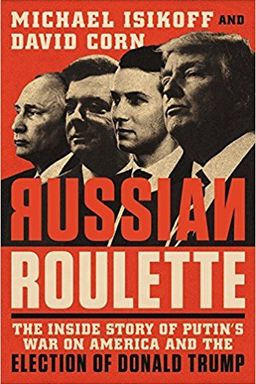
Russian Roulette cover

Russian Roulette

by Michael Isikoff and David Corn

Russian Roulette offers an in-depth investigation into Russia''s interference in the 2016 U.S. presidential election. Authors Michael Isikoff and David Corn unravel the intricate connections between Trump''s campaign and Russian operatives, exploring how cyber tactics and disinformation shaped the election''s outcome. This compelling account provides crucial insights into the vulnerabilities of modern democracies.

Russia, Power, and the 2016 Political Web

You can think of this book as an anatomy of modern influence—how Russian power strategies evolved from Cold War espionage into cyber age manipulation and how those tactics intersected with Donald Trump’s business life and the 2016 election. Across its chapters, you watch personal ambition, digital deception, and geopolitical rivalry merge into one narrative of hybrid conflict and political vulnerability.

From Business Ties to Political Exposure

The first thread follows Trump’s long pursuit of deals in Russia: his partnership efforts with Aras and Emin Agalarov after Miss Universe 2013, subsequent negotiations through Felix Sater for Trump Tower Moscow, and multiple attempts to gain Kremlin signoff on real estate branding. These decades of overtures formed a business-political nexus that blurred lines between private aspiration and national interest—an important source of scrutiny as Trump later ran for president.

(Note: Similar patterns of personal diplomacy shaping foreign exposure appeared in books about oligarchic networks by Catherine Belton and Masha Gessen.)

Geopolitical Turn: From Reset to Rivalry

In parallel, the U.S.–Russia relationship transformed during the Obama years. Efforts at an early-term "reset" collapsed after Russia’s invasion of Ukraine and the Magnitsky Act’s sanctions. These events set the stage for Russia’s antagonism toward Western institutions and pushed the Kremlin toward active measures—covert methods blending intelligence, hacking, and propaganda aimed at weakening opponents without traditional military confrontation.

Kompromat and Covert Leverage

The book situates kompromat, or compromising material, as a longstanding Russian tactic—stretching from the Yury Skuratov scandal of 1999 to the Litvinenko poisoning in 2006 and into modern cyber-enabled leaks. Putin’s inner circle learned that personal or political exposure can yield control; kompromat thus became both deterrent and weapon. By the time the 2016 race unfolded, email hacks and timed leaks functioned as digital kompromat—reshaping perception rather than coercing directly.

Digital Hybrid Warfare

General Valery Gerasimov’s 2013 doctrine reframed war as a continuum of informational, economic, and psychological pressure. You see how this played out through troll farms like the Internet Research Agency (IRA), cyber intrusions by groups known as Cozy Bear and Fancy Bear, and the coordinated use of state outlets RT and Sputnik. Together, they ran not only theft operations (as in the DNC hack) but intentional release campaigns designed to polarize voters and undermine faith in democratic systems.

Campaign Contacts and Counterintelligence

These digital tactics met fertile ground in an American campaign eager for foreign-sourced opposition research. You follow figures like George Papadopoulos hearing rumors of Russian "dirt" on Hillary Clinton, Trump Jr.’s willingness to meet Natalia Veselnitskaya, and Paul Manafort’s emails to Oleg Deripaska’s aide. Those interactions motivated FBI counterintelligence action—beginning with Papadopoulos’s tip and expanding into secret FISA surveillance on Carter Page.

Information Warfare in Practice

The DNC and Podesta email releases showcased the full orchestration: intelligence theft paired with timed disclosure through WikiLeaks to dominate the news cycle. Social-media manipulation amplified fallout as the IRA’s U.S.-targeted personas spread divisive ads and memes. Media coverage reacted mostly to content, not attribution, which is precisely what Russian strategists intended—to redirect focus from "who did this" to "what was said."

Government Deliberations and Policy Constraint

Inside Washington, national-security principals debated action. Susan Rice, John Brennan, and James Clapper weighed sanctions, disclosure, and cyber retaliation. Their caution reflected fear of escalation and politicization. Ultimately, the October 7, 2016, ODNI/DHS statement publicly attributed the operation to senior Russian officials—but the announcement was overshadowed the same day by the explosive Access Hollywood tape, demonstrating how media timing neutralized state-level messaging.

Transition and Consequences

After the election, Obama’s administration expelled diplomats and imposed sanctions. However, Trump transition contacts—Michael Flynn’s calls with Russian Ambassador Kislyak and Jared Kushner’s meeting with banker Sergey Gorkov—raised new alarms. These episodes laid groundwork for congressional and special-counsel investigations that defined U.S. politics in 2017 and beyond.

Central takeaway

Across all parts, you witness the collision of personal ambition, systemic vulnerability, and foreign exploitation. Russia’s updated hybrid warfare meets an American political culture unhardened against informational attack—producing a case study in how state power can weaponize openness, media, and ego to achieve strategic disruption.

This synthesis invites you to connect cues: real estate overtures preluding political flirtations; cyber intrusions morphing into public leaks; cautious policymaking setting conditions for misinformation; and an enduring lesson—that transparency itself can be turned into a tool for control when adversaries master its rhythms better than democracies do.


Trump’s Business Nexus with Russia

Donald Trump’s fascination with Russia predates his presidency and reveals an enduring pattern: commercial ambition intertwining with political exposure. The book recounts how Trump’s pursuit of Moscow real estate, particularly around Miss Universe 2013 and subsequent Trump Tower projects, connected him to oligarchs like Aras Agalarov and intermediaries such as Felix Sater. These ventures were not isolated—they became touchpoints later reexamined when Russian influence operations surfaced.

Miss Universe and Kremlin Gateways

The Miss Universe event in Moscow served as Trump’s introduction to high-level Russian figures. Aras Agalarov’s hospitality and Rob Goldstone’s coordination brought Trump close to Kremlin-linked partners. Putin’s press secretary Dmitry Peskov reached out by phone, reinforcing Trump’s perception of political welcome. Shortly afterward, Trump and his children explored Moscow sites for branded development, demonstrating how celebrity enterprise can morph into geopolitical visibility.

Business Meets Geopolitics

Trump Tower Moscow negotiations faltered amid sanctions following Russia’s Ukraine invasion. When Felix Sater tried reviving the deal in 2015–2016, leveraging I.C. Expert Investment Company with hints of Kremlin financing, Trump’s campaign intersected with private efforts requiring Russian approval. This overlap illustrates institutional risk: foreign partners positioned to offer commercial advantages during political ascent.

Key takeaway

The history of Trump’s ventures shows how profit motives can open channels of influence. Those financial pathways later became conduits for political messaging and potential leverage—the very mechanics exploited by Moscow’s active measures strategy.


Russia’s Hybrid and Information Warfare

Under Vladimir Putin, Russia modernized its intelligence toolkit into a hybrid strategy combining military, cyber, and informational operations. The Gerasimov doctrine redefined war as omnidimensional—using influence instead of invasion. That framework underpinned actions from hacking campaigns to troll factories designed to fracture societies and undermine Western cohesion.

Mechanics and Actors

Groups like Fancy Bear and Cozy Bear performed penetrations of U.S. systems; the Internet Research Agency orchestrated social-media hysteria through fake accounts and event planning; RT and Sputnik served as megaphones for misleading counter-narratives. You learn how each pipeline—technical, social, media—formed part of an integrated operation aimed at perception manipulation.

Weaponized Release

The book stresses timing. Stolen data mattered less for its content than for when and how it was released—near conventions or debates to inflame internal party rifts. Russian planners used disinformation amplification to foment anxiety about fairness and legitimacy of U.S. elections. The term “active measures” thus evolved from KGB jargon into digital choreography.

For you, understanding hybrid warfare means seeing media ecosystems as combat zones and recognizing that narrative dominance—rather than territorial conquest—is the modern battlefield’s ultimate prize.


Kompromat and Covert Power

Kompromat remains central in Russia’s political toolbox—a continuity from Soviet blackmail to cyber-era exposure. The Litvinenko case, poisoned in London in 2006, symbolizes the regime’s reach. Subsequent scandals such as Yury Skuratov’s videotape humiliation reveal how personal vulnerability is used to maintain obedience. Putin rehabilitated this method as both deterrent and spectacle, signaling that dissent carries personal cost.

Digital Evolution of Kompromat

Where old kompromat relied on film or surveillance, modern versions exploit hacked data—emails, private documents, or photographs—to achieve the same ends publicly rather than secretly. The DNC and Podesta leaks were effectively kompromat released en masse; rather than coercing individuals, they destabilized institutions. (Note: Scholars such as Mark Galeotti describe this progression as “the weaponization of transparency.”)

Insight

Treat sensational or timed leaks not merely as revelations but as structured state interventions—psychological warfare disguised as free information.


Campaign Contacts and Crosscurrents

Trump’s campaign saw numerous intersections with Russian-linked individuals—creating a mosaic of opportunity and risk. George Papadopoulos’s claim that Russia possessed Clinton emails kicked off FBI counterintelligence interest. The June 2016 Trump Tower meeting demonstrated direct willingness by senior campaign members to entertain supposedly official Kremlin material. Manafort’s ongoing exchanges with Konstantin Kilimnik connected the campaign to oligarchic networks.

Patterns and Overlaps

  • Economic channels: promises of real estate or energy collaboration paralleled communication efforts.
  • Media intermediaries: Roger Stone’s messaging about WikiLeaks linked campaign rhetoric to leak timing.
  • Diplomatic exposure: Carter Page’s Moscow visit and Michael Flynn’s RT appearance reinforced external perception of receptivity.

Key observation

You see how scattered contacts—each defensible individually—aggregated into a systemic vulnerability, inviting investigation and spurring unprecedented political scrutiny.


The DNC Hack and Media Impact

The breach of the Democratic National Committee epitomized data weaponization. When Cozy Bear and Fancy Bear infiltrated servers, they executed espionage but also prepared content for psychological release. Guccifer 2.0 and WikiLeaks became the delivery channels, transforming stolen files into viral political instruments.

Media and Timing

The July 22 WikiLeaks dump coincided with the Democratic convention, ensuring maximum disruption. Journalists focused on internal email gossip instead of foreign attribution. Later, the Podesta emails’ drip-feed timed through October sustained damaging headlines and absorbed media oxygen. The Access Hollywood tape release the same day as the ODNI/DHS attribution demonstrates timing manipulation: public attention became a finite resource, easily redirected.

Managing narrative becomes part of national defense because media behavior determines whether citizens perceive manipulation or merely entertainment.


U.S. Intelligence and Policy Response

Washington’s deliberations reveal the difficulty of responding to an influence attack during an election. National Security Council meetings chaired by Susan Rice kept participation minimal to prevent leaks. Officials debated cyber retaliation, sanctions, and disclosure. Michael Daniel’s team proposed offensive operations but was told to stand down—illustrating institutional caution.

Public Attribution

The final choice was modest: issue an intelligence-community statement without direct presidential involvement. The October 7 pronouncement confirmed senior Russian authorization but avoided naming Putin. FBI Director Comey withheld endorsement, fearing politicization. The strategy prioritized stability, though critics said restraint allowed misinformation to flourish unchallenged.

Key lesson

Rapid, transparent attribution can deter future interference—but only if matched with media bandwidth and political unity.


Social Media and Psychological Operations

Russia’s Internet Research Agency turned Facebook and Twitter into delivery mechanisms for propaganda. By creating false American personas, organizing rallies, and purchasing microtargeted ads, the troll farm exported divisiveness at scale. Their content exploited racial, ideological, and cultural tensions—showing that information warfare thrives on existing fractures, not invented causes.

Amplification Dynamics

Social algorithms rewarded emotional engagement, aiding the disinformation cascade. When the Trump campaign’s own digital targeting overlapped with IRA narratives, network synergy amplified both—regardless of intent. A modest budget created millions of impressions, proving how cheaply influence could be purchased when combined with platform design.

Practical takeaway

For you as an observer, every viral story merits forensic curiosity: who seeded it, who shared it, and whose interests it served?


The Steele Dossier and Investigative Fallout

Christopher Steele’s memos bridged the private and official intelligence worlds. Commissioned by Fusion GPS for political research, the dossiers contained allegations of Kremlin cultivation of Trump and purported sexual kompromat. Though unverified, their existence catalyzed FBI inquiries and media frenzy. Glenn Simpson’s dissemination to journalists and Steele’s briefings to FBI agent Michael Gaeta blurred lines between partisan opposition research and national security concern.

Political and Institutional Consequences

The dossier influenced surveillance decisions (notably the Page FISA) and prompted debate about intelligence standards. When BuzzFeed released the full document, public conversation pivoted from substance to sensationalism. This incident illustrates how unverified intelligence can both illuminate risks and distort discourse.

Key takeaway

Private intelligence becomes perilous when its plausible but unproven data navigates public and institutional domains—it can spark oversight or chaos with equal ease.


Transition Turmoil and Lasting Repercussions

The post-election months exposed how diplomacy and intelligence intersect in unstable handovers. Obama’s administration imposed late sanctions and expulsions, while members of Trump’s incoming team initiated contacts contradicting standard protocols. Flynn’s conversations with Russian Ambassador Kislyak and Kushner’s meeting with banker Sergey Gorkov symbolized blurred boundaries between campaign, transition, and governance.

From Reaction to Investigation

These interactions, combined with earlier hacking evidence, drove momentum for congressional inquiries and Special Counsel Mueller’s appointment. The transition showed how foreign communication—even absent explicit illegality—can reshape political legitimacy.

Final note

Crises rarely end on election night; they evolve through the institutions expected to contain them. The transition’s blurred diplomacy became the origin of the next political chapter—investigations, indictments, and enduring mistrust.

Dig Deeper

Get personalized prompts to apply these lessons to your life and deepen your understanding.

Go Deeper

Get the Full Experience

Download Insight Books for AI-powered reflections, quizzes, and more.