
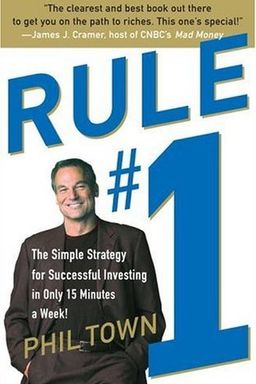
Rule #1 cover

Rule #1

by Phil Town

Rule #1 by Phil Town is a transformative guide that simplifies investing for everyone. Learn how to identify promising stocks and make savvy investment decisions using straightforward strategies and online tools, ensuring financial growth in just 15 minutes a week.

Building Wealth by Not Losing Money

How do ordinary people build lasting wealth without gambling on Wall Street? In Rule #1, Phil Town argues that true investing isn't about speculation or blind trust in mutual funds—it’s about applying one unbreakable rule: Don’t lose money. This deceptively simple command, borrowed from Warren Buffett, becomes a complete, actionable system centered on buying wonderful businesses at attractive prices. Town shows you how to think like an owner, not a trader, using repeatable processes grounded in logic, data, and discipline.

At its heart, Rule #1 investing fuses value investing principles from Buffett and Benjamin Graham with practical, DIY tools adapted for the modern investor. It’s accessible to anyone—teachers, parents, young professionals—who wants to grow their savings at 15% compounded returns while keeping risk minimal. Town isn’t selling abstract theory; he uses his own story as a river guide turned millionaire and the journey of real students like Julie, a stay-at-home mom who doubled her savings, to prove that the approach works in real life.

From Speculation to Ownership

Rule #1 rewires how you see stocks. Instead of treating them as lottery tickets, you see each share as part ownership in a real business you could hold for a lifetime. This mindset forces you to ask four essential questions before buying—whether the company has Meaning to you, a durable Moat, strong Management, and a price that includes a Margin of Safety. These “Four Ms” form the book’s core decision framework.

Town’s philosophy doesn’t demand hours in front of a ticker. With the right process, he insists, you can manage your portfolio in about 15 minutes a week. You spend that time reviewing watch lists, checking business results, and comparing current prices to fair value—treating investing like shopping for bargains, not gambling on trends. The goal is retirement-ready, inflation-beating returns using discipline rather than dependence on financial advisors or fund managers.

The Big Picture of Rule #1

Town guides you through practical phases that flow logically: learning how to identify great businesses (Four Ms), confirming their predictability through financial metrics (the Big Five), determining what price to pay (Sticker Price and Margin of Safety), and using timing tools to buy or sell with confidence. Each phase builds on the prior one, creating a step-by-step path any motivated reader can follow. The book blends robust fundamentals—like Value Investing 101—with tactical trading awareness, bridging the worlds of long-term ownership and short-term risk control.

Avoiding the Myths That Keep You Poor

Phil dedicates part of the book to dispelling industry myths: that you have to be an expert to invest, that you can’t beat the market, and that diversification is always safe. In his words, these myths keep regular investors passive and dependent on fund fees while delivering mediocre outcomes. By embracing Rule #1, you learn that markets misprice assets constantly and that disciplined individuals can outpace the averages by waiting patiently for obvious bargains and then pouncing with confidence.

A Blueprint for Everyday Investors

Rule #1 is relentlessly practical. Town shows you how to use free financial websites, estimate growth rates using simple “Rule of 72” math, and apply visual timing tools like MACD and Moving Averages to track institutional flows. He emphasizes practical risk controls—paying off high-interest debt, using tax-advantaged accounts, and diversifying wisely across a handful of fantastic businesses. Throughout, stories like Doug and Susan Connelly’s show you how average couples can replicate his method step-by-step to transform small portfolios into foundations of long-term freedom.

Certainty Through Simplicity

What makes Town’s method powerful is its blend of simplicity and rigor. His 15% target anchors every decision—from valuation models to growth estimates—and his 50% Margin of Safety ensures you protect yourself from error. He insists on emotional control: you never buy a company you don’t understand or one that fails your checklist. You learn to act only when opportunity aligns with discipline, making fear and greed your servants rather than your masters.

The Core Insight

Rule #1 isn’t about quick trades—it’s about permanent principles of capital preservation and compounding. Once you learn to identify meaning, confirm a moat, verify management integrity, and buy at a generous margin of safety, you no longer need luck. You gain a system that balances defense and offense, logic and patience, math and mindset.

In sum, Phil Town reframes investing as a disciplined act of ownership rooted in common sense. By combining Buffett’s philosophy with modern tools and an everyday workflow, he gives you a playbook for financial independence built on one idea that never changes: never lose money.


The Four Ms of Smart Investing

The Four Ms—Meaning, Moat, Management, and Margin of Safety—are the cornerstone of Rule #1 investing. They transform investing from guesswork into disciplined evaluation. If a company fails any one of them, you walk away. If it passes all four, you’ve found a potential lifetime business at a bargain price.

1. Meaning — Know and Care About What You Own

Meaning asks whether you understand and connect with the business. If you wouldn’t own it for ten years, don’t buy it for ten minutes. Phil’s Three Circles exercise—what you love, what you’re good at, and where money flows—helps you identify industries within your “circle of competence.” Personal experience (like Town’s background in outdoor sports) can give you valuable investment insight into brands such as Columbia Sportswear or Harley-Davidson.

2. Moat — Find What Protects Profit

A Moat is a company’s durable competitive advantage—its economic castle walls. Town outlines five Moat types: Brand (Coca-Cola), Secret (Pfizer patents), Toll (utilities), Switching Costs (Microsoft), and Price Advantage (Wal-Mart). A wide moat keeps competitors out and profits predictable. He teaches you to spot Moats in the numbers—stable ROIC, consistent equity growth, and rising free cash flow all signal a fortress business.

3. Management — Bet on the Jockey

Warren Buffett says he bets “on the jockey, not just the horse,” and Town adopts the same rule. Great CEOs act like owners, communicate transparently, and align their pay with long-term value creation. You look for candor in letters (like those by John Mackey of Whole Foods) and red flags in excessive compensation or frequent insider selling. Reading 10-Ks, SEC filings, and interviews helps reveal character; honesty and competence matter more than charisma.

4. Margin of Safety — Protect Yourself from Error

Even the best business can be a terrible investment if you overpay. The Margin of Safety (MOS) ensures you don’t. Town insists on buying a company only when its market price is roughly 50% below its fair intrinsic value—its “Sticker Price.” This cushion allows for mistakes in forecasts, market volatility, or surprise events. In essence, the MOS is how you obey Rule #1 even if you misjudge slightly.

In Practice

You apply the Four Ms sequentially: start with Meaning, confirm a real Moat, vet honest Management, and only then check price. You’ll reject most companies—but the few that qualify can change your financial life.

The Four Ms aren’t just filters—they’re habits that shift you from emotional guessing to rational ownership. They help you internalize the mindset of elite investors without needing Wall Street credentials.


Decoding the Big Five Numbers

To confirm a company’s quality, Town simplifies finance into five core metrics he calls the Big Five: Return on Invested Capital (ROIC), sales growth, earnings per share (EPS) growth, equity growth, and free cash flow growth. Across all five, consistency is the magic word. Each should trend above 10% annually over a decade to signal a predictable, high-quality business worthy of deeper analysis.

1. ROIC — The True Test of Business Quality

ROIC measures how efficiently management turns capital into profit. A steady ROIC above 10% means the company creates true owner value. For instance, Apollo Group’s 30% ROIC reflected strong pricing power; General Motors’ near-zero ROIC revealed a deteriorating business with no moat. Town treats ROIC as the ultimate sanity check for Management performance.

2. Sales and EPS Growth — The Engine of Expansion

A decade of steady revenue and earnings growth implies customer loyalty and managerial skill. If EPS lags behind sales, it raises red flags about costs or dilution. You look for harmony across both indicators to ensure the growth story isn’t hollow. Town uses examples like Dell and Whole Foods to illustrate how aligned growth across metrics builds investor certainty.

3. Equity Growth — The Book Value Multiplier

Equity growth is Town’s favorite predictor of future returns. It measures the increase in owners’ capital—essentially how much “surplus cash” the business keeps and reinvests productively. He notes that Harley-Davidson’s steady 24% annual equity growth made it a textbook Rule #1 candidate, while erratic book value signals poor survivability. Equity growth drives intrinsic value more reliably than EPS alone because it reflects retained earnings, not accounting tricks.

4. Free Cash Flow and Debt Discipline

Free cash flow reveals how much money the company truly generates after expenses. You want to see consistent positive cash flow aligned with growth metrics. Town also folds in a simple debt test: divide total long-term debt by annual free cash flow. A result under 3 signals manageable leverage; higher than that, danger. (For instance, H&R Block’s 3-year debt payoff was acceptable; GM’s wasn’t.)

The Power of Pattern Recognition

When all five numbers point up steadily, you’re seeing the footprint of a widening moat. When even one turns erratic, you’re seeing cracks in the defenses. That pattern determines whether you dig deeper—or walk away.

The Big Five turn investing from an art into a measurable science. They expose whether Management, Moat, and Meaning align into a predictable engine of compounding wealth. Without Big Five consistency, no MOS can protect you long-term.


Valuing Businesses the Rule #1 Way

Once you spot a wonderful business, the next challenge is knowing what it’s worth. Town teaches a practical valuation process combining Buffett’s intrinsic value logic with simple math. He calls the outcome the Sticker Price—the business’s fair market value today—and the price you’re willing to pay the Margin of Safety (MOS) price.

Step 1 — Estimate Future Earnings

Find the company’s current EPS and estimate a growth rate for ten years—ideally based on historical equity growth or conservative analyst consensus. Using the “Rule of 72,” you approximate how often earnings will double. For Harley-Davidson (EPS ≈ $0.89, 24% growth), the company’s profits doubled roughly every three years, reaching ≈ $7.50 in a decade.

Step 2 — Assign a Conservative Future PE

Town suggests starting with 2× the growth rate as a default price-to-earnings multiple, then comparing to the company’s historical average, using the lower of the two. Conservatism protects you from optimism bias. Harley’s example used a future PE of 46 despite a possible 48, while GM’s weaker fundamentals warranted only 12.

Step 3 — Discount to Today

Multiply future EPS by the chosen PE to find the estimated future price. Then discount it back ten years at your 15% target return (money quadruples every decade at that rate). The result is the Sticker Price—the fair value today. Buying at half of that (your MOS) ensures at least 15% compounded returns even if the forecast slips.

Examples in Action

Apollo Group trading at $10 when its Sticker was $40 became a multibagger success; GM trading above Sticker delivered subpar returns. The same math applies to real estate and private businesses—buy at yield rates that embed safety. Town proves how MOS transforms volatility into opportunity by turning price drops into signal lights for buying.

MOS is the Safety Net

By demanding a 50% discount to fair value, you protect yourself from analytical errors and market chaos. Miss a few assumptions and you’ll still likely win. Skip the MOS and one bad estimate can destroy years of gains.

Town’s valuation model is the disciplined bridge between business fundamentals and investor behavior. It lets you quantify “Don’t lose money” and, just as importantly, gives you patience—because when price meets MOS, you act; when it doesn’t, you wait.


Timing and Institutional Flows

After you know what a business is worth, the final decision is when to buy or sell. While value provides direction, market timing can protect you from being crushed by institutional waves. Town introduces three Tools—MACD, Stochastics, and Moving Averages—that reveal when big money is entering or leaving a stock.

Understanding Mr. Market’s Stick

Phil’s metaphor is vivid: Mr. Market swings a stick, and when institutional investors sell, small holders feel the blow. Institutions move billions slowly like cruise ships—you, the retail investor, are a speedboat that can dodge early if you watch their wake. The Tools are your radar.

The Three Tools Explained

  • MACD: Measures momentum. When the faster EMA crosses its slower counterpart upward, institutions are likely buying. Town favors an 8–17–9 configuration for quick signals.
  • Stochastics: Shows when a stock is overbought (>80) or oversold (<20). Crossovers from oversold zones often precede big institutional buying rounds.
  • Moving Average: A simple confirmation that price trends align with buying or selling pressure. Town often uses a 10-day average as the simplest stress test.

You act only when all three agree—buy when all turn positive, sell when all turn negative. It’s simple pattern confirmation, not day trading.

Case Studies

Starbucks’ buy signal in 2004 (Tools aligned near $49) preceded a climb to $57; Apple’s sell signal in 2000 came two weeks before earnings collapsed—proof that the Tools trace institutional footprints before headlines arrive. Similar patterns in Enron showed quiet exits months before disaster. These Tools help you avoid blind optimism even when fundamentals look pristine.

Why Timing Matters

Even a 50% MOS can’t shield you from panic-driven collapses if you hold through institutional outflows. The Tools give you the flexibility Buffett has through intuition—with data instead of gut feel.

Town empowers everyday investors to use this “radar” without complexity. Spend minutes a day reviewing chart indicators, and you can enter and exit with confidence, preserving capital while compounding returns at Buffett-like rates.


Practical Steps and Real-Life Discipline

Translating Rule #1 from theory to daily practice requires process, not perfection. Town equips you with a workflow, safety nets, and habits that make the philosophy livable. His “baby steps” approach—exemplified by Susan and Doug Connelly’s story—proves that average people can start small and build substantial wealth through consistency.

The Step-by-Step Workflow

  • Identify your circle of competence through the Three Circles (passion, skill, money flow).
  • Screen compatible companies with the Big Five and Four Ms.
  • Calculate Sticker and MOS prices using the Rule of 72.
  • Wait patiently for MOS-level pricing, then confirm technical buy signals with the Tools.
  • Monitor 15 minutes weekly—checking ROIC, equity, management updates, and price trends.

Risk and Tax Discipline

Town stresses that “Don’t lose money” starts at home. Pay off high-interest debt before investing—it’s illogical to seek 15% investment returns while paying 18% to credit cards. Use Roth or self-directed IRAs to avoid tax drag, and employ small trailing stops (about 5%) as insurance against sudden downturns.

Case Study — The Connellys’ Transformation

Doug and Susan start with $20,000 and $500 monthly investments. They apply Rule #1 to Cheesecake Factory, validate a 20% growth rate, and buy below MOS with all three Tools signaling green. Within two years, their account compounds to nearly $78,000. The takeaway: systematic discipline trumps complexity. Learning beats luck.

Keep It Simple and Repeatable

Town’s practical toolkit includes Ruleoneinvestor.com calculators, free financial statements, and quick mental shortcuts. You don’t need spreadsheets—you need consistency. He allows a small “risky biz” bucket (around 10%) for speculation, but insists that 90% of wealth should follow Rule #1 rigorously.

Key Attitude

Investing mastery is less about IQ than EQ. The habit of waiting, watching, and acting only when the odds align keeps your emotions from becoming your enemy—a thread tying Town, Buffett, and Graham together.

By combining a financial process with mental discipline, Phil Town offers a pathway to financial freedom that scales with your life. Rule #1 isn’t a get-rich-quick scheme; it’s a get-smart-slowly system. With patience, math, and a margin of safety, you win by never letting losses define your story.

Dig Deeper

Get personalized prompts to apply these lessons to your life and deepen your understanding.

Go Deeper

Get the Full Experience

Download Insight Books for AI-powered reflections, quizzes, and more.