
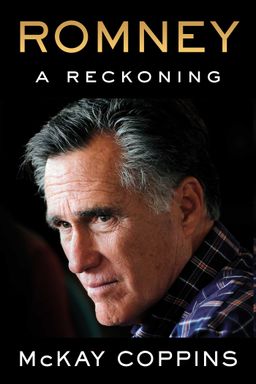
Romney cover

Romney

by Mckay Coppins

A staff writer at The Atlantic profiles the Republican senator from Utah and former governor of Massachusetts.

Conscience Against Convenience

What does it cost to choose your oath over your tribe? This book argues that Mitt Romney’s career is a sustained test of whether conscience can restrain convenience in American public life. From a father’s example of lonely courage to a son’s vote to convict a president of his own party, the narrative shows you how principles and prudence wrestle inside a leader who treats institutions as sacred rather than as weapons.

The moral yardstick

The story opens on January 6, 2021, with visceral detail: a warning call from Senator Angus King about online chatter, texts to Mitch McConnell that go unanswered, and Ann Romney’s plea that her husband skip the certification. Romney goes anyway. He believes the peaceful transfer of power requires witness, not retreat. When rioters breach the Capitol, he tells colleagues like Josh Hawley, "You did this"—a direct line drawn from rhetoric to physical consequence. That scene sets the book’s thesis: leadership is measured when institutions tremble.

Formation: George’s shadow and Mormon duty

You can’t understand Romney without George Romney. The father, who marched for civil rights and opposed Barry Goldwater in 1964, taught that being alone can be the price of being right. But George’s 1967 Vietnam "brainwashing" comment also taught how truth-telling can be politically fatal. Mitt absorbs both lessons. He vows to be courageous like his father and disciplined enough to avoid self-immolation—a hybrid that shapes his campaigns, boardroom conduct, and Senate votes. (Note: this inheritance echoes other political dynasties, but it is uniquely inflected by Latter-day Saint notions of service and sacrifice.)

Markets, management, and moral cost

Romney’s Bain years sharpen his operational reflexes and expose him to the ethical ambiguities of private equity. Staples becomes a showcase win; Ampad and Dade International become cautionary tales of optimization’s human costs. He writes in his journals about rationalization—the easy slide from "fiduciary duty" to moral blinders—and later pays a political price as opponents cast him as callous. This duality becomes the book’s throughline: Romney both benefits from systems discipline and learns how spreadsheets can miss community harm.

Crisis as proving ground

The 2002 Salt Lake Olympics transform Romney from financier to civic rescuer. He inherits scandal, deficits, and with 9/11, a new security reality. He insists on symbolism (coach-class travel, city-wrap imagery) and logistics (new sponsors, DOJ cooperation). The Games end in surplus and praise—Dick Ebersol credits Romney for the turnaround—and give him a cinematic identity: fixer under pressure. That mold recurs in COVID response, where he pushes early remote work, direct $1,000 payments, and expert-led logistics over performative rhetoric.

The authenticity trap

In campaigns, Romney manages like a consultant—hire killers, message-test, iterate. The paradox bites: "I’m the authentic person who seems inauthentic." He triangulates on issues (abortion, the individual mandate) and pursues policy he believes will work, then retrofits ideology with think-tank cover. The 2012 "47 percent" video becomes a crucible where one sentence overrides months of competence. His first-debate comeback can’t erase a viral frame: elitist and out of touch. The book’s lesson is blunt—empathy and narrative coherence matter as much as spreadsheets.

The Trump test and an oath above party

Romney’s relationship with Donald Trump evolves from uneasy transactionalism (a 2012 endorsement, a post-2016 secretary-of-state courtship) to moral rupture. He denounces Trump as a "phony, a fraud" in 2016 and later casts the lone Republican vote to convict in the first impeachment. He rereads Federalist No. 65, scrutinizes the Ukraine evidence, prays, and accepts the backlash. He frames it as fidelity to an oath before God and history. (Note: few modern senators narrate conscience with this mix of law, faith, and diary.)

Institutional realism and bipartisan craft

Inside the Senate, Romney finds ritual masking performance. Hearings play to empty rooms; colleagues prize reelection over policy; caucus lunches feel like pep rallies. He adapts with executive habits—lists, targeted questions, meeting all 99 colleagues—and helps assemble a cross-party "gang of ten" to pass a $1.2 trillion infrastructure bill. The mechanics—50+ meetings, CBO scoping, fiscal offsets—become a template for results in a performative age.

Thesis in one line

When a republic’s incentives reward spectacle, a leader’s conscience must reimpose standards—of truth, process, and duty—even at personal cost.

Why it matters to you

Whether you run a team, a company, or a civic group, you live in institutions where optics can swamp substance. Romney’s arc—formed by a father’s lonely stands, tested in markets and crises, and clarified by impeachment and January 6—offers a practical ethic: tell hard truths, design for reality, and trade purity for progress without surrendering the core oath. If you want durable impact, pair managerial competence with moral guardrails, and expect to pay a price for both.


George’s Shadow

Romney’s inner compass takes shape under the influence of his father, George W. Romney, and the family’s Latter-day Saint ethic of duty. The book presents George as a parable: an auto executive who turned American Motors around with the Rambler, marched for civil rights as Michigan governor, and defied Barry Goldwater’s 1964 conservatism. Courage was the family’s north star—captured in the line, "If thousands cheer and Dad sits alone, I knew he was right and they were wrong."

The parable and the proverb

The Romney proverb—"When a Romney drowns, look for the body upstream"—signals stubborn principle. George’s childhood in a Mormon colony near Mexico and his ascent at AMC give the family a frontier myth of grit and reform. That myth saturates Mitt’s youth and mission service in France: virtue equals work, conviction equals action. (Note: as with the Kennedys or Bushes, family narrative becomes political identity; here it is more moral than dynastic.)

Two poles: courage and cost

George’s tragic lesson arrives in 1967 when he says he was "brainwashed" in Vietnam briefings. One phrase tanked a presidential bid. For young Mitt, the episode becomes a cautionary tale about candor’s price. The result is a lifelong tension: admiration for anti-demagogic courage, coupled with fear of unguarded speech. He resolves to wield his father’s spine with a consultant’s calibration—be brave, but not reckless.

From inheritance to operating system

This dual inheritance explains Romney’s managerial politics. He prizes message discipline and process control (to avoid a "brainwashing" replay), yet he keeps a private ledger of conscience. You see it in Bain memos that coolly manage cost while journals record misgivings; in gubernatorial choices (Massachusetts health reform) where he embraces an individual mandate for practical reasons, then backfills ideological cover via the Heritage Foundation; in presidential debates where hours of prep try to prevent one fatal phrase from eclipsing substance.

The father as measuring stick

When Romney later faces moments like the impeachment vote or January 6, you hear George’s voice. He frames decisions in terms of oath and history, not polls. Even his interactions with Donald Trump carry a George-inflected boundary: he will serve if he can do good without humiliation, but he won’t recant truth to gain office. That calculus echoes the scene of George standing alone in a crowd—lonely, but unbent.

Why it matters to you

Your first mentors script your future trade-offs. Learn their virtues, and outlearn their vulnerabilities. Romney’s career is a case study in honoring a parent’s courage while designing systems to survive modern media and party warfare.

Applied lessons

If you manage a public-facing role, treat integrity as your brand and discipline as your risk insurance. Build procedures that prevent catastrophic misstatements (prep, dissent checks), but leave room for conscience to overrule polls when institutions need defenders. That balance—principle with prudence—is Romney’s inherited operating system.


Markets and Moral Cost

Romney’s business story is both a masterclass in operational excellence and a meditation on capitalism’s blind spots. At Boston Consulting Group and Bain, he learns to turn diagnosis into execution—what to fix, who is accountable, and how to measure. At Bain Capital, he scales that logic into active ownership: embed teams, refocus strategy, enforce frugality. Staples becomes the signature proof that disciplined bets can build enduring value.

The method: optimize to survive

Romney enforces cultural cues—fly coach, keep overhead lean—to signal that dollars go into the work. He treats companies as solvable puzzles: cash burn, pricing power, logistics flow. This mindset serves him in later crises (the Olympics, COVID) because he defaults to concrete questions: which vendors, what lead times, where the bottlenecks? (Compare this to the narrative in business classics like "Good to Great"—disciplined people, disciplined thought, disciplined action.)

Human fallout and rationalization

The same excellence produces pain. At Ampad in Indiana or Dade in Puerto Rico, layoffs and closures devastate communities. Romney’s fiduciary defense—obligations to investors, the need to shut failing units—holds in a boardroom, but not in a family’s kitchen. The book doesn’t sanitize his inner conflict. He journals about how humans rationalize what benefits them; he carries the memory of workers used as campaign props against him.

From balance sheet to ballot box

These decisions follow him into politics. In 1994, Ted Kennedy weaponizes Ampad; in 2012, Democrats cast him as a plutocrat. The lesson is not that efficiency is evil, but that markets misprice social externalities absent guardrails. Romney’s later policy instincts—means-tested relief with speed during COVID, infrastructure with offsets—reflect a Bain-honed belief in measurable returns, married to an emerging respect for social resilience beyond a P&L.

What you can use

If you lead turnarounds, borrow Romney’s habit of pairing ruthless clarity with structured empathy. Ask: how do we soften landings for workers? What community partners can absorb shock? Which timelines reduce harm without abandoning fiscal realism? Build these questions into your decision templates so you don’t depend on last-minute conscience to supply after-the-fact mercy.

The decisive paradox

Romney is unapologetic about fiduciary logic and chastened by its limits. The book keeps you inside that paradox rather than resolving it—because in real systems, optimization and obligation rarely align perfectly.

Foreshadowing public life

The Bain toolkit—facts first, frugality, process control—prepares Romney to rescue the Salt Lake Olympics and to design policy with conservative offsets. It also breeds the political vulnerability that he will fight for the next two decades: competence can look cold when your life is reduced to a 15-second ad. The rest of the book shows him trying to bridge that gap without abandoning either truth or spreadsheets.


The Olympics Playbook

The 2002 Salt Lake City Winter Olympics are Romney’s conversion moment from private excellence to public trust. He inherits scandal (bribery probes), a $400-million shortfall, and flighty sponsors. He imposes austerity optics (coach class for executives), invents new sponsor categories (furniture, meat), and turns the city into a visual spectacle with giant athlete wraps—symbolism that says, "We’re open for business, and we’re disciplined."

Logistics meets legitimacy

Romney resets credibility with two levers: transparency and operational competence. He cooperates with investigations to purge taint and obsesses over budgets to assure funders. After 9/11, the stakes rise—now security and national mood fuse. Romney pivots, coordinating with federal agencies, securing a critical $13 million bridge from Washington, and building a risk posture strong enough to calm global audiences. (Note: he blends technical fix and moral theater—an underrated leadership combination.)

Culture work with stakeholders

The book captures how Romney works inside Utah’s religious-cultural ecosystem. He meets LDS Apostle Robert D. Hales to win permission for a figure-skater wrap on a church-affiliated building—negotiating aesthetics without sacrificing impact. These micro-moves—respectful, firm, symbolic—compound into macro-trust with sponsors and the IOC.

Execution details that matter

Romney’s team redesigns sponsorship tiers, re-bundles assets, and cuts non-essential spend. He tracks timelines mercilessly. Staff travel coach. Messaging highlights athlete grit and community pride, not organizational redemption—because audiences reward achievement, not apology. The Games close with a surplus near $50 million and rave reviews. NBC’s Dick Ebersol singles out Romney for the turnaround, converting performance into national credibility.

The launchpad effect

The Olympics give Romney the story politics values: a clean narrative of crisis met with competence. It also hardens his taste for emergencies—situations where meritocratic process beats charisma and you can prove results. This is the playbook he will later apply to COVID: move early, focus on supply chains, spend big and fast when systems are at risk. It’s also the brand that will clash with the mass-emotion demands of presidential politics.

Lesson for you

In any reputational crisis, pair visible austerity and transparency with targeted boldness. People forgive past scandal when current leaders show both restraint and decisive competence.

A template with limits

The Olympics demonstrate that operational mastery can restore trust, but they don’t solve the future authenticity gap. In campaigns, the same method—scripts, stunts, metrics—can feel contrived. The book uses the Games as both inspiration and warning: results build capital; narrative still chooses presidents.


The Authenticity Trap

Politics, in Romney’s hands, becomes a management puzzle—hire talent, test messages, and optimize. He brings in Mike Murphy and a data-first team, stages blue-collar tableaus (selling hot dogs, driving tractors), and runs meticulous debate preps where Beth Myers needles him to expose and tame flashes of temper. The process is formidable—and steadily collides with a stubborn perception: he seems manufactured.

Triangulation as method

On policy, he prefers workable designs over ideological alignment, then finds the arguments that make them saleable. Massachusetts health reform uses the individual mandate—a Heritage-originated idea—because it balances coverage expansion with personal responsibility. On abortion, his positioning shifts across races as he tries to balance conviction, state context, and national aspirations. The method is consistent: choose efficacy, then retrofit coalition logic. (Note: classic triangulation—think Clinton-era governance—creates wins and trust gaps.)

When one sentence erases a campaign

The "47 percent" video from a Boca Raton fundraiser distills the danger. Caught describing nearly half the electorate as dependent and unreachable, Romney watches months of disciplined work collapse into a viral caricature. His journals record the self-flaying—"Stupid, stupid, stupid"—and his team stops internal polling to preserve morale. Even a commanding first debate against President Obama can’t erase a sticky moral frame once it lands.

The "authentic who seems inauthentic" paradox

Romney objects that he is genuine—church callings, charitable tithes, family discipline—but concedes he can read as calculating. The book makes the paradox concrete: the more he optimizes (pull bad ads fast, rehearse answers, avoid "brainwashing" moments), the more people smell the optimization. Even small phrases—"binders full of women"—become memes that eclipse substance.

Actionable takeaways

If you lead in public, learn Romney’s hard lesson: competence must be narrated, not inferred. Anchor policy in human stories, not just facts. Stress-test language the way you stress-test budgets. And build a "why" that voters or employees can feel—because, in high-noise environments, people don’t audit your spreadsheets; they adopt your story.

Bottom line

Pragmatism wins governing; identity wins elections. The gap between the two is where Romney’s campaigns falter—and where his later legislative work flourishes.


The Trump Reckoning

Romney’s path through the Trump era starts with awkward reciprocity and ends in principled rupture. In 2012, he accepts Trump’s endorsement, an act that ages poorly as birtherism and demagoguery intensify. By March 2016 in Salt Lake City, Romney calls Trump a "phony, a fraud" and tries to orchestrate a math-based blockade at the convention—urging Marco Rubio, John Kasich, and Ted Cruz to deny Trump a delegate majority and force an open contest. The plan fails under the weight of ego and distrust.

Influence without humiliation

After Trump’s victory, an extraordinary dance begins. Trump courts Romney for secretary of state. Romney sets conditions: weekly presidential meetings, State-led foreign policy, choice of subcabinet officials, and veto power over ambassadors. Crucially, he refuses to recant his public criticisms. It is a line in the sand—he’ll serve if he can bend policy toward seriousness, but not at the cost of truth. The offer evaporates. (Note: the episode captures a dilemma faced by many in that era—proximity versus complicity.)

A Senate seat as counterweight

Charlottesville and other flashpoints convince Romney that institutional ballast is needed. He runs for Orrin Hatch’s Utah seat. The path isn’t smooth—state delegates initially rebuff him—but he wins the primary and enters the Senate determined to model a different Republicanism. The White House tracks him as a problem: when he opposes Trump’s emergency declaration to fund the border wall, he moves from "orange" to "red" on a loyalty scorecard.

Private disdain, public compliance

Inside the GOP caucus, Romney hears colleagues mock Trump in private while defending him in public. That hypocrisy calcifies his resolve. The Ukraine pressure campaign on President Zelensky becomes dispositive: the call transcript arrives, Attorney General Bill Barr tries to distance himself, and Romney sees a pattern—personal gain over public duty. The stage is set for the impeachment vote that will define his Senate tenure.

What this teaches you

When a leader’s character threatens norms you value, decide early whether your strategy is containment from within or open resistance. Either path has costs; pretending there isn’t a choice is itself a choice.

The enduring question

Romney’s Trump-era arc pushes a recurring question to the front of the book: is policy agreement enough to justify tolerating assaults on democratic habits? His answer, increasingly, is no—because institutions outlast tax cuts and trade tweaks, and character corrupts institutions faster than policy can repair them.


Oath Above Party

Romney’s vote to convict Donald Trump for abuse of power in the first impeachment is the book’s crystalline act of conscience. He builds to it with a lawyerly and spiritual process: he rereads Federalist No. 65, pores over the July 25 Ukraine call, consults colleagues like Joe Manchin, and prays about the meaning of his oath. His journal strips the choice to its essence: the only plausible motive for secret pressure on Ukraine is personal political gain.

The standard he applies

As a senator-juror, Romney insists on an evidentiary standard tethered to constitutional purpose: did the president corrupt the electoral process for self-preservation? He answers yes on the abuse-of-power article (and no on obstruction). On the floor he says, "Corrupting an election to keep oneself in office is perhaps the most abusive and destructive violation of one’s oath of office that I can imagine." He casts the vote publicly as an oath before God and history, not a tactical play.

Costs and countercurrents

Backlash is immediate: censure efforts in Utah, death threats, and media attacks from Fox voices like Lou Dobbs; Donald Trump Jr. calls him a traitor. Mitch McConnell privately tells Romney he’s "lucky" to be able to say out loud what others believe but can’t. The split shows a party’s fracture—private doubts, public discipline. Later, Caroline Kennedy presents Romney a Profile in Courage Award, underscoring how cross-partisan respect can coexist with partisan punishment.

The Senate he actually finds

Parallel to the impeachment drama, Romney is mapping a Senate that prizes optics over outcomes. Hearings are performances; caucus lunches resemble pep rallies. One colleague tells him the first question before any vote is, "Will this help me win reelection?" He notes in his journal "job preservation above principle preservation" as the chamber’s default operating system. That realism doesn’t sour him; it refocuses him on where progress is still possible.

Conscience with craft

Rather than retreat into purism, Romney doubles down on process: he meets all 99 colleagues, keeps a flip-book of faces, lists 42 targets from immigration to athlete compensation, and looks for pragmatic partners. He’s willing to vote for both a Republican and a Democratic plan to reopen government during a shutdown. On climate he asks supply-chain questions that cut through slogans: how many tons of lithium, cobalt, and copper do targets actually require?

The governing ethic

Hold the line on first principles, bargain fiercely on everything else. That is how Romney moves from isolated dissenter to consequential legislator.

Why it matters to you

Institutions need both whistleblowers and builders. The book’s impeachment chapters show that calling out wrongdoing can coexist with rolling up your sleeves to get bills written. If you’re tempted to choose only purity or only pragmatism, Romney’s example invites a harder discipline: do both, sequentially and stubbornly.


Bipartisan Craft That Delivers

After the drama of impeachment and January 6, the book turns to the gritty hope of bipartisan work. Romney helps form a "gang of ten"—five Republicans, five Democrats—who trade ego for spreadsheets. Names like Rob Portman, Joe Manchin, Jon Tester, and Jeanne Shaheen anchor a process-first cohort that meets more than fifty times to hammer the Infrastructure Investment and Jobs Act into existence.

How the gang worked

They divide issues, assign leads, and insist on CBO math. Portman coordinates across working groups and the White House. Romney and Shaheen dig into lead-pipe removal policy. They debate offsets, scope, and timelines with the hard constraint that every claim must survive a budget score and implementation reality. The culture is competence-first: bring facts or step back.

Conservative spine, pragmatic heart

Romney plays the fiscally conservative voice—pressing for pay-fors and realistic spend-out rates—yet he embraces incremental wins. The group’s mantra is "take what you can get and build off it." The result is a $1.2 trillion package that passes with 69 Senate votes—an almost unthinkable bipartisan margin in a tribal era. It funds broadband, lead-pipe removal, and transit with a seriousness that matches campaign promises to potholes and pipes.

Trust as currency

The book highlights a simple truth: credibility accumulates when you show up prepared, negotiate in good faith, and deliver what you promise. Romney, once a pariah for breaking with Trump, rebuilds capital through dependable craft. It’s not cable-news glory; it’s legislative respect—the only currency that passes in rooms where laws are written.

Blueprint you can copy

If you want cross-tribal results in any organization, replicate this playbook. Small group, clear scope, shared facts, incrementalism, and visible wins that compound. Appoint a coordinator (Portman’s role), assign domain pairs (Romney–Shaheen on pipes), and adopt a veto on fantasy math. Celebrate passage, not press conferences. (Note: this echoes negotiation best practices from business literature—BATNA clarity, issue bundling, and trust-building through repeated games.)

Payoff

Bipartisanship isn’t sentiment; it’s systems design. Get the system right, and even a polarized Senate can move asphalt, fiber, and water.

After the bill

The infrastructure win reframes Romney not just as a conscience in a loud era, but as a builder in a broken one. It proves that integrity and efficacy can reinforce each other—courage earns skepticism; consistency earns trust back.


COVID and January 6

Two modern crises—COVID-19 and the January 6 insurrection—reveal Romney’s reflexes and red lines. In the pandemic’s early days, he spots system risk before the federal apparatus acts decisively. On March 11, 2020, he sends staff home, starts logistics triage, and even helps coordinate hotel rooms for the stranded Utah Jazz after their flights collapse. He champions direct $1,000 payments to every adult, arguing that households need immediate cash to bridge an engineered shutdown.

Pragmatism over ideology

The CARES Act, a $2.2 trillion lifeline, reflects his crisis metric: conserve systems and people now; audit later. He criticizes the White House’s erratic briefings—especially pseudoscientific riffs about disinfectants—and insists you must trust domain experts in catastrophe. He treats the economy as a logistics stack: move PPE, stabilize income streams, unblock supply chains. (Note: the same Olympics muscle memory—symbolism plus spreadsheets—powers this response.)

January 6 as moral shock

The book’s most searing pages bracket the same principle under physical threat. Before certification, Romney gets Senator Angus King’s alert about extremist chatter and reports of smuggled guns. Ann Romney begs him not to go. He goes—oath over fear. When rioters overrun the Capitol, he is hustled to safety, livid that leaders had ignored warnings. In the chamber chaos, he tells colleagues who fueled election lies, "You’re the reason this is happening!"

Truth as respect

That night, Romney says on the floor: "The best way we can show respect for the voters who are upset is by telling them the truth!" It’s a rebuke to senators like Josh Hawley and Ted Cruz who chose grievance entrepreneurship over civic duty. He frames January 6 as an "insurrection, incited by the president of the United States," and warns that normalizing evidence-free claims of rigged elections is a gateway to authoritarianism.

Aftershock and revisionism

The aftermath displays institutional fragility. An initial bipartisan recoil gives way to partisan amnesia: Fox revisionism, Kevin McCarthy’s pilgrimage to Mar-a-Lago, and GOP resistance to a January 6 commission. Colleagues confess fears for their families—violence now shadows votes. Romney, appalled, keeps calling the thing by its name and privately refers to party leaders who sanitize it as "morons."

Your takeaway

In cascading crises, do three things: move early on logistics, anchor to verifiable truth, and anticipate backlash from those who profit from confusion. Prepare to pay the cost of clarity.

The throughline

COVID and January 6 compress the book’s thesis into action: competence saves lives; conscience saves the republic. Romney’s record—cash relief when markets freeze, condemnation when ballots are attacked—models a priority stack you can use in any high-stakes environment.

Dig Deeper

Get personalized prompts to apply these lessons to your life and deepen your understanding.

Go Deeper

Get the Full Experience

Download Insight Books for AI-powered reflections, quizzes, and more.