
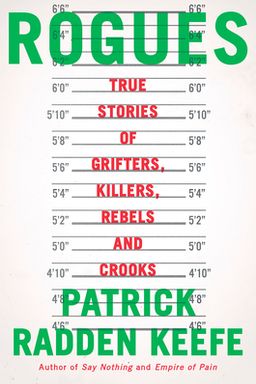
Rogues cover

Rogues

by Patrick Radden Keefe

Rogues delves into the intricate lives of notorious criminals and con artists, exploring their motivations and the justice systems that pursue them. Patrick Radden Keefe offers a captivating look at the gray areas of morality and justice through compelling true stories.

The Ethics and Art of Investigative Narrative

Patrick Radden Keefe’s collection of long-form investigations reveals a central conviction: storytelling can be both forensic and moral. You navigate worlds where truth hides in partial evidence—bank records, taped conversations, outtakes, legal documents—and realize that narrative nonfiction is the art of assembling fragments without distortion. His work spans explanations of how reality-TV editing reshaped politics, how arms dealers and hedge-fund managers test legality, how grief and obsession inspire justice, and how journalists wrestle with conscience in pursuit of clarity.

Narrative as moral inquiry

Every chapter explores not just events but ethical tension. In “Magazine Feature Craft,” Keefe defines journalism as sustained moral attention—doing justice to complexity even when a subject refuses access. His "writearound" technique (portraying figures through others’ eyes) proves that absence can sharpen truth. He learned this discipline at The New Yorker, where fact-checkers operate like forensic scientists. For Keefe, each story is a small act of accountability, made permanent once digital archives ensure that magazine writing never dies.

Power, secrecy, and spectacle

Keefe links hidden systems: financial secrecy (Falciani’s HSBC leak), political theatre (Mark Burnett’s creation of Trump on The Apprentice), and criminal mythology (El Chapo’s rise from shadow to celebrity). In all, media and institutions manufacture alternate realities, often more durable than truth. The Apprentice turns editing into propaganda; Chapo’s escapes turn capture into legend. Transparence depends not just on evidence but on who controls its release—whether MGM’s vault of unaired tapes or sealed letters in a terrorism trial. Narrative itself becomes an instrument of power.

Crime as family and identity

Stories like Astrid Holleeder’s testimony against her brother show how crime corrodes intimacy. Loyalty morphs into fear; justice demands betrayal. Astrid’s covert recordings, later publicized by her memoir, show the collision between personal truth and national spectacle. Similarly, Amy Bishop’s tragedy—the shooting of her brother and later her colleagues—reveals how unprocessed trauma can incubate catastrophe when institutions ignore early warnings. Keefe’s human narratives blur moral binaries: victims can be insiders, perpetrators can be loved ones. What endures is the demand for ethical clarity amid chaos.

Markets, manipulation, and law

In financial and corporate worlds, Keefe exposes the gray zones between genius and crime. The “Empire of Edge” investigates how hedge-fund culture rewards deceit disguised as intelligence—an ecosystem of consultants like Sid Gilman and traders like Mathew Martoma whose pursuit of “edge” erases legal boundaries. Likewise, the Simandou mine, Beny Steinmetz’s billions, and the forged Jefferson wines orbit the same principle: when validation and profit depend on secrecy, expertise itself becomes weaponized. Science, law, and taste collide; authenticity turns into a commodity.

Grief, vengeance, and restraint

Ken Dornstein’s obsession with identifying the Lockerbie bomber illuminates another moral frontier. You watch a man transform grief into method, tracing circuits and passport numbers until an unseen perpetrator gains a name: Abu Agila Mas’ud. His journey converts emotion into patience—the journalist’s ideal praxis. Keefe admires this endurance but warns of danger: the pursuit of justice can consume compassion. The avenger’s paradox is knowing when to stop, how to avoid replicating harm in pursuit of resolution.

Humanizing the condemned

Judy Clarke’s defense philosophy stands as Keefe’s counterweight to moral absolutism. She refuses to let society define worth by crime alone. Her cases—from Kaczynski to Tsarnaev—illustrate narrative as empathy in action. By reconstructing a life story, she asks jurors to weigh human contingency instead of vengeance. Keefe aligns with Clarke in method: both insist that understanding evil requires proximity, not disgust. They remind you that mercy, facts, and context are inseparable.

Truth through leaks, tapes, and trials

Finally, Keefe’s recurring motif is control of evidence—who owns the tapes determines what public truth becomes. Falciani’s stolen files reform tax systems; a filmmaker’s unreleased footage shapes politics; a recorded sting in Marbella (Monzer al-Kassar) dismantles an empire of arms. The moral universe of secrecy and leak defines the twenty-first century. Keefe makes you conscious that journalism and law depend on timing, custody, and courage to handle information.

Core lesson

You learn that truth survives only when someone accepts responsibility for its fragments. Keefe’s work turns meticulous reporting into a mirror for power, reminding you that every story—corporate, criminal, or familial—is a question of what conscience will reveal and what secrecy will preserve.


The Craft and Moral Duty of Journalism

Keefe regards journalism as a discipline of patience and conscience. A magazine feature is not entertainment but moral inquiry—trying to capture a life’s full dimension within finite access and evolving facts. He invites you to treat every subject, even notorious ones, with ethical precision.

The writearound and absence as revelation

When access vanishes, inventiveness replaces proximity. Keefe’s “writearound” strategy turns secondary voices into primary texture—ex-wives of Mark Burnett, colleagues of El Chapo, or victims’ families stand in for absent protagonists. You learn that indirect inquiry can yield honesty free from manipulation. (Note: Truman Capote pioneered a similar intimacy in “In Cold Blood,” but Keefe amplifies moral rigor by rejecting glamorization.)

Ephemerality and digital permanence

Magazines once felt disposable; the internet fossilizes them. This creates moral pressure: the record lasts, so precision matters more than timeliness. Facts may evolve—Guzmán escaping again, new indictments in Lockerbie—but the published text remains immutable. For long-form writers, permanence means accountability not just for narrative but for its afterlife.

Conscience over access

Keefe’s refusal to ghostwrite El Chapo’s autobiography epitomizes integrity. He prioritizes victims’ dignity over exclusive material. The lesson: in narrative nonfiction, you decide whether curiosity serves truth or exploitation. Ethical attention demands restraint. Readers inherit authenticity because the writer denies corruption.

  • Treat every subject with full human gravity—even villains.
  • Respect fact-checking as moral architecture, not bureaucracy.
  • Write as if permanence will expose all shortcuts later.

Markets, Fraud, and the Illusion of Expertise

From the Jefferson wine scandal to insider trading and mineral corruption, Keefe reveals how expertise and desire conspire to make deceit credible. People believe what flatters them—whether connoisseurs savoring a fake 1787 Bordeaux or traders misusing confidential trial results.

Authentication and deception

In wine forgery, scientific tools—carbon-14, cesium-137, engraving analysis—compete with taste and reputation. The contradiction teaches humility: authority without verification breeds myth. Keefe’s precision mirrors forensic reporting—reminding you that truth is not sensory but evidential.

Information as commodity

In "The Empire of Edge," the chase for insider data becomes structural. Traders reward risk; consultants monetize knowledge. Sid Gilman’s slip of medical confidentiality reshapes Wall Street fortunes. Keefe demonstrates how systems bless unethical leaps under pressure. Regulation catches individuals but rarely reforms incentives.

Extractive greed and global corruption

Simandou’s unmined iron mountains symbolize how resource wealth turns poor nations poorer through capture. Beny Steinmetz’s bribe allegations and Frédéric Cilins’s recorded cover-up define the anatomy of transnational manipulation. You grasp that globalization amplifies secrecy more than transparency.

Lesson

In markets and industries alike, confidence can be counterfeit. Keefe’s cases prove that moral intelligence—not technical expertise—is the only true edge.


Family, Loyalty, and Moral Betrayal

Astrid Holleeder’s and Amy Bishop’s stories expose how familial bonds can mask danger and delay justice. In both, the private sphere breeds moral conflict more potent than organized crime or academic politics.

Betraying blood to protect others

Astrid’s decision to record her brother Willem, the Netherlands’ most feared gangster, situates moral courage inside domestic space. She transforms feared loyalty into public evidence. Her diligence—secret microphones, coded conversations—recalls investigative professionalism born from trauma. Yet public exposure converts survival into spectacle.

Unprocessed trauma and institutional blindness

Amy Bishop’s arc illustrates systemic neglect: an accidental fratricide, ignored red flags, and eventual campus shootings. Institutions that prize excellence often evade emotional responsibility. Keefe connects domestic denial to bureaucratic failure: tragedies grow in the silence between family and authority.

  • Family intimacy can conceal violence until law replaces loyalty.
  • Public attention commodifies private pain; victims must navigate fame and fear simultaneously.
  • Institutions need emotional accountability as much as procedural protocols.

Power, Image, and Media Construction

Keefe’s investigation of Mark Burnett’s reality TV empire dissects how editing and branding fabricate cultural authority. You understand that perception—more than performance—builds political reputation.

Editing as ideology

Burnett’s manipulation of footage turned ordinary boardroom scenes into myth. Reverse-engineered episodes validated predetermined outcomes, cementing Trump’s image as decisive capitalist. Through repetition and stylized framing, television manufactured credibility. Keefe deconstructs how truth in entertainment becomes collective memory, shaping elections and civic discourse.

Commercial symbiosis

The Apprentice monetized image: product placements, property rentals, brand amplification. Media capitalism fused character and corporation. Keefe’s insight parallels Bourdain’s opposite ethic—using television for empathy rather than ego. Both prove that screens can either distort or deepen understanding.

Key reflection

When editors control raw material, reality itself becomes negotiable. Consumers, therefore, inherit shaped narratives rather than truths—a power dynamic that repeats from propaganda to corporate storytelling.


Leaks, Evidence, and Information Control

Throughout Keefe’s stories, who holds the evidence determines the moral outcome. You track an unbroken line from Hervé Falciani’s stolen HSBC files to Judy Clarke’s sealed court letters and MGM’s unreleased Apprentice tapes. In every sphere—finance, media, or justice—visibility defines consequence.

Transparency and theft

Falciani steals data to expose tax evasion, sparking global reform but earning criminal charges. His dilemma—public good versus private illegality—embodies modern whistleblowing. Keefe invites you to weigh means against ends: transparency costs the transgressor as much as the corrupt.

Secrecy and justice

In the Tsarnaev case, withheld letters prevent mercy from reaching jurors. In Monzer al-Kassar’s sting, taped deals prove guilt beyond rhetoric. Secrecy can guard or distort justice, depending on motive. Keefe turns custody of records into a moral frontier, demanding ethical protocols for exposure.

Cultural diplomacy and authenticity

Anthony Bourdain’s televised dinners contrast commercial control with human openness. His camera grants visibility to shared vulnerability. Against all secret tapes and leaks, Bourdain’s practice demonstrates transparency through empathy—conversation as evidence of common humanity.

  • Evidence custody is power.
  • Transparence demands courage, not just access.
  • Media can expose injustice or commodify it—the motive shapes the outcome.

Justice, Complexity, and the Modern Moral Imagination

The composite of Keefe’s reporting culminates in a moral puzzle: can you understand wrongdoing without surrendering empathy? His subjects—spies, traders, killers, and whistleblowers—force reconciliation between law and humanity.

Seeing the full picture

From the avenger’s restraint (Dornstein) to the defender’s empathy (Clarke), Keefe shows that justice requires layered perception. Society reduces crimes to headlines; journalism re-expands them into biographies. Each revelation demands you confront ambiguity—what motives coexist with evil, what systems enable harm.

Living with unresolved truths

Keefe rejects tidy endings: Chapo’s capture doesn’t end cartel power; economic fines don’t correct greed; exposure doesn’t guarantee reform. His stories resist closure precisely because reality keeps unfolding. That recognition—truth as process, not verdict—defines ethical adulthood in both writing and citizenship.

Final understanding

Investigative narrative, when done with conscience, transforms outrage into insight. Keefe teaches you that moral imagination—seeing human context inside atrocity—is not weakness but courage. That lesson turns reporting into a civic art.

Dig Deeper

Get personalized prompts to apply these lessons to your life and deepen your understanding.

Go Deeper

Get the Full Experience

Download Insight Books for AI-powered reflections, quizzes, and more.