
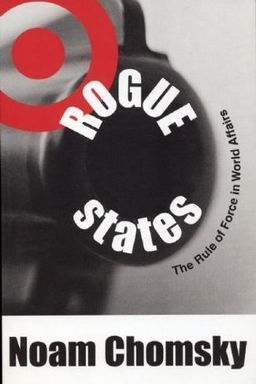
Rogue States cover

Rogue States

by Noam Chomsky

Rogue States by Noam Chomsky critically examines US foreign policy and its use of power to label nations as ''rogue states.'' Chomsky challenges the mainstream narrative, revealing economic motivations behind US interventions and the media''s role in shaping public perception, offering an essential read for those interested in global politics.

Rogue Power and the Crisis of Human Rights

Have you ever wondered what happens when the nations claiming to protect freedom are the ones most often undermining it? In Acts of Aggression, written by Noam Chomsky, Edward W. Said, and Ramsey Clark, three of the 20th century’s most incisive thinkers dissect the contradictions in U.S. foreign policy and its self-appointed role as global guardian. The authors argue that the rhetoric of human rights, democracy, and liberty often masks violent interventions, sanctions, and systems of domination that destroy the very values they claim to defend.

The book—an activist pamphlet rather than a dry academic text—offers a fierce critique of what the authors call the “rogue behavior” of the United States and its allies. They frame Washington not as a neutral enforcer of international law but as a power that frequently acts above the law, shaping the global order to serve corporate, strategic, and political interests. Through essays originally published in the late 1990s, the authors examine key moments like the sanctions on Iraq, U.S. interventions across the Middle East, and the neglect of economic and social rights even in the rhetoric of the Universal Declaration of Human Rights.

The Core Question: What Is a Rogue State?

In Noam Chomsky’s section, he flips the familiar term “rogue state” on its head. Instead of applying it to places like Iraq, Libya, or North Korea, he argues that the most consistent violator of international law is the United States itself. Citing examples such as the bombing of Libya in 1986, the invasion of Panama, and the disregard for World Court rulings against U.S. actions in Nicaragua, Chomsky reveals a pattern: Washington applies one legal standard to others and another to itself.

He analyzes how the U.S. justifies unilateral force, often invoking Article 51 of the U.N. Charter in ways that directly contradict the Charter’s text. Far from maintaining peace, such actions institutionalize war as an extension of policy, normalized by a compliant media that frames aggression as defense. This inversion—where power defines legality—is, for Chomsky, the essence of modern imperialism.

Edward Said’s View: The Cultural Logic of Punishment

Edward Said brings a humanistic and cultural perspective to the argument. In “Apocalypse Now,” he critiques both U.S. policy toward Iraq and Arab political incoherence. Said describes the post–Gulf War sanctions as a form of moral and material devastation—the deliberate strangling of a civilian population under the guise of enforcing international law. Yet he also admonishes Arab leadership for fragmentation and submission to U.S. pressure, arguing that inter-Arab division made possible the ongoing humiliation of entire nations.

Said’s analysis is especially striking because he integrates politics and culture. He argues that America’s hostility toward Arabs stems from deep-seated orientalist myths—the portrayal of Arabs as violent, irrational, and backward—myths that justify aggression. In this worldview, Arabs are judged collectively guilty, while Western nations absolve themselves of responsibility. The result, according to Said, is a perverse moral system where “punishment is conceived in apocalyptic terms”—a world in which military destruction is framed as divine justice.

Ramsey Clark’s Legal Indictment

The book’s closing essay by former U.S. Attorney General Ramsey Clark grounds these moral and political critiques in the language of law. Writing on the fiftieth anniversary of the Universal Declaration of Human Rights, Clark contrasts its noble principles with the catastrophic consequences of U.S.-imposed sanctions and wars. He calls economic sanctions “the most dangerous and harmful violation” of human rights, equating their effects to weapons of mass destruction. His examples—Cuba, Iraq, Libya—illustrate how entire populations are targeted in the name of political compliance.

Clark warns that the Declaration’s failure lies not only in its selective enforcement but in its economic myopia. Western powers emphasize civil and political rights while ignoring social and economic rights—adequate food, shelter, and healthcare—that are the foundation of dignity. Without addressing economic violence, he argues, human rights remain a moral illusion.

Why This Matters Today

Together, the authors foreshadow the crises of the 21st century: endless wars justified by moral rhetoric, global inequality disguised as economic freedom, and media-driven narratives that celebrate aggression as virtue. The conversations in Acts of Aggression resonate deeply in a world still wrestling with the question Lincoln posed and Clark revisited: what do we mean by liberty? The book invites you to reimagine freedom not as domination or privilege but as shared humanity grounded in justice, accountability, and truth.

In the end, Acts of Aggression isn’t only about foreign policy—it’s about moral vision. It asks whether a civilization that prizes its power above its conscience can ever claim to lead the world in human rights.


Noam Chomsky: Redefining the Rogue State

Chomsky opens with a provocation: if you define a rogue state as a power that defies international law and uses violence unilaterally, the United States fits that definition better than any official “rogue.” He dismantles the illusion of moral authority by comparing U.S. policy toward Iraq, Libya, and Nicaragua with the principles laid out in the U.N. Charter.

The Legal Framework and Its Betrayal

Chomsky meticulously traces the rules of international conduct outlined in the Charter: nations may not use force except in self-defense or with Security Council authorization. Yet Washington routinely bypasses that system. He cites examples such as the 1986 bombing of Libya, justified as “self-defense against future attacks,” and the 1989 invasion of Panama, rationalized as a drug enforcement action. In each case, Chomsky notes, U.S. officials claimed to follow Article 51—even though these events had nothing to do with immediate self-defense. What emerges is an imperial license to kill, rooted in the belief that American intention equals moral legitimacy.

Manufacturing Consent Through Language

Equally important to Chomsky’s analysis is how public understanding is shaped. He shows how the press reinforces power by framing aggression as defense—for instance, during the 1991 Gulf War, when airstrikes were described as “liberation.” He highlights the almost Orwellian inversion of meaning where “preventive war” becomes peacekeeping, and “rogue states” are those that resist U.S. control. This, Chomsky argues, is not mere propaganda—it’s a culture of obedience where legality is replaced by national interest.

“The rogue state,” Chomsky writes, “is not the defiant outlaw that resists global order; it is the self-anointed enforcer that destroys law itself.”

To you as a reader, this flips a familiar narrative. When you hear politicians invoke “international norms,” Chomsky urges you to ask: whose norms, and who enforces them? He doesn’t defend dictators like Saddam Hussein; rather, he insists that legality must apply universally or it collapses into hypocrisy.


Edward Said: The Cultural Politics of Punishment

Edward Said’s essay, “Apocalypse Now,” complements Chomsky’s political analysis with moral and cultural insight. He portrays the Gulf War and its aftermath as a theater of cruelty, fueled by myth and media rather than reason. For Said, the crisis reveals how easily moral language can be turned into a weapon.

Sanctions as Collective Punishment

Said exposes how sanctions became a tool of collective punishment. By the late 1990s, more than half a million Iraqis—mostly children—had died due to malnutrition and disease exacerbated by embargoes. Western officials openly described these sanctions as “unprecedented in severity.” Yet, in Western media, this mass suffering was largely invisible. Said argues that apathy comes from dehumanization: Iraqis were seen not as individuals but as symbols of defiance to be subdued. In such a context, empathy itself becomes political resistance.

The Orientalist Imagination

Drawing on his earlier work Orientalism, Said links U.S. foreign policy to deep cultural prejudices. The “Arab” in Western imagination embodies danger, fanaticism, and chaos—an image that justifies intervention. This psychology, Said suggests, replaces diplomacy with ritual punishment: bombing campaigns, sanctions, and humiliation masquerade as moral cleansing. You can see echoes of this logic in later conflicts, from Afghanistan to Iraq (2003), where war became a narrative of salvation rather than domination.

“Sinners are meant to be condemned terminally,” Said observes, “with the utmost cruelty regardless of whether or not they suffer the cruelest agonies.”

For Said, liberation requires not only political solidarity but also a revolution of perception. If you can break free from inherited images—of the ‘savage East’ and the ‘civilized West’—you can begin to see people as human beings again, not as caricatures to be saved or destroyed.


Ramsey Clark: The Betrayal of Human Rights

Ramsey Clark’s “Appendix on the Fiftieth Anniversary of the Universal Declaration of Human Rights” anchors the book’s critique in law and morality. A former U.S. Attorney General, Clark uses his insider knowledge to show that the United States—while extolling liberty—has consistently violated the very principles it helped draft.

The Forgotten Rights: Economic and Social Justice

Clark reminds us that the Declaration includes not only civil and political rights but also economic and social ones. Article 25 guarantees every person the right to food, housing, medical care, and security. Yet Washington treats these as optional moral ideals rather than binding obligations. Clark highlights the U.S. embargo on Cuba and the sanctions on Iraq as crimes against humanity, designed to break nations by starving their populations. When an entire country’s access to medicine and clean water is blocked, he argues, sanctions become “the most deadly form of warfare.”

Hypocrisy and Power

Clark warns that American courts refuse to enforce the Declaration’s provisions, claiming it is only symbolic. Yet international law—through the concept of customary law—treats these principles as binding. By denying them, the U.S. places itself above global standards. Ironically, it then uses those same standards to demonize others. Clark urges citizens to confront this hypocrisy domestically—not simply to blame leaders abroad, but to hold their own government accountable.

His plea is not academic: “Without passionate commitment by the people... there will be no protection for the poor and powerless.” Justice requires action, not rhetoric.

For you, Clark’s message is simple but urgent: rights mean nothing unless they are defended from within. A society that tolerates injustice abroad will inevitably erode its freedoms at home.


Media and the Manufacture of Consent

One thread running through all three essays is how media turns war into spectacle. Both Chomsky and Said highlight the press as an unofficial arm of power, translating complex debates about law and morality into simple good-versus-evil narratives.

The War Show: Framing Aggression as Virtue

During the Gulf War, images of missiles hitting targets played like video games. Said calls this “theatrical punishment.” Chomsky points out that instead of investigating legalities, commentators discussed “how America should respond.” Even when the U.N. disapproved of unilateral strikes, headlines changed the story: “U.S. Insists It Retains Right to Punish Iraq.” Such framing, he notes, normalizes violence by presenting it as inevitable and righteous.

Controlling the Narrative

Clark emphasizes that domestic media also serves to seduce citizens into complacency. Americans boasting of liberty rarely question why their nation spends more on weapons than the next ten countries combined, or why four out of ten young Black men are trapped in California’s prison system. Once media defines violence as protection and inequality as freedom, dissent becomes unpatriotic. (Compare with George Orwell’s warning in Politics and the English Language: corrupt language leads to corrupt conscience.)

For you as a reader, recognizing this manipulation is transformative. It allows you to see past slogans and ask who benefits from fear, who profits from silence, and how truth itself can become a casualty of war.


The Moral Cost of Empire

All three authors converge on one devastating insight: empire corrodes morality from within. Whether through bombs, blockades, or bureaucratic disregard, the exercise of domination demands denial—of empathy, of memory, of shared humanity.

Cruelty as Policy

Said calls U.S. vindictiveness “brazen inhumanity.” Clark describes sanctions as economic torture. Chomsky reminds us that every great power justifies atrocity by invoking virtue: France brought “civilization” to Africa, Britain “order” to India, and America “freedom” to Iraq. In each case, the moral vocabulary hides material interests. For you, the takeaway is sobering: when moral language becomes a weapon, truth itself becomes expendable.

Redefining Liberty

Clark ends his essay with a return to Abraham Lincoln’s warning: everyone speaks of liberty, but few mean the same thing. Real freedom, he argues, is inseparable from equality and justice—it cannot coexist with domination. The book thus reframes liberty as a collective condition, not a national privilege. That redefinition might be the most radical act of all.

Empires fall not because of external enemies but because they forget the moral meaning of their own ideals.

Dig Deeper

Get personalized prompts to apply these lessons to your life and deepen your understanding.

Go Deeper

Get the Full Experience

Download Insight Books for AI-powered reflections, quizzes, and more.