
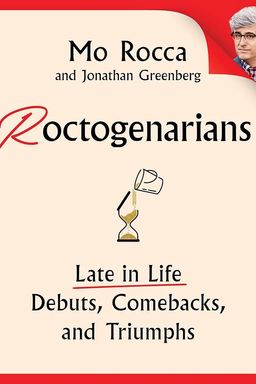
Roctogenarians cover

Roctogenarians

by Mo Rocca And Jonathan Greenberg

The author of “Mobituaries” profiles people who made an impact later in life.

Rethinking Age as Advantage

Rethinking Age as Advantage

What if the second half of life isn’t a slow fade but a strategic opening? This book argues that late life can be a launchpad—if you claim it. The authors name the people who do this “Roctogenarians,” not because they’re all eighty, but because they carry a rock-solid mindset: they actively convert time, perspective, and accumulated skill into new relevance. That frame flips the cliché of decline on its head. Instead of doors closing, you see different doors appear—some only visible after decades of practice, relationships, and reflection.

The core argument

The book’s central claim is simple and subversive: aging brings unique comparative advantages. You hold pattern recognition, institutional memory, and a honed sense of what matters—assets younger peers can’t match yet. When Mo Rocca jokes with Chance the Rapper about becoming a rapper at forty-six, it’s not just humor; it’s permission to redraw your timeline. The narrative then shows how elders thrive by reframing constraint as design brief, using identity reinvention, and leaning on compounding experience.

Patterns across stories

Across fields—art, science, activism, design, cuisine, athletics—you watch the same moves repeat. Colonel Harland Sanders doesn’t mourn his failed restaurant; he pilots a franchising model at sixty-six and crafts a persona that opens doors. Henri Matisse can’t hold a brush after cancer surgery; he invents “painting with scissors” and produces late masterworks like Icarus. Diana Nyad fails four times to swim Cuba to Florida; at sixty-four she crosses the Straits with better gear, a trained crew, and tactical realism. Brian May sets Queen aside long enough to finish a PhD at sixty and later helps NASA visualize asteroids. These arcs aren’t random; they’re a playbook.

Why late life works differently

As you age, you accumulate narrative capital. Ann Roth, who wins an Oscar at eighty-nine for Ma Rainey’s Black Bottom, uses empathy at fittings to let actors disappear into character. Eddy Goldfarb’s century-long curiosity yields Yakity-Yak teeth, KerPlunk, and hundreds of toys—small inventions that stack up to cultural ubiquity. In activism, Mary Church Terrell’s decades of alliances and legal knowledge help desegregate D.C. lunch counters at eighty-nine. In institutions, I. M. Pei modernizes the Louvre by excavating downward and placing a glass pyramid above—an elegant synthesis of past and future that only sticks with political stamina and public persuasion.

The book’s breadth

You move from personal reinvention to systemic redesign. Pei’s Grand Louvre and Yasmeen Lari’s post-retirement “barefoot social architecture” show two poles: high-tech transparency aligning with heritage, and low-tech vernacular methods that empower communities after floods and quakes. In culture, Estelle Getty’s late TV debut, Rita Moreno’s longevity, and Brenda Lee’s sixty-five-year-old holiday hit rising to No. 1 at seventy-eight prove that timing and platforms (hello, TikTok) can revive work. In recognition, Tyrus Wong (Bambi’s mood-maker), Carmen Herrera (geometric abstractionist), and Nobel laureate John Goodenough reveal how bias and slow institutional clocks can delay credit—longevity lets the world catch up.

Aging as refinement

Food and craft ground the metaphor. Mike Grgich’s Napa triumph at the 1976 Judgment of Paris, Bitto Storico aged eighteen years, Tabasco mellowing three years in bourbon barrels, and Yixing teapots absorbing decades of tea oils all remind you: time can deepen texture, not just erode edge. Cast-iron skillets get better with seasoning; so does your judgment. Snow’s BBQ pitmaster Tootsie Tomanetz returns to the fire at sixty-eight, turns pre-dawn shifts into ritual, and earns statewide reverence—purpose as resilience.

Key Idea

Treat age as an engine, not an anchor. Use constraints as prompts, identity as a tool, and patience as strategy.

How to read this playbook

The chapters that follow translate narrative patterns into tactics you can use. You’ll learn to: (1) shift identity or medium to keep goals alive (Matisse, Sanders, Borges, OXO); (2) leverage moral authority for civic wins (Terrell, Embrey, Evers-Williams); (3) modernize systems without erasing heritage (Pei) or center dignity with low-tech resilience (Lari); and (4) convert unfinished business into disciplined quests (Nyad, May). You’ll also see what to expect emotionally: reinvention is exhilarating and humbling; late acclaim is sweet and sometimes bittersweet.

The upshot is both hopeful and grounded. Physical limits are real, bias persists, and some attempts will fail. But the record is clear: if you cultivate curiosity, test small, partner widely, and design for longevity, late life doesn’t narrow your path—it clarifies it. (Note: Think of this as a companion to books like Charles Duhigg’s The Power of Habit or Atul Gawande’s Being Mortal—the former on systems of action, the latter on honest constraints. This one fuses both.)


Reinvention Playbook

Reinvention Playbook

Reinvention isn’t magic; it’s a series of deliberate moves. You can shift identity, switch mediums, and redesign around constraints without abandoning your purpose. This chapter distills a repeatable method from the book’s case studies—so you can apply it when a career stalls, a body changes, or a market moves.

Shift identity to unlock options

Public identity is a tool. Colonel Harland Sanders at sixty put on a white suit, adopted the “Colonel” persona, and reframed himself from small-town restaurateur to national franchiser. The persona wasn’t vanity; it was strategy—an instantly recognizable brand that reduced friction for deals. Ask yourself: what new title or frame would free you to experiment? “Consultant,” “fellow,” “artist-in-residence,” or even a playful alter ego can legitimize your next act.

Switch mediums, keep intent

When a primary tool disappears, protect the intention behind it. Henri Matisse could no longer paint the way he had; he re-expressed his vision with paper cut-outs, “painting with scissors.” Jorge Luis Borges, facing blindness, returned to memorized formal verse. In each case, the medium changed but the artistic aim stayed intact. Your question becomes: which adjacent medium preserves your aims with fewer physical or market constraints?

Treat constraints as creative prompts

Your limits can sharpen you. The authors show constraints producing elegant solutions: OXO Good Grips began with Betsey Farber’s arthritis pain while peeling an apple. By testing with arthritis sufferers and choosing Santoprene grips, Sam and Betsey Farber created an inclusive design that helped everyone. The heuristic is powerful: solve for an edge case, and you often solve for the mass market. (Note: This mirrors the “curb-cut effect” in public policy—changes for wheelchairs benefit strollers and carts, too.)

Prototype, don’t pontificate

Reinvention grows through low-cost experiments. Sanders proved demand one restaurant at a time. Matisse juggled paper shapes in his bed before committing them to murals. The OXO team mocked up handles, sourced Japanese manufacturing partners, and iterated with users. Rather than announcing a new self, run micro-tests: a short-run product, a pop-up class, a zine, a guest sermon, a pilot grant.

Leverage compounding experience

Late-life shifts stick because you bring compound interest in skills and networks. Sanders knew kitchens and margins; the Farbers understood distribution and industrial design; Matisse arrived with an entire visual grammar to reapply. This compounding explains why late moves can look fast from the outside—they ride decades of tacit knowledge.

Principle

Redesign the work to fit the worker. Adjust the tool, timeline, or team before you abandon the goal.

A four-step reinvention cycle

  • Scan constraints and assets: name what changed (health, tech, market) and what you still have (skills, trust, story).
  • Design a low-risk pilot: one venue, one client, one series—small enough to learn, large enough to feel.
  • Iterate with users: include the “edge” user early (arthritic hands, low-vision readers, time-poor caregivers).
  • Codify and scale: document your method and find partners who extend reach without diluting intent.

Mindset guardrails

Expect resistance—from others and from yourself. Identity changes can feel like loss; treat them as translation. Hold standards high and ego light (Matisse sought purity through reduction; OXO privileged user comfort over designer flourish). Measure by learning speed, not initial applause. Most “overnight” turns—Sanders, Matisse, OXO—are really multi-year refinements.

If you apply this playbook, reinvention shifts from risky leap to managed experiment. You don’t wait to feel young again; you design the older, wiser version of your craft—and often make something better than what came before. (Comparison: like Cal Newport’s “career capital” idea, you spend accumulated assets to buy autonomy and impact.)


Patience, Craft, Peak Late

Patience, Craft, Peak Late

Creative excellence doesn’t belong to the young; it belongs to the practiced. This chapter shows how patience and craft prime you for late breakthroughs—on stages, at pits and looms, and in kitchens and vineyards. You’ll see how culture cycles rediscover work, how subtle mastery beats flash, and why slow processes (like wine or cast iron) are your best metaphors for a flourishing late life.

Late debuts and renewed arcs

Estelle Getty became a household name at sixty-two on The Golden Girls—decades of stage craft distilled into an “overnight” success. Rita Moreno’s energy powers roles into her eighties and nineties, recasting her as a living bridge across eras (an EGOT who’s still curious). Pianist Ruth Slenczynska released a new album at ninety-seven, returning to repertoire with a lifetime’s touch. Cultural platforms help: Brenda Lee’s “Rockin’ Around the Christmas Tree” hit No. 1 when she was seventy-eight, amplified by TikTok—proof that cyclic attention can revive old recordings if an audience can find them.

Quiet mastery over spectacle

Ann Roth calls a costume successful if you don’t notice it. That humility hides ferocious craft: Jon Voight’s fringed jacket in Midnight Cowboy telegraphs character without a line of dialogue; Nicole Kidman’s prosthetics in The Hours transform presence, not just appearance. At eighty-nine, Roth wins an Oscar for Ma Rainey’s Black Bottom, showing how the long apprenticeship of taste pays off late.

Everyday genius and the long tail

Eddy Goldfarb’s toys—Yakity-Yak teeth, KerPlunk, Spin-Art—aren’t “high art,” but they encode a century of observation and delight. He invented hundreds of small joys, proving that influence can be cumulative and playful. Norma “Tootsie” Tomanetz returns to barbecue at sixty-eight, stokes fires at 2 a.m., and becomes Texas Monthly’s best-in-state pitmaster. For Tootsie, work is liturgy: season the pit, mop the meat, greet the line. Craft becomes therapy and community glue.

Food and objects that get better with time

Mike Grgich’s 1973 Chardonnay wins the 1976 Judgment of Paris, elevating Napa’s reputation—and he keeps refining into his nineties. Bitto Storico ages eighteen years; Tabasco mellows three years in bourbon barrels; honey keeps indefinitely; Yixing teapots deepen tea with each brew. Cast-iron skillets, like careers, require seasoning—use, care, patience. The point isn’t nostalgia; it’s engineering: time interacts with material to yield qualities you can’t fast-track.

Takeaway

Your later decades aren’t a smaller toolbox; they’re a different kit—restraint, economy, and gravitas replace speed, volume, and virtuosity.

How to apply this to your craft

  • Choose depth over novelty: build a signature method, then iterate calmly. Audiences reward clarity of voice.
  • Design for longevity: make things that season—process journals, modular products, traditions people can inherit.
  • Let cycles help you: re-release, remix, or reframe earlier work when platforms shift.

When you treat time as an ingredient, not a tax, you give yourself permission to peak late. (Note: This complements Anders Ericsson’s “deliberate practice”; here, the emphasis is practice that matures—not just sharpens—taste.)


Moral Authority, Real Change

Moral Authority, Real Change

Late life can be a civic force multiplier. You hold credibility, networks, and patience—exactly what hard public problems demand. This chapter shows how elders use these assets to shift law and culture, and how some finally receive overdue credit when institutions catch up.

Strategic elders in action

Mary Church Terrell, approaching ninety, leads sit-ins in Washington, D.C., and pairs protest with law. She helps surface a Reconstruction-era civil rights statute, pushes through courts, and contributes to the capital’s lunch counter desegregation. The method matters: she collaborates with Annie Stein, lawyers, and cultural figures like Josephine Baker to braid pressure, policy, and publicity. This isn’t just inspiration; it’s instruction—age amplifies strategy.

Continuity across decades

Sue Kunitomi Embrey spends decades preserving Manzanar’s memory, resisting historical amnesia about Japanese American incarceration. Myrlie Evers-Williams persists until 1994 to secure the conviction of her husband Medgar’s murderer—thirty-one years after the crime. In movements that outlast news cycles, elders provide memory, stamina, and a moral ledger the public can’t ignore.

Delayed recognition and repaired canons

Tyrus Wong shapes the emotional look of Bambi yet is credited merely as “background painter,” his artistry sidelined by race. Only in his nineties do museums honor him. Carmen Herrera paints rigorous abstractions for decades until, near one hundred, the Whitney lifts her into the American canon. John B. Goodenough, told he was “too old” for physics, helps birth the lithium-ion battery and wins a Nobel at ninety-seven—because science often rewards long arcs of utility.

Lesson

Bias, bureaucracy, and slow uptake delay justice and recognition; longevity gives you time to outlast them and the wisdom to choose leverage points.

How you act on this

  • Document institutional memory: archive tactics, filings, and correspondence so the next generation doesn’t start from scratch.
  • Pair moral claim with legal path: identify dormant statutes, procedural levers, or venues ripe for test cases.
  • Build unlikely coalitions: artists, lawyers, clergy, and journalists extend reach and resilience.

If your goal is justice or historical repair, age is an asset. You can absorb slow timelines, mentor continuity, and rewrite canons—so the next generation’s starting line is fairer than yours. (Note: This complements John Lewis’s “good trouble” ethos—disciplined, strategic confrontation sustained over a lifetime.)


Designing for the Long Game

Designing for the Long Game

Some problems require system-scale imagination—upgrading museums, re-housing flood survivors, or reframing retirement for athletes. Late-life leaders often make these bets because they’re playing for legacy, not headlines. Here you’ll see how modern and vernacular designs converge on one aim: dignity sustained over time.

Modernizing heritage: Pei’s Grand Louvre

By the 1980s the Louvre was a traffic knot and an infrastructural mess. I. M. Pei’s move was surgical: excavate the courtyard, create two underground levels to compress walking distances, and crown the space with a hyper-transparent glass pyramid. The politics were brutal—critics mocked the “Egyptian” form, and some questioned a Chinese American altering a French icon—but Pei and President Mitterrand held the line. When the project opened, exhibition space doubled, circulation improved, and the pyramid became an emblem. Design lesson: juxtapose old and new to honor both; expand downward to protect the skyline.

Barefoot social architecture: Yasmeen Lari

Yasmeen Lari pivoted from corporate towers to zero-carbon, community-built shelters after Pakistan’s 2005 earthquake. She uses bamboo, lime, and mud; elevates stoves to beat floods; and trains locals—especially women—to build and maintain. Her Pakistan Chulha cookstove reduces toxic smoke and fuel demand; her shelter program (tens of thousands of units) scales because it’s affordable, teachable, and dignifying. The ethic is partnership, not paternalism. If Pei exemplifies high-tech heritage upgrades, Lari models low-tech justice—two ends of a humane design spectrum.

Redesigning retirement and performance

Michael Blowen’s Old Friends farm turns horse retirement from hidden disposal into public celebration. Champions like Silver Charm graze, receive massage, and greet visitors; donors see value beyond earnings. Snowman, rescued for eighty dollars, becomes a show-jumping champion at ten and eleven; John Henry wins Grade 1 races at nine. These stories push you to treat “end of peak” as a design problem: what environments, routines, and expectations extend dignity and even capability?

Design insight

Systems that age well combine usability (clear entrances, short paths), maintainability (local materials, community know-how), and symbolism (forms that invite pride).

Translating to your world

  • Audit friction points: where do people get lost, hurt, or excluded? Fix those first.
  • Choose materials/time horizons: when you can, prefer solutions communities can repair themselves.
  • Secure political cover: bold civic projects need champions who will absorb heat while you build.

Whether you modernize a museum, a school, a clinic, or a choir, design for decades, not demo reels. (Comparison: like Jane Jacobs versus Robert Moses—Pei and Lari show you can blend boldness with human-scale reality.)


Second Acts, Full Lives

Second Acts, Full Lives

Not every milestone is public. Late marriage, parenthood, coming out, and renewed community roles reveal that emotional risk and joy have no sell-by date. This chapter centers the intimate side of roctogenarian life—how love, identity, and purpose refresh meaning in your final chapters.

Late love and reconnection

Carol Channing reunites with her junior-high sweetheart Harry Kullijian in her eighties; Suzanne Pleshette and Tom Poston reconnect later in life. These aren’t just cute epilogues; they’re clean reads of compatibility after decades of living. You make different choices when you know yourself and have grieved and healed. The practical lesson: revisit earlier bonds with new clarity—and establish practical supports (estate planning, caregiving, housing) that let romance flourish.

Parenthood and biology, with nuance

The book’s playful nods—Mr. Pickles, a radiated tortoise, becoming a first-time dad at ninety; Sarah bearing Isaac at ninety—acknowledge cultural and biological surprises. Modern fertility tech can extend timelines (Erramatti Mangamma delivered via IVF at seventy-three), but the authors stress tradeoffs: energy demands, lifespan overlap, and financial planning. The honest counsel is balanced: weigh love and legacy against logistics and support networks.

Coming out and reclaimed identity

Kenneth Felts comes out at ninety and marries at ninety-three. His story shows how late authenticity can heal families and inspire communities. Identity shifts late in life don’t erase the past; they reinterpret it, offering younger relatives a model of courage and truth-telling. That’s legacy, too.

Work as medicine

Tootsie Tomanetz returns to pitmastery after deep losses and finds rhythm and resilience in smoke and fire. Her pre-dawn Saturdays aren’t a grind; they’re a heartbeat. Public praise follows, but the deeper reward is purpose. You can borrow this pattern: choose a craft you know with your hands, and let routine carry you through grief into service.

Practical counsel

Don’t let assumed timelines make your choices. Do run the numbers, plan care, and recruit community; then pursue the personal act that makes your life feel whole.

Late life isn’t a wrap-up; it’s a re-edit. You keep the best scenes, cut what no longer serves, and sometimes film a new ending that changes the meaning of everything before it. (Note: Compare to the “encore career” idea from Marc Freedman—purpose after midlife can be social or intimate, paid or volunteer, but it’s always chosen.)


Your Late-Life Action Plan

Your Late-Life Action Plan

Here’s a concrete framework to move from story to strategy. It blends the book’s recurring tactics—identity shifts, micro-experiments, inclusive design, moral leverage, and systemic thinking—into steps you can start this month. Think of it as an operating manual for roctogenarian momentum.

1) Inventory and narrative

List your assets (skills, trust, archives, savings, reputation) and your constraints (time, health, caregiving). Write your throughline: the problem or theme you’ve always chased. Brian May’s line is curiosity about the cosmos; his tools change, the theme persists. Your narrative becomes a compass for pivots.

2) Micro-experiments

Pilot small and learn fast. Colonel Sanders tested franchising one diner at a time. OXO mocked up handles with arthritis users. Tootsie re-entered barbecue one pit, one Saturday. Choose a seven-week cycle: define a question, build a minimal version, measure a behavior (not a like), and decide to kill, keep, or scale.

3) Design around constraints

If a body or market changes, adapt the tool. Matisse’s scissors, Borges’s memorized forms, Nyad’s stinger suit and navigational crew—all show that adaptation is not concession; it’s craft. Ask: What makes the next attempt 20% easier or safer? Fix that first.

4) Partnership and persuasion

Bold projects need shields and spotlights. Pei had Mitterrand; Lari had UN partners and local women builders; Terrell had lawyers and journalists. Make a map of allies: who grants access, who confers legitimacy, who extends distribution? Recruit them on purpose.

5) Endurance methods

Translate big goals into durable practices. Nyad ramped swim durations methodically; John Henry’s team managed training to extend peak years; Old Friends designed routine and care to dignify retirement. Use checklists, cadence calendars, and recovery protocols. Mastery is logistics, not just inspiration.

6) Risk, metrics, and legacy

At sixty or eighty, you balance different risks. Time may be costlier than money; reputation may be safer than you think. Choose meaning metrics: number of lives stabilized (Lari), friction removed (Pei), archives preserved (Embrey), or students trained (Tootsie mentoring pit crews). Document as you go—future curators, biographers, or grandkids will need your notes. Recognition might arrive late (Wong, Herrera, Goodenough), but only if the trail is legible.

Operating rule

Do the smallest valuable thing next, with the people who feel it most, and design it to last.

If you run this plan, your late life won’t be about holding on; it’ll be about building forward. You’ll trade youthful horsepower for steering and suspension—less speed, more control—and you’ll still get where you want to go. (Note: Echoes of James Clear’s atomic habits; here, the atoms build legacies.)

Dig Deeper

Get personalized prompts to apply these lessons to your life and deepen your understanding.

Go Deeper

Get the Full Experience

Download Insight Books for AI-powered reflections, quizzes, and more.