
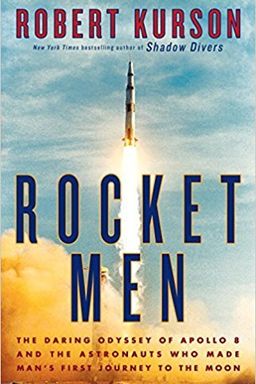
Rocket Men cover

Rocket Men

by Robert Kurson

Rocket Men delves into the daring Apollo 8 mission that catapulted the United States ahead in the Space Race. In just four months, NASA overcame immense technical and political challenges, uniting a divided nation and forever changing our perspective on Earth with the iconic Earthrise photograph. Discover the story behind this historic achievement and its enduring impact.

Apollo 8: Risk, Resolve, and a Nation in Orbit

When you think of Apollo 8, you don’t just think of a rocket—you think of a moment when technology, politics, and human courage fused to redefine possibility. In December 1968, three men—Frank Borman, Jim Lovell, and Bill Anders—left Earth’s orbit for the first time and circled the Moon. It was an audacious decision: NASA would send a crew around the Moon months earlier than planned, without the lunar module, in a spacecraft that had never been tested beyond Earth orbit. The choice was made not only for science but for history—to meet President Kennedy’s decade pledge and to restore American faith in a year fractured by war, protest, and assassination.

Why this mission mattered

The book positions Apollo 8 at the intersection of technological acceleration and cultural need. In 1968, the world was unraveling—Vietnam, the assassinations of Robert Kennedy and Martin Luther King Jr., riot-scarred cities, and Cold War paranoia. Against that backdrop, NASA’s decision to leap ahead became a metaphor for recovery. The mission was framed as a unifying gesture—a proof that America could still do something noble, precise, and transcendent.

(Note: Other historians, such as Charles Murray in *Apollo: The Race to the Moon*, also describe this pivot as NASA’s most courageous management decision.) George Low’s quick-thinking proposal turned a stalled lunar landing schedule into an achievable orbit flight. His risk calculus accepted near-term danger to secure long-term victory—and to regain political momentum lost after Apollo 1’s tragedy.

The gamble behind the greatness

The Soviet Zond missions had already orbited the Moon, and intelligence suggested they might send humans next. So the United States accelerated. Wernher von Braun, Chris Kraft, and Thomas Paine rallied engineers through secret planning sessions. They debated Saturn V reliability, the Service Propulsion System, and even human survival through radiation belts. Every meeting was a reminder that human spaceflight is engineered courage—an equation of physics balanced against politics.

NASA operated in stealth for weeks. Only after Apollo 7’s success did leadership announce the lunar mission publicly. The gamble compressed testing cycles, demanded absolute simulation discipline, and forced decisions under pressure rarely seen outside wartime. Yet it also showed you how organizations can adapt when vision overruns bureaucracy—how cautious engineers become bold strategists when a deadline defines identity.

Humanity inside the machine

Frank Borman’s command carried the discipline of a soldier and the trauma of Apollo 1. Jim Lovell’s navigation skill gave the mission its safety net. Bill Anders’s photographic focus immortalized Earthrise. Their families became part of the narrative—Susan Borman’s fear and retreat into drink, Marilyn Lovell’s calm pragmatism, Valerie Anders’s strength at home—each reflecting the private cost of public exploration. When Anders snapped Earthrise, the intimate and the infinite merged: three humans living inside a metal capsule came to see every living thing as one world.

Inside that capsule were 700 switches, rationed meals, and waste bags that symbolized the unglamorous part of greatness. Borman’s illness—the vomiting, diarrhea, and secrecy about his condition—revealed the fragility behind command. You begin to understand that Apollo was never only a triumph of machinery but of restraint, hierarchy, and trust in one another. Survival depended on procedural memory and moral clarity: if trust broke down, no simulation could save them.

From launch to legacy

At dawn on December 21, 1968, Saturn V lifted humanity’s hopes. The flight unfolded as choreography—stage separations, translunar ignition, lunar orbit burns executed behind the Moon in silence. When radio contact resumed, applause filled Mission Control. Later, Anders looked out and saw a blue globe rising from darkness. That photograph became the planet’s mirror. On Christmas Eve, the crew read from Genesis; the broadcast reached a billion viewers and carried moral grace across Cold War boundaries. It was both theology and therapy, a national benediction disguised as transmission.

After splashdown on December 27, the world celebrated. The astronauts became heroes, NASA unlocked new confidence, and the mission paved the way for Apollo 11 within months. But the deeper legacy came later—in art, ecology, and philosophy. Earthrise inspired Earth Day and reframed humankind’s relationship with its planet. It proved that perspective, not territory, was our next frontier. You see in Apollo 8 not a simple flight but an allegory: risk accepted for meaning gained, engineering serving existential clarity.

Core message

Apollo 8 teaches that courage is systematic, not spontaneous. From George Low’s beach epiphany to Anders’s photograph, every step reveals that humanity’s highest achievements arise from disciplined vision joined to collective trust. It was a moment when people, machines, and purpose aligned—and the world looked back at itself, seeing unity in a small, blue sphere.


Deciding the Impossible

NASA’s decision to orbit the Moon before the lunar module was ready redefined boldness. In August 1968, George Low envisioned skipping intermediate steps. At stake was not only schedule but symbolic dominance. The Soviets had flown Zond 5; America risked losing ground. Managers like Wernher von Braun and Chris Kraft weighed technical readiness against geopolitical urgency. Their deliberation exemplified how institutional vision can pivot under pressure without collapsing into chaos.

The technical turning point

Low’s plan substituted a free-return trajectory—using lunar gravity to slingshot back—for the absent lunar module. Kraft argued to upgrade it: not just a flyby, but orbit itself. That leap demanded unmanned confidence in Saturn V and manned readiness to accept no backup. Von Braun’s team agreed only after quick audits showed structural soundness in the rocket and plausible simulation of SPS ignition. Decision-making became a ritual of bravery disguised as procedure.

Politics and secrecy

Because failure could end careers or kill dreams, NASA kept the plan secret. Managers convened privately; leaks could have triggered congressional or press pushback. Administrator James Webb initially rejected the idea—terrified of repeating Apollo 1’s tragedy. Thomas Paine’s pragmatism reversed the tide. Once Apollo 7 succeeded, the green light came on November 11, 1968. The decision’s secrecy underlines a truth about innovation: sometimes progress requires controlled silence until preparation matches conviction.

Apollo 8’s approval embodied an uncomfortable wisdom—you sometimes accept greater short-term risk to preserve the integrity of a long-term vision. That blend of engineering verification and geopolitical awareness converted crisis into opportunity, ensuring Kennedy’s promise stayed alive.


Three Men and Their Families

Frank Borman, Jim Lovell, and Bill Anders weren’t just astronauts—they were character studies in balance under stress. The book examines how individual temperament shapes collective success. Borman, molded by West Point and responsibility, led with discipline and loyalty to procedure. Lovell embodied curiosity and steadiness. Anders was the intellectual bridge between engineering detail and poetic vision. Together they formed a triad of rationality, resilience, and reflection.

Leadership and complementarity

The crew’s dynamics mattered. Borman commanded every checklist, forbade distractions, and ensured safety through control. Lovell mastered navigation via sextant in case of computer failures, practicing ancient techniques to protect modern missions. Anders managed systems—electrical, environmental, photographic—turning abstraction into observation. Friction among them improved focus, each challenging the other’s competence respectfully. That microcosm of teamwork modeled NASA’s organizational ideal: trust sharpened by skepticism.

Families and invisible labor

Susan Borman’s terror, Marilyn Lovell’s preparation, and Valerie Anders’s calm domestic command gave emotional texture. Apollo wasn’t only male heroism—it was domestic courage. These women sustained the psychological infrastructure without which operational confidence collapses. Bill Anders’s goodbye tape for Valerie underscores mortality awareness. The book makes clear that exploration expands collective identity, not just individual bravery.

Lesson in human risk

Selecting astronauts is selecting a social chemistry. Apollo 8’s crew blend shows how personality balance—not perfection—turns impossible missions into achievable ones.


Simulations and the Discipline of Preparation

Training for Apollo 8 was a psychological crucible. The simulators were not gentle—they simulated catastrophe. The Simulation Supervisors (SimSups) designed deadly cascades: system failures, loss of power, misalignments. Crews were repeatedly 'killed' in rehearsal so they could learn the rhythms of recovery. You learn that mastery begins with failure practiced safely.

The simulation ecosystem

The command module simulator contained over 700 switches, each linked to a subsystem. The SimSup’s job mirrored a conductor: trigger chaos until order emerged. Astronauts cultivated muscle memory—reactions stripped of panic. Mission Control joined these rehearsals, developing coordination so that flight directors, CapComs, and console specialists could act as a single nervous system. Chris Kraft’s insistence on communication clarity turned chaos into symphony.

Human factors and cognitive load

Cockpit design respected human limitation. Anders labeled switches with Velcro strips; Lovell fine-tuned star sightings; Borman removed unnecessary tasks to avoid distraction. These decisions reveal an elegant truth of systems design: remove complexity to allow mastery. Every prelaunch minute rehearsed that principle—simplicity under pressure saves lives.

Apollo 8’s training arc reads like a blueprint for high-performance learning. Simulation replaces comfort with confidence, reshaping instinct into skill. In your own work, it reminds you that preparation’s goal isn’t predictability—it’s resilience.


Technical Tightropes and Flight Execution

From ignition to splashdown, Apollo 8 was a ballet of precision and risk. The Saturn V’s reliability hung on two prior unmanned flights, one troubled by vibration and restart failure. The spacecraft’s single propulsion engine—the SPS—had to fire twice behind the Moon. Each phase tested mathematics against uncertainty.

Launch to lunar orbit

At 7:51 a.m. on December 21, 1968, Jack King’s calm voice announced lift-off. Crowds wept, families prayed. Fifty minutes later, translunar injection transformed orbit into voyage. A midcourse burn at 60,000 miles built trust in the SPS, revealing the helium bubble issue that would later vanish—a small win that restored faith in design. Hours later, Apollo 8 entered the Moon’s shadow, executed its four-minute Lunar Orbit Insertion burn, and reemerged triumphantly. Every margin had held.

Engineering precision

Apollo 8 relied on a two-degree reentry corridor—too steep or shallow meant death. Heat and trajectory were controlled by shaping capsule mass offset and computing the perfect angle. Recovery by the USS Yorktown within three miles showed how practice beats probability. Radiation fears through Van Allen belts proved minor; Anders’s dosimeter readings were negligible. Engineering curiosity transformed fear into empirical relief.

Engineering insight

Apollo 8 demonstrates that redundant design plus training equals confidence. Systems synchronize when human understanding outruns mechanical uncertainty.


Earthrise and Cultural Awakening

When Bill Anders captured Earthrise, he didn’t just take a photograph—he reframed reality. Through one window, humanity saw its own fragility. The blue marble rising over gray lunar dust turned geopolitics into perspective. Apollo 8’s Christmas Eve broadcast, with the crew reading Genesis, united a planet fractured by war and doubt.

Global resonance

One billion people watched as Anders, Lovell, and Borman spoke from lunar orbit. Mission Control wept; families wept; Walter Cronkite faltered. The anonymous telegram—“THANKS. YOU SAVED 1968.”—captured the world’s catharsis. For a moment, humanity felt itself suspended together. (In national broadcasts later compared to Kennedy’s funeral and Neil Armstrong’s step, this broadcast represented redemption.)

Image as ideology

Earthrise became the icon of stewardship. Environmentalists adopted it for Earth Day. Artists and theologians saw spiritual unity. Even legal debate arose—Madalyn Murray O’Hair’s lawsuit opposing religious readings on government missions highlighted how shared awe could still divide interpretation. Yet across divisions, the image and words reshaped consciousness.

You realize that perspective changes power. Apollo 8 didn’t bring materials home; it brought meaning. The mission’s cultural aftershock reminded all that exploration at scale reveals identity, not just territory.


Lasting Legacy of Apollo 8

Apollo 8’s conclusion was not an ending but a generational ripple. Within months, Apollo 11 followed its pathway. Technically, it proved Saturn V’s reliability and the command module’s durability. Psychologically, it proved human courage in undefended space. Its aftershocks persist across careers, culture, and civic memory.

The astronauts after the mission

Borman turned to Eastern Airlines leadership; Lovell lived Apollo 13 and became a public storyteller; Anders entered industry and philanthropy. Their trajectories reflected how exploration redefines purpose—each translated risk discipline into civilian life. Their families continued bearing emotional consequence: Susan Borman’s later health decline, Lovell’s public optimism, Anders’s quiet legacy through his museum.

Enduring social meaning

The photograph Earthrise became moral infrastructure. It seeded environmental awareness and reflected planetary fragility. Historians and NASA veterans later argued Apollo 8 may matter more than Apollo 11—it taught humanity the art of leaving safely. It verified both technology and worldview.

Legacy distilled

Apollo 8 saved 1968 not by landing but by looking back. Its lesson endures: true progress requires perspective that recognizes unity—and risk embraced in service of shared meaning.

Dig Deeper

Get personalized prompts to apply these lessons to your life and deepen your understanding.

Go Deeper

Get the Full Experience

Download Insight Books for AI-powered reflections, quizzes, and more.