
Idea 1
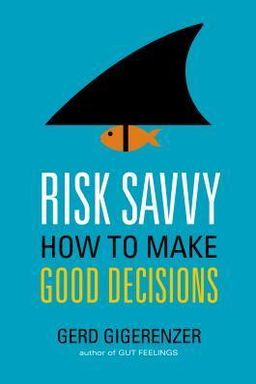
Risk Savvy: Thinking Clearly in an Uncertain World
In a world overflowing with numbers, forecasts, and expert claims, you often feel surrounded by certainty—but much of it is illusion. Gerd Gigerenzer’s Risk Savvy: How to Make Good Decisions explains why your mind routinely misreads risk and uncertainty, and how simple, teachable tools can make you smarter and freer. The book challenges the popular view that people are irrational and need paternalistic control. Instead, Gigerenzer argues that most errors stem from risk illiteracy—a lack of understanding of probabilities, reference classes, and uncertainty.
Why you misunderstand risk
You don’t need to be stupid to misjudge risk; you just need to be human. Media and experts often present relative risks that sound dramatic but hide small absolute changes. When British health authorities announced that a birth-control pill "doubled" the risk of thrombosis, they failed to mention that the increase was actually only one case in several thousand. Thousands of women panicked, stopped using the pill, and caused more unintended pregnancies—the opposite of the intended protection. Gigerenzer's lesson: whenever you hear percentages, ask two questions—Percent of what? and One in how many? Those simple checks reveal whether a number describes a major risk or a minor noise.
Risk vs uncertainty
Gigerenzer draws a crucial distinction between risk—situations where probabilities are known—and uncertainty—where probabilities cannot be confidently assigned. Most real-world decisions fall into the second category: markets fluctuate, pandemics evolve, and people change behavior. Under uncertainty, complex optimizations crumble because they rely on false precision. Instead, simple heuristics—rules of thumb—often outperform statistical models by being robust and adaptable.
The illusion of certainty
Humans love definite answers. Doctors promise definitive diagnoses, investors demand firm forecasts, politicians preach “zero risk.” But certainty is often an illusion. A positive medical test doesn’t equal disease, and a 25-sigma market event means the model was wrong, not that reality misbehaved. The craving for certainty drives disastrous overconfidence, whether in medicine (misread mammograms) or finance (false security before the 2008 crash). Gigerenzer’s antidote is skeptical curiosity: ask for the underlying assumptions, base rates, and reference classes before trusting any “precise” number.
Heuristics: smarter simplicity
Heuristics—fast and frugal mental rules—are your natural tools for uncertain worlds. When airline pilots saved Flight 1549 by gliding onto the Hudson, they didn’t run equations; they used a gaze heuristic: keep a fixed visual angle on your target. Simple rules like 1/N investing or satisficing a good-enough restaurant choice often outperform complex algorithms. (Herbert Simon called this “bounded rationality”—recognizing the limits of perfect models.) Gigerenzer expands it into an adaptive toolbox: practical tips that help you navigate risk in medicine, money, and daily life.
From fear to literacy
Gigerenzer also explores the psychology of fear. You react strongly to dread risks—many deaths at once—while ignoring slow dangers like car crashes or lifestyle disease. After 9/11, many Americans drove instead of flying, causing over a thousand extra deaths. Understanding how emotion and imitation shape fear enables you to redirect anxiety toward genuine threats and maintain perspective. Risk literacy transforms passive fear into active competence.
Building a risk-literate culture
The book moves from personal judgment to cultural reform. Medicine’s defensive practices—ordering excess tests to avoid blame—contrast with aviation’s healthy error culture, where mistakes are openly shared and systems improved. Transparency tools like natural frequencies, icon boxes, and fact boxes make numerical data visible: how many lives saved, how many false alarms, how many harms. Such clarity empowers patients and disarms manipulative statistics. In finance, simple limits on leverage and diversified portfolios protect more reliably than ornate models built on fantasy precision.
Why it starts in schools
Gigerenzer closes with a civic mission: teach kids probabilistic thinking early. Young students can grasp Bayesian reasoning if you present data as counts, not formulas. Health, finance, and digital literacy should join reading and writing as core competencies. Risk literacy is democratic literacy—it shields citizens from manipulation, paternalism, and the seductions of false certainty. Once you see risks clearly, you reclaim autonomy—the very opposite of being nudged or ruled by fear.