
Idea 1
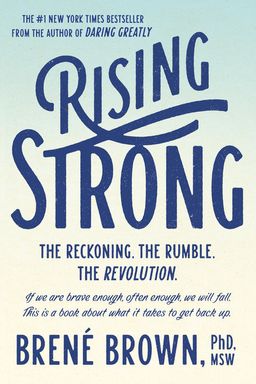
Rising Strong: The Courage to Get Back Up
When was the last time you tried something brave and found yourself face down in failure—or heartbreak? In Rising Strong, Brené Brown argues that this moment of collapse isn’t the end of the story—it’s where transformation begins. Drawing on more than a decade of research into vulnerability, courage, shame, and resilience, Brown contends that the ability to rise strong after a fall is not a superhuman trait. It’s a process—a learnable practice—that defines how we live, love, parent, and lead.
Brown calls this process the physics of vulnerability: when we choose courage over comfort and show up in the arena of life, we will inevitably fall. But getting back up—rising strong—requires reckoning with our emotions, rumbling with our stories, and writing new endings. Her message is both personal and universal: struggle is not a sign of weakness, but a doorway to deeper strength.
The Anatomy of Falling and Rising
Brown structures the book around three core stages: The Reckoning (recognizing what we feel and getting curious about why), The Rumble (owning our story and questioning the false narratives we build), and The Revolution (transforming our lives by integrating these lessons). Each stage represents a move toward authenticity and wholeness, replacing shame and fear with meaning and intention.
Her stories—ranging from a marital argument that nearly derails a vacation to professional missteps and moments of shame—illustrate the messy process of confronting reality. Through these real-life examples, she models what it means to be both brave and brokenhearted, inviting readers to see vulnerability as strength, not a flaw.
Why Vulnerability Is the New Measure of Courage
Brown’s starting point is vulnerability—the willingness to show up and be seen when we can’t control the outcome. Building on her previous work in Daring Greatly, she insists that vulnerability is not weakness, but rather our most accurate measure of courage. Using Roosevelt’s famous “Man in the Arena” speech, she frames life itself as that arena, where we inevitably get bloodied and bruised when we dare greatly.
But most people are taught to either avoid emotion (by armoring up) or minimize struggle (by pretending everything’s fine). Brown argues that these defensive strategies are exactly what disconnect us from meaning. Rising strong, then, begins with turning toward the discomfort that we instinctively avoid. Her guiding principle: “We can choose courage or we can choose comfort, but we can’t have both—not at the same time.”
The Story as a Source of Healing
Underlying every fall, Brown shows, is a story—one we tell ourselves about what happened, who’s to blame, and what it means about us. Because we are “wired for story,” our first instinct after a disappointment is to fill in the blanks. But these early drafts are often confabulations—emotionally charged, half-true narratives shaped by fear and shame. Our brain rewards certainty, even at the cost of truth. Thus, Brown teaches us to pause and write down “the story I’m making up,” a deceptively simple yet powerful tool that opens the way to rumble with reality instead of defensively rewriting it.
As she learns while working with organizations like Pixar and the U.S. military, storytelling is more than a metaphor—it’s how we integrate experience and emotion into wisdom. Connection, empathy, creativity, and spirituality all come through the stories we own. Unowned stories, in contrast, own us.
A Revolution of Wholeness
The ultimate goal of Rising Strong is not just personal growth but cultural change. Brown calls for a “wholehearted revolution”—a movement against shame, scarcity, and perfectionism, and toward the integration of our messy, imperfect selves. This revolution begins in our individual lives, in marriages, families, workplaces, and communities, wherever people have the courage to say: “Our stories matter because we matter.”
By the end of the book, Brown has given readers both a framework and a mirror: a framework for processing failure and hurt with compassion, and a mirror showing how resilience and creativity emerge precisely from our willingness to stumble. Vulnerability becomes not a risk to avoid, but the birthplace of love, courage, empathy, and meaning.
“People who wade into discomfort and get up again are the real badasses,” Brown writes. This is the heart of Rising Strong: the conviction that daring, falling, and rising again is not just how we become resilient—it’s how we become fully human.