
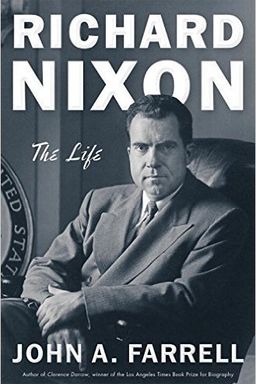
Richard Nixon cover

Richard Nixon

by John A Farrell

Explore the riveting biography of Richard Nixon, a president whose ambitious ascent was marred by scandal and controversy. From his humble beginnings to groundbreaking diplomacy and the infamous Watergate scandal, uncover the complexities of Nixon''s life and legacy.

The Making of Richard Nixon

How does a quiet, disciplined boy from a Quaker family become one of the most ambitious and controversial figures in American politics? Throughout this biography of Richard Nixon, you watch a man shaped by contradictions—moral restraint versus relentless drive, idealism versus insecurity, and ever-deepening tension between public service and personal survival.

Origins and temperament

Born in Yorba Linda to Frank and Hannah Nixon, Richard inherits the hardness of his father and the piety of his mother. The family’s Quaker values instill restraint and solitude, but the constant struggle for survival builds drive and ambition. The deaths of his brothers Harold and Arthur leave deep scars—survivor guilt mixed with a sense that disciplined effort is the only defense against chaos.

This formative environment teaches him two conflicting lessons: achievement wins love, but emotional openness invites pain. That paradox becomes Nixon’s emotional blueprint—a capacity for extraordinary effort accompanied by chronic suspicion.

War, duty, and the awakening of ambition

World War II forges Nixon’s worldview. As a naval officer in the South Pacific, he witnesses suffering and absorbs lessons on order, leadership, and moral clarity. His wartime readings—Lincoln, Roosevelt, Wilson—sharpen ideals about public duty. You see him return home less idealistic and more strategic, convinced that public office provides a way to impose order upon chaos.

The war also gives him credibility, a veteran’s authority that converts ambition into opportunity. When local banker Herman Perry urges him to run for Congress, Nixon seizes the moment and begins crafting his political persona: tireless, prepared, and self-styled defender of moral order in a dangerous world.

Politics as theatre and combat

From his first congressional race against Jerry Voorhis in 1946 through his 1950 Senate battle with Helen Gahagan Douglas, Nixon refines a signature method: frame opponents through association and moral implication. He learns that guilt-by-association works as powerfully as proof. Ads, repetition, and carefully planted rumors generate momentum. His allies—bankers, oil donors, and media figures like Kyle Palmer—help orchestrate perception. (Parenthetical note: These campaigns prefigure modern political media operations.)

The resulting reputation is double-edged. Nixon becomes a rising star for conservatives but earns enduring suspicion among liberals. The tactics that propel him also label him ruthless—a theme that will shadow every stage of his life.

Television, vulnerability, and redemption

In 1952, accused of financial impropriety over the Dana Smith fund, Nixon crafts the Checkers speech—a performance that saves him and revolutionizes politics. On live television, he explains his debts and family modesty, introduces the family dog Checkers, and wins sympathy from millions. You see emotional candor packaged as strategy: a new form of directly televised self-defense that bypasses press skepticism.

The speech teaches an enduring lesson—television rewards emotional accessibility even when it’s carefully staged. Nixon internalizes this, becoming both master and victim of media’s new power: capable of theatrical authenticity while deepening his mistrust of journalists.

Power, paranoia, and the psychology of control

When Nixon enters the White House as vice president under Eisenhower, his efficiency is praised but his emotional distance grows. Excluded from Ike’s inner circle, he compensates with tireless engagement—Asia tours, congressional mediation, and anti-McCarthy diplomacy. These years teach him loyalty’s political value but entrench his hunger for independent power. (Compare with Johnson’s Senate apprenticeship: both men convert exclusion into drive.)

By the 1960s, disappointment hardens into calculation. After losing to Kennedy and the California governorship, Nixon studies the electorate from exile and re-emerges in 1968 appealing to the “silent majority”—Americans craving order and respect amid cultural upheaval. His comeback strategy joins moral rhetoric to social anxiety, shaping a coalition that shifts U.S. politics rightward for decades.

Triumph and collapse

The presidency magnifies Nixon’s strengths and flaws. His foreign-policy audacity—opening China, negotiating détente, extracting the U.S. from Vietnam—shows brilliant strategic vision. Yet his secrecy and distrust metastasize during crises like the Pentagon Papers and Watergate. Believing enemies surround him, he sanctions covert operations—the Plumbers, surveillance, and cover-ups—that cross into criminality.

Watergate is the logical endpoint of Nixon’s lifelong pattern: control through secrecy, defense through attack. When the tapes expose his complicity, resignation follows. Yet he uses exile to reforge reputation—writing, advising, and reappearing as foreign-policy sage. His legacy remains divided: diplomatic genius shadowed by moral collapse.

Core insight

Nixon’s life demonstrates how insecurity can coexist with discipline, how ambition and paranoia can drive both triumph and ruin. You see in him a mirror of modern politics—media mastery intertwined with mistrust, strategy inseparable from self-destruction.


Origins and Early Drive

Richard Nixon’s childhood in Whittier, California molds every later habit. Frank’s volatile temper and Hannah’s Quaker discretion create an environment of alternating noise and silence. From store work at 3:45 a.m. to caregiving during Harold’s illness, Nixon absorbs the gospel of labor and self-control.

At Whittier College, discipline meets performance. He becomes student-body president, debate champion, and actor. These small victories matter because affection is scarce at home—achievement substitutes for emotional intimacy. Nixon thus learns to turn pressure into performance.

Emotional restraint and ambition

Quaker silence and competitive childhood yield an inward man. He pacifies pain through work—hours of speech practice, meticulous note-taking, ceaseless improvement. (Psychologists later describe similar ambition in Lincoln and Truman, driven by moral duty rather than mere vanity.)

This pattern defines Nixon’s psychology across decades: emotional privacy paired with craving for recognition. His later need to justify, to explain, to control audience reaction reflects that early dynamic—achievement as the only safe form of affection.


War and the Awakening of Duty

World War II transforms Nixon from small-town bureaucrat to ambitious public servant. Serving in the South Pacific, he faces death and disorder, reading voraciously under tent light and drawing lessons on endurance. The Pacific foxholes teach him practical leadership, while the readings—Lincoln and Roosevelt—infuse moral nationalism.

From service to aspiration

Returning home, Nixon channels wartime lessons into political ambition. Veterans’ issues guide his first campaign; discipline and moral clarity guide his rhetoric. He crafts a method of persuasion rooted in public duty—arguing for strength, containment, and reform. The war provides not just experience but narrative power: a veteran preaching civic renewal.

Insight

War shapes Nixon’s sense that politics is moral combat—an arena where disorder must be controlled, enemies exposed, and endurance rewarded.


Crafting Political Combat

The campaigns of 1946 and 1950 reveal Nixon’s tactical genius—and moral ambiguity. Running against Jerry Voorhis and Helen Gahagan Douglas, he experiments with tactics that blend grassroots enthusiasm with negative framing. Early allies like Roy Day and Herman Perry help fund operations, while media figures such as Kyle Palmer provide coverage.

The pattern of association

When proof is thin, Nixon learns to imply connection—linking Voorhis to leftist PACs and Douglas to Communist sympathizers. The technique relies on repetition, symbolism (the pink sheet), and timing. It transforms political argument into moral crusade. (Note: Modern attack advertising uses identical associative logic.)

Ethical cost

Victories elevate Nixon but stain reputation. The Voorhis and Douglas defeats paint him as ruthless. Old allies rationalize, “He had to win.” Nixon internalizes the lesson—politics rewards efficacy over virtue. That conviction will later justify far darker operations in the White House.


Media, Television, and Public Image

Nixon’s career unfolds alongside the rise of television, a medium he simultaneously masters and distrusts. The 1952 Checkers speech inaugurates televised authenticity. Struggling against fund scandal, he turns personal confession into national empathy—displaying family and humble finances before millions.

Afterward, he learns that image management equals survival. The same television that saved him nearly destroys him eight years later: the 1960 debates against Kennedy reveal the perils of unvarnished appearance. Pale, tired, and makeup-free, Nixon looks defeated despite sound arguments. Television rewards charm over data.

Transformation of politics

Checkers teaches that emotion can outweigh fact. Nixon’s media instincts reshape campaigning—scripted spontaneity, relentless packaging, and stagecraft. (Parenthetical note: Later politicians from Reagan to Clinton exploit identical formulas.) Yet the manipulation poisons his trust—after attacks from Herblock and Drew Pearson, Nixon begins treating journalists as adversaries.

By the mid-1950s, he realizes that media exposure both humanizes and endangers. Television becomes his double-edged sword—his greatest ally and his most feared judge.


Vice Presidency and Global Theater

Nixon’s eight years under Eisenhower showcase both competence and frustration. Denied closeness to Ike, he channels energy into action—mediating in Congress, tackling the McCarthy crisis, and traveling abroad. His rebuke of McCarthy’s excesses, the “rat shooting” metaphor, demonstrates moral calibration: attack subversion without attacking institutions.

His Asia tour of 1953 and later diplomatic missions energize foreign policy. In Caracas (1958), mobs assault his motorcade; rather than retreat, he confronts them, shouting, “You are cowards!” These episodes transform his image from cautious lawyer to courageous statesman.

Spectacle as diplomacy

The 1959 Kitchen Debate with Khrushchev epitomizes Nixon’s evolution. In Moscow’s American Exhibition, amid refrigerators and color TVs, he sparrs with Khrushchev on ideology. Cameras roll; the “debate” becomes a broadcast of American confidence. For Nixon, foreign policy merges performance and conviction—politics conducted before global spectators.

These experiences teach him that courage and theatre unite public approval. They prepare the psychological stage for future presidential diplomacy—the China opening and Vietnam negotiations will follow the same logic of visible, dramatic assertion.


Comeback and Realignment

Defeats in 1960 and 1962 push Nixon into temporary exile—but exile becomes laboratory. Practicing law in New York and writing Six Crises, he reframes losses as proof of perseverance. By 1968, he reappears as a candidate attuned to cultural backlash.

The Silent Majority and the Southern shift

Nixon’s campaign reconstructs American conservatism. He appeals to “forgotten Americans”—suburban, blue-collar, and Southern voters unsettled by protest and crime. He uses coded rhetoric—law and order, peace with honor—to unite middle-class anxiety and patriotic pride. Choosing Spiro Agnew reinforces this posture while courting Southern moderates. (Historian Kevin Phillips calls it the architecture of Republican realignment.)

Nixon’s language of dignity and restraint contrasts with national turmoil. This rhetorical positioning—moral normalcy amid disorder—wins the presidency and reshapes politics for a generation.


Foreign Policy and the Pursuit of Order

As president, Nixon’s most profound achievements appear in global strategy. With Henry Kissinger, he directs back-channel diplomacy, secret summits, and realpolitik that end two decades of Cold War frozen fronts. The China opening (1972) redefines world equilibrium; détente with Moscow and SALT follow suit.

Strategic vision

Nixon imagines a five-power balance—U.S., USSR, China, Japan, Europe—stabilizing global order. He combines ideological flexibility with procedural control. The “linkage” policy ties trade and arms to diplomatic behavior, expanding U.S. leverage. Yet secrecy breeds mistrust: Cambodia bombing and the Chennault affair show how covert acts erode moral legitimacy even amid strategic success.

Domestic contrast

Domestically, paradox reigns. Nixon creates the EPA and promotes desegregation through law and quiet persuasion, yet he also manipulates racial and cultural anxiety. His strategy of visible order and hidden innovation mirrors his personal divide—public reassurance masking private control.

You see a leader brilliant in global calculus and conflicted on ethics, where secrecy both achieves policy and destroys trust.


Watergate and the Politics of Secrecy

The Watergate scandal reveals the destructive endpoint of Nixon’s obsession with control. Starting with paranoia after the Pentagon Papers leak, his circle forms covert operations—the Plumbers, hunt for leaks, and later the Committee to Re-Elect the President (CREEP). The same methods used to fight enemies abroad turn inward.

From paranoia to lawbreaking

Ellsberg’s Pentagon Papers disclosure sparks fear of conspiracy. Nixon authorizes illegal break-ins to find secrets, culminating in Watergate. When burglars are caught, the cover-up begins—hush money, obstruction, and misuse of federal agencies. Nixon’s tapes document participation, sealing his fate.

Collapse and consequence

The Supreme Court orders tape release in U.S. v. Nixon; the June 23, 1972 “smoking gun” reveals direct involvement. Facing impeachment, Nixon resigns on August 8, 1974. His downfall exposes systemic dangers: secrecy without oversight, ambition without accountability.

Lesson

Watergate teaches that the same discipline that builds achievement can, when warped by fear, create self-destruction. Secrecy may advance power—but unchecked, it destroys legitimacy.


Exile, Reflection, and Legacy

Nixon’s post-1974 years illustrate redemption through intellect. Retreating to La Casa Pacifica, he battles humiliation and illness, then reasserts a role as elder statesman. The Frost interviews, bestselling memoirs, and diplomatic consults mark his gradual re-entry into public esteem.

Reconstructing reputation

Books such as RN and Beyond Peace frame his career as misunderstood patriotism. He travels to China and Russia, counseling Reagan and Bush on strategy. For future policymakers, he remains touchstone for realpolitik and resilient ambition (even amid moral controversy).

The lasting paradox

History divides him: diplomatic visionary versus constitutional violator. His legacy endures because it encapsulates the paradox of power—brilliance joined with mistrust. You leave his story understanding that mastery of systems, without mastery of self, cannot last.

Nixon’s career is thus a morality tale for power in the modern age—spectacular achievement shadowed by the human cost of relentless control.

Dig Deeper

Get personalized prompts to apply these lessons to your life and deepen your understanding.

Go Deeper

Get the Full Experience

Download Insight Books for AI-powered reflections, quizzes, and more.