
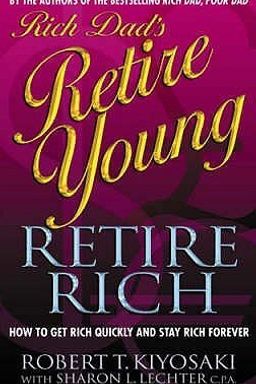
Rich Dad’s Retire Young Retire Rich cover

Rich Dad’s Retire Young Retire Rich

by Robert T Kiyosaki

Rich Dad''s Retire Young Retire Rich reveals Robert Kiyosaki''s powerful approach to personal finance. Learn to cultivate habits conducive to wealth, leverage debt for income-generating assets, and embrace a mindset that sees opportunities where others perceive risks. This book provides actionable insights for achieving financial independence and retiring early.

Leverage: The Engine of Wealth

Leverage: The Engine of Wealth

Robert Kiyosaki argues that the reason some people become rich and others do not comes down to one decisive force: leverage. Leverage is the ability to do more with less—using tools, partners, systems, and ideas that magnify results while minimizing individual effort. From Rich Dad’s teachings, Kiyosaki learned that leverage is not merely a financial mechanic but a worldview shift. It explains why David could defeat Goliath with a slingshot, why a single entrepreneur can beat enormous corporate structures, and why wealth accumulates exponentially rather than linearly. Once you understand leverage, you stop thinking in terms of effort and start thinking in terms of multipliers.

The forms of leverage

Leverage appears in many forms. Other People’s Money (OPM)—borrowing capital to buy income-producing assets—is one of the most visible. Kiyosaki contrasts the couple in a newspaper that relied on equity savings to retire slowly with his own experience: he retired early because he used OPM to acquire apartment buildings that generated passive cash flow. Other People’s Time (OPT) comes next: it’s the systemized use of teams and staff that create scalable business structures. In the B quadrant (business owners), you use OPT to serve hundreds or thousands while freeing your time. There’s also Mind leverage, the mental frameworks and words you use to create structural advantage; technology leverage, which scales your reach globally; and network leverage, the social ties and mentors that open wholesale opportunities not available to retail players.

A structural explanation of success

Rich Dad teaches that leverage multiplies outcomes. Two people may be equally intelligent, but the one who stacks education, partnerships, and tools will accelerate faster. Civilization itself evolved through leverage—fire, the wheel, agriculture, and technology all allowed societies to accomplish more with less. (Note: This perspective resembles Nassim Taleb’s idea of asymmetric payoff—where one small input can yield outsized returns if structured correctly.) Kiyosaki emphasizes that leverage is neither good nor bad by itself; it is a power tool. Debt or technology used unwisely destroys, yet when used intelligently it compounds into life-changing outcomes.

The mindset of leverage

Seeing the world through leverage means shifting from linear to exponential thinking. You stop asking “How can I earn more?” and start asking “How can I multiply what I already do?” Mind leverage reinforces this shift by changing your internal language. When you say “I can’t afford it,” you close possibility; when you ask “How can I afford it?”, you trigger your brain to find solutions. Kiyosaki’s insight is psychological as well as financial: your words are tools, and your vocabulary defines your level of reality.

Applying the power safely

Kiyosaki reminds you that leverage is like a loaded gun: useful but dangerous if misapplied. You must learn debt basics before borrowing, distinguish good debt from bad, and treat every borrowed dollar like a responsibility to produce more dollars. Start small, use mentors, and respect the tax and system structures that make leverage sustainable. Rich Dad’s motto—“Respect leverage, never fear it”—captures the heart of this philosophy. Once you understand leverage across money, time, and mind, your possible outcomes in life expand geometrically.

In essence, this book’s big idea is that leverage is the language of the rich. It appears in loans, systems, words, and relationships—and you can learn it. You begin by mapping what levers you already have, educating yourself on debt and cash flow, and adding new forms—mentors, systems, education—safely. The rich grow richer not because of luck but because they layer leverage intelligently and continually expand their reality to hold larger opportunities.


Mind Leverage and Language Power

Mind Leverage and Language Power

Your mind, Kiyosaki says, is your most potent form of leverage. The words and mental models you use shape the boundaries of your reality. Rich Dad famously forbids phrases like “I can’t afford it” because they collapse curiosity into defeat. When you replace those words with questions like “How can I afford it?” you activate creativity and open paths to action. The book demonstrates, through personal anecdotes and exercises, that changing language literally changes results.

Words as mental tools

Kiyosaki treats words as financial instruments. He quotes scripture—“and the word became flesh”—to assert that thoughts take physical form when acted upon. If you repeatedly claim that investing is risky, you create an environment where every investment feels like danger. If you reframe that statement into “What returns justify the risks?” or “How many times can I lose safely before I win?”, the question itself expands your reality. Each improved phrase becomes a small lever for larger understanding.

Practical mental leverage

Mind leverage isn’t about affirmations—it’s about cognitive training. Kiyosaki advises writing a list of loves and hates to fuel motivation; studying biographies of bold thinkers to stretch context; and replacing negative language for one week to observe what changes. His Whistler Mountain story exemplifies this process: he spent hours arguing with himself on New Year’s Day in 1985 until he identified his “why.” That simple internal pivot—from fear to purpose—launched a ten-year plan toward financial freedom.

Reframing failure and reality

Rich Dad’s key insight is that winners build failure into the plan. Like the Wright brothers, they practice losing safely until success emerges. When you see failure as training rather than shame, you extend your capacity to take action. The words you attach to experience—“setback” versus “training”—determine your long-run momentum. Kiyosaki calls this reality expansion: as your vocabulary widens, what once felt impossible now feels routine. (In psychology, this aligns with cognitive reframing—a central strategy for growth and resilience.)

When you master mind leverage, your sentences become structures of wealth. You ask better questions, attract new partners, and transform risk into information. Mental expansion precedes financial expansion. Every rich person you’ll study—from Rockefeller to Gates—used language to reshape what was thinkable before they acted. This is the quiet leverage behind every external success.


Planning for Freedom

Planning for Freedom

Kiyosaki emphasizes that investing is not random—it’s a plan. If you want to retire young, you design your exit first, then reverse-engineer the road to it. Most people ride what he calls the slow train—working for decades in jobs, saving bits in 401(k)s, and hoping compounding will carry them to safety. The rich, conversely, design fast exit plans with specific ages, income targets, and measurable passive cash flow.

Start at the end

Rich Dad’s rule: “Always start at the end before you begin.” Kiyosaki and Kim decided in 1985 to retire within ten years and achieved it by 1994—Robert at 47, Kim at 37. They mapped a clear end: passive income exceeding expenses. Every choice—education, mentors, properties—fed that end goal. This forced velocity meant rejecting slow habits like saving into equity-only assets and instead focusing on high-leverage, cash-flow investments.

Designing the fast train

To make your plan move fast, Kiyosaki recommends specifying targets: choose your exit age, income goal, preferred asset class, and learning timeline. During their fast years, he and Kim took seminars, joined investor groups, and prepared for the 1989–1994 market window when properties became undervalued. Preparedness turned opportunity into outcome. (Note: This mirrors military planning philosophy—define objectives clearly, train before battle, and execute when conditions align.)

Fast versus slow money

In contrast to slow savers, the fast planner moves money through velocity and leverage. Debt becomes an accelerant instead of a constraint, provided it funds appreciating and income-generating assets. Strategic planning connects mindset to execution: you use mind leverage to expand possibility, then use financial systems to compress time. The result is freedom years earlier than conventional wisdom predicts.

Your plan must match your chosen speed. If freedom in 20 years feels acceptable, take the slow route. But if you value time more than safety, use leverage intelligently, keep learning, and design backward from your finish line. Planning for freedom starts in the mind and ends in measurable passive income streams that sustain you for life.


Debt, Cash Flow, and Tax Power

Debt, Cash Flow, and Tax Power

Leverage isn’t complete without understanding money structure—debt and taxes. Kiyosaki insists that not all debt or income is created equal. Good debt earns you money; bad debt costs it. Likewise, there are three types of income: ordinary, portfolio, and passive, each taxed differently. Knowing these distinctions transforms financial tactics into strategy.

Three income types

Ordinary income—your paycheck—is highest taxed. Portfolio income from stocks enjoys modest advantages. Passive income from real estate or businesses, when structured correctly, can approach zero tax through depreciation or deferrals. Rich Dad teaches this as “50-percent money, 20-percent money, and 0-percent money,” symbolic shorthand for relative burden. Learning how taxes actually work transforms fear of the IRS into respect for incentives.

Case example: compounding by deferral

Kiyosaki and Kim bought a 12-unit apartment for $335,000 with $35,000 down and seller financing. It produced $1,100 monthly cash flow and later sold for over $500,000. They rolled gains into a larger building through tax deferral, effectively buying new assets with untaxed profits. That maneuver was legal under tax rules designed to encourage economic productivity—the art of using the government’s structures as part of your leverage system.

Debt philosophy

Good debt funds income-producing assets. Bad debt funds consumption. Simple but critical distinction. Rich Dad compares loans like surgical instruments—you must learn technique before operating. Financial education turns potentially destructive tools into accelerators. This principle also applies to refinancing and cash-out strategies, which enable velocity—the re-use of capital without selling assets.

Once you know how debt and taxation interact, you can compound wealth exponentially while staying legal and safe. Treat every transaction as a lesson in structure. The real win is not simply high income but self-sustaining cash flow protected by intelligent leverage.


Expanding Reality and Building Networks

Expanding Reality and Building Networks

As you grow richer, Kiyosaki insists that progress eventually stalls unless you expand your reality—the size, scale, and scope of what you consider possible. He tells of hitting an invisible ceiling at $4 million projects until a friend explained that deals above $5 million actually became easier: financiers, government programs, and institutional investors played by different rules. The lesson: the world reorganizes itself once you cross thresholds of size and confidence.

Crossing boundaries

At small scales, capital and attention are scarce. At larger scales, institutions prefer lending because systems and guarantees are established. When Robert and Kim pursued $10 million low-income housing developments, they discovered government-backed programs with 95–110% financing, 40-year fixed rates, and nonrecourse terms. Leverage became cheaper and safer because their projects served a public mission. Expansion, therefore, is not just ambition—it strategically moves you into different rulesets.

Network economy

You further accelerate expansion through networks. Rich Dad shows ratio thinking: a poor person’s leverage might be 1:1; a business owner’s could reach 1:300 or 1:450. Kiyosaki cites Metcalfe’s Law—that network value scales by the square of its members—to explain why franchises and collaborative ventures outclass solo effort. A connected individual leverages more minds, money, and time than any single achiever could.

Practical steps

Map your current comfort zone and determine what lies just beyond it. Learn new vocabulary, attend events, and find one mentor already operating at your next level. Each conversation stretches your reality. Expansion doesn’t mean reckless growth—it means upgrading the frameworks and networks through which capital flows to you. (Comparable thinkers like Peter Diamandis echo this: abundance grows when you increase scale and connectivity.)

When you consciously expand your reality and network power, the math of wealth changes from addition to multiplication. You tap economies and connections that thrive on generosity and shared vision, making the next $10 million not harder but easier than the first $4 million.


Integrity, Action, and Generosity

Integrity, Action, and Generosity

The final tier of leverage is character. Rich Dad says that money follows integrity, because credibility is leverage itself. Banks and partners fund people they trust. Breaking small promises breaks big opportunities. Kiyosaki extends this to action—you practice financial vision through games, small deals, and keeping your word daily. Consistency transforms intentions into momentum.

Integrity as a multiplier

Integrity isn’t moral posturing—it’s a strategy. People who deliver become magnets for OPM and OPT. Every honor kept adds leverage; every dishonor subtracts it. Rich Dad’s simplest warning: “The most life-destroying word of all is tomorrow.” You build credibility today, not later. When your word equals your deed, reputation compounds.

Generosity as access

Generosity is structural leverage because systems reward service. Kiyosaki learned that low-income housing projects qualified for powerful financing precisely because they served public needs. Aligning a business with social value attracts institutions and partners that fund and fortify your mission. Rich Dad even provides a pay-sequence list—asset first, employees second, specialists third, investors fourth, owner last—illustrating that generosity creates stability and, paradoxically, richer outcomes.

Action and continuous learning

Integrity without movement doesn’t multiply. Kiyosaki compares financial mastery to Top Gun training—practice repeatedly so you can act at high speed under stress. You learn to lead teams, build B-quadrant businesses, and use every lesson as leverage. Leadership, responsibility, and generosity converge: when you help others rise, your own opportunities multiply. This law of reciprocity is the moral physics of wealth.

Wealth grows fastest when combined with truthfulness and service. You treat every promise as sacred and every deal as shared value. In doing so, you unlock capital not available to those who operate from greed or delay. The final lesson of leverage is character—the invisible foundation on which all other levers stand.

Dig Deeper

Get personalized prompts to apply these lessons to your life and deepen your understanding.

Go Deeper

Get the Full Experience

Download Insight Books for AI-powered reflections, quizzes, and more.