
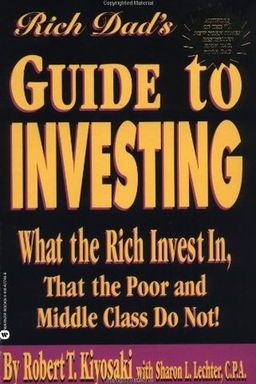
Rich Dad’s Guide to Investing cover

Rich Dad’s Guide to Investing

by Robert T Kiyosaki

In ''Rich Dad’s Guide to Investing,'' Robert Kiyosaki reveals the secrets of how the wealthy invest differently from others. Drawing on insights from his ''rich dad,'' Kiyosaki empowers readers to adopt a rich mindset, improve financial literacy, and harness business opportunities to achieve financial independence and wealth.

Building Wealth Through Financial Intelligence

Why do only a small fraction of people ever become truly wealthy? In Rich Dad’s Guide to Investing, Robert Kiyosaki argues that it isn’t income, luck, or inheritance—it’s financial intelligence. The book teaches that wealth begins and ends in the mind: how you think about risk, money, and opportunity determines almost everything else. The central premise is the 90/10 principle of wealth—10% of people control 90% of the money, not because the system is rigged, but because that 10% thinks differently, acts strategically, and learns faster than the rest.

Mindset: Seeing Two Worlds

Kiyosaki’s comparison of his rich dad and poor dad forms the psychological foundation. The poor dad sees scarcity and secure jobs as the goal; the rich dad sees abundance and ownership as the path. You must stop asking, “Can I afford this?” and start asking, “How can my business afford it?” This subtle shift aligns your thinking with entrepreneurs like Ray Kroc and Henry Ford, who used business structures to buy assets. Wealth begins with mental flexibility—the ability to think on both sides of the coin about debt, risk, and focus versus diversification.

Plan Before Product

The second mental evolution is to treat investing as a plan, not a product. Stocks, real estate, and mutual funds are vehicles—not strategies. You design the roadmap first, defining destination (your financial goals), timing (your horizon), and method (your chosen path). Without a coherent plan, you are gambling. Kiyosaki’s analogy of travel clarifies this: you wouldn’t ride a bicycle from Hawaii to New York; the vehicle must fit the plan. Mechanical consistency, not cleverness, creates wealth—evidence comes from research by James O’Shaughnessy showing that simple rules outperform emotional trading.

Financial Literacy and Cash Flow

At the practical level, Kiyosaki insists you master financial statements. The rule is brutally simple: an asset puts money in your pocket; a liability takes it out. The income statement and balance sheet form a “magic carpet” that reveals truths hidden in prices. A house is not automatically an asset—if it drains cash, it is a liability. Understanding flow rather than appearance protects you from bubbles and bad advice. Financial literacy gives you the language of wealth—without it, you misinterpret the world.

Learning Through Business Creation

True wealth builders practice entrepreneurship. Rich dad teaches that “rich people don’t just buy investments—they create them.” Building a business allows you to use corporate capital, tax rules, and leverage to buy assets others cannot. Entrepreneurship turns ideas into assets: McDonald’s profits from real estate as much as hamburgers; early inventors in Kiyosaki’s stories turned small ideas into scalable wealth. Even failed ventures teach critical lessons that later lead to success—the price of education is time and mistakes.

Climbing the Investor Ladder

Kiyosaki’s investor continuum—from qualified to sophisticated, inside, and ultimate investor—explains how control and knowledge expand. To climb, you must develop the Three E’s: Education, Experience, and Excess cash. Education teaches vocabulary; experience offers judgment; excess cash provides optionality. As you grow from reading statements to managing deals and forming entities, you evolve from passive trading to active creation. Sophisticated investors design transactions; inside investors create them; ultimate investors sell or go public.

Control as the Antidote to Risk

Rich dad warns that investing isn’t risky—being out of control is. The ten investor controls—over yourself, management, taxes, timing, information, and agreements—determine safety. Advanced investors master E‑T‑C: Entity, Timing, and Character of income. By building corporations and understanding tax timing (such as 1031 exchanges), you legally convert ordinary income into passive or portfolio income, protecting wealth through structure rather than evasion. Control transforms hazard into strategy.

The B‑I Triangle: The Architecture of Enterprise

The B‑I Triangle diagram ties the system together. Its layers—mission, team, leadership, cash flow, communications, systems, legal, and product—describe how to make any business sustainable. “Money follows management,” rich dad says. McDonald’s thrives because its systems permit repetition worldwide. Leadership and teamwork act as stabilizing structures; mission gives enduring purpose. The triangle mirrors Dr. Buckminster Fuller’s tetrahedral philosophy: businesses survive only when structurally balanced.

The Price and Purpose of Wealth

Wealth requires patience. You pay with time and mistakes. Mistakes are tuition; they teach you judgment others never acquire. Rich dad outlines the five D’s—Dream, Dedication, Drive, Data, Dollars—as the sequence for lasting success. Finally, wealth must serve more than the self. Kiyosaki closes with the moral of “giving back.” Great investors—from Gates to Buffett—transform profits into philanthropy, reflecting the final phase of abundance. In a world where ideas and information are the new capital, the real asset is your mindset and education—the ability to keep learning faster than the economy changes.


90/10 Mindset Shift

The 90/10 principle is both a wake-up call and a blueprint. Ninety percent of people earn and spend within a comfort zone, hunting for job security; the remaining ten percent design systems and own those jobs. To cross the divide, you must change the lens through which you view money—from seeing scarcity to seeing potential. Rich dad’s mantra, “Don’t be average,” captures the difference in focus and courage.

Scarcity vs. Abundance Thinking

Scarcity thinking starts with limitations: “I can’t afford it.” Abundance thinking asks, “How can I make it happen?” When rich dad buys oceanfront property, it’s not his personal savings but his business doing the purchase—a profound frame shift. Poor dad saw risk; rich dad saw structure. You adopt abundance thinking by viewing business as an extension of creativity, not just commerce.

Both Sides of the Coin

Rich dad teaches a dual lens for decision-making. Manage risk; don’t merely avoid it. Use debt strategically; don’t fear it blindly. Diversify when defensive; focus when attacking. Flexibility is elite thinking: when others panic, you analyze. You develop psychological range—not certainty.

Actionable Shifts

Audit your own self-talk. Replace comfort-seeking statements with opportunity-seeking ones. Choose to think like a business owner instead of an employee. The practical result: you begin noticing flows and systems, not just paychecks. That awareness attracts investment opportunities because you start thinking in levers, not hours. The 90/10 mindset isn’t arrogance—it’s strategic self-education.


Investing as a Designed Plan

Kiyosaki dismantles a widespread myth: investing is not about buying products; it’s about designing a plan. This distinction transforms chaos into clarity. Stocks, real estate, mutual funds—these are tools. Your wealth depends not on which you pick, but on how they fit into a cohesive plan that defines goals, timeframes, and exit routes.

Vehicles and Map

Think like a traveler. Your financial journey requires the right vehicle for distance and terrain. Want rapid growth? Choose high-return, high-education vehicles. Need stability? Park wealth in controlled cash-flow assets. The book’s metaphor of Hawaii to New York hammers the lesson: never pick a product before confirming the route.

Simple Beats Clever

Rich dad reminds you that simple mechanical processes—like dollar-cost averaging or rule-based filters—often beat complex improvisation. James O’Shaughnessy’s research validates this: consistency outperforms intuition. The lesson is humility and discipline. Write a one-page plan answering where you are, where you’re going, and how soon. If the plan isn’t written, you are gambling, not investing.

How to Implement

Start with three stages: security, comfort, wealth. Match vehicles to each. Create repeatable procedures. Test a simple system for months before judging results. Every sophisticated investor begins with clarity and patience. The long-term distinction between the wealthy and everyone else is planning, not products.


The Three E’s and Investor Evolution

Progress as an investor requires three building blocks: Education, Experience, and Excess cash. These are gateways to sophistication. They separate accredited investors—those who qualify by income—from sophisticated investors—those who qualify by competency. You can meet government thresholds without knowing anything; rich dad insists competence matters more than status.

Education: Learning the Language

The first E is vocabulary literacy. Money uses its own language—balance sheets, tax codes, corporate terms, and memorandum clauses. When Robert analyzes private-placement documents, he learns that definitions like “accredited investor” have exact thresholds ($200k income, $1M net worth) but deeper implications. Without language, you misunderstand deals and miss opportunities.

Experience: Close to the Engine

Exposure to real deals turns theory into insight. Rich dad places Robert at meetings and deal reviews. Observing operations builds intuition about legitimate offers versus hype. Through participation, you internalize patterns and decide with confidence rather than emotion.

Excess Cash: Optionality

The third E gives freedom. You can walk away from bad deals only when you have spare capital. Desperation blinds judgment. Build cash reserves through secure and comfortable stages first, then allocate a small portion—perhaps 10%—to speculative or growth plays. Optionality is the hallmark of sophisticated investors.


Entity, Timing, and Character Controls

The E‑T‑C system—Entity, Timing, Character—is perhaps the most tangible wealth lever in the book. Sophisticated investors shape how money is earned, taxed, and reinvested through legal and timing choices. Instead of chasing returns, learn to control the rules.

Entity: Protect and Control

Your entity defines your power. Corporations, LLCs, and trusts can separate your personal and business assets, limiting liability. Rich dad cites examples like Onassis and McDonald’s—leaders who used corporate forms as protection and leverage. Business entities let you buy assets “pre-tax” while employees buy them “post-tax.”

Timing: Play with the Calendar

Taxes depend on when you realize income. C corporations can choose fiscal years; real-estate investors can use Section 1031 exchanges to defer payment on gains. Timing transforms taxable income into deferred wealth. Understand the rhythm of reporting periods and design your transactions accordingly.

Character: Change What You Earn

Income has three legal characters: ordinary, passive, and portfolio. Most taxes hit ordinary earned income—wages and salaries. Passive and portfolio income enjoy lower taxes and provide scalability. Rich investors restructure their flows to favor these categories. The poor focus on rates; the rich focus on classification. By mastering E‑T‑C, you keep more and compound faster.


The B‑I Triangle and Systems Building

Rich dad’s B‑I Triangle is the master template for creating durable businesses. Each side represents essential disciplines: mission, team, leadership, and five internal blocks—cash, communication, systems, legal, and product. A missing side collapses the structure. Learning to build a triangle prepares you to create assets that acquire other assets.

Mission: Dual Foundations

Mission combines purpose and profit. A spiritual mission explains why your enterprise matters; a business mission clarifies how it survives. Purpose attracts commitment—the examples of Ford and Gates show that a meaningful mission outlives market cycles. Without it, teams scatter when profits dip.

Systems and Legal Management

Systems make success repeatable. Document operations so growth doesn’t depend on one person. Franchises thrive because they sell systems. Legal management protects what you build—patents, copyrights, and contracts become strategic armor. Kiyosaki’s early loss of his wallet design proves that unprotected ideas vanish quickly.

Leadership and Teamwork

Leadership carries vision and discipline. Rich dad’s framework likens business teams to a tetrahedron—four balanced roles providing stability (owner, investor, specialists, operators). Every successful company—McDonald’s, Apple—embodies this structure. Leadership requires adaptability: visionary, cheerleader, pit bull.

Iteration and Mastery

No triangle starts perfect. Each failure strengthens integration among mission, systems, and cash flow. Entrepreneurs learn from trial more effectively than from theory. Start small—simple rentals or micro-products—to practice the full triangle. Iteration builds mastery.


Cash Flow and Real Estate Discipline

Cash flow is oxygen—without it, profit figures mean nothing. Businesses die from lack of liquidity, not lack of ideas. Rich dad teaches strict management: delay owner salary, invoice immediately, watch overhead, and secure lines of credit before you need them. Apply the same rigor to real estate, where leverage magnifies both success and failure.

Cash Flow Reality

Distinguish between actual cash flow and phantom cash flow. Depreciation benefits or rising valuations don’t pay bills. CASHFLOW games simulate this logic safely, letting you train judgment before spending real money. Positive cash flow equals survival; everything else is speculation.

Due Diligence Discipline

Never skip verification. Inspect leases, title abstracts, financials, and environmental records. The book lists 20+ due diligence items; the essence is control. Bargains often hide problems—bad management, deferred maintenance, legal exposure. You profit only when diligence confirms that cash flow is real and defendable.

Real Estate Metrics

Learn the cash-on-cash return. It reveals efficiency of invested capital. A $100k down payment yielding $2k monthly equals 24% annually—real yield, not headline price. Combine leverage and tax tools like 1031 exchanges and depreciation to accelerate wealth legally. Cash flow first; appreciation second.


Raising Capital and Going Public

At higher levels, you cease spending your own capital—you raise and manage others’. Rich dad’s Phase Four goes inside the mechanics of capital markets and IPOs. You learn how private placements, venture rounds, and public listings generate liquidity and how front-money investors capture large upside through early participation.

Capital Sources

Funding follows a progression: family and friends, angel investors, private placements, institutional venture capital, and public offerings. Each stage trades money for control. Kiyosaki’s story of EZ Energy shows how early insiders turning $25,000 into millions did so because they took early risk and had managerial insight.

Exchange Strategy

Markets vary. Canadian exchanges cater to resource startups; U.S. markets require scale. Listing choice affects liquidity, regulation, and access. Rich dad emphasizes competent counsel for term sheets—one clause can surrender control. Prepare audited financials and build trust with investors before negotiation.

Raising Capital Ethos

Capital-raising is storytelling. Your numbers prove reality, your mission inspires belief. Frank, rich dad’s partner, repeats: “Raising capital is the entrepreneur’s most important job.” Aim for alignment, not extraction. Done right, raising capital is partnership creation, not begging.


Controlling Expenses and Giving Back

The book closes with the internal mastery of wealth: managing your own psychology, expenses, and purpose. Many rich people lose fortunes not from bad investments but from poor self-control. You must learn that expenses can enrich or impoverish you depending on how they are structured.

Expense Intelligence

Employees buy assets with after-tax dollars; business owners buy them pre-tax. Savvy expense control means turning outflows into deductions or investments: property owned by your company, insurance paid via business, retirement plans funded through corporate accounts. Always track what goes out and question if it could be structured better.

Psychology of Keeping Wealth

Wealth magnifies character. Many collapse from impulse and lack of foresight—lavish spending, poor partnerships, emotional decisions. Build systems and advisors as guardrails. Failure is fine if educational; ruin by ego is not. Your mindset needs humility and curiosity to sustain gains.

Giving Back and New Rules

Phase Five is philanthropy. You plan generosity as part of mission and tax structure. Bill Gates and others exemplify structured giving—foundations that compound impact. Kiyosaki places this in the Information Age: ideas are capital, education replaces factories. Teaching wealth thinking, he suggests, is the ultimate form of giving back. True wealth includes wisdom and contribution.

Dig Deeper

Get personalized prompts to apply these lessons to your life and deepen your understanding.

Go Deeper

Get the Full Experience

Download Insight Books for AI-powered reflections, quizzes, and more.