
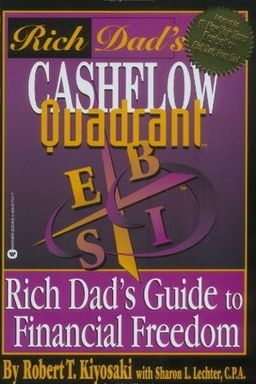
Rich Dad’s Cashflow Quadrant cover

Rich Dad’s Cashflow Quadrant

by Robert T Kiyosaki with Sharon L Lechter

Rich Dad’s Cashflow Quadrant offers a transformative guide to achieving financial independence. Through compelling stories and insightful principles, Robert T. Kiyosaki and Sharon L. Lechter reveal how to shift from traditional employment to business ownership and investment, empowering readers to attain lasting wealth and freedom.

Escaping the Rat Race: How to Move from Working for Money to Making Money Work for You

Why do some people seem to effortlessly build wealth while others spend their lives working harder yet staying stuck financially? In Rich Dad’s Cashflow Quadrant, Robert T. Kiyosaki argues that true financial freedom has little to do with how much money you earn—and everything to do with how you generate income. He contends that financial independence comes from shifting your mindset and position within what he calls the “Cashflow Quadrant”—a powerful framework that shows how different people earn money based on who they are, not just what they do.

Kiyosaki divides the world of income earners into four distinct categories: Employees (E), Self-Employed (S), Business Owners (B), and Investors (I). Those on the left side of the quadrant (E and S) work for money, chasing paychecks and trading time for income. Those on the right side (B and I) create systems and investments that make money work for them. The book is a map for crossing that divide—from job-dependence to financial freedom.

The Two Sides of the Quadrant

The left side of the Quadrant is where most people live. Employees value job security; they seek stable income through paychecks. Self-employed individuals—like doctors, lawyers, or freelancers—value independence but still trade their time for money. Meanwhile, the right side of the Quadrant represents leverage and true economic independence. Business owners own systems that generate income regardless of their physical presence. Investors put their capital to work, allowing money itself to create more wealth over time.

Kiyosaki’s premise is clear: you must move from the left to the right side of the Quadrant to achieve financial freedom. But that shift is not just about acquiring new skills—it’s about changing who you are. It’s a transformation in mindset, values, and how you see risk, work, and wealth.

The Mindset Divide

People on the left side of the Quadrant prioritize safety and security. They often fear risk and view the right side as dangerous or unattainable. In contrast, successful business owners and investors think in terms of systems, cash flow, and opportunities. They understand that financial education—not job titles—determines long-term stability.

For example, Kiyosaki contrasts his “Poor Dad,” a highly educated government employee obsessed with job security, with his “Rich Dad,” a high-school dropout who built businesses and invested strategically. Despite similar intelligence, their financial outcomes diverged dramatically because of their core beliefs about money. The Poor Dad said, “Go to school, get good grades, and find a safe, secure job.” The Rich Dad said, “Go to school, graduate, build business systems, and become a successful investor.”

Learning through Financial Awareness

The book’s fundamental lesson is that financial education is the missing element in traditional schooling. Kiyosaki warns that our educational systems prepare students to become employees, not entrepreneurs or investors. We’re taught to work hard for money but not how money works. The Information Age, he notes, will reward those who understand investments, business structures, and taxes—not those who cling to Industrial Age ideals of lifelong employment.

To illustrate this, he tells the parable of Ed and Bill, two men who won contracts to deliver water to a village. Ed carried buckets manually every day—much like an employee trading time for money. Bill, however, built a water pipeline system that continued generating income even when he wasn’t working. Bill “built a pipeline to deliver money as well as water,” achieving financial freedom while Ed stayed trapped hauling buckets. This vivid story captures the essence of moving from the left to the right side of the Quadrant.

Why This Shift Matters Now

Kiyosaki frames his message in the context of global shifts: the end of the Industrial Age and the rise of the Information Age. Stable jobs and guaranteed pensions are fading relics. Individuals must now take personal responsibility for their retirement, investments, and lifelong financial education. Those who remain in the employee mindset, expecting security from the government or corporations, risk being left behind.

Ultimately, this book offers both a warning and a guide. It warns that financial ignorance will lead to dependence and stress—and guides readers to develop the mindset, skills, and strategies needed to thrive in the modern economy. The promise of the Cashflow Quadrant is not just wealth, but freedom: freedom to choose how you live, what you do, and what kind of legacy you leave.

Key Takeaway:

Financial freedom isn't found in job promotions or higher salaries—it comes from transforming your identity, mastering financial education, and moving from the left to the right side of the Cashflow Quadrant, where systems and investments work for you.


The Four Cashflow Quadrants Explained

Kiyosaki’s Cashflow Quadrant is a simple yet revealing visual model—a square divided into four parts, each labeled E, S, B, and I. This framework isn’t just about how people make money; it reveals how they think, act, and experience life. Understanding these quadrants helps you see not just where you are financially, but who you are being.

Employees (E): Security over Freedom

On the top-left side is the Employee Quadrant, where most people live. Employees work for someone else and trade time for a paycheck. Their primary motivation is security. Phrases like “I need benefits,” “I want a stable job,” and “It’s a good company to retire from” are characteristic of this group. Kiyosaki points out that there’s nothing wrong with being an employee—but staying in this quadrant can mean lifelong dependence on someone else’s system.

His own Poor Dad was a model “E”—a high-ranking state superintendent in Hawaii’s education department, proud of his job security and retirement plan. Yet that mindset ultimately left him vulnerable when politics forced him out of work, showing that the illusion of security can be more dangerous than real risk.

Self-Employed (S): Independence with Limits

Self-employed individuals—doctors, lawyers, freelancers, consultants—value independence and control. They often say, “I do it myself,” or “I want to be my own boss.” They despise bureaucracy but also struggle to delegate. The problem, Kiyosaki warns, is that they often own a job rather than a business. If they stop working, their income stops too. They achieve autonomy but not real freedom.

He illustrates this with the example of many professionals who proudly say, “I’m self-made,” yet are trapped by perfectionism and overwork. They shoulder everything—from marketing to paperwork—and often burn out. Without converting their skills into a system, they remain stuck in self-created bondage.

Business Owners (B): Systems that Work Without You

On the right side is the Business Owner Quadrant. Business owners don’t just work hard—they build systems and teams that work for them. “If you can leave your business for a year and find it more profitable when you return, you’re a true business owner,” Kiyosaki says. His mentor, “Rich Dad,” exemplified this philosophy, creating companies that provided jobs, products, and continuous income—without requiring his daily presence.

This quadrant values leverage—of time, talent, and people. Instead of doing everything themselves, business owners delegate and lead, multiplying results through systems. They thrive on teamwork and innovation rather than individual perfection. Bill Gates and Oprah Winfrey are examples of people in this quadrant—their ideas live on through vast organizations.

Investors (I): Money That Works for You

Finally comes the Investor Quadrant, the ultimate destination for financial freedom. Here, money earns more money. Investors buy or create assets—such as businesses, real estate, or stocks—that generate income with minimal personal effort. It’s the playground of the rich, where the wealthy gain enormous tax advantages and financial leverage.

According to Kiyosaki, wealth isn’t measured by dollars—it’s measured in time: the number of days you can survive without physically working. When your investment income exceeds your expenses, you’re truly wealthy. This is where his own journey led him and his wife: from homelessness in 1985 to financial independence less than a decade later—through systems, real estate, and smart investing.

Key Insight:

Every quadrant represents a world with different rules and emotions. The goal isn’t to judge them—it’s to choose your world consciously. The more you move right, the closer you get to real freedom and self-determination.


Why People Choose Security Over Freedom

If financial freedom is so attractive, why do most people stay trapped in jobs they dislike? Kiyosaki answers bluntly: because they are afraid. The comfort of a predictable paycheck seduces people into a lifetime of dependency. Fear, debt, and outdated social programming combine to keep millions on the left side of the Quadrant.

The Trap of Debt and Consumerism

From an early age, we’re conditioned to follow a script: go to school, get good grades, find a nice job, and buy a house. That script, Kiyosaki says, is the blueprint for the rat race. People finish school already burdened with student loans, then buy homes, cars, and gadgets on credit. Every new possession deepens their financial captivity. He describes this as being “three paychecks away from bankruptcy.”

In one vivid sequence, he describes the typical middle-class life: a couple meets, marries, buys a house, throws a party, takes on a mortgage, fills the house with new furniture, and spends decades working to pay for it all. Each promotion or raise brings a bigger house, a nicer car, or new debt. Their income grows—but so do their expenses and taxes. They confuse busyness with progress and comfort with success.

The Hidden Cost of seeking “Security”

Ironically, those who chase security become the most insecure. The employee depends on decisions made by others—bosses, governments, and markets beyond their control. Kiyosaki tells the story of his educated father, who lost his government job after running for office. At 54, he found himself unemployable and broke. His faith in the system had betrayed him. Without financial literacy or entrepreneurial experience, he was helpless outside the world of secure paychecks.

The real difference between Kiyosaki’s two fathers wasn’t just education—it was courage. His Rich Dad embraced uncertainty. He saw risk as part of growth, and security as an illusion. As he often said, “If you take on debt and risk, make sure you get paid for it.” Meanwhile, the Poor Dad took on debt (mortgages, loans, taxes) but didn’t get paid—it only made others richer. That’s why Kiyosaki declared: “Your home is not an asset—it’s a liability.”

Breaking Free from the Security Mindset

The key to escaping the trap, Kiyosaki insists, is education and awareness. You must learn the language of money—cash flow, balance sheets, and tax strategy. With knowledge, you can see opportunities where others see risk. Without it, you’re doomed to believe the myths taught by financially blind advisers. True security isn’t a paycheck—it’s the confidence that comes from knowing how to make money in any economy.

Kiyosaki sums it up powerfully: “Freedom may be free—but it has a price.” That price is the discomfort of learning new skills, facing fears, and questioning deeply ingrained beliefs. The good news? Once you begin thinking like the right side of the Quadrant—like a business owner or investor—the fear fades. You stop working for money and start letting money work for you.


Building Systems That Work for You

To move from self-employment or job-dependence to financial freedom, Kiyosaki emphasizes one critical skill: building systems. Systems are what separate the “S” quadrant from the “B” quadrant. A person in the “S” quadrant is the system—a dentist, consultant, or artist whose work stops when they stop. A true “B,” on the other hand, owns a system that continues to operate and generate cash flow even in their absence.

Three Types of Business Systems

Kiyosaki identifies three main ways to become a business owner:

  • Traditional Corporate Systems: Build your own company from scratch. This requires leadership, sales, accounting, and management skills—long-term but highly rewarding.
  • Franchise Systems: Buy a proven business model. It’s like renting someone else’s system. You pay upfront but gain immediate structure and brand support.
  • Network Marketing Systems: Join an existing network that allows you to build teams and recurring income with minimal upfront cost. Kiyosaki defends this model for its educational value in leadership and sales.

Each path requires developing the mindset of a leader, not a worker. Kiyosaki warns: “If you can’t manage people, you’ll spend your life managing things.” Leadership—the ability to inspire, delegate, and scale—is the fundamental bridge between the left and right sides of the Quadrant.

The Power of Leverage

Business owners use leverage to multiply their income. He defines two main types: OPT (Other People’s Time) and OPM (Other People’s Money). On the right side, these are tools, not threats. By building structures that leverage time, money, and knowledge, a business owner can grow exponentially without working 100 hours a week.

Kiyosaki embodies this idea with his own companies, from his nylon “surfer wallet” brand to his educational enterprise that trained thousands globally. When one business faltered, his knowledge of systems allowed him to rebuild and scale even faster the next time.

Shifting from Technician to Architect

Building a system means learning to think differently. Instead of asking “How can I do this job best?” you ask, “How can I design a system so others can do this job?” Kiyosaki recommends reading The E-Myth by Michael Gerber, which teaches that successful entrepreneurs work “on” their business, not “in” it. The goal is to eventually have your business be an engine of passive income, freeing your time to pursue new ventures or investments.

Key Lesson:

You achieve freedom when your income no longer depends on your labor. To reach that point, stop being the system—and start owning the system.


The Seven Levels of Investors

Kiyosaki expands on financial literacy by classifying investors into seven levels of increasing sophistication. These levels reveal not just how much money you have, but how intelligently you use it.

Levels 0–3: The Financially Blind

At the bottom sit Level 0 – Those with nothing to invest. They spend everything they earn or more—living paycheck to paycheck. Level 1 – Borrowers try to fill gaps with credit, living on loans and interest payments. Level 2 – Savers feel virtuous but lose money quietly to inflation by keeping cash in the bank.

Then come Level 3 investors, the “smart” but misguided. They participate in 401(k)s, listen to brokers, and diversify because they fear losing money. They may include professionals and educated people who read finance pages but rarely understand what they own. They follow crowds, buying high and selling low, mistaking activity for intelligence.

Levels 4–6: The Financially Educated

Level 4 – Long-Term Investors plan deliberately, manage cash flow, and think decades ahead. They invest regularly in solid assets, turning compounding and patience into wealth. Many millionaires fall here. Level 5 – Sophisticated Investors master financial reports, manage teams of advisors, and invest in or build enterprises that generate 25%+ returns. They don’t gamble—they design outcomes. Finally, Level 6 – Capitalists create opportunities for others. They use other people’s time and money to build industries, jobs, and entire systems that outlive them. This is where figures like Rockefeller, Buffett, and Gates operate.

Why It Matters

Each level reflects a mindset rather than a bank balance. You can move upward gradually through education and experience. The biggest leap, however, is psychological—shifting from fear and dependency to confidence and control. Kiyosaki emphasizes that sophisticated and capitalist investors aren’t born lucky; they’re willing to learn, fail, and keep refining their systems until money naturally flows toward them.

Key Message:

You don’t need to be rich to start investing—but you must become financially educated to stay an investor. True wealth is built on knowledge, not luck.


The Power of Emotional Intelligence in Wealth Building

Kiyosaki believes financial intelligence alone isn’t enough. Emotional intelligence—the ability to manage fear, risk, and disappointment—determines success more than analytical skills. Citing Daniel Goleman’s concept from Emotional Intelligence, he argues that money amplifies your emotions: if you’re fearful, you’ll panic and sell; if you’re greedy, you’ll overextend and lose. To succeed, you must master yourself before mastering money.

Fear, Desire, and Control

Two emotions dominate the financial world: fear and greed. Employees fear losing jobs, so they cling to paychecks. Investors fear losing money, so they avoid opportunities. Conversely, greed drives reckless risk-taking. Kiyosaki insists that winners feel these emotions too—but they don’t let feelings dictate decisions. They channel energy into planning, research, and calm action. “Fear is natural,” he writes, “but cowardice is a choice.”

Emotional Reprogramming

Changing your quadrant isn’t just about new skills—it’s about emotional breakthroughs. Moving from employee to investor requires enduring uncertainty, criticism, and even failure. Kiyosaki recounts long periods of homelessness and rejection before his ventures paid off. His endurance came from remembering his purpose: teaching financial freedom through education. He learned that when pressure mounts, emotional discipline—not IQ—decides who survives financially.

He uses a formula called BE-DO-HAVE: most people focus on what to “do” to “have” money, but true mastery starts with who you “are being.” You have to become the kind of person who thinks, speaks, and acts like an investor before the results appear. (This mirrors Napoleon Hill’s teaching in Think and Grow Rich that thoughts become reality.)

Faith Over Fear

The book closes on the theme of faith. When high school mentors once declared he would “never amount to anything,” Kiyosaki and his friend Mike used that sting as fuel. He tells readers that doubt, fear, and setbacks are part of the journey—but each disappointment contains lessons. “The size of your success,” he says, “is measured by the strength of your desire and how you handle disappointment along the way.”

Faith, then, is the invisible engine behind the entire Cashflow Quadrant. You must trust that your efforts to move toward the right side—through learning, investing, and persistence—will pay off. Emotional strength transforms money from a source of fear into a tool for freedom.

Dig Deeper

Get personalized prompts to apply these lessons to your life and deepen your understanding.

Go Deeper

Get the Full Experience

Download Insight Books for AI-powered reflections, quizzes, and more.