
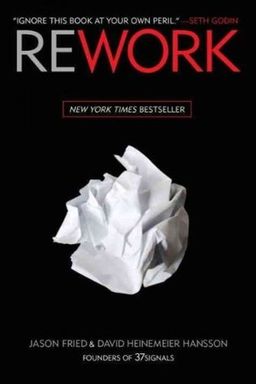
ReWork cover

ReWork

by Jason Fried & David Heinemeier Hansson

Rework by Jason Fried and David Heinemeier Hansson revolutionizes business strategy with fresh, unorthodox advice. Drawing from successful entrepreneurship experiences, it encourages launching with minimal resources, valuing smallness, and fostering authenticity. This book offers actionable insights for creating impactful and agile businesses.

Rethinking Business as Usual

Have you ever wondered why we make business so complicated? Why we glorify long hours, endless meetings, and five-year plans that rarely pan out? In ReWork, Jason Fried and David Heinemeier Hansson argue that everything you’ve been taught about work, growth, and success is wrong. They contend that real progress comes not from following conventional business wisdom but from questioning it, simplifying it, and doing less to achieve more.

The authors—founders of Basecamp (formerly 37signals)—use their own story to challenge assumptions about how companies should operate. For over a decade, they’ve run a small, lean, distributed company that rejects the typical trappings of corporate life: no excessive meetings, no venture funding, no obsession with scaling. Yet they’ve remained profitable, innovative, and influential. Their secret? Rethinking work itself. They “rework” the way business is done—cutting through bureaucracy, rejecting toxic habits, and focusing relentlessly on what matters.

The Core Argument: Small is Mighty

At the heart of ReWork lies the idea that size and speed don’t guarantee success. Fried and Hansson believe small businesses, freelancers, and tiny teams have a massive advantage because they can remain agile and close to their customers. Instead of chasing endless growth for its own sake, they advocate finding the right size—one that allows you to remain focused and human. Growth, they argue, often brings waste, bureaucracy, and distraction. Small teams move faster, make better decisions, and stay resilient.

That perspective runs counter to business school orthodoxy. While most founders chase investors and scale, the authors embrace frugality and independence. They insist that outside money should be your last resort (“Plan Z”), not your first move. When you take other people’s cash, you take their agenda too. Instead, start small, stay lean, and build something that makes money from day one. That’s how you keep control and build sustainability instead of hype.

The Myth of the Real World

We often hear people say, “That would never work in the real world.” Fried and Hansson call this phrase what it is—an excuse for inertia. The “real world,” they argue, is just a pessimistic construct used to suppress innovation and tell dreamers to fall in line. In their experience, the most successful ideas often look unrealistic to cynics. By ignoring the so-called real world, you free yourself to invent your own. Their company has defied norms—working remotely, staying small, and rejecting traditional hierarchies—and thrived for more than a decade. This, they insist, is proof that the “real world” is a myth for those afraid to reimagine work.

Action Over Ideas

Ideas are cheap. Execution is priceless. ReWork relentlessly pushes readers to stop planning and start building. The authors argue that long-term plans are just guesses—they anchor you to predictions that will inevitably change. Instead, act decisively, learn from results, and adjust as you go. The mantra here is simple: ship early, iterate constantly, and learn from successes rather than failures. Their approach mirrors agile startup culture but without the jargon. Planning is guessing. Doing is knowing.

Work Smarter, Not Longer

The book also attacks the cult of overwork. Fried and Hansson argue that workaholism isn’t heroic—it’s lazy. Burnout leads to bad decisions, wasted effort, and poor morale. Sustainable productivity comes from making smart choices, setting realistic boundaries, and valuing time off. They proudly send their employees home at 5 p.m. because they know rested minds produce sharper insights. True heroes are those who finish their work efficiently, not those who stay late pretending to be indispensable. (This echoes the ideas in Cal Newport’s Deep Work, which praises focus over frantic activity.)

Value Doing Less

In a world that tells you to “hustle,” the authors tell you to slow down. Meetings are toxic, interruptions destroy focus, and perfectionism stalls progress. “Good enough is fine,” they say—release now, improve later. Half a great product beats a whole mediocre one. This minimalist ethos applies everywhere: build fewer features, write shorter emails, hire fewer people, even make fewer decisions. The less mass you accumulate, the easier it is to pivot and adapt. Flexibility is freedom.

Culture, Not Rules

Lastly, Fried and Hansson demystify company culture. Culture, they argue, isn’t built through mission statements or perks—it emerges from consistent behavior. If you treat people like adults, you create a culture of trust. If you communicate like humans, you build authenticity. A small, respectful team can outperform any “rock star” company obsessed with appearances. Culture is how you act, not what you say.

Why It Matters

In a business landscape obsessed with startups, blitz-scaling, and hustle, ReWork offers refreshing sanity. It’s a manifesto for creators, freelancers, small entrepreneurs, and anyone disillusioned by corporate insanity. Fried and Hansson don’t just distill wisdom—they model it. Their company’s longevity proves that simplicity, independence, and integrity are not only possible but profitable. For readers tired of empty motivational mantras, ReWork feels like a conversation with pragmatic rebels who’ve already done it differently—and succeeded. It’s less about dreaming big and more about starting small, thinking clearly, and doing what matters right now.


Embrace Constraints to Spark Creativity

Jason Fried and David Heinemeier Hansson argue that limitations aren’t obstacles—they’re creative fuel. When resources are tight, deadlines are short, or teams are small, ingenuity flourishes. The authors call this “embracing constraints.” Far from idealizing abundance, they show that having less forces you to focus, prioritize, and invent solutions others overlook.

Why Less Is More

Lack of money, time, or people isn’t a curse—it’s a gift. Fried and Hansson compare resource scarcity to the structure of a haiku or a sonnet: strict limits produce surprising beauty. Shakespeare thrived under poetic rules; Southwest Airlines thrives by flying only one kind of plane. When options narrow, clarity expands. You learn to make every decision count.

Their own company started with limitations galore: three people in different countries, no investors, and long client hours. But those very constraints led them to build simple, elegant tools like Basecamp. Because complexity was impossible, simplicity became their strength.

Build Half a Product, Not a Half-Assed One

One of their most effective rules of thumb is, “Build half a product, not a half-assed product.” Don’t stretch yourself thin trying to deliver ten ideas at once. Cut ambition in half and focus on getting one thing right. Like a museum curator clearing the clutter, refine until only the essentials remain. Many creators, they note, obsess over adding features—meanwhile, customers just want clarity and reliability.

Start at the Epicenter

The way you start anything determines its fate. The authors teach you to identify your “epicenter”—the one element without which your business wouldn’t exist. For a hot dog stand, that’s the hot dog. For software, it’s the core functionality. Everything else—condiments, logos, extras—can wait. Find your epicenter and perfect it first. Then expand outward.

Why It Matters

Constraints aren’t something to overcome—they’re something to use. Limits sharpen focus, push innovation, and force minimalism. By embracing what you lack, you discover what you truly need. This mindset flips traditional business thinking on its head: success isn’t about having more resources—it’s about having fewer excuses. (Tim Ferriss offers similar wisdom in The 4-Hour Workweek, emphasizing efficiency over scale.) In short, scarcity doesn’t stifle creativity—it sets it free.


Workaholism Is Not a Virtue

Our culture celebrates exhaustion. We admire entrepreneurs who burn the midnight oil and employees who sleep at the office. Fried and Hansson call this obsession toxic. “Working more doesn’t mean you care more,” they write. It just means you work more. The heroes of ReWork aren’t marathon grinders—they’re efficient thinkers who go home on time.

The Workaholic Trap

Workaholics mistake hours for impact. They try to fix problems with brute force instead of intelligence. They create crises so they can feel heroic solving them. Worse, they burn out—and drag teams down with them. Fried and Hansson dismantle the myth that “hustle” equals dedication. True commitment means getting results without drama.

Why Rest Matters

The authors insist that sharp minds need rest. Fatigue clouds judgment and kills creativity. They encourage teams to leave the office at 5, sleep well, and value leisure. Meetings are replaced with focused solo hours. Rest isn’t laziness—it’s strategy. When your team has energy, decisions get better, and productivity spikes naturally.

The Real Hero

In this book’s world, the hero isn’t the person who stays late—it’s the person who finishes early because she worked smart. That message echoes research from Charles Duhigg’s Smarter Faster Better, showing that productivity grows through focus and decision quality, not duration. Fried and Hansson’s rule is simple: respect time, because it’s your most finite resource. Build a business that runs on clarity, not caffeine.


Plans Are Just Guesses

Most business advice glorifies strategic planning, forecasting, and long-term projections. Fried and Hansson boldly declare that planning is guessing. Unless you’re a fortune-teller, you can’t predict the future—so stop pretending you can. Instead of detailed blueprints, focus on immediate execution and adaptability.

Why Plans Fail

Plans give a comforting illusion of control. But reality—markets, customers, technology—changes faster than your spreadsheet. Once you make a rigid plan, you stop noticing new opportunities because you’re fixated on what you “should” do. Plans let the past dictate the future. The better approach? Decide when you’re actually doing, not before.

Decide Right Before Doing

The authors encourage making decisions “just in time.” You have the most information when you’re in action, not when you’re hypothesizing. Plan only what’s necessary for the next step, then adjust. Wing it intelligently. This doesn’t mean chaos—it means responsiveness. As they say, “It’s okay to wing it. Just get on the plane and go.”

The Danger of Long-Term Thinking

Five-year plans are fool’s gold. They fossilize ideas before reality can test them. Moreover, they breed inertia: no one wants to admit the guessing was wrong. The authors urge you to treat every plan as a temporary hypothesis. Change direction freely, learn from what works, and keep moving. (This mirrors Eric Ries’s Lean Startup principle of “build-measure-learn.”)

Act Now

The antidote to guesswork is momentum. Decide, act, evaluate. Every decision adds a brick to progress. Perfection and certainty are delusions. What actually builds success is a rhythm of continual small decisions—many reversible, all learning-driven. Fried and Hansson’s approach teaches agility as a mindset, not a method.


Start Making Something Now

“Ideas are cheap; execution is everything.” With those words, Fried and Hansson destroy the myth of the perfect business idea waiting for the right time. The only real difference between dreamers and doers is that doers start now. They don’t wait for funding, permission, or the perfect plan—they make something.

Action Beats Ideation

Everyone knows someone who says, “I had the idea for eBay!” But ideas are worth nothing until you act. Stanley Kubrick told young filmmakers, “Get hold of a camera and make a movie—any kind.” Fried and Hansson echo that spirit. Building, creating, and launching create learning. You find your direction not through thinking but through doing.

No Time Is No Excuse

People often say, “I’d love to, but I don’t have time.” The authors call this out. You don’t need endless free hours—you need focus. Skip TV, wake up an hour earlier, work a few nights. Start small, while keeping your day job. If you truly want something, you’ll find the time. Excuses hide fear, not scarcity.

Drawing a Line in the Sand

Every business needs a backbone—a clear sense of what it stands for. When you make something, have a point of view. Fried and Hansson proudly stand for simplicity, even though critics demand more features. Whole Foods sells only natural products, even if shoppers complain about prices. Having convictions filters your audience—but deepens loyalty.

Why It Matters

Starting builds momentum; hesitating builds regret. Fried and Hansson’s call to action transcends business—it’s a philosophy of life. You can’t plan inspiration, but you can act on it before it fades. Start now, with what you have, for who you are. No one ever launched by waiting for the stars to align.


Promotion Without the Noise

Traditional marketing depends on noise—advertising, PR, and spin. Fried and Hansson show a smarter approach: authentic promotion through teaching, transparency, and substance. Don’t shout your greatness; show it.

Start With Obscurity

At first, no one knows you—and that’s good. Obscurity is a sandbox for mistakes. Experiment publicly while few are watching. The Broadway model—testing plays in smaller cities before New York—illustrates this beautifully. Early-career anonymity gives room to refine before fame magnifies every flaw.

Teach, Don’t Sell

Instead of competing for attention, earn it by educating customers. When Gary Vaynerchuk taught wine tasting online, he built trust, not ads. Fried and Hansson’s “Signal vs. Noise” blog did the same, sharing lessons from product design openly. Teaching makes you an authority—and creates an audience that comes to you naturally.

Be Transparent and Real

Show people how your business really works. Behind-the-scenes stories humanize your brand. Audiences crave authenticity more than polish—think chefs sharing recipes or production teams revealing their creative process. As Fried notes, “Nobody likes plastic flowers.” Imperfections make you memorable. Sincerity trumps professionalism every time.

Marketing Everywhere

Marketing isn’t a department—it’s everything you do. Every email, invoice, and conversation markets your company’s values. Forget PR firms chasing headlines; real credibility comes from communication that feels human. Build followers through presence and honesty, not hype. Slow growth, done authentically, lasts longer than overnight fame.


Culture Without Bureaucracy

Culture can’t be manufactured—it’s grown. Fried and Hansson insist you don’t create culture with slogans or perks. You create it with consistent behavior. Over time, the habits you reward become your company’s DNA.

Organic, Not Instant

Fake culture hides behind mission statements and foosball tables. Real culture emerges from action: sharing information, trusting teammates, treating customers with respect. You can’t install it overnight—it’s a byproduct of countless small decisions. Like patina on old wood, culture accumulates naturally.

Think Temporary Decisions

Don’t agonize over policies that might scale someday. Make temporary decisions based on present realities. Flexibility is your advantage as a small team. Change course whenever you need to—big companies can’t. Decisions are disposable until they’re tested.

Respect Over Rules

Treat people like adults. Trust them with autonomy and privacy. Don’t ban YouTube or police hours; build accountability through trust. Send people home at five. Don’t scar your company by making policies after minor mistakes. One employee’s shorts don’t require a dress code—they require conversation.

Sound Human

Corporate jargon kills authenticity. Write and speak like you talk. Drop “monetization” for “making money.” Drop “transparent” for “honest.” Fried reminds you to sound like yourself—communication is culture. Words shape relationships; clarity builds trust. The simplest language is the most powerful.

Dig Deeper

Get personalized prompts to apply these lessons to your life and deepen your understanding.

Go Deeper

Get the Full Experience

Download Insight Books for AI-powered reflections, quizzes, and more.