
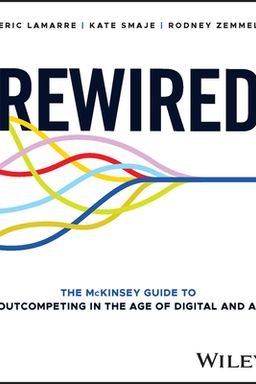
Rewired cover

Rewired

by Eric Lamarre & Kate Smaje & Rodney Zemmel

Rewired presents a strategic guide from McKinsey for businesses to excel in the digital age. Learn how to enhance customer experiences, optimize costs, and leverage digital and AI technologies for enduring success. Equip yourself with insights to transform your organization and lead it to the forefront of the digital revolution.

Rewiring the Enterprise for the Digital and AI Era

How can you transform a traditional organization into one that continuously outcompetes with digital technology and artificial intelligence? In Rewired: The McKinsey Guide to Outcompeting in the Age of Digital and AI, Eric Lamarre, Kate Smaje, and Rodney Zemmel argue that the digital and AI revolution isn’t just about new tools—it’s about fundamentally reshaping how your business learns, builds, and operates. They contend that competitive advantage in this era no longer comes from owning a specific technology or executing one flashy transformation project. Instead, the edge lies in developing the enterprise capabilities

The authors, all senior leaders at McKinsey, suggest that transformation isn’t an end state but a perpetual discipline: a practice of “rewiring” your firm to adapt faster than competitors. They note that while 89% of companies claim to have launched digital transformations, only a fraction achieve meaningful impact, capturing less than a third of the expected revenue lift and cost savings. To fix this, Lamarre, Smaje, and Zemmel introduce a comprehensive blueprint based on insights from McKinsey’s global client work—an integrated framework for leaders who must build digital excellence from the inside out.

Why Digital Alone Isn't Enough

The authors begin by puncturing the illusion that buying new systems or hiring more technologists will make a business digital. Historically, companies saw technology as plumbing—tools that supported operations but didn’t set them apart. Now, digital technologies and architectures such as cloud computing, APIs, microservices, and AI have become the ground zero of value creation. But their true competitive advantage comes only when combined with cross-functional collaboration, agile ways of working, and a talent culture capable of ongoing innovation.

Companies like Amazon, DBS Bank, and LEGO (all profiled in the book) demonstrate what rewiring looks like in practice. Amazon automated its processes by building thousands of proprietary systems coordinated by cross-functional teams, eventually enabling the firm to release hundreds of innovations daily. DBS, a multinational bank in Singapore, restructured its organization around customer journeys rather than legacy products and doubled down on data-driven insights, cutting service time from weeks to days. LEGO, facing digital-native competitors for children’s attention, recreated its operating model around modular data and product teams that work fluidly with engineering pods. These examples reveal that transformation doesn’t depend on the industry—it depends on how courageously leaders redesign their businesses.

Six Capabilities That Drive Digital Success

The book’s central premise is that true success in digital and AI transformation requires mastering six interlocking capabilities. You must:

  • Create a transformation roadmap that aligns the top team around a shared vision and ambition.
  • Build your talent bench—ensuring the right mix of digital skills, engineering excellence, and collaborative working cultures.
  • Adopt a new operating model—shifting from projects to products, and from silos to agile pods that iterate endlessly.
  • Build technology for speed and distributed innovation—engineering a modern, modular architecture that empowers hundreds of teams to innovate simultaneously.
  • Embed data everywhere—turning information into reusable products that power AI solutions and insights across the company.
  • Unlock adoption and scaling—driving change management so that solutions actually get used, replicated, and monetized organization-wide.

These six capabilities represent not just a checklist but a continuous loop—a system of learning, experimentation, and improvement. When integrated, they enable a firm to create hundreds of technology-driven solutions instead of chasing one “big app.” (In comparison, Ram Charan’s Talent Wins and Satya Nadella’s discussions of a “learning organization” echo this mindset of constant iteration and capability-building.)

Culture and Leadership: The Hidden Ingredients

No transformation endures without leadership resolve. The authors argue that CEOs must lead the digital charge—not delegate it. The C-suite must become a unified orchestra: CFOs tracking value realization; CHROs attracting digital talent; CTOs building platforms for distributed innovation; and business leaders defining domain-level opportunities. Lamarre, Smaje, and Zemmel highlight that high performers consciously design collaboration and accountability structures. Freeport-McMoRan achieved mine-level AI breakthroughs because executives and operators learned agile methods together. DBS’s CEO made GANDALF (“Google, Amazon, Netflix, Apple, LinkedIn, Facebook, with DBS at the center”) its rallying mantra, signaling cultural ambition on par with the world’s best technology firms.

Why “Rewired” Matters Now

For the authors, the message is clear: digital transformation is never finished. Generative AI, automation, and edge computing amplify the need for ongoing reinvention. To “rewire” a business means to accept endless iteration and development as the new normal. If you can build a system where thousands of people innovate together using shared data, technologies, and agile rhythms, you shift your organization from reacting to disruption to generating it. In short, Rewired offers a pragmatic, deeply detailed playbook for leaders who must engineer not just technology, but the organizational DNA that will let it continually evolve. As the authors put it: it’s still Day 1 for digital transformation—and how ready you are to embrace that may define your company’s future.


Building the Transformation Roadmap

One of the first tasks in rewiring your organization is to create a transformation roadmap—a practical blueprint that aligns your leadership team around specific goals, domains, and investments. Without this shared compass, digital projects scatter across departments, draining resources and enthusiasm. LaMarre, Smaje, and Zemmel emphasize that five mistakes consistently derail transformations: lack of alignment, pet-project syndrome, overfocus on technology instead of people, overambitious scope, and the CEO delegating responsibility. A clear roadmap, in contrast, centers the organization on impact and purpose.

Start with Vision, Alignment, and Commitment

First, the roadmap begins with a shared vision—a North Star that defines how technology will create business value. These vision statements shouldn’t be vague slogans like “become world-class in customer service,” but concrete, measurable ambitions. For example, a leading logistics firm aimed to “deliver personalized, proactive customer outreach at multiple points in the shipment journey,” linking technology directly to financial results. Once defined, every domain—from marketing to supply chain—should translate that vision into measurable KPIs and goals.

Alignment then converts this vision into joint accountability. In McKinsey’s research, companies that report successful transformation efforts are nearly four times more likely to have a shared sense of accountability. The authors recommend investing in a leadership learning journey: 20 hours of hands-on experience through visits to leading digital companies, “art of the possible” workshops, and digital bootcamps. You can’t manage what you don’t understand. Finally, commitment means the C-suite staking its reputation and resources on transformation—budget, governance, talent, and time. CEOs must personally sponsor a transformation office and devote multiple days each month to steering progress.

Choose the Right Bite Size: Domains Over Pilots

The roadmap avoids extremes of either tinkering with pilots or attempting to transform the entire enterprise at once. Instead, the authors advocate a domain-based approach—selecting two to five coherent units (customer onboarding, procurement, fulfillment, or pricing) where measurable value is at stake. Each domain must be large enough to matter but contained enough to avoid overwhelming dependencies. Once chosen, domains are prioritized through twin lenses of value potential and feasibility. Executives assess impact through metrics like customer experience, financial benefits, time to value, and synergy, balanced against readiness, sponsorship, data quality, and ease of scaling.

Case Example: Sanofi’s Ruthless Prioritization

Sanofi’s digital leader, Dr. Pius Hornstein, explains how the company reduced fragmentation by ruthlessly focusing on fewer priorities with higher resources per project. “Six months down the road, new shiny objects will creep in… Today, we invest less in aggregate but devote more to our chosen priorities.” Sanofi’s lesson: prioritization breeds speed and collaboration.

Define What’s Possible—and What’s Worth It

The C-suite must lead the reimagination of domains. Using tools like zero-based journey design and end-to-end process mapping, executives identify unmet customer needs and operational pain points. This generates ambitious but realistic domain blueprints that estimate investments, benefits, and timeline. Each domain should deliver meaningful impact—typically 20%+ EBITDA improvement. The authors caution against “digital magic,” where companies invest little and expect massive returns. Instead, early value comes through iterative releases (version 1, version 2, and so on) that compound impact over time.

Translate Plans into a C-Suite Contract

Eventually, the roadmap becomes a contract for your leadership. Each executive takes ownership of domains and capabilities, and the digital roadmap details investments, payback horizons, expected benefits, and capability maturity targets. It binds the C-suite to long-term accountability—making transformation a team sport. As the authors put it, “No one can whistle a symphony; it takes a whole orchestra.” When CEOs, CFOs, CHROs, CTOs, and business leaders play in harmony, their transformation roadmap becomes not just a plan, but the architecture of competitiveness itself.


Creating a Digital Talent Advantage

You cannot outsource excellence. That’s the blunt truth driving the second capability of Rewired: building your digital talent bench. In the authors’ view, success in digital transformation depends less on the technologies you deploy than on the human systems that design, code, and scale them. Many established firms assume they can’t compete with Silicon Valley for top engineers and data scientists—but Lamarre, Smaje, and Zemmel show that they can if they craft the right strategy.

Diagnose Your Core vs. Noncore Capabilities

Start by distinguishing what digital talent you must own versus what can be sourced. Core capabilities—data science, software engineering, cloud architecture, and UX design—create your competitive differentiation and must be in-house. Noncore capabilities such as penetration testing, geolocation, or specialized cloud services can be contracted. The goal: have 70–80% of your digital workforce internally for context and culture, using partners for speed and flexibility. A consumer packaged goods company exemplified this by starting its transformation with five pods largely staffed externally, then hiring 10–15 experts per month until they reached 80% in-house within a year.

Understand the Talent You Already Have

The authors highlight that most organizations fail this audit—they know job titles, not skills. To assess your current talent, use four complementary methods: manager assessment (ranking staff by observable proficiency), employee self-assessment (surveying skills against taxonomy), online testing (using platforms like HackerRank or Codility), and technical interviews (led by expert technologists). These combine to reveal the actual skill distribution. One financial firm discovered that only 20% of its 100-person tech team passed a 50% coding test benchmark, exposing the urgent need for upskilling.

Build the Talent Engine: The Talent Win Room

To centralize and accelerate recruiting and development, the authors recommend creating a “Talent Win Room” (TWR)—a permanent multidisciplinary HR team operating like an agile pod focused exclusively on digital talent. The TWR handles recruiting, onboarding, diversity, career pathing, and continuous learning, tracking success through metrics like offer-acceptance rate and new-hire productivity. A global agricultural firm built its 80-person digital bench within six months by deploying a TWR that redesigned its hiring funnel and created coding exercises as part of interviews. As agile organizations scale, TWRs become permanent engines for culture renewal.

Hire for Craft, Not Just Fit

Digital professionals are interviewing you as much as you’re interviewing them. A compelling employee value proposition (EVP) grounded in meaningful work, modern tools, diversity, and continuous learning beats higher pay. Marc Andreessen recalls that elite engineers move to firms “where leadership understands their craft.” To attract them, emphasize modern tech stacks, visible career paths, and transparent compensation models that pay for skill rather than tenure. Many leading firms now offer dual tracks: management or technical expert, enabling a data scientist to rise as a “distinguished engineer” without turning into a people manager.

Nurture Craftsmanship and Learning

Finally, retention depends on learning journeys. Digital talent values growth over hierarchy. Build on-boarding bootcamps to immerse new hires in your tech stack, agile practices, and business context. Offer continuous learning stipends and personalized curricula for cloud engineers, product owners, or UX designers. Majid Al Futtaim’s analytics “school” trained 40,000 employees, mixing simulation-based learning and peer coaching. As Doc Rivers said, “Good players want to be coached. Great players want to be told the truth.” Treat your digital talent as craftspeople whose mastery defines your company’s future, and they’ll stay to build it with you.


Adopting an Agile Operating Model

If talent is the heart of digital transformation, agile is its circulatory system. LaMarre, Smaje, and Zemmel argue that switching to an agile operating model—where small, cross-functional teams (pods) own customer outcomes—is the difference between experimenting with digital and living it. But being agile is not just performing agile rituals like sprints or stand-ups. It’s about rethinking how objectives, accountability, and collaboration work across the enterprise.

From Doing Agile to Being Agile

Agile pods work best when they combine autonomy with accountability. Each pod has a clear mission, measurable outcomes, and full ownership of design, development, and deployment. The authors cite Johnson & Johnson’s CIO, Tom Weck, who likened agile transformation to product management: “You wouldn’t launch a medical device and then walk away—you’d keep investing.” Successful pods iterate rapidly to improve their product, reporting progress through Objectives and Key Results (OKRs)—a system that transforms planning from output to outcome.

Scaling Agile: Factories, Products, and Platforms

Moving from a handful of pods to hundreds requires structure. The authors describe three scaling models: the digital factory (self-contained, fast setup for divisions), the product & platform model (where business and technology integrate), and enterprise-wide agility (agile across all functions, as DBS and ING achieved). For instance, BHP built digital factories for mining operations with reusable code libraries, while JPMorgan restructured its 50,000 tech staff into product-centric “mini-CEOs.” The right model depends on digital maturity and industry focus.

Making Agile Work Through Discipline

Despite its reputation for flexibility, agile thrives on rigor. Three ceremonies drive high performance: setting missions and OKRs quarterly, progressing through two-week sprints, and reviewing results via quarterly business reviews (QBRs). These anchor pods in outcomes, rhythm, and accountability, reducing management meetings by up to 75% in some firms. Pods measure health through DORA metrics (deployment frequency, lead time, mean time to recover, and change-failure rate) to track their speed and resilience. This disciplined cadence turns agility into competitive advantage.

Beyond Tech: Building Customer-Centric Agility

Agility ultimately migrates beyond IT into business and operations. Agile structures enable contact centers, finance, or HR functions to operate as “self-managed teams” or “flow-to-work” pools that respond flexibly to priorities. Spark New Zealand, for example, reduced overhead by 20% and improved customer satisfaction to +78 NPS by making cross-functional agility standard company-wide. The lesson: agile isn’t just a way of building software; it’s a new governance model for modern enterprise metabolism—one where management leads less and empowers more.


Technology for Speed and Distributed Innovation

Technology is often seen as the bottleneck in transformation, but the authors redefine it as the enabler of distributed innovation: a system that empowers thousands of employees to build, test, and deploy digital solutions simultaneously. To achieve this, you must rearchitect your technology for speed, flexibility, and security—making innovation scalable rather than centralized.

Decoupling and Modularization

A decoupled architecture, built through APIs and microservices, allows teams to evolve applications independently without breaking others. Jeff Bezos’s legendary Amazon memo—mandating all internal teams communicate exclusively via APIs—became the blueprint for modern digital agility. The authors advise minimizing API proliferation by standardizing through gateways and taxonomies. In practice, this architecture enables pods to integrate data and functionality freely, turning technology into a living organism rather than rigid machinery.

Cloud as a Business Enabler

The cloud’s value lies not in lower hosting costs but in agility and resilience. A “surgical and value-backed” approach focuses migration on domains that unlock business ROI. Replatforming and refactoring applications (rather than simply rehosting) lets you exploit cloud-native capabilities. Leading banks now combine on-prem and public clouds using hybrid architectures to balance compliance and speed. The secret lies in robust cloud foundations: shared security, monitoring, and automated pipelines, supported by FinOps teams that optimize cloud spend dynamically.

Engineering Excellence and Automation

DevSecOps is the new factory floor of innovation. Automating the software development lifecycle (SDLC) through continuous integration and delivery (CI/CD) ensures code quality and rapid deployment. Netflix can push hundreds of changes daily using fully automated pipelines. McKinsey’s clients that adopt modern engineering practices—like testing automation, linting tools, and version control—reduce deployment times by more than 80%. Technical debt, the silent killer of digital velocity, must be managed aggressively through modular engineering and standardized frameworks.

Security and MLOps at Scale

With hundreds of pods deploying live code, cybersecurity cannot remain a final checklist. “Shift left” principles embed security early into development, automating checks through DevSecOps and runtime protection. AI at scale adds complexity: machine learning models evolve with new data, demanding continuous retraining and monitoring through MLOps pipelines. As the authors warn, digital leaders must make security, automation, and data governance self-sustaining rather than reactive. Done right, technology becomes an amplifier of human creativity—not its inhibitor.


Making Data a Strategic Advantage

Many digital transformations stall because their data is fragmented, poor quality, or trapped in silos. Lamarre, Smaje, and Zemmel reveal that 70% of AI development time goes into fixing data rather than building models. Their solution? Treat data as a product—curated, reusable, and owned by the business. When designed this way, data becomes the nervous system connecting every digital effort.

Determine What Data Matters

Start by mapping data to the digital roadmap: identify data elements driving your highest-value domains. Prioritize by impact, not abundance. An insurer, for instance, focused first on catastrophe and safety data from NOAA and FEMA instead of cleaning every dataset. Assess data readiness along nine dimensions—accuracy, completeness, timeliness, and privacy among them—then invest where improvement translates into business results, not perfection.

Create Data Products, Not Data Dumps

Data products are packages of high-quality data built for specific consumption archetypes: analytics dashboards, APIs, or digital twins. A credit card company consolidated 200 customer-data systems into eight reusable data products such as Customer360 and Merchant360, cutting annual costs by $300 million and simplifying regulatory compliance. Each data product has a dedicated owner and pod responsible for ongoing improvement, data provenance, and documentation. The goal is creating “single sources of truth” that other teams can use safely and consistently.

Architect for Connectivity

Your data architecture—the “pipes” of the enterprise—must let information flow easily from source systems to consumption points. The authors outline five archetypes: data lakes (for AI), cloud data warehouses (for BI), lakehouses (combining both), data meshes (decentralized ownership), and data fabrics (cross-cloud virtualization). The right choice depends on size and complexity, but the principle remains: favor openness, modularity, and reuse. Banks and retailers increasingly use lakehouses or data meshes to empower business domains to own and share data products.

Governance and Culture

Strong data governance does not slow innovation—it enables it. Modern data offices shift from policing to empowering. They install federated stewardship, where domain owners ensure quality and compliance, supported by platforms like Collibra or Alation for lineage tracking. Data science pods then operate with automated DataOps tools to deploy and monitor data assets continuously. Over time, this builds a data culture where employees use dashboards instead of slides and make decisions in near real time—just as DBS did when moving from PowerPoint to live business intelligence. In short: data is value only when it flows.


Driving Adoption, Scaling, and Cultural Change

Even exceptional digital solutions fail if people don’t use them. The authors emphasize that adoption—the human side of transformation—is where most programs stumble. You must tackle two intertwined challenges: getting users to embrace new tools and scaling solutions enterprise-wide. Adoption is not marketing; it’s behavioral engineering.

Winning User and Customer Adoption

User adoption requires addressing both rational and emotional barriers. Lamarre and his coauthors anchor their approach in a four-part influence model: leadership role modeling, compelling change stories, measurable incentives, and tailored training. When Freeport-McMoRan deployed AI in copper concentrators, teams instituted three-hour check-ins between operators, engineers, and metallurgists. Their involvement turned skeptics into advocates and delivered a 10% throughput increase.

Scaling Through Assetization

Scaling means replicating success efficiently. The authors propose “assetization”—standardizing digital solutions into reusable modules. A mining company modularized its optimization code so 60% was reusable across sites, reducing deployment time by half. Three scaling archetypes—linear waves, exponential waves, and big-bang rollouts—fit different contexts. For highly complex operations, linear waves ensure stability; for many lower-risk sites, exponential waves drive speed. Each must be supported by central funding and a “train-the-trainer” approach to sustain scale.

Tracking Impact and Managing Risk

Impact tracking connects effort to outcome. High performers use stage-gate reviews and transformation offices as central engines of measurement. KPIs cover three families: business value (EBITDA, cost-to-serve), pod health (DORA metrics, configuration maturity), and change management (capability growth and engagement). CEOs can finally answer, “Are we making progress?” because dashboards turn anecdotes into data. Meanwhile, emerging risks—from cybersecurity to AI bias—require proactive digital trust strategies: embedding privacy checks into DevSecOps pipelines and establishing cross-functional ethics boards.

Culture: The Final Frontier

Ultimately, rewiring culminates in cultural transformation. Digital-ready cultures reward curiosity, collaboration, and customer obsession. Leaders must model these traits and periodically measure progress through surveys and feedback. Programs like Roche’s leadership bootcamps or DBS’s “DigiFy” curriculum show how skill-building reinforces mindset shifts. As Jessica Tan of Ping An notes, “Technology innovation requires leaders who can be receptive, cross-disciplinary collaborators.” A rewired culture doesn’t just adapt to technology—it becomes an engine that continuously transforms itself, keeping the enterprise forever Day 1.

Dig Deeper

Get personalized prompts to apply these lessons to your life and deepen your understanding.

Go Deeper

Get the Full Experience

Download Insight Books for AI-powered reflections, quizzes, and more.