
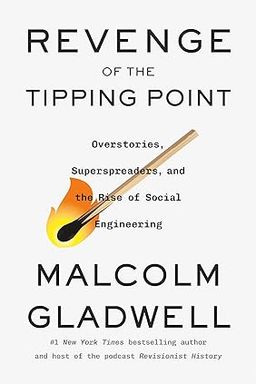
Revenge Of The Tipping Point cover

Revenge Of The Tipping Point

by Malcolm Gladwell

Through a series of stories, Gladwell explicates the causes of various kinds of epidemics.

The Architecture of Contagion

How do outbreaks—of disease, crime, ideas, or fraud—really spread? This book argues that contagions are not random waves but engineered cascades shaped by four forces you can learn to see: place, people, proportions, and stories. The author weaves medical studies (John Wennberg’s small-area variation), crime investigations (L.A.’s bank-robbery boom), genetic sleuthing (Jacob Lemieux’s C2416T lineage from the Biogen meeting), media history (NBC’s Holocaust), and market design (Purdue Pharma and McKinsey) into one claim: the big things that sweep through societies grow from hidden structures you can map and manage.

Place: the overstory that governs behavior

You think behavior flows from individual choice, but place matters more than you expect. Wennberg mapped Vermont’s hospital districts and found staggering differences in surgeries and procedures that could not be explained by patient need. The overstory—local norms, training networks, insurance rules, and institutional incentives—pulled doctors into distinct “practice styles.” Parents at Waldorf schools in California drifted toward low vaccination rates even when neighboring schools were near 100 percent. Miami’s Medicare fraud ecosystem—revealed in the Esformes case—thrived because the city’s financial and enforcement canopy (post-1980s drug cash, bank laxity, normalized laundering) made brazenness routine.

(Note: This extends the classic sociological insight that “context is king” with granular, measurable proof. Think of Wennberg as doing for medicine what urbanists like Jane Jacobs did for streets.)

People: the law of the very, very few

A few actors do most of the work in epidemics. L.A.’s bank-robbery fever wasn’t a swarm; it was Casper and C-Dog industrializing crime by recruiting teams and running logistics. In Boston, one genetic fingerprint (C2416T) tied a vast web of global COVID cases back to a two-day corporate retreat. Aerosol scientists William Ristenpart and David Edwards show why: some “superemitters” produce tenfold more airborne particles while speaking. A British COVID challenge study found that just two of 36 volunteers generated 86 percent of emitted virus. You don’t have uniform spreaders; you have outliers who write the story.

Proportions: monoculture or critical mass

Groups tip not because everyone changes at once, but because the mix crosses a threshold. Rosabeth Moss Kanter showed that token minorities are burdened by visibility and stereotype; add numbers and they become individuals. Damon Centola’s experiments confirm a stunning threshold: around 25 percent dissent flips a norm. The same math explains fragility: Poplar Grove’s homogeneous pursuit of elite success left teens with few alternative identities, letting suicide cluster like a virus in a monoculture. Diversity acts like an immune system; the “Magic Third” creates resilience.

Stories: overstories that rewrite reality

Cultural narratives set the bounds of the possible. NBC’s 1978 Holocaust miniseries popularized the very word “Holocaust,” moved museums and curricula, and even affected German prosecutions. Will & Grace brought a gay protagonist into the center of mainstream comedy, normalizing daily life rather than moral panic—and later, activists credited television with shifting opinion on marriage equality. Overstories operate like atmospheric pressure: invisible until you try to move against them, potent when tuned to a mass audience.

Key Idea

Epidemics—biological and social—are structured phenomena. Map the place, find the few, manage the proportions, and mind the story.

Why this matters to you

Once you see architecture, you act differently. Don’t spray and pray; target superspreaders and hubs. Don’t blame “bad apples”; fix the canopy that grows them. Don’t chase averages; engineer proportions to reach the Magic Third. Don’t ignore narrative; change the story that frames people’s choices. The opioid crisis illustrates the stakes: a small bureaucratic lever (Paul E. Madden’s triplicate prescriptions) bent decades of prescribing, while Purdue and McKinsey’s precision targeting of “Core” prescribers seeded a national catastrophe and reformulation pushed users toward fentanyl (Powell and Pacula’s counterfactual).

In this summary you’ll see how small-area variation exposes the power of place; how aerosols and superemitters make superspreading legible; how monocultures fail and critical mass protects; how markets and micro-rules engineer epidemics; and how media and institutions rewrite the canopy. You’ll also confront the ethical dilemmas of targeted control—Stedman’s emissions testing, superemitter screening, and neighborhood quotas—where effectiveness rubs against fairness. The goal isn’t cynicism. It’s literacy: to become the kind of leader who can read the blueprint of contagion and redesign it for good.


Places Make Patterns

The book starts on the ground: where you are predicts what you do. John Wennberg’s “small-area variation” work showed that supposedly clinical decisions—hysterectomies, hemorrhoid surgeries, cardiac catheterizations—cluster geographically for reasons other than need. In Boulder, doctors used catheterization in 75 percent of heart attacks; in Buffalo, only about 24 percent did. Pop across town lines and your probability of surgery changes. That isn’t biology; it’s an overstory of training ties, referral patterns, insurance rules, and local norms.

Local canopies pull you in

Parents at California’s Waldorf schools drifted toward vaccine refusal over time. The same parents, in a different school ecosystem, vaccinate at near 100 percent. When doctors move between cities, their practice styles converge with local peers within a year. These are signs of social learning and institutional enforcement: you don’t just live in a neighborhood; the neighborhood lives in you.

(Note: Economists call this “supply-sensitive care,” where provider capacity and habit—not patient demand—drive utilization. Wennberg gave it a map.)

Miami’s fraud ecology

Philip Esformes’s billion-dollar Medicare-fraud empire is not simply a villain’s tale. Miami’s 1980 shocks—drug money, riots, and the Mariel Boatlift—rewired finance and enforcement. Banks normalized gym bags of cash. Sham clinics sprouted in strip malls. Recruiters and doctors with a “loose pen” fed patient flows into shell companies. Investigators like Kirk Ogrosky untangled 256 bank accounts and a web of kickbacks. The overstory made audacity rational: in that place, the path of least resistance pointed to fraud.

Micro-rules that become macro differences

Paul E. Madden’s 1939 triplicate-prescription rule in California—one pad, two carbons, monthly reporting—sounds trivial. It wasn’t. It put friction at the moment of opioid prescribing and signaled, culturally, that narcotics are different. States that adopted triplicate rules built a different prescribing ecology than those that didn’t. Decades later, when OxyContin arrived, overdose curves diverged by state. A one-page form hardened into a regional overstory.

Key Idea

If you want to change outcomes, change the canopy: the local rules, routines, and role models that make certain choices easy and others unthinkable.

How to use place as a lever

First, map the anomalies. Where are procedures or behaviors unusually high or low? Second, audit the institutions behind them: training pipelines, payer policies, inspection regimes, and media narratives. Third, tweak the micro-rules at the point of decision: forms, defaults, reporting, and peer comparison. Finally, expect mobility effects: if you hire or transfer people across regions, they will probably adapt to the new overstory—so move them into the canopy you want.

This lens also keeps you from misdiagnosing crises. When you see a pocket of extreme behavior—bank robberies, fraud, vaccine refusal—don’t jump straight to moralizing. Ask what in the local environment rewards it. In Los Angeles, a surge in easily robbed bank branches plus attention-grabbing hauls created opportunity; in Miami, a financial plumbing built for laundering scaled health-care scams; in non-triplicate states, lax opioid paperwork primed prescribers for a sales blitz. The pattern is not bad people; it’s potent places.


The Very Few Rule

Across crime and contagion, outbreaks hinge on a handful of outsized actors. The L.A. bank-robbery wave looked like a mass trend until investigators followed the threads to producers. “Casper” didn’t just rob banks; he manufactured robberies by recruiting teenagers, arranging cars, and managing logistics. Once the FBI dismantled his network (and that of “C-Dog”), the fever broke. The lesson generalizes: focus on system builders, not just the last-mile participants.

Superspreading events, traced by genes

In Boston, Broad Institute scientists led by Jacob Lemieux tied a distinctive mutation—C2416T—to the Biogen leadership retreat at the Marriott Long Wharf in February 2020. That genetic tag surfaced in twenty-nine U.S. states and in countries from Australia to Sweden. Early estimates of 20,000 infections ballooned to hundreds of thousands. One meeting, one lineage, global reach. The superspreading wasn’t mysterious once you looked at the room: dense contact, poor ventilation, continuous speech, rapid onward travel.

Aerosols make the math plausible

William Ristenpart showed that normal speech creates a cloud of tiny droplets as vocal cords snap open and closed; those particles float like smoke. David Edwards found a skewed distribution of emitters: a minority blast out many times more particles. The British COVID challenge trial nailed it: two of 36 volunteers produced 86 percent of detected emissions. Just as Donald Stedman discovered that 5 percent of Denver cars spewed 55 percent of pollution, a few people dominate airborne risk. That is the Law of the Very, Very Few.

(Note: This sharpens the “connectors” idea from The Tipping Point; here, the outlier isn’t just well-networked—he physiologically emits more contagion.)

Profiles and mechanisms

Why are some people superemitters? Hypotheses point to saliva viscoelasticity, airway hydration, age, and BMI. Picture the index case: an older, heavyset traveler, dehydrated after a long flight, speaking loudly in a ballroom. That profile, Ristenpart suggests, creates more aerosolized droplets with each word. Pair that physiology with a superspreader environment—crowded indoor venue, poor ventilation, prolonged talk—and you have exponential reach.

Key Idea

Targeting the few—people and places—often beats broad, blunt controls. Find the producers, the superemitters, and the hubs; fix their leverage points.

Action steps for real life

In epidemics, invest in ventilation, monitor CO2 as a proxy for buildup, cap voice volume indoors, and move talk-heavy events outside. In crime, follow logistics, not just offenders; remove the factory managers. In information spread, track which accounts or outlets inject the most reach and target their incentives. And in organizations, map which teams or leaders propagate practices—good and bad—and redesign their incentives and constraints. The principle is stable: if 5 percent drive 55 percent of harm, precision beats mass effort.


Monoculture vs. Critical Mass

Uniformity feels safe—same goals, same values—but it breeds fragility. Stephen O’Brien discovered cheetahs carry so little genetic diversity that a coronavirus (FIP) ravaged zoo populations. Captivity concentrates susceptibility, turning a rare virus into a mass killer. The same dynamic appears in human communities: when everyone aspires to one narrow ideal, stressors spread unchecked because there are no alternative identities to buffer the shock.

Poplar Grove’s lesson

In Poplar Grove, a high-achieving, affluent suburb, expectations converged on straight As, AP overload, elite colleges, and athletic glory. When suicide struck high-status students—the very avatars of success—the signal was devastating: “If they couldn’t survive, how can I?” Sociologists Abrutyn and Mueller show how status and homogeneity amplify contagion: grief and maladaptive coping spread rapidly when there’s one script for worth.

(Note: This connects to Durkheim’s classic work on anomie but adds a modern mechanism: monocultures lack social antibodies.)

From tokens to members

Rosabeth Moss Kanter found that token minorities suffer stereotype pressure and isolation. The exit ramps—voice, challenge, deviance—are blocked when you are one of a few. But change the numbers, and the roles change. Damon Centola’s experiments quantify the threshold: when about 25 percent consistently adopt a new norm, it cascades through the majority. Four dissidents in twenty do nothing; five flip the room. That “Magic Third” turns tokens into a subculture with enough mass to resist assimilation and to reshape the whole.

Practices that build resilience

Diversity isn’t just moral; it’s mechanical defense. The Florida panther recovery introduced Texas cougars to boost genetic variability, restoring vigor. Neighborhoods like the Lawrence Tract in Palo Alto used careful proportion management to integrate without triggering white flight—a controversial but effective attempt to avoid monoculture dynamics. Corporate boards that move from one to three women (on a nine-person board) often see qualitative shifts in deliberation and agenda-setting. In classrooms, achievement gaps narrow when underrepresented students cross roughly a quarter of the roster.

Key Idea

To stop harmful contagions and enable change, break monocultures or build to critical mass. Think in percentages, not slogans.

Applying the threshold mindset

If you run a team, don’t add “one” of anything—get to the Magic Third quickly. If you manage risk, watch for homogeneous clusters where stress might cascade; seed heterogeneity deliberately (interests, schedules, peer leaders). If you advocate for a new norm, don’t chase everyone; organize a committed quarter who act consistently—the rest will follow. And when tragedy hits a status leader, counter-program fast: highlight diverse pathways to worth so the monoculture doesn’t convert grief into imitation.


Engineered Opioid Epidemic

The opioid catastrophe wasn’t destiny; it was design. Start with the counterfactual: Paul E. Madden’s triplicate-prescription system in California (and similar rules elsewhere) embedded friction into narcotic prescribing for decades. Those states built cultures of caution. Against that backdrop came Purdue Pharma’s OxyContin—a high-dose, extended-release oxycodone that removed acetaminophen’s “governor switch” and promised round-the-clock relief.

Market mechanics, not mass persuasion

Purdue didn’t market to everyone. With McKinsey’s “Evolve to Excellence” (E2E) playbook, it segmented prescribers by volume and concentrated fire on “Core” and “Super Core” doctors—the top deciles who wrote an outsized share of scripts. In a six-month window, 358 physicians averaged 247 prescriptions each. Sales reps staged repeated, incentivized visits to this tiny elite, showering them with attention, meals, and messaging calibrated by focus groups.

(Note: This is the Law of the Very Few in a marketing department. Find the superspreader physicians; turn them into amplifiers.)

Geography as strategy

Crucially, Purdue prioritized non-triplicate states, where Class II prescribing already flowed more freely. A small bureaucratic choice from 1939 now guided a billion-dollar sales map. The result was predictable: non-triplicate states saw steeper rises in morphine-milligram-equivalents and overdose deaths. Individual doctors like Michael Rhodes in Tennessee wrote tens of thousands of OxyContin prescriptions, turning towns into hotspots.

Reformulation’s unintended push

When Purdue reformulated OxyContin (OP) to deter crushing and snorting, many expected misuse to fall. Instead, dependence migrated to heroin and then fentanyl, controlled by illicit markets with far greater lethality. Economists David Powell and Rosalie Pacula’s analysis suggests overdose death rates rose above the likely counterfactual because reformulation shifted a dependent population into a deadlier supply chain.

Diagnosis

This epidemic was built at three layers: product design that eased high-dose exposure, precision marketing that leveraged superspreader prescribers, and regulatory gaps that varied by place.

What you can do differently

Regulators: install frictions at the point of risk—triplicate-like systems, real-time prescription monitoring, and default dose limits. Health systems: track outlier prescribers and intervene early. Policymakers: expect displacement; pair product reforms with treatment access and supply-side enforcement to avoid deadly migration. And everyone: resist narratives that pin blame on “abusers” alone. The canopy—rules, incentives, and sales tactics—made widespread harm possible. Change the canopy, and you change the curve.


Stories, Slots, and Ethics

Culture and institutions don’t just reflect society; they engineer it. In April 1978, NBC aired Holocaust to half the nation. Executives Paul Klein, Irwin Segelstein, and Herbert Schlosser fought to keep the title—and, with it, the moral focus. After broadcast, use of the capitalized word “Holocaust” spiked, museums multiplied, and Germany abolished statute-of-limitations barriers for Nazi crimes. Decades later, Will & Grace normalized gay life at sitcom scale, upending tropes about “issue episodes” and isolation. Activists like Evan Wolfson later credited television with moving voters on marriage equality. Stories changed the canopy.

Hidden engineering in elite admissions

Universities also write overstories—quietly. Harvard’s ALDC preferences (Athletes, Legacies, Dean’s interest, Children of faculty) and varsity roster slots act as levers to shape campus proportions. Women’s rugby can be a pipeline, recruiting globally while privileging students with expensive club backgrounds. Court cases (SFFA, Khoury) exposed how coach nominations all but guarantee admission even when academic ratings lag. The irony is sharp: institutions publicly defend “critical mass” for racial diversity while privately preserving privilege via athletics.

Design vs. dignity: the hard trade-offs

Engineering proportions can work—the Lawrence Tract managed neighborhood mix to prevent white flight—but it risks exclusion in the name of inclusion. Environmental controls can be effective too—Donald Stedman’s roadside emissions tests targeted the dirtiest 5 percent of cars—but they raise fairness concerns. Looking forward, saliva-based screens might identify biological superemitters during pandemics. Should those people be barred from planes or choirs?

Caution

As Adam Kucharski warns, targeting “at-risk” groups can breed an us–them divide, even when it works epidemiologically.

Principles for ethical engineering

Use the least intrusive tool that gets the job done (ventilation before surveillance). Be transparent about goals, data, and trade-offs. Build proportionality and sunset clauses into policies. Prefer environment-level interventions (air changes per hour, event caps, roster sizes) over identity-level bans. And always pair targeted controls with protections against stigma—appeals processes, privacy safeguards, and support for those most constrained.

The throughline holds: overstories—media narratives, admissions levers, regulatory micro-rules—shape who we become. You can steer them, but you owe the public a fair ride. Change the story and the slots with care, and you can make societies resilient to the next wave—whether it’s a virus in the air, a product in the market, or a norm on the verge of tipping.

Dig Deeper

Get personalized prompts to apply these lessons to your life and deepen your understanding.

Go Deeper

Get the Full Experience

Download Insight Books for AI-powered reflections, quizzes, and more.