
Idea 1
Resolute: Turning Catastrophe Into Fuel
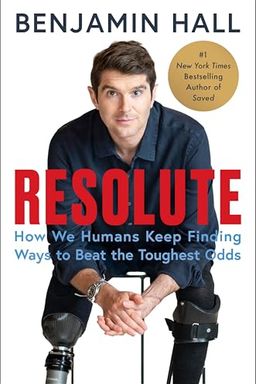
When life knocks you flat—harder than you imagined possible—what will you do next? In Resolute, Benjamin Hall argues that resilience is not rare heroism; it’s your default human setting. He contends that survival and growth come from a sequence you can learn to run under pressure: trust your built-in resilience, accept reality without illusions, adapt fast, embrace small wins, and aspire beyond “back to normal.” But to do so, you must understand how mindset, community, meaning, and love actually work under fire.
Across battlefields, burn units, rehab gyms, and kitchen tables, Hall lays out the anatomy of resolve through his near-death bombing outside Kyiv (which killed colleagues Pierre Zakrzewski and Oleksandra “Sasha” Kuvshynova), his improbable extraction by Save Our Allies, and the long months of recovery at Brooke Army Medical Center (BAMC). He weaves in stories from Ukrainian doctors, Invictus Games athletes, Israeli massacre survivors, a freed hostage (Maya Regev), and a small Kentucky town that reinvented itself after coal, opioids, floods, and Covid. The result isn’t a checklist—it’s a lived field manual on how ordinary people convert adversity into strength.
What the book claims—and why it matters
Hall’s core argument is bracingly simple: we are, as Richard Dawkins once wrote, “survival machines.” Resilience is our default. The trick is learning to trust it and to deploy it deliberately. That trust starts the minute you face a reckoning: moving from “I survived” to “what does rebuilding look like?” In Texas, doctors told Hall to expect two years inpatient. He quietly set a defiant goal—home to London by his 40th birthday six months later. Such audacious timelines, he shows, don’t ignore reality; they energize it.
These ideas matter because you will face your own Horenka: a diagnosis, a layoff, a betrayal, a disaster. Hall’s methods—cognitive reframing, tiny milestones, community activation, pain endurance, and meaning-making—scale down to daily life. If they work when a man wakes on fire and missing a limb, they work when you’re trying to re-enter social life post-burnout, parent through a crisis, or retrain after an injury.
What you’ll learn in this summary
You’ll begin with Hall’s reckoning at BAMC—how he moves from survival to will and defines resilience as “your built-in operating system.” You’ll then see why clinging to “back to normal” makes you slow and sad, and how he and his wife Alicia redesigned a home and a life instead. You’ll learn cognitive tools he used after a traumatic brain injury (TBI): turning threats into challenges, committing “scale errors” on purpose (from child-development research), and pre-building compensating systems.
From there, we’ll track micro-wins (his first stand and first step with a prosthetic), the choice to embrace challenge (even on a backyard trampoline), and the most transferable chapter of them all: how he “befriends” relentless pain using CBT-like self-talk to reach “the other side.” We’ll revisit stoicism and why it fails alone, as Hall opens up to Alicia about flashbacks in Portugal and fireworks-triggered surges in Sydney—then shows you how to define your core (family) and activate community without shame (think Brené Brown on vulnerability, paired with military precision).
You’ll also meet athletes at the Invictus Games who move beyond recovery to competition (“Masters of Our Fate”), and you’ll follow Hall back to Kyiv to interview President Zelenskyy inside Mariinskyi Palace—an act of personal and symbolic defiance. You’ll see faith reframed in a BAMC chapel, where doubt isn’t disloyalty; it’s part of a conversation with the “bigger thing.” You’ll finish in Israel (with survivor testimonies from Nir Oz and freed hostage Maya Regev) and in Hazard, Kentucky—two radically different communities proving that reinvention is a civic superpower, not just an individual one.
The promise of Resolute
Resilience isn’t denial. It is clear-eyed acceptance, rapid adaptation, joyful micro-wins, and bold aspiration—amplified by love, community, and meaning. You don’t bounce back; you grow beyond.
By the end, you’ll walk away with Hall’s most practical reframes—how to convert pain into an ally, how to reset goals upward once you stabilize, and how to “breathe” so you don’t miss life’s flashes of wonder (like the white-limbed tree outside his London window or the arrival of his fourth daughter, Sage). If you’re navigating grief, rehab, or reinvention, this is a map you can carry in your pocket—and a reminder that you’re stronger than you think, and closer than you realize.