
Idea 1
Resilience as the Blueprint for Modern Entrepreneurship
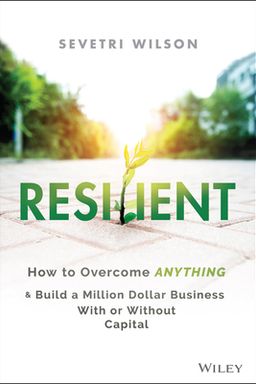
What keeps you moving forward when everything around you seems to fall apart? In Resilient, entrepreneur Sevetri Wilson argues that resilience is not merely a trait but a strategy—a mindset that allows founders to thrive despite systemic barriers, scarce resources, or personal tragedy. Her journey from bootstrapping her first company to raising millions for her tech startup proves that success can be built without a safety net, as long as you sustain the discipline and adaptability to keep going when the odds are stacked against you.
Wilson weaves her deeply personal story into a practical guide for entrepreneurs and changemakers. She shows that resilience is learned through experiences of loss, failure, and risk. Through vivid examples—from starting Solid Ground Innovations after her mother’s death to building Resilia from an idea into a multimillion-dollar company—she demonstrates how emotional grit and strategic thinking converge to create success. Her central argument: while determination opens doors, focus, fiscal discipline, and cultural awareness keep them open.
Building Against All Odds
The book begins from Wilson’s humble origins, a first-generation college student in Louisiana raised on her mother’s $26,000 salary. Her story grounds the reader in the reality faced by many entrepreneurs without legacy access or financial backing. Rather than waiting for a perfect moment, she dove in—bootstrapping, learning through failure, and gradually turning challenges into stepping stones. Her transition from a communications agency to a tech startup underscores a theme that runs throughout the book: growth demands reinvention.
Wilson also introduces the concept of the “triple threat”—being Black, female, and young—which shaped her entrepreneurial path. She highlights how intersecting biases can intensify the difficulty of raising capital and securing contracts, especially in industries dominated by white male networks. Yet, these barriers didn’t deter her; instead, they heightened her purpose. Every chapter pits systemic inequity against personal determination, revealing how resilience translates into tactical success.
Bootstrapping, Focus, and Financial Control
Wilson’s mantra—“cash is king”—reflects her belief that financial control defines independence. She contrasts bootstrapping with raising capital, showing that while external investment accelerates growth, bootstrapping cultivates ownership, discipline, and strategic patience. Her first company, SGI, thrived without venture capital because she mastered repeatable revenue models and cash flow management. Later, when launching her tech company, she used lessons from SGI to attract investors on her own terms. Bootstrapping, for Wilson, is less about scarcity and more about stewardship—knowing how to turn limited resources into sustainable leverage.
Her guidance is practical: separate “needs” from “wants,” avoid upside-down contracts, and prioritize profitability before prestige. In emphasizing focus, she warns against the “hustle mentality” that glorifies constant motion without direction. Through meditation, time-blocking, and mentorship, she cultivated clarity—arguing that mental discipline directly affects business performance. (Similar to Cal Newport’s idea of deep work, Wilson insists that intentional focus creates compounding results over time.)
Turning Service into Scalable Impact
One of the book’s defining insights is Wilson’s evolution from a consultant serving nonprofits to a tech founder creating tools that empower them. By productizing her service—transforming manual nonprofit formation into a digital platform—she shows how scaling begins with systematization. “Do it yourself, but not by yourself,” was the mantra behind Exempt Me Now, later rebranded as Resilia. Her SaaS platforms enabled organizations and philanthropic enterprises to automate formation, fund management, and reporting, democratizing access across sectors historically closed to small or minority-led groups.
Wilson’s path illustrates that innovation often arises from lived experience—not from technical expertise alone. She debunks the notion that nontechnical founders can’t build in tech, proving that deep industry insight can fuel powerful software solutions. (In the same vein as Reid Hoffman’s argument in The Startup of You, Wilson sees entrepreneurship as a process of constant self-reinvention.)
Resilience in Crisis and Social Change
A major portion of Resilient unfolds against the backdrop of global upheaval—the COVID-19 pandemic and the racial justice movement following the murders of George Floyd and Breonna Taylor. Wilson recounts closing her Series A during lockdown and guiding her team through grief and uncertainty. These chapters reveal that resilience transcends business survival; it includes emotional intelligence, ethical leadership, and social responsibility.
She speaks candidly about the exhaustion of racism, writing about her conversations with investors and team members during 2020’s reckoning. Through personal experience, Wilson expands the definition of entrepreneurship to include advocacy: buying Black, restructuring corporate procurement, and elevating Black-led tech companies from invisibility. Her reflections align with leaders like Mellody Hobson and Darren Walker, calling for inclusive equity not as charity but as smart capital allocation.
A Legacy of Generational Wealth and Purpose
The final chapters bring the narrative full circle—linking resilience to generational wealth. For Wilson, success means building systems that outlast the founder: companies that employ and empower others, wealth that fuels future entrepreneurs, and technology that uplifts marginalized communities. This broader moral vision makes Resilient more than a business manual; it’s a call to design your life intentionally and to measure success not only by revenue but by impact.
Ultimately, Resilient argues that business mastery demands emotional mastery. Wilson’s tone—both instructive and compassionate—invites you to redefine what it means to win. You don’t need to start with privilege; you need to start with clarity, adaptability, and unrelenting belief in your capacity to build something that matters. The book’s achievement lies in uniting the blueprint of entrepreneurship with the humanity behind it—showing that resilience, in business and in life, is the most powerful form of capital you can ever possess.