
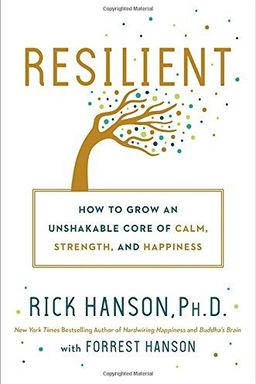
Resilient cover

Resilient

by Rick Hanson with Forrest Hanson

Resilient offers a practical roadmap to cultivate inner strengths like compassion, confidence, and grit. Through simple techniques and real-life examples, learn to harness your brain''s resources to overcome stress, embrace opportunities, and achieve lasting happiness.

Building Inner Strength Through Resilient Well-Being

How do you stay grounded when life throws uncertainty, pain, or stress your way? Rick Hanson’s Resilient: How to Grow an Unshakable Core of Calm, Strength, and Happiness contends that true resilience isn’t just recovering from hardship—it’s cultivating lasting inner strengths that make you unshakeable in the face of adversity. Hanson, a psychologist known for connecting neuroscience with mindfulness (as in his book Buddha’s Brain), shows how resilience and well-being reinforce each other in a virtuous upward spiral. You learn to harness your mind’s neuroplasticity to grow resources like compassion, confidence, and equanimity until they become hardwired traits rather than fleeting states.

At the heart of Hanson’s approach is a deceptively simple question: how do you turn passing experiences into lasting inner resources? His answer is grounded in neuroscience. The brain operates like fertile soil; whatever you repeatedly focus attention on—whether fear or gratitude—strengthens its related neural circuits. Through deliberate practice, you can shape your brain for happiness rather than for threat response. Hanson calls this method positive neuroplasticity, and the book is a guide to putting it into practice, cultivating what he calls a “garden of resilience.”

The Three Fundamental Needs

Every chapter revolves around our three ancient survival needs: safety, satisfaction, and connection. These have been wired into our brains for millions of years by evolution. When we feel safe, we can engage life from calm strength instead of fear; when our need for satisfaction is met, we experience contentment instead of frustration; when we feel connected, love replaces loneliness. Hanson argues that true well-being comes not from chasing external rewards but from fulfilling these internal needs through learned psychological resources. To make this practical, he organizes the book around four fundamental ways of meeting those needs—Recognizing, Resourcing, Regulating, and Relating—each containing chapters that build specific strengths like mindfulness, grit, calm, and generosity.

The HEAL Method: Turning Experiences Into Resources

Throughout Resilient, Hanson returns to a four-step process known as HEAL: Have, Enrich, Absorb, and Link. You first have a beneficial experience—like gratitude or comfort. You then enrich it by fully feeling it in body and mind. Next, you absorb it by sensing that it sinks into you, transforming into emotional memory. The optional link step connects this positive experience to old painful material, so that the good gradually soothes and replaces the bad. HEAL is the practical core of positive neuroplasticity, reminding us that repeated awareness of the positive rewires the brain over time. Hanson’s mantra captures this insight simply: “Neurons that fire together wire together.”

Resilience in Context

In many ways, Hanson’s argument echoes ideas found in modern psychology and ancient contemplative traditions. Like Carol Dweck’s Mindset, it emphasizes that effort and repeated practice transform capacity. Like Buddhist teachings on impermanence, it reminds you that experiences pass, but the traces they leave—if consciously nurtured—become enduring wisdom. Where Buddha’s Brain explored mindfulness and neural change theoretically, Resilient offers hands-on application: mini meditations, reflections, and practices that take only seconds but accumulate lasting results.

Why This Matters

Hanson insists that becoming resilient isn’t escapist self-help—it’s a moral act. When you cultivate calm, gratitude, and courage, you not only reduce personal suffering but also expand your capacity to help others. We tend to outsource stability to things that change—jobs, relationships, health—but as Hanson reminds us, “You take your mind wherever you go.” Real strength comes from growing inner resources into neural traits you carry through every circumstance. Rather than striving for perfection, resilience means feeling less anxiety, disappointment, and loneliness, and meeting life’s waves with steady peace and compassion. This book therefore asks: what if you didn’t just survive life’s storms—what if you learned to sail through them skillfully, joyfully, and free?


Recognizing: Awareness as the Starting Point

The first step on Hanson’s path—Recognizing—focuses on mindfulness, compassion, and learning as foundational strengths. He begins with compassion, urging you to be your own ally. Often we show more empathy toward friends than toward ourselves. He recalls being six years old in Illinois, feeling sad about family conflict, and realizing he wanted to care for himself. That moment of self-compassion, he argues, is how resilience begins: when you care about your own suffering enough to do something about it. Being “for yourself,” as he puts it, is not selfish—it’s sane. When you treat yourself like you would a friend, you build an inner advocate who makes growth possible.

Mindfulness and Mental Training

Mindfulness forms the second pillar of recognizing what's real. Hanson defines mindfulness simply as sustained present-moment awareness without judgment. It’s not just for calm afternoons on a meditation cushion—it’s for moments of conflict, loss, and tension. When you pay attention, the mind stops reacting and starts responding. He ties this to neuroscience: mindfulness strengthens the prefrontal cortex, which regulates emotions and calms the amygdala’s alarm system. He encourages daily mindfulness “micro-practices”—feeling your breath while speaking to others, noticing body sensations during stress—to train attention like a muscle. He calls your attention your “property”; reclaiming it from distractions and negativity is how you own your mind again.

Learning and Positive Change

In “Learning,” Hanson explains the mechanics of change itself. We learn through experience-dependent neuroplasticity—the brain’s ability to reshape itself in response to repeated stimulation. He reframes learning as growth: every trait you admire in others began as a fleeting experience someone practiced until it became part of them. That’s what HEAL operationalizes: take small drops of good each day until the “pot of water fills.” The metaphor comes from the Dhammapada: “Drop by drop is the water pot filled.” Hanson’s practical message is simple but profound: by staying mindful of daily positive experiences—completing a task, receiving kindness, feeling protected—each becomes a neural resource that strengthens resilience from the inside out.

Recognition Leads to Growth

Recognizing is therefore the act of noticing what’s true—in your world, body, and mind. You see your needs clearly: safety, satisfaction, connection. You accept your imperfections with compassion; you observe experiences with mindfulness; and you learn deliberately by internalizing the good. As Hanson puts it, “You cannot grow what you do not first experience.” The practice begins not by striving to fix yourself, but by seeing yourself—to acknowledge the stress, the love, and the potential waiting beneath the mind’s surface.


Resourcing: Building Emotional Supply

Once you recognize what’s happening, Hanson moves into Resourcing—the process of building the inner reserves that meet life’s challenges. This section covers grit, gratitude, and confidence, three interlocking capacities that sustain motivation, endurance, and self-worth. Hanson illustrates grit with a chilling wilderness adventure: stranded in snowy Sequoia National Park, he and his friend Bob nearly froze because Bob had used up his “internal supply of grit.” Through exhaustion, they learned that grit isn’t endless—it must be consciously refueled. Agency, patience, persistence, and “fierceness” are the roots of grit, cultivated by deliberate choice.

Grit and Agency

Agency—the belief you can influence outcomes—is grit’s foundation. Hanson contrasts agency with learned helplessness (à la Martin Seligman’s research). If you repeatedly experience powerlessness, your brain learns futility, weakening motivation and resilience. The antidote is practicing small acts of control: “Choose something, anything,” Hanson writes, from adjusting your posture to speaking up in a meeting. Each moment reminds your brain you are a cause, not just an effect. Over time, you unlearn helplessness and reclaim agency.

Gratitude and Emotional Abundance

Gratitude broadens perception from scarcity to sufficiency. Hanson borrows from Barbara Fredrickson’s “broaden-and-build” theory: positive emotions expand awareness, helping us see opportunities instead of obstacles. Through everyday practices—writing down three blessings before bed, saying “thank you” for mundane gifts like warm water or sunlight—you teach the brain that life is already full. Hanson quotes Piglet from A. A. Milne: “Even though he had a Very Small Heart, it could hold a rather large amount of Gratitude.” In cultivating gratitude, your heart enlarges, making resilience sustainable.

Confidence and Secure Attachment

The last resource in this part—confidence—rests on secure attachment. Hanson details how dependable caregiving wires children for self-assurance, while cold or rejecting environments breed insecurity. Adults can heal that history through internalizing feelings of being cared about, respected, and loved. He describes creating an inner “caring committee” composed of supportive figures real or imagined—friends, mentors, even Gandalf or Spock. Their compassionate voices anchor self-worth. This practice transforms conditional confidence (“I’m okay if others approve”) into unconditional worth (“I’m okay because I exist”).

Together, grit, gratitude, and confidence form the psychology of resourcing—the emotional savings account you draw upon when life gets rough. Hanson reminds you that external stability is unreliable, but inner supplies never run dry if refueled through awareness, appreciation, and self-trust.


Regulating: Staying Centered Amid Pain and Desire

The third pillar—Regulating—teaches how to manage your thoughts, feelings, and impulses when faced with pain or pleasure. Hanson explores calm, motivation, and intimacy as key aspects of self-regulation. His rafting story on the Klamath River symbolizes what calm feels like: alert but relaxed, aware of danger but not consumed by it. The rafting guide, Hanson observes, embodied equilibrium—mindful strength flowing under pressure. Calm doesn’t mean indifference; it means keeping balance between sympathetic arousal (the gas pedal) and parasympathetic slowdown (the brake). A calm nervous system restores “the healthy resting state” where resilience grows.

Handling Fear, Anger, and Desire

Hanson addresses the universal triad of reactive emotions: fear, anger, and helplessness. He calls most anxiety “paper tiger paranoia”—evolved fear systems misfiring against imaginary threats. We mistake harmless bushes for lurking predators. To undo this, he teaches perspective: ask yourself how likely, how big, and how permanent a threat truly is. By bounding fear with facts and recognizing resources, you shrink it to realistic size.

For anger, Hanson compares emotional ignition to a “priming and trigger” system: accumulated irritations (priming) lead small sparks (triggers) to explode disproportionately. Cooling anger means noticing priming early, reducing righteousness, and slowing reactions before the “amygdala hijack” takes over. You can still be assertive and strong—but from conscious intention, not explosive reaction.

Healthy Motivation and Desire

In “Motivation,” Hanson draws on neuroscience of reward systems. He distinguishes liking from wanting: liking is enjoyment without grasping, wanting is craving that generates stress. The shift from liking to wanting marks the tipping point from the green zone to the red zone. By enjoying pleasures mindfully rather than clinging to them, you awaken positive energy without addiction. Hanson reminds us, “Liking without wanting is heaven; wanting without liking is hell.”

Together, these skills form emotional regulation—calm that meets fear soberly, motivation that pursues goals joyfully, and intimacy that balances autonomy and empathy. They transform reactivity into responsiveness, the core of resilient stability.


Relating: Courage, Aspiration, and Generosity

The final stage—Relating—extends resilience beyond the self. Hanson explores three strengths that connect inner growth with outer action: courage, aspiration, and generosity. Courage, he writes, means “speaking from the heart.” Most fear does not come from physical danger but from interpersonal vulnerability. Citing Buddhist ideals of wise speech, Hanson outlines six traits of communication: well-intended, true, beneficial, timely, not harsh, and ideally wanted. When practiced, these make relationships safe enough for honesty and growth. Courage here isn’t aggression—it’s openness with boundaries intact.

Aspiration Without Attachment

In “Aspiration,” he quotes Mary Oliver: “Tell me, what is it you plan to do with your one wild and precious life?” Hanson argues that we all lean forward into the future, pulled by dreams rooted in childhood longings. Yet fear often fences our lives with “dreaded experiences” we avoid, such as rejection or failure. His solution is to reclaim those dreams while remaining at peace with outcomes—what he calls “aspiring without attachment.” He illustrates this with a rock-climbing story: setting an improbable goal (climbing 5.11 difficulty) and achieving it joyfully because detached effort freed him from shame. Defining success not as results but as growth aligns with Carol Dweck’s growth mindset framework.

Generosity and Forgiveness

The last chapter, “Generosity,” begins with a tender story about Hanson’s son Forrest giving away his restaurant candy to a stranger. True generosity, Hanson notes, reflects fullness inside you, not depletion. It’s how Homo sapiens evolved into “Homo beneficus”—the generous human. Daily giving can be emotional, practical, or spiritual; when balanced with self-care, it nurtures both giver and receiver. Hanson then expands generosity into forgiveness, defining two types: disentangled forgiveness (releasing resentment without pardoning) and full pardon (complete acceptance). He recounts forgiving a neighbor who delayed cutting down a fallen tree, moving from irritation to compassion as he saw the man’s loneliness. Forgiveness, he concludes, is proof that empathy and perspective are the roots of peace.

Relating completes Hanson’s circle of resilience—what begins with compassion for yourself ends as compassion for all. When courage speaks authentically, aspiration fuels purpose, and generosity softens the heart, resilience becomes an offering to others. “As you grow more,” he writes, “you give more. And as you give, the world gives back.”


Applying Positive Neuroplasticity in Daily Life

Hanson insists that resilience doesn’t grow in theory—it grows in daily practice. The HEAL framework is designed to fit ordinary moments, not retreats or therapy sessions. You can activate micro-practices anytime: enjoying warmth from coffee, feeling appreciation after a brief smile, or acknowledging patience during traffic. Each positive experience neurons consolidate if you linger long enough. Hanson likens this to physical exercise: “You must work the brain the same way you would work a muscle—lots of little efforts add up over time.”

Let Be, Let Go, Let In

He distills mental training into three modes: Let Be, Let Go, and Let In. First, you let be—observe experience without judgment, much like mindfulness meditation. Second, you let go—release tension or distorted thoughts. Finally, you let in—actively cultivate warmth, gratitude, or joy to replace what’s released. These correspond to observing the mind (the foundation), pulling weeds (releasing the harmful), and planting flowers (installing the beneficial). When practiced daily, this trinity of acceptance, release, and enrichment stabilizes your emotional equilibrium.

Integrating Mind and Body

Because the body and mind are inseparable in Hanson's model, physical practices reinforce psychological ones. He points to deep breathing, progressive relaxation, movement forms like yoga or t’ai chi, or even imagining calming scenery as ways to balance the parasympathetic and sympathetic systems. Modern neuroscience supports this—slow exhalations engage the parasympathetic branch that slows heart rate and quiets the amygdala. Hanson’s exercises thus bridge psychology and physiology, emphasizing that you regulate emotions not by suppressing them but by harmonious rhythm—“You are the sky; everything else is just the weather.”

Micro-Moments of Change

Hanson’s gift lies in showing that change happens in micro-moments. Ten seconds of consciously feeling peace after an argument, thirty seconds appreciating accomplishment—these brief acts integrate well-being into the brain. Over weeks and months, they accumulate like compound interest. Through repeated activation and installation, fleeting states become neural traits: calm becomes your baseline, gratitude your default lens, confidence your autopilot response. In essence, Hanson offers a flexible approach any reader can integrate into ordinary living—a neuroscience-informed method for everyday emotional fitness.

Dig Deeper

Get personalized prompts to apply these lessons to your life and deepen your understanding.

Go Deeper

Get the Full Experience

Download Insight Books for AI-powered reflections, quizzes, and more.