
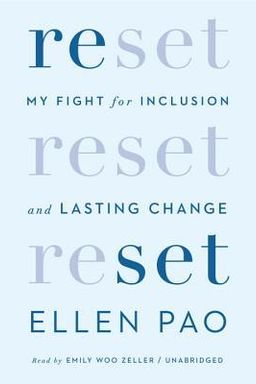
Reset cover

Reset

by Ellen Pao

Ellen Pao''s ''Reset'' chronicles her groundbreaking legal battle against gender discrimination in Silicon Valley''s tech industry. Her story of resilience and activism not only sparked a global movement for workplace equality but also led to the creation of Project Include, advocating for systemic change and inclusion.

From Meritocracy to Movement

How does a belief in merit evolve into a fight for justice? In Ellen Pao’s memoir, you trace that transformation—from an upbringing defined by the promise of hard work and equality to a public battle against systemic discrimination in Silicon Valley. Pao begins convinced that credentials and effort guarantee progress, only to discover through lived experience how institutions use the myth of meritocracy to conceal structural bias. Her story moves from childhood lessons in exclusion to high-stakes venture capitalism, legal battles, and activism—offering both diagnosis and roadmap.

Roots: Belief in Fairness and Merit

Raised by immigrant parents who valued education, Pao internalized the idea that focus and excellence enable mobility. She earned degrees from Princeton and Harvard, worked for elite firms, and expected even playing fields. Yet early hints—the teacher who discouraged Chinese at home, the Harvard interviewer implying an Asian quota—showed her how cultural biases masquerade as neutral standards. These moments framed a lifelong tension: institutions teach equality rhetorically but practice selectivity socially.

The Breaking Point: Silicon Valley’s False Meritocracy

As she enters startups and venture capital, Pao discovers that performance alone rarely controls advancement. At WebTV, Tellme, and Danger, she thrives in product execution yet witnesses gendered coding of roles—being told that even a business developer could make a demo, as if competence were unexpected. At Kleiner Perkins, she encounters opaque promotion norms and networks of power built on dinners, ski trips, and jokes—social currencies unavailable to outsiders. The rhetoric of merit obscures the rule of belonging.

A painful discovery

Institutional systems equate success with cultural similarity. Pao learns that merit can open the door only if others decide you fit inside—revealing exclusion as an engineered, not accidental, feature of Silicon Valley.

Conflict and Consequence

The book’s middle arc centers on Kleiner Perkins. Pao enters as chief of staff to John Doerr with high hopes but faces undermined deals, manipulated reviews, and blatant retaliation after reporting harassment. Partner politics override merit; colleagues poach her investments and erase her contributions. The firm’s mishandling of sexual harassment complaints—Ajit Nazre’s advances, HR’s deficient investigation—exposes how power circles protect perpetrators while punishing truth-tellers. Meritocracy collapses into hierarchy.

Litigation and Personal Sacrifice

Pao’s lawsuit against Kleiner becomes a landmark moment, not for the verdict but for the conversation it sparked. She faced immense asymmetry: armies of lawyers, selective evidence control, and a PR narrative designed to discredit her. Her courage—choosing public trial over private settlement—spotlights what whistleblowers risk. The personal toll mounts: isolation, miscarriage, family strain, and digital harassment. She embodies the “price of speaking up” that institutions quietly impose.

Redemption and Redesign

After the trial, Pao’s leadership at Reddit and creation of Project Include reframe the struggle as solution-building. At Reddit, she implements anti-harassment policies, improves diversity, bans revenge porn, and models inclusive leadership. Project Include converts her lessons into frameworks—data-driven methods for bias reduction and accountability in tech firms. Her journey completes an arc from individual grievance to collective agency.

The Larger Lesson

You end understanding that fairness in innovation industries requires more than idealism; it demands structural transformation. Pao’s story teaches that meritocracy without transparency becomes mythology, and inclusion demands both courage and design. (Note: This connects to Sheryl Sandberg’s Lean In and Joan C. Williams’s What Works for Women at Work, yet Pao’s lens extends beyond personal ambition to institutional accountability.) Her testimony stands as both warning and invitation—to contest systems that claim fairness yet reproduce inequity.


Inside Venture Capital Power

Pao’s years at Kleiner Perkins reveal how venture capital really operates beneath glossy pitches. You learn that VC is not just about financial analysis—it is a social and political network where access and trust decide who gets to lead deals and who gets excluded. Her role, designed to blend legal, business, and technical expertise, exposes structural hierarchies hidden behind claims of partnership.

Money Mechanics and Influence

VC firms charge fees and take percentages of profits, ensuring wealth concentration even when investments fail. Partners with entrenched relationships—the ones on the private jet or at the ski dinners—dominate decision flow. Reviews, promotions, and partner votes rely heavily on subjective impressions like “cultural fit” or “chemistry.” These unwritten rules perpetuate economic and cultural homogeneity.

Politics of Deals

Pao’s accounts of missed deals—Twitter, Nutanix, and Flipboard—demonstrate how gatekeeping costs firms real money. Senior partners dismissed her insights, later chasing inflated prices, proving how bias translates directly into lost alpha. When partners secretly offered Flipboard extra cash without her inclusion, the episode revealed how control, not collaboration, defines VC. Merit and profits yield to hierarchy and favoritism.

Hidden architecture of power

If you are not in the room where bonding happens, you lose access to deal flow—and thus to career-defining wins.

Cultural Filters

Pao notes the obsession with the “twenty-six-year-old mindset,” coding youth and maleness as innovation archetypes. These beliefs reproduce self-similar founders and partners, sidelining diversity as risk. Management training occasionally flagged the bias, but the firm’s top leaders preferred preserving comfort zones. You grasp how these filters perpetuate exclusion by design, not accident.

Understanding this inner machinery clarifies why systemic reform in VC requires transparency and new metrics—not mere awareness sessions. Venture ecosystems reward those who already belong, turning network privilege into market advantage. Recognizing that reality is the first step toward redesigning access.


Harassment and Institutional Failure

When Pao and colleagues reported sexual harassment at Kleiner, the firm’s reaction exposed a deep incapacity to self-regulate. Ajit Nazre’s repeated misconduct toward Pao and Trae Vassallo met tepid responses—performative investigations, manipulated evidence, and token accountability. The chapter uncovers how corporate HR systems often exist to protect reputations, not people.

Pattern Recognition

Ajit’s inappropriate remarks and physical advances form part of a spectrum of normalized sexism. The firm handled complaints inconsistently, offering vague assurances and ultimately granting Ajit generous exit terms. Meanwhile, reporting women endured exclusion, downgraded reviews, and reputational attacks. Internal investigators later sought work with the company—a conflict of interest emblematic of the system’s rot.

Retaliation Dynamics

After reporting, Pao was isolated from deals and communication threads. “Too aggressive” and “not a team player” surfaced in reviews built from selective voices chosen by biased managers. These labels, detached from performance data, showcase how language becomes weapon. Retaliation is portrayed not through overt firings but through micro-removals of influence.

What you learn

Formal systems often act as shields for perpetrators and screens for deniability. Without independent oversight, even top firms lack meaningful accountability strategies.

This section challenges you to understand harassment not as individual misconduct but institutional complicity—the network that rewards silence, discredits truth, and protects hierarchy. It’s a cautionary model applicable far beyond venture capital.


The Trial and Its Toll

Pao’s public lawsuit against Kleiner Perkins transformed private injustice into a cultural flashpoint. This portion of the book explores the grueling logistics and emotional cost of litigation against a powerful employer—and the double bind of wanting reform but facing retaliation amplified by media.

Imbalance of Power

Kleiner deployed vast resources: dozens of lawyers, consultants, and experts, while Pao faced mounting costs and limited backing. Discovery skewed—hundreds of thousands of pages from her versus mere thousands from the firm—making evidence asymmetric. Despite settlement offers, she demanded public trial to reveal systemic issues, not hush-money resolutions.

Emotional and Social Fallout

The trial magnified stress. Media painted her unfeeling due to tactical restraint under cross-examination; anonymous comments followed, along with physical threats online. Her husband, Buddy Fletcher, endured character assassination. During proceedings, a miscarriage added tangible trauma, underscoring that institutional battles exact human cost.

The verdict paradox

Though the jury ruled against her, the trial opened public discourse about gender bias, reputation attacks, and corporate accountability in tech—an outcome arguably more influential than legal victory.

You learn that litigation in asymmetric power systems is less about winning and more about exposure. Pao’s strategy—refusing confidentiality—demonstrates the trade-off between personal relief and collective enlightenment. Her resilience transforms defeat into societal momentum.


Leading Change at Reddit

Stepping from courtroom to boardroom, Pao’s time as interim CEO of Reddit becomes the laboratory for implementing fairness. She translates lessons from Kleiner’s failures into operational and cultural reforms—proof that inclusion is achievable when leaders act deliberately.

Structural Integration

Her first move: unify offices and promote cohesion under the motto “One Company, One Team.” She built leadership pipelines centered on competence and diversity—hirings like bethanye McKinney Blount and Missy Tidwell reshaped tone and accountability. Separated technical pods reduced toxic interference, allowing progress on mobile initiatives.

Policy and Cultural Reform

Drawing on earlier trauma, she instituted anti-harassment training and banned all-male and alcohol-driven events. She tackled toxicity in platform culture: banning revenge porn, doxxing hubs, and abusive communities. These actions demonstrated leadership’s responsibility to define boundaries, not defer to chaos under false free-speech ideals.

Operational Impact

Under her tenure, user numbers and stability improved dramatically—from 40 million to nearly 200 million—proving that ethical governance and growth can coexist. Despite backlash, including personal threats, her team’s policy overhaul influenced industry norms, paving ground for other platforms’ anti-harassment models.

Reddit’s transformation exemplifies how leadership guided by fairness yields measurable success. Inclusion, she shows, is not sentiment but disciplined management practice.


Building Solutions: Project Include

Turning experience into collective strategy, Pao co‑founding Project Include represents the book’s constructive climax—a blueprint for systemic change in tech. This initiative redefines diversity work from rhetoric to operation, focusing on measurable inclusion throughout employment cycles.

Formation and Philosophy

Created with leaders like Erica Joy Baker, Tracy Chou, and Freada Kapor Klein, Project Include embodies collaboration across engineering, advocacy, and venture. Their 80‑20 rule for decisions ensured speed without erasing diverse input—a practical antidote to committee paralysis. The mission: inclusion for all employees, comprehensive coverage of processes, and accountability via data.

Programs and Application

Startup Include and VC Include directly engage CEOs and investors, turning the most powerful levers—capital allocation and leadership pipelines—toward equity. The project offers audits, surveys, and toolkits that measure progress objectively. Thousands of signups demonstrate industry appetite for tangible frameworks.

From activism to architecture

You see that scalable fairness comes from designing systems—data transparency, structured interviews, and accountability metrics—rather than relying on goodwill alone.

Project Include closes Pao’s narrative loop: the belief in merit refashioned into an institutional model where inclusion is quantifiable and nonnegotiable. It invites you to treat justice as infrastructure, not a personal crusade.


Practical Lessons for Navigating Bias

Pao ends with practical advice drawn from every battle fought—guidance for readers navigating bias while preserving career traction. Her approach combines financial foresight, emotional strategy, and ethical leadership.

Strategic Awareness

Understand systemic behavior before taking slights personally. Patterns like “culture fit” or “personality mismatch” often reflect broader exclusion. She urges choosing environments where allies and mentors exist, building networks cross‑company so isolation cannot corner you. (Note: Similar to themes in Brené Brown’s work on vulnerability and courage at work.)

Defensive Preparation

Financial readiness—the “F‑you fund”—is essential. It grants freedom to speak or leave. She encourages bundling complaints coherently and demanding transparent distribution of unpleasant tasks. Avoid career promises anchored in future promotions; negotiate clarity upfront. Emotional support, therapy, and trusted peers become survival tools.

Collective Empowerment

Her closing metaphor—the “thousand Band‑Aids”—captures micro‑acts of solidarity. Each referral, fair assignment, or affirmation sustains others facing inequity. Cultural repair accumulates through these small empathic gestures. Leadership, she suggests, begins with consistent fairness in everyday choices.

You leave with a toolkit: analyze systems, protect autonomy, contribute support. That triad synthesizes Pao’s philosophy—that resilience is communal and justice begins at the level of daily work.

Dig Deeper

Get personalized prompts to apply these lessons to your life and deepen your understanding.

Go Deeper

Get the Full Experience

Download Insight Books for AI-powered reflections, quizzes, and more.