
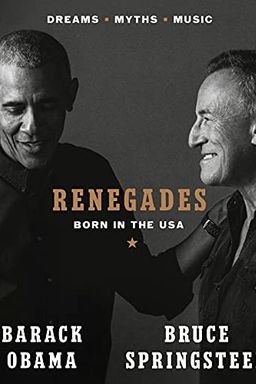
Renegades cover

Renegades

by Barack Obama and Bruce Springsteen

Renegades captures the profound conversations between Barack Obama and Bruce Springsteen as they explore American identity, fatherhood, and hope. These dialogues reveal their shared commitment to addressing the country''s challenges and inspire a vision for a more unified future.

Renegades: Two Journeys Through the American Soul

What happens when a rock star from Freehold, New Jersey, and a president from Honolulu, Hawaii, sit down to talk about America? In Renegades: Born in the USA, President Barack Obama and Bruce Springsteen share an honest, intimate, and often surprisingly tender conversation about friendship, race, masculinity, family, and the enduring—but contested—idea of America. The book, expanding on their 2021 podcast, captures two men's search for what binds this fractured country together—and what it means to live with integrity in complex times.

Across eight themed chapters, Obama and Springsteen trace the trajectory of their unlikely friendship and use it as a lens to explore the country's contradictions. They revisit small-town childhoods and restless roads, reflect on fatherhood and fame, examine race and justice, wrestle with faith, and imagine an America that might one day live up to its ideals. Both men come from working families and know what it means to feel like outsiders; both created their own versions of American storytelling—Springsteen through music and Obama through politics—and both grapple with the tension between individual freedom and collective responsibility that defines the American experiment.

Stories as a Shared Compass

Their goal isn’t to lecture or to glorify celebrity. Instead, Renegades invites you into a conversation about values: work, love, justice, and the power of story itself. For Obama, storytelling is civic—a means to weld together difference and hope. For Springsteen, it’s spiritual—a way to heal alienation and resurrect purpose. Together, their narratives become parallel roads leading toward a shared horizon: the search for belonging in a country that constantly reinvents itself and leaves many behind. Each chapter plays like a duet, with memories and metaphors harmonizing across decades of music and politics.

Why This Conversation Matters

The timing of the book amplifies its importance. Recorded during the COVID-19 pandemic and after George Floyd’s murder, it lands in a moment of immense social unrest. Both men ask, “What’s happening to America’s story?” Their answer isn’t nostalgia—it’s reflection. They trace their own awakenings in tumultuous times: civil rights and Vietnam for one, the Reagan era and culture wars for the other. Through dialogue, they turn private memory into a collective meditation on how the personal and political intertwine. Obama’s analytical calm and Springsteen’s lyrical emotion offer a rare synthesis of intellect and heart.

An Intimate Blueprint for Connection

By speaking vulnerably—about depression, marriage, grief, and the need for grace—the two men model something beyond civics or art: human connection across difference. “You can’t tell the story of America,” Obama says, “without hearing all the voices.” Springsteen replies, “That’s what me and Clarence were doing, every night, side by side.” Their friendship becomes an allegory for American possibility: imperfect, uncomfortable, yet guided by mutual respect and common purpose.

Ultimately, Renegades argues that to reconcile America’s contradictions, you must first tell its story honestly. You must acknowledge the country's ghosts—racism, inequality, toxic masculinity—while nurturing its promise of freedom, resilience, and love. The result is part cultural memoir, part moral dialogue, and part invitation: to build a story big enough for everyone to belong.


Our Unlikely Friendship

At first glance, Barack Obama and Bruce Springsteen seem worlds apart: one is a polished intellectual and the other an earthy rock poet. Yet their friendship, forged in the late 2000s, reveals a deep kinship rooted in shared values and a lifelong quest to define what it means to be American. In their opening chapter, they recount how mutual respect blossomed into genuine brotherhood after years of brief encounters during Obama’s presidential campaigns.

Kindred Outsiders

Both men grew up on the margins of belonging. Springsteen, raised in Freehold, New Jersey, came from a working-class Irish-Italian family shadowed by his father’s mental illness. Obama, the son of a Black Kenyan father and white Kansan mother, grew up in postwar Hawaii without a clear place in America’s racial narrative. “We were both outsiders,” Obama recalls. “Trying to find our way into a story that didn’t quite include us.”

That sense of dislocation shaped their journeys: Obama sought community through organizing and storytelling; Springsteen found his voice in music that told small-town truths. Both turned alienation into empathy. Each learned to see art or politics not as self-expression alone but as ways to connect with others who felt invisible.

From Stage to Statehouse

When they met during the 2008 campaign—with Springsteen performing at rallies—the bond formed almost instantly. Obama admired Springsteen’s fierce moral clarity; Springsteen saw in Obama “an American who understands the country’s contradictions.” What began as professional admiration became an honest friendship born of long dinners, candid talks about race and fatherhood, and shared work toward unity. Michelle Obama’s wry observation that Bruce “had put in the work” on self-reflection deepened the connection—each man challenging the other to dig inward.

“We are both creatures stamped born in the U.S.A.,” Springsteen writes. “There’s no other country that could have concocted the mix that makes a Barack Obama or a Bruce Springsteen.”

Their friendship becomes the emotional spine of Renegades: two men of different races, generations, and callings, finding common ground in their devotion to truth, decency, and the unfinished American project. It shows that empathy, curiosity, and willingness to listen can bridge even the widest divides—a message as personal as it is political.


The American Story

No theme animates Renegades more powerfully than the question: What does it mean to be American? Obama and Springsteen approach this by contrasting their youthful patriotism with the disillusionment that followed the civil rights struggles and Vietnam. America, they conclude, is a paradox: a place of remarkable ideals and recurring betrayals of those ideals.

The Myth of the Open Road

Cars, highways, and the idea of movement become Springsteen’s chosen metaphors for American freedom. The open road represents promise—and escape. For Obama, that same road manifests as a metaphor for reinvention: a young man driving from New York to Chicago, literally moving toward his purpose. Both discover, as they age, that freedom without roots is loneliness. “The road can cleanse you,” Bruce admits, “but eventually you need a home.” (This tension echoes John Steinbeck’s Travels with Charley on restless identity.)

Ideal and Reality

Postwar America—the fifties and early sixties—sold a vision of unity: small towns, white picket fences, and opportunity for all. But beneath the surface were racial segregation and gender constraints. As the sixties unfolded, the dream frayed. In Springsteen’s New Jersey, race riots erupted; in Obama’s youth, America’s myth of equality clashed with visible injustice abroad and at home. “Vietnam was the first time I felt the country had lost its way,” Springsteen reflects.

By revisiting these stories, they uncover America’s recurring contradiction: the longing to be both free and fair, independent yet communal. The true American story, they argue, isn’t one of perfection but of constant self-revision—a never-ending attempt to bridge the gap between creed and conduct. And that revision, both men suggest, is each citizen’s responsibility.


American Skin: Race and Reckoning

“American Skin,” one of Springsteen’s most haunting songs, becomes a framework in which he and Obama examine race in America. Using the story of Amadou Diallo—an African immigrant shot forty-one times by NYPD officers—as a starting point, they discuss how fear and privilege shape people’s realities.

The Fear Beneath the Surface

Springsteen tells Obama about his friend Clarence Clemons, the Black saxophonist and bandmate whose onstage presence symbolized the “America that could be.” Their bond embodied racial harmony, but moments of bigotry—like when Clemons was called the N-word by someone he knew—revealed the fragility of that hope. Obama connects, recalling being called a racial slur as a child in Hawaii. Both recognize that racism persists precisely because many Americans fear losing social status when equality expands.

Reparations and Honest Telling

Obama’s reflections on whether America is ready for reparations highlight his political realism. “The wealth of this country was built in part on the backs of slaves,” he says, “but you can’t get justice if people won’t own that history.” Like Ta-Nehisi Coates’s The Case for Reparations, Obama argues that progress requires truth-telling before policy. Springsteen agrees, framing music as his form of activism—a way to witness and humanize pain, even when audiences resist.

“Skin is destiny,” Springsteen writes. “What a privilege it is to forget you live in a particular body.”

Their conversation becomes not just a diagnosis of systemic racism but a call for empathy—to “see with grace.” Progress, they suggest, depends less on guilt than on the courage to face history’s ghosts and turn them into ancestors who walk beside us, not haunt us.


The Almighty Dollar

When Obama and Springsteen turn to economics, the tone shifts to lament. Both came of age in eras when the American Dream began to fracture under inequality. They dissect how the pursuit of wealth replaced the pursuit of dignity, and how the culture of greed eroded the social contract that once bound Americans together.

From Work to Worth

For Bruce, the changes hit home in Freehold, where factories shut down and unions crumbled. “Everybody worked till Friday, spent what they had, and started again,” he says. “We didn’t call that poor—we called it life.” But by the 1980s, consumerism had replaced solidarity. Reagan’s mantra—“Government is the problem”—and pop culture’s “Greed is good” made selfishness aspirational. Obama recalls watching this transformation from Chicago’s South Side: when work lost its links to fairness and family, meaning collapsed too.

Two Americas

Together, they trace America’s split between those who hoard and those who hustle. Obama points out how corporate gains exploded while wages stagnated, leaving the working class disillusioned. Springsteen’s album Nebraska captured that dread—a strange, quiet protest against cruelty wrapped in minimalist storytelling. “I wasn’t trying to be political,” he explains. “I was trying to tell the truth.”

Their conclusion is quietly radical: America’s renewal requires a new story about value. “What confers status,” Obama says, “should be how you live an honest, generous life, not how much you own.” For both men, that’s the spiritual backbone of patriotism: community over consumption.


Wrestling with Ghosts: Fathers and Masculinity

In one of the book’s most intimate sections, Obama and Springsteen confront the men who shaped them—and wounded them. Their fathers, though different, left similar scars. Bruce’s father, Douglas, struggled with mental illness and silence; Obama’s, an absent intellectual figure from Kenya. Both sons spent decades trying to meet or heal imagined expectations.

The Inheritance of Absence

For Bruce, his father’s brooding silence became both wound and muse. “Everything I wrote came from his life, not mine,” he admits. Songs like “My Father’s House” turned that pain into poetry. For Obama, the absence became mythic; he tried to live up to an idealized version of a man he barely knew. “Every man is trying to live up to his father’s mistakes,” he says.

They describe learning manhood through contradiction: strength without tenderness, stoicism without vulnerability. Both struggled against the cultural script equating masculinity with domination. Obama recalls that pop culture taught boys to be invincible—Bond’s cool detachment, Shaft’s swagger, Dr. J’s control. “We never learned to be open.”

Turning Ghosts into Ancestors

Springsteen eventually sought therapy, saying, “If you can’t get the love you want, you become the person who denied it to you.” Obama reframes the healing process as transforming ghosts into guides: “Ghosts haunt you. Ancestors walk with you.” They conclude that manhood matures through humility—the courage to express love, raise children, and accept imperfection.

Their conversation extends beyond family to culture: America itself, they argue, suffers from a “father wound.” Learning to love the nation honestly, neither idolizing nor despising it, mirrors their reconciliation as sons. Healing the self and healing the republic are, in their view, the same work.


A Fearless Love: Marriage and Fatherhood

If ghosts haunted their youth, love redeems their adulthood. In “A Fearless Love,” Obama and Springsteen reflect on marriage, family, and the hard labor of intimacy. Both credit their wives—Michelle Obama and Patti Scialfa—with grounding and refining them. “They taught us how to be men,” Obama says simply.

Learning Presence

Springsteen describes how domestic life forced him to trade midnight studios for morning breakfasts. Patti told him, “If you sleep in, you’ll miss them at their best.” That advice transformed him from performer to father. Obama shares how fatherhood redefined his priorities through simple rituals: family dinners, bedtime reading, listening to his daughters’ stories. “It was my lifeline in the chaos of power,” he recalls of his presidency.

Partnership as Mirror

Both men reveal that strong women illuminated their flaws. Michelle challenged Obama’s ambition; Patti confronted Bruce’s detachment. Neither partner tolerated self-pity or escape. Instead, love became an apprenticeship in humility. “It was my first experience of unconditional love,” Bruce admits. “I felt fearless for the first time.” Obama likens marriage to democracy: continual negotiation balanced by mutual respect. What endures, they agree, isn’t romance but shared growth.

From changing diapers to major decisions, their stories show that love is a craft learned through mistakes. The reward is not comfort but clarity: realizing that real freedom—the kind America promises—thrives not in escape, but in devotion.


The Rising: Hope and American Renewal

In the closing chapters, Obama and Springsteen bring their conversation full circle, asking: Can America still rise? Amid polarization, inequality, and distrust, both men resist cynicism. They turn to music, history, and youth for reasons to hope. Springsteen’s song “The Rising,” born from the ashes of 9/11, symbolizes this faith in rebirth; Obama’s presidency, once branded on hope, seeks the same moral revival.

Culture as Bridge

They discuss cultural power—from Elvis’s rebellious origins to Edith Childs’s rallying cry “Fired up, ready to go”—as an engine of renewal. Obama recalls how chants on the campaign trail transformed doubt into connection: “You’re channeling their energy,” he says. Springsteen explains that rock and roll, at its best, mirrors America’s contradictions—critical yet celebratory, wounded yet joyful. Together, they insist that culture must tell the truth but still keep the lantern lit.

Generational Faith

Their optimism rests with the next generation. They describe young activists protesting for justice after George Floyd’s murder as heirs to John Lewis’s courage. “They believed what their elders only preached,” Obama says. “They’ll push us until we catch up to our ideals.” For Springsteen, watching his son march in those crowds confirmed that the American spirit still breathes: “You gotta keep the lantern lit, my friend.”

They end on a shared conviction: Hope isn’t blind belief—it’s discipline. To keep faith means doing the hard, daily work of democracy, relationships, and art. Their “long walk home,” as Springsteen sings, is America’s collective journey: faltering, unfinished, but still illuminated by the promise that we can, someday, become what we say we are.

Dig Deeper

Get personalized prompts to apply these lessons to your life and deepen your understanding.

Go Deeper

Get the Full Experience

Download Insight Books for AI-powered reflections, quizzes, and more.