
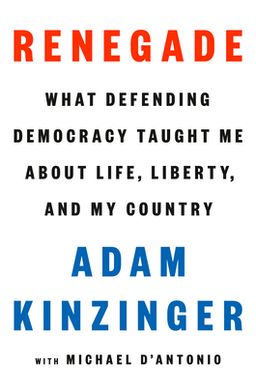
Renegade cover

Renegade

by Adam Kinzinger With Michael D’antonio

The former congressman from Illinois gives an account of his time serving in the military and on the Jan. 6 committee.

Defending Democracy in a Divided House

What do you do when the tribe you’ve loved, served, and helped lead stops believing in the rules of the game? In Renegade, former GOP congressman and Air National Guard pilot Adam Kinzinger argues that America’s core institutions—free elections, checks and balances, public service bound by oath—hold only if leaders act with integrity when it’s costly. He contends that the modern Republican Party’s descent from hardball politics into cult-like authoritarianism culminated in January 6—an attack made possible by long-building trends in religious extremism, media radicalization, performative politics, and the abandonment of civic courage.

Kinzinger’s story tracks a journey from small-town Midwestern kid to war pilot to rising GOP star to one of only ten House Republicans who voted to impeach Donald Trump after January 6—and then to co-lead investigator on the January 6 Committee. Along the way you see how culture-war religion fused with power politics, how attention economies on cable and social media reward rage over solutions, and how a real public servant weighs party loyalty against an oath to the Constitution.

Why This Book Matters Now

You live in the same conflict Kinzinger describes: friends split over election lies; family chat threads inflamed by cable segments; leaders ducking hard truths to placate online mobs. Renegade gives you a map of how we got here—and, crucially, the habits you need if you want to be part of the fix: insist on facts, break with your tribe when needed, and put country over clout.

What the Book Covers

First, Kinzinger roots his moral compass in a childhood of faith and responsibility: service-minded parents, a strict Independent Fundamental Baptist church whose rule-bound culture taught him both community’s power and the dangers of conformity, and early exposure to the Christian Right’s first big political pushes under Jerry Falwell and Pat Robertson. Then he fast-forwards to 9/11 and military service: grueling training in T-37 jets, survival school (SERE), KC-135 tanker missions over Iraq and Afghanistan, and intelligence work in the RC-26 that helped capture insurgent leaders. Combat sharpened his view of duty: real stakes, real teammates, real accountability.

Next comes his political career: a 2010 Tea Party–era victory, formative mentorship by Speaker John Boehner, budget knife fights with purists willing to crash the economy, and a growing alarm at the media–politics feedback loop that rewarded the wildest claims—from birtherism to UN “black helicopters.” As Trump rose, Kinzinger watched colleagues capitulate to a personality cult. The book’s core unfolds in the run-up to—and aftermath of—January 6: fake electors, legal contortions, explicit warnings of violence, the riot itself, and then Kinzinger’s vote to impeach, the backlash (including a blistering letter from extended family accusing him of joining “the devil’s army”), and his service on the select committee.

How the January 6 Committee Worked

Kinzinger shows you the mechanics behind the hearings: 1,000+ interviews, a million documents, and a presentation strategy that felt like a limited series—clear episodes on the Big Lie, pressure on state officials and DOJ, the fake electors, extremist mobilization, and Trump’s 187 minutes of inaction. Witnesses like Cassidy Hutchinson and Sarah Matthews offered inside-the-West-Wing clarity; John Eastman, Roger Stone, and others pleaded the Fifth dozens of times. Kinzinger’s session detailed how Trump tried to enlist DOJ to “just say the election was corrupt” and leave the rest to him and Republican congressmen.

Key Claim

“Laws are just words on paper. They mean nothing without public servants dedicated to the rule of law—and held accountable by a public that believes oaths matter.”

What You’ll Take Away

You’ll see how decades of grievance politics, apocalyptic religion, and attention-harvesting media primed millions to accept a lie and act on it. You’ll also see how ordinary courage—sometimes as simple as saying “No”—stopped worse outcomes: DOJ leaders refusing a corrupt order; state officials upholding certified results; officers holding the line long enough to save lives. Finally, you’ll learn what Kinzinger thinks must change: incentives (ranked-choice voting and open primaries), leadership habits (tell the truth even if you lose your seat), and culture (civic compassion over tribal domination).

Renegade is part memoir, part field manual, part alarm bell. It’s written by a conservative who still believes in conservatism—but not at the expense of truth, elections, or the rule of law. If you’ve ever wondered when to break with your group, how to navigate faith and politics without turning either into an idol, or what concrete acts of citizenship actually make a difference, this book gives you a blunt, detailed answer—grounded in cockpit checklists, committee subpoenas, and one oath that ultimately mattered more than a party whip count.


Faith, Formation, And First Alarms

Kinzinger’s bearings come from family, church, and the Midwest. His mother taught third graders; his father ran faith-based services for the homeless and innovated with thrift stores that preserved clients’ dignity. Sundays meant Independent Fundamental Baptist (IFB) church—strict rules against drinking, dancing, shorts, and secular music—and a tight-knit community that could lift you in crisis and crush you with conformity. He recalls being sent home from a 95-degree church youth trip to Six Flags for wearing shorts—and a “Singspiration” bus where saying “Son of a biscuit!” drew a scolding: “Jesus knows what you’re saying!”

Two Lessons From A Strict Church

First, community is powerful. The IFB’s dense web of relationships meant someone showed up with meals when tragedy struck. Second, when rules become identity, truth-telling suffocates. In Kinzinger’s world, kids learned to cloak doubts and adults hid hypocrisy. The result: brittleness. That brittleness, he argues, later resurfaced in politics as a demand for purity over prudence.

When Religion Met Power Politics

As a teen in the early 1990s, he attended Pat Robertson’s Christian Coalition convention—the “Road to Victory.” George H. W. Bush showed up to court the delegates while signaling limits (“not going back to the days of Ozzie and Harriet”). What struck Kinzinger wasn’t policy finesse—it was the machinery: media, money, and mobilization guiding millions of believers into GOP structures. He watched rhetoric harden into a cosmic struggle: “war for the soul of America,” “radical feminism,” “homosexual rights” (Pat Buchanan at the 1992 GOP convention). He also saw conspiracism creep in: Robertson’s book about the Illuminati, world financial cabals, and coded symbols on the dollar. (Compare Anne Applebaum’s Twilight of Democracy on how conspiracy narratives colonize respectable politics.)

A Child’s Eye For Hypocrisy—And A City’s Ideals

Kinzinger grew up idolizing Lincoln—the Lincoln Museum in Springfield displays the bloodstained gloves from Ford’s Theatre—and absorbing quotes about responsibility you can’t “evade” and being “on God’s side.” The paradox of his formation: reverence for duty beside a subculture ready to declare outsiders damned. That paradox primes his adult argument: faith can shape humble service, or it can become a license to impose and excoriate.

A Telltale Moment

At age 14 in Jacksonville, he’s wowed by a young Democrat’s hot-pink yard signs—and devastated when the candidate loses. He starts reading the paper, collecting political facts the way other kids collected baseball cards.

Purity Culture Becomes Purity Politics

Kinzinger traces a straight line from IFB separatism to political absolutism. IFB churches defined themselves by what they opposed; so too did the later Tea Party and then MAGA. Both punish dissent, elevate anointed leaders, and sanctify anger as righteousness. The theological subtext matters: apocalyptic sermons and End Times books like Left Behind amplified a sense of emergency. If the end is near, compromise is betrayal.

The early “alarms” in the book are thus spiritual as much as political: when God-talk reduces opponents to enemies, democracy—rule by argument and concession—starts to look like sin. Kinzinger isn’t anti-faith; he’s anti-idol. He wants a faith that checks your party, not one that baptizes it. (For a theological complement, see N. T. Wright’s Surprised by Hope and Russell Moore’s critique of Christian nationalism.)


War Made Me Grow Up

September 11 rerouted Kinzinger’s life, but he had already begun the path. He aced Air Force pilot aptitude tests, joined the Wisconsin Air National Guard, and learned officer basics before he ever strapped into a cockpit. He describes the T-37 “Tweet” trainer’s kerosene scream, pulling Gs so fast your vision browns out, and nearly blacking out on a too-fast split-S he somehow recovered. He reveals the culture that shapes military judgment: checklists, crew cohesion, and humility under risk.

SERE: A School For Courage And Limits

In survival school near Spokane, he kills a rabbit for food, is hooded and interrogated in a mock POW camp run by pros (the “commandant” looks like Santa), and learns the hard lesson that everyone breaks. Your job isn’t to be superhuman; it’s to limit harm, delay, and survive. That realism about human limits later informs his view of politics: pressure changes people; systems must hold when individuals falter.

KC-135s, Midnight Skies, And Moral Math

Tankers keep war planes alive—“giant airborne gas stations” that refill bombers and fighters at 30,000+ feet. He describes “boxes” in the sky where they orbit, the choreography of 600-gallon-per-minute hookups, and a hairy moment with a B-2’s bow wave that forced an emergency breakaway. War at altitude felt abstract: below, IEDs maimed and killed; in the cockpit, hours droned by. That dissonance fed a lingering unease about whether he was “really at war” while living on safe bases with three-drink limits and reflective-belt rules.

Plan Colombia, Guam, And Incirlik

Kinzinger uses deployments as history lessons: Guam’s Magellan landing and sunken warships (a B-52 and German Cormoran II) show how misunderstanding breeds violence; Turkey’s Incirlik base illustrates NATO’s quiet backbone and the messy alliances required to fight terror; Colombia’s counterinsurgency plan (begun under Clinton, expanded under Bush) demonstrates that development, justice reforms, and interdiction together can bend a conflict’s arc. (Compare David Petraeus’s counterinsurgency manual and David Galula’s classic theory: you win by securing people, not just territory.)

From Tankers To Man-Hunting

Wanting more direct impact, he transfers to the RC-26, a twin-engine turboprop packed with sensors that vacuum up cell metadata and video to help Special Operations grab insurgent leaders in minutes, not hours. He flies from Balad (“Mortaritaville”), taking steep takeoffs to outrun small-arms fire, and learns to time the dance between intelligence and operators on the ground. One vignette: teams nab an Iranian Quds Force player at Baghdad’s airport—only to watch Iraqi authorities let him go. Politics, again, sets the ceiling on tactical success.

A Civilian Hero Moment

In Milwaukee, a woman bursts from a bar with her throat slashed. Kinzinger disarms and pins her attacker until police arrive. He’s later awarded the Airman’s Medal. His reflection: the Air Force taught him to act without hesitation under adrenal stress.

What Combat Taught Him About Politics

Combat ingrained three habits he later brought to Congress. First, oaths matter: leaders are custodians of lives and missions, not their own egos. Second, reality beats rhetoric: if a plan ignores ground truth, it fails—whether in Fallujah or the House chamber. Third, courage scales: the bravery to fly into a hot LZ and the bravery to vote against your party spring from the same muscle—do the right thing, then take the hit.


From Tea Party To Trumpism

Kinzinger rides the 2010 Tea Party wave into Congress—and immediately sees its contradiction. The movement began as a protest against bailouts and Obamacare but metastasized into a catchall of grievances: birtherism, conspiracy theories about the UN’s Agenda 21, and “Don’t Tread on Me” as a license to tread on deliberation. He welcomed the energy while pleading for civility at local rallies—and won big against Democrat Debbie Halvorson. But he also saw cable cameras amplify the loudest, least tethered voices.

Boehner’s “Crazytown” vs. The Bomb-Throwers

Speaker John Boehner—the “Mayor of Crazytown”—enlisted Kinzinger to build vote coalitions for budgets and debt ceiling deals. The job: stop a shutdown, trim spending, and keep faith with markets. Tea Party purists balked at any compromise, pushed the U.S. to the brink of default, and helped trigger a credit downgrade and $1B in extra borrowing costs. Boehner called them “knuckleheads.” Kinzinger’s takeaway: confusing TV stardom for governing is a hell of a drug.

The Media–Outrage Flywheel

Conservative media became both megaphone and leash. Kinzinger couldn’t attend a constituent Q&A without hearing, “Rush says…” or “Bill [O’Reilly] says…” He details how Glenn Beck turned a nonbinding environmental framework (Agenda 21) into a “UN takeover,” and how the birther lie persisted despite legal and documentary debunking. He admits he sometimes fed the machine—e.g., blasting Obama’s renaming of Alaska’s Mount McKinley to Denali—then recognized the pattern: hot-button “wins” that left the country colder and problems unsolved. (See also Jonathan Haidt on social media’s moral-emotional tilt.)

Redistricting And Moderation Tested

In 2012 Illinois Democrats eliminated his district in a gerrymander, forcing a primary against veteran Republican Don Manzullo, a Tea Party favorite who once called Islam a “savage religion.” Kinzinger beat him by courting pragmatic conservatives who wanted someone to govern, not just rage. Two years later he cruised against a Tea Party challenger. He thought normalcy was returning. He was wrong.

Enter Trump: From Show To Shakedown

The 2016 primary stage rewarded insult comedy over policy. Trump mocked “Low-energy Jeb,” “Little Marco,” and “Lyin’ Ted,” sucked up all oxygen, and translated 35 percent in crowded fields into pluralities. Kinzinger backed Jeb Bush, then Marco Rubio, and refused to support Trump after the “Access Hollywood” tape and pleas for foreign interference. On election night, a longtime supporter confronted him in a VFW hall: “If he loses, it’s your fault.” He shot back: “You think it’s me—and not that he’s a racist idiot?”—and realized the cult logic had arrived.

Addiction To Attention

He confesses the pull: greenrooms, makeup, “Great hit!” texts. In politics, attention is currency—and a cage. It can bend your spine before you notice.

A Culture Shift With A Cost

Trump’s presidency accelerated three trends Kinzinger had been warning about: (1) Party over oath—colleagues adopted whatever line the leader set, even when it contradicted yesterday’s line; (2) Outrage as identity—owning the libs replaced owning your responsibilities; (3) Conspiracy as catechism—QAnon-lite talking points seeped into mainstream talking heads. The result wasn’t just bad policy; it was a party unmoored from the norms that make democracy functional.


Inside Congress: Oath vs. Obedience

Kinzinger lifts the curtain on incentives that push members to posture, not legislate. Leadership PACs reward TV loudness; primary threats enforce orthodoxy; and a siloed media diet punishes nuance. He shows what it meant to be on Boehner’s team—counting votes, courting holdouts, and saving a country from default while being called a traitor by your own base. He also shows how Kevin McCarthy, unlike Boehner, used juvenile intimidation and submission to Trump as operating principles.

Two Speakers, Two Models

John Boehner: funny, pragmatic, willing to share a drink and move an agenda one compromise at a time. He called Congress a city of “jackasses and media hounds” but believed deals serve the country. Kevin McCarthy: a “windsock” who shoulder-checked Kinzinger in the aisle after he broke ranks and later empowered insurrection objectors to stall the electoral count. If Boehner’s North Star was governing, McCarthy’s was surviving—whatever the cost.

The Debt-Ceiling Wars

In 2011, Kinzinger helped pass a budget that averted shutdown and trimmed spending. Tea Partiers withheld votes to force a crisis and demanded a debt-ceiling hostage that spooked markets. Standard & Poor’s downgraded U.S. credit for the first time. The true price of purity politics showed up in treasury yields—and in lost public trust. (Economists often note: you can’t run the world’s reserve currency with cable-news timelines.)

Courage As A Rep’s Daily Choice

He voted to trim some defense fat (unnecessary flight suits), supported funding for heating assistance, and explored free clinics for the uninsured—deviations that earned him “traitor” letters from local Tea Partiers and low ratings from Heritage Action. He kept saying what his district needed to hear, not what interest groups wanted to score.

The Trump Years: Cult Capture In Real Time

By 2017, Kinzinger watched colleagues flip overnight from private scorn to public fealty. He recalls the Philadelphia GOP retreat where Trump insisted Mexico would pay for the wall and urged Republicans to let Obamacare “blow up” so he could replace it later—policy as spectacle. He details the Kurds episode: after a Sunday call with Turkey’s Erdogan, Trump pulled U.S. troops shielding Kurdish allies in Syria. Turkish forces attacked; hundreds died or were wounded. For Kinzinger, that was moral whiplash—and a bright line.

A Telling Exchange

In the Oval, Trump praises Kinzinger’s suits and TV chops—performer compliment to the end. Later, when pressed on ZTE sanctions after China pleads jobs, Trump says he promised Xi; principle yields to transactional showmanship.

Impeachment Round One—and Hesitation

Kinzinger regrets not voting to impeach during the first Ukraine impeachment. He accepted leadership’s framing that the Senate would acquit anyway. In hindsight, a bolder stand might have stiffened spines and curbed later damage. It’s one of the book’s most honest admissions: courage is a habit you build—or atrophy—over time.


January 6: Anatomy Of A Betrayal

Kinzinger saw the train coming. On January 1, 2021, during a House GOP call, Liz Cheney circulated a memo: Congress had no authority to overturn state certifications. Kinzinger warned colleagues that online talk looked violent. Kevin McCarthy brushed past him to “Who’s next?” Meanwhile, Trumpworld pursued “multiple paths”: pressuring state officials, assembling fake electors, and leaning on Vice President Pence to reject slates (the John Eastman theory). Rick Perry texted Mark Meadows a plan on November 4; Donald Trump Jr. wrote Meadows, “We have multiple paths… We control them all.”

The Day Itself

Kinzinger kept a Ruger LCP on his desk and watched C-SPAN security feeds as a sea of red caps flowed toward the Capitol. He saw tear gas plumes and helmeted men in tactical gear batter doors. He fielded texts from members sheltering in the House gallery as rioters breached. Outside, he later noted, Senator Josh Hawley had raised a fist to the crowd—then sprinted inside on video as the mob closed in.

Impeachment And The Family Backlash

The next day, Kinzinger called for Pence to invoke the 25th Amendment (“the president has become unmoored from reality”). When that failed, he voted for impeachment—one of ten House Republicans to do so. The blowback was fierce: censures, primary threats, and a letter from extended family accusing him of joining “the devil’s army” and listing Fox hosts—Dobbs, Hannity, Ingraham, Mark Levin, Rush Limbaugh—as their moral arbiters. He calls it what it is: proof that a media priesthood had replaced Christian discipleship for many.

Inside The January 6 Committee

The committee structured its work like a public masterclass: eight hearings with cinematic clarity, backed by 1,000+ interviews and a million records. Chair Bennie Thompson’s steady hand and Liz Cheney’s prosecutorial framing anchored the effort. Witnesses brought the receipts: Cassidy Hutchinson relayed Trump’s demand to drop magnetometer screening because “they’re not here to hurt me,” and his lunge toward the wheel when agents refused to drive him to the Capitol; Sarah Matthews described Mark Meadows scrolling his phone as the West Wing begged Trump to act; DOJ leaders recounted resisting Trump’s push to “just say the election was corrupt” and leave the rest to him and GOP congressmen.

The 187 Minutes

Trump watched the riot on TV, called Rudy Giuliani twice, refused Pentagon calls, and edited a next-day statement to remove “I am sickened” and “you do not represent me.” He added the lie that he deployed the National Guard. Dereliction distilled.

What Stopped The Coup

Boredom didn’t stop it; oaths did. State officials refused to falsify results. DOJ leaders refused to be weaponized. Pence refused to violate the Constitution. Police held doors against medieval-style heave-ho assaults for crucial minutes. Congress returned at 9 p.m. to finish the count. Kinzinger closes this section with the book’s moral: institutions are only as strong as the people who honor them when it hurts.


Courage Without Permission

Kinzinger is blunt about costs: shunning in the halls, graphic death threats mailed to his home (one addressed to his wife promised he would be executed; “you and Christian will be joining Adam in Hell too!”), county party censures, and a flood of primary challengers. He chose not to seek reelection. Instead, he launched Country First to back democracy-defending Republicans, Democrats, and independents—and to push reforms (ranked-choice voting, nonpartisan primaries) that reduce the power of extremist minorities.

Accountability Is Working—Slowly

Hundreds of January 6 rioters have been charged; Oath Keepers’ Stewart Rhodes received 18 years for seditious conspiracy. Trump faces multiple criminal and civil cases: classified documents mishandling, New York business fraud, a hush-money case, and pending election-interference investigations. Kinzinger argues this isn’t “criminalizing politics”; it’s normalizing consequences. Without them, deterrence dies.

Faith After Idolatry

Kinzinger engages voices like Russell Moore and N. T. Wright to disentangle Christian faith from Christian nationalism. The metrics are grim: public respect for religious people has fallen in the Trump years, in part because many Christians fused gospel with grievance. He proposes “civic compassion”: listen first, refuse demonization, and love your country without making it your god.

How You Build Courage

Courage scales from cockpit to committee room by habit. He cites former CIA field worker Jamie Winship’s practice: pray, discern, act without fear. In politics, that looks like telling constituents the truth they don’t want to hear, accepting lost elections as a price of integrity, and mentoring the next person to do the same. It also looks like recognizing when you hesitated (his first impeachment regret) and recommitting to act sooner next time.

A Final Word

“Being able to be a father and a husband is amazing… Maybe I will run again someday… But I now know one thing: I don’t need it.” That freedom, he suggests, is the soil where courage grows.

What You Can Do This Week

  • Check your inputs: diversify news sources; read across differences.
  • Join the boring: serve on an election board, volunteer as a poll worker, or attend a city budget session.
  • Reward integrity: donate to candidates who accept outcomes and reject conspiracies—across parties.
  • Model oaths: at work or home, keep promises when it costs you.

Renegade closes with a definition of courage fit for citizens, not superheroes: do the next right thing, in public if necessary, without waiting for permission from your tribe. In a country built on voluntary restraint, that’s how self-government survives the next test.

Dig Deeper

Get personalized prompts to apply these lessons to your life and deepen your understanding.

Go Deeper

Get the Full Experience

Download Insight Books for AI-powered reflections, quizzes, and more.