
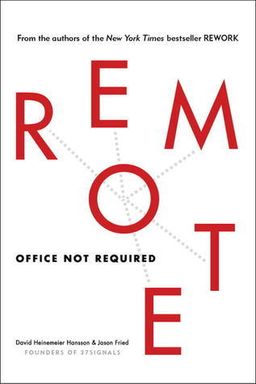
Remote cover

Remote

by David Heinemeier Hansson

Remote: Office Not Required offers a comprehensive guide to embracing the future of work. It challenges traditional office norms, revealing how remote work boosts productivity and employee satisfaction. With practical strategies for managers, it navigates the complexities of virtual teamwork, enabling businesses to thrive in a flexible work environment.

The Rise of Remote Work: A New Way to Live and Work

Have you ever looked up during a long commute and wondered why work has to mean sitting in traffic or spending eight hours under fluorescent lights? In Remote: Office Not Required, Jason Fried and David Heinemeier Hansson argue that we're living through one of the most transformative shifts in how human beings work—a shift from physical presence to digital productivity. They contend that remote work isn’t just a trend but the logical outcome of technology, economics, and human values converging. It’s not merely about avoiding the office; it’s about reclaiming autonomy, attention, and creativity in a world dominated by interruptions and outdated notions of control.

Through their own experience running 37signals (now Basecamp), Fried and Hansson expose the myth that office-bound work produces better results. They reveal that the traditional office has become an interruption factory—a place where collaboration often means distraction and where managers mistake visibility for productivity. Remote work, they argue, solves these structural problems while making work healthier, saner, and more humane.

Why the Office Is Broken

Most people, when asked where they go to get real work done, rarely say "the office." At best, they mention early mornings or weekends—when the office is quiet. Fried and Hansson describe offices as food processors that shred your day into tiny bits of uselessness: meetings, conference calls, and spontaneous interruptions slice hours into minutes, destroying any hope of deep focus. Remote work restores what the modern office has taken away—a chance to enter the elusive realm of flow, where uninterrupted stretches lead to meaningful output. Without hallways full of chatter and managers hovering nearby, workers can design their environment for concentration rather than compliance.

Technology Made It Possible

The authors remind us that the remote revolution wasn’t possible until the right tools arrived. From email and instant messaging to Basecamp, GitHub, and Dropbox, the infrastructure now exists to share ideas, track progress, and collaborate across continents. Technology made location irrelevant, but culture hasn’t caught up. Remote work demands an upgrade not of devices but of habits and mindsets: trust instead of supervision, asynchronous coordination instead of clock-watching. (Note: This theme echoes Clay Shirky’s argument in Cognitive Surplus—that technology amplifies human motivation when institutions relinquish control.)

Freedom from the City Monopoly

For centuries, cities were magnets for talent. Companies clustered together to harvest creativity—but that bargain came with costs: cramped apartments, long commutes, and soaring rent. Fried and Hansson show that cities no longer hold a monopoly on opportunity. Culture, entertainment, and connection can now be streamed everywhere. The luxury of the future, they predict, will be freedom from the urban grind. When you can access everything from anywhere, why stay tethered to one place? Remote work decentralizes talent and redistributes economic growth beyond the traditional hubs of Silicon Valley, New York, and London.

Human and Business Benefits

For employees, remote work offers an escape from stress, pollution, and wasted hours. For employers, it opens a global talent pool. Fried cites IBM’s remote-work program, which saved billions in office costs, while employees saved thousands on gas and car maintenance. It’s not just about money—it’s about alignment. A company focused on results, not appearances, finds that remote work erases superficial metrics and replaces them with one clear question: did we make progress? When work becomes output-based rather than presence-based, the best workers rise naturally to the top.

Culture Without Cubicles

One of the greatest fears about remote work is the loss of culture. Yet Fried and Hansson dismantle the notion that culture comes from ping-pong tables or beer parties. True culture, they write, emerges from how people behave—how they collaborate, communicate, and support one another. Transparency in decision-making, respectful dialogue, and shared values can thrive even better online than in physical offices because they require clarity, not charisma. At 37signals, weekly threads like “What have you worked on?” replaced hallway gossip with collective purpose.

Remote Is Here—and You’re Probably Already Doing It

Ironically, the authors point out that many organizations already work remotely without realizing it. From accountants and lawyers to outsourced HR systems and advertising agencies, critical tasks are done off-site by default. Even within offices, people often email and message colleagues sitting three desks away. The difference between that and full remote collaboration is simply admitting the truth: physical proximity doesn’t equal teamwork. Once you recognize this, remote work becomes not radical innovation but realistic evolution.

A Manifesto for the Modern Era

Fried and Hansson’s book is not merely about where we sit when we type—it’s a manifesto for modern freedom. It asks you to question old dogmas: that productivity requires supervision, that creativity demands meetings, that culture means co-location. It invites you to design a life that merges work and living instead of pitting them against each other. The real revolution of remote work lies not in software but in philosophy—the belief that trust, autonomy, and results matter more than attendance. As Fried and Hansson conclude, “Office not required” isn’t the future; it’s the present. The only question left is whether you’ll embrace it or keep commuting while the world moves on.


Making Remote Collaboration Work

Once you move beyond the myth that collaboration needs shared walls, the question becomes how to actually make it work. The authors lay out a practical framework for effective remote teamwork—a set of principles about communication, overlap, transparency, and rhythm. Collaboration is not about constant availability; it’s about thoughtful synchronization and clearly shared artifacts.

Overlapping Hours and Asynchronous Work

They suggest at least four hours of overlap among teammates. This window allows real-time discussions while preserving long periods of concentration. For example, when 37signals managed a team in Chicago and Copenhagen, they scheduled 8am–5pm in Chicago and 11am–7pm in Copenhagen, giving four hours of live collaboration each day. The rest of the time was deep work—quiet, uninterrupted execution. This balance between synchronous overlap and asynchronous independence represents the heart of remote effectiveness.

Transparency as the Default

The worst enemy of remote coordination is secrecy. If files, messages, and decisions live in individual inboxes, collaboration grinds to a halt. To address that, Fried and Hansson insist on all out in the open—every discussion thread, document, and deadline accessible to all. That’s why they built Basecamp, which centralizes progress so that nobody loses half a day waiting for others to come online. Shared calendars, GitHub repositories, and Dropbox folders make projects collectively visible, replacing the chaos of scattered inboxes with structured transparency.

The Digital Water Cooler

A common critique of remote work is loneliness. Fried and Hansson counter that connection just needs new venues. They use Campfire, a group chat room where employees joke, share memes, and celebrate milestones—an online water cooler. Social chatter isn’t wasted time; it builds camaraderie and glue. (Remote veterans like Automattic and GitHub echo this, using Slack channels dedicated to hobbies or random talk.) The key is voluntary participation—you can join in when you want, not be trapped in idle hallway interruptions.

Forward Motion and Accountability

Remote work shines when accountability equals progress. Weekly threads like “What have you been working on?” keep momentum visible. Instead of micromanagement, peer visibility creates moral pressure to contribute. It’s harder to bluff when your deliverables are public, and easier to respect colleagues whose output speaks for itself. Remote work replaces judgment by optics (hours, smiles, punctuality) with substance—the work itself.

Fewer Meetings, Better Managers

Interestingly, distance improves management. When conversation happens over email or Basecamp threads, interruptions carry a record. Managers can’t casually demand attention. Meetings and managers—the M&Ms of office dysfunction—become deliberate tools used only when necessary. Fried argues that every meeting costs hours of collective time. Used sparingly, both become more meaningful. Remote collaboration, in this sense, curates communication: fewer interruptions, more intention.


Overcoming Excuses and Building Trust

Before remote work can flourish, it must overcome an obstacle course of excuses. Fried and Hansson list classics like "Magic only happens when we’re all in a room," "If I can’t see them, how do I know they’re working?" and "The office is more secure." Each is dismantled by logic and experience, revealing deep managerial insecurities rather than functional barriers.

The Illusion of Control

The biggest hurdle is fear of losing control. Managers equate supervision with productivity, imagining their teams as troops awaiting orders. Fried and Hansson liken this to Mel Gibson in Braveheart shouting "Now!"—a primal need to see action instantly. But great management isn’t about barking commands; it’s about creating environments where people self-direct. Remote settings strip managers of their crutches. If you can’t trust your team outside your sightline, you have a hiring problem, not a working-location problem.

Trust and Autonomy

At Accurate Biometrics, managers use surveillance software to record screens—a tragic misunderstanding. By contrast, companies like the IT Collective see trust as non-negotiable. As Chris Hoffman quips, “We employ professionals, not children.” When leaders treat employees like adults, output improves naturally. As Richard Branson put it, real collaboration requires trust to work anywhere. In remote cultures, autonomy replaces oversight as the primary motivational engine.

Culture and Communication

Excuses about "losing culture" misunderstand what culture means. It’s not about ping-pong or Friday parties—it’s about how people treat clients, approach risk, and communicate. Remote cultures become explicit: values are written, decisions are explained, tone is standardized. The authors argue that culture grows stronger when divorced from superficial togetherness, since it relies on values rather than rituals.

Dealing with Distractions

Home distractions—children, chores, Netflix—are real, but so are office ones. The difference is control. You can turn off the TV or shut the door; you can’t stop someone tapping your shoulder mid-focus. Productive remote workers design their spaces intentionally. If distractions persist, it’s not the location—it’s the quality of your work or motivation, signaling it’s time to reassess purpose.


Hiring and Managing Great Remote Teams

Hiring remotely flips recruitment upside down. Instead of hiring proximity, you hire performance. Fried and Hansson detail a process that filters for self-discipline, written clarity, and emotional maturity—and then explain how management changes when physical surveillance disappears.

Global Talent, Local Impact

37signals hired experts from Copenhagen, Idaho, Ontario, and beyond, proving talent isn’t bound by geography. Remote work not only broadens the talent pool but also stabilizes teams—workers in smaller towns are less likely to be poached or job-hop, creating long-term loyalty. Paying big-city salaries to those in small communities keeps morale high and turnover low.

Testing, Not Guessing

Before hiring, 37signals runs “test projects”—short paid assignments that preview real work. These projects filter candidates better than abstract interviews or riddles. Fried rejects the Microsoft-style quiz culture and instead advocates realism: hire based on demonstrated performance, not puzzles. (This practical emphasis mirrors Cal Newport’s principle in Deep Work: quality comes from focused output, not credentials.)

Writing as a Superpower

Strong writing predicts remote success, since most collaboration happens through text. Cover letters become the first real test: clarity equals competence. The authors recommend studying classics like On Writing Well to improve coherence and tone. Poor communicators fail faster remotely because ambiguity multiplies with distance.

Management by Output

Managers must stop “managing chairs.” When attendance ceases to matter, leadership transforms into removing obstacles. Great remote managers ensure access to tools, permissions, and independence. 37signals gives all staff company credit cards and unlimited vacation “within reason”—trusting judgment over policy. The biggest management task isn’t enforcing control; it’s preventing burnout. Remote workers are prone to overwork, blending days into nights, so managers must guard against enthusiasm turning into exhaustion.


The Remote Lifestyle and Personal Discipline

Remote work grants freedom—but freedom without structure can devolve into chaos. Fried and Hansson tackle the personal side: how individuals maintain discipline, balance, and motivation when home and office merge.

Routine and Boundaries

Without fixed hours, days can dissolve. So you need rituals—wake times, work times, wardrobe cues (even changing slippers, as one employee does). The goal isn’t conformity but clarity: signal to yourself when the workday begins and ends. Divide tasks into segments: mornings for catch-up, afternoons for creation, evenings for rest. Routine sustains both focus and sanity.

Physical Health and Ergonomics

Home offices risk sedentary habits. The authors recommend investing in ergonomic essentials—chairs, desks, and monitors that prevent chronic strain. 37signals even subsidizes gym memberships and fruit deliveries. The absence of commutes should make room for healthier practices, not feed a sedentary spiral.

Motivation and Meaning

Motivation, they remind you, can’t be bribed. The best way to sustain energy is meaningful work and human connection. If you’re disengaged, the problem isn’t laziness but misalignment between task and purpose. Managers should spot demotivation early through one-on-ones, not annual reviews.

Nomadic Freedom and Family Time

Remote work lets you design a life that blends travel and family. Employees like Peter Baumgartner moved to Mexico with their kids while running their firms. Others take half-day schedules to spend mornings at home. The key isn’t escapism but integration—work and life sharing the same space without cannibalizing each other.

Avoiding Isolation

Solitude is both gift and danger. Cabin fever strikes if you never leave the house. The remedy: co-working spaces, cafés, volunteer events. Human connection fuels creativity more than corporate chatter ever did. Working alone doesn’t mean being alone; it means choosing when and how to connect.


The Future of Work and the End of the Office

In their conclusion, Fried and Hansson forecast the decline of traditional offices as inevitable—not by catastrophe, but by evolution. The industrial-age model of supervision and cubicles is giving way to the networked age of autonomy. In thirty years, they predict, people will look back at commuting as absurd as faxing documents seems today.

The Tipping Point

Borrowing Gandhi’s model—first they ignore you, then they laugh, then they fight, then you win—the authors argue remote work is at the fighting stage. Resistance like Yahoo’s reversal on telecommuting reflects fear, not logic. The cost of ignoring remote possibilities will soon outweigh nostalgia for office life. Companies embracing remote today will be the winners of tomorrow’s economy.

Freedom as Efficiency

Remote work isn't utopian idealism—it’s efficient pragmatism. It saves hours, reduces stress, increases talent diversity, and aligns work with life. The old office was about surveillance; the new one is about trust. As technology continues to shrink distance, geography will matter less and humanity more. The best companies will stop managing presence and start measuring progress.

The Human Upgrade

Fried and Hansson close with hope. They write that remote work is not the triumph of machines but the triumph of human will—an upgrade for the mind that refuses to be reduced to a desk. The future of work will not be faster, louder, or more connected—it will be quieter, wiser, and freer. Whether you lead teams or write code, the invitation is clear: stop commuting your life away and start living it where it matters most.

Dig Deeper

Get personalized prompts to apply these lessons to your life and deepen your understanding.

Go Deeper

Get the Full Experience

Download Insight Books for AI-powered reflections, quizzes, and more.