
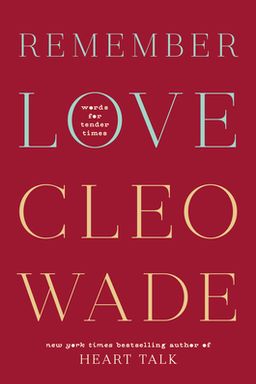
Remember Love cover

Remember Love

by Cleo Wade

In ''Remember Love'', Cleo Wade guides readers through the transformative journey of embracing lostness as a gateway to self-discovery and love. This enlightening book encourages finding inner peace amidst life''s uncertainties, offering a fresh perspective on growth, self-love, and healing.

Remembering Love in Tender Times

How do you remember love when life feels heavy, uncertain, or broken apart? Cleo Wade’s Remember Love: Words for Tender Times serves as a luminous answer to that question—a blend of poetry, memoir, and meditation on healing, change, and the enduring power of love. Wade invites you to see tenderness not as weakness but as strength. She argues that remembering love, especially in moments of distress and lostness, is a spiritual practice that reconnects us to our wholeness when the world feels fragmented.

At the heart of Wade’s message lies the idea that love is both a refuge and a renewable source of inner light. This book navigates four intertwined landscapes: personal healing, self-reclamation, the courage of emotion and vulnerability, and the many forms of release that come with growth. Each part reminds you that getting lost is not failure—it’s part of finding your way home to yourself. Poetry becomes the companion that helps you pause long enough to return to your own internal rhythm, far removed from the relentless pace of modern life.

The Healing Power of Words

From the opening pages, Wade confesses that poetry was her therapy before she could afford a therapist. This personal truth underpins the entire book: words are medicine. Through writing, she learned to transform fear into grounded choice, shame into acceptance, and confusion into clarity. When she heard the phrase “Remember love” in a talk by meditation teacher Tara Brach, it became her mantra — a reminder that, in dark nights of the soul, love remains our most reliable torchlight.

Wade shows how remembering love can save you, not by erasing difficulty, but by illuminating your resilience. It reaffirms that your spirit, even when soft, is durable. This reframing moves beyond clichés of self-care and dives into what she calls “the heart work” — repeatedly choosing softness and compassion over shame and anxiety.

Self-Reclamation Through Stillness and Rest

Across early chapters like “for people like me who don’t know how to relax,” Wade identifies busyness and self-disconnection as epidemics of the modern age. She challenges the culture that glorifies exhaustion and productivity as signs of worth. She writes candidly about painting rooms and building six-thousand-piece Lego castles during global uncertainty—acts of coping that, though distracting, delayed real restoration. Her turning point came with Nikki Giovanni’s advice: relax.

Relaxation, Wade discovers, is not laziness—it’s radical rebellion. To love yourself is to continuously reclaim yourself from distractions and the expectations of others. Rest becomes not a privilege but a spiritual necessity, the act of returning home to one's body and breath. (This echoes similar sentiments found in Audre Lorde’s essay “Uses of the Erotic,” where rest and presence are tools of self-possession rather than indulgence.)

Reframing Brokenness as Transformation

Wade introduces the notion of “rebirth” as an antidote to the fear of change. Drawing from her pregnancies, heartbreaks, and career shifts, she illustrates that we don’t simply transition—we get reborn. Each radical change, whether joyful or tragic, invites you to inhabit a new world with different eyes. She contrasts this rebirth mindset with the constant tug-of-war of transition, offering liberation in the idea that you can simply breathe into what’s new rather than resist it.

You see this philosophy through vivid metaphor: the sky pouring unfamiliarity over everything, storms that lead to clear days, or light left on at a Motel 6—a reminder that your inner home always welcomes you back. Wade’s writing style bridges spiritual reflection and grounded imagery, turning simple observations about nature and daily life into profound meditations on belonging and renewal.

Worthy Rebellions: The Courage to Choose Yourself

In the second part of the book, Wade shifts from individual healing to collective empowerment. These are her “worthy rebellions,” acts of emotional resistance that protect your peace and authenticity. She explores boundaries as sacred structures of self-love—reminding readers that just because something is within your capacity doesn’t make it your responsibility. She invites you to stop being “the glue” that holds everyone together while neglecting your own need to be held.

These lessons resonate with ideas from bell hooks’ All About Love, which defines love as care and responsibility rather than self-sacrifice. Wade’s version of rebellion is tender but fierce; it honors softness, curiosity, and imperfection. She reframes self-kindness and rest as revolutionary acts in a world that prizes perfection and production above peace.

Heartbreak, Forgiveness, and Letting Go

In later sections, the tone shifts to heartbreak and release. Wade reminds you that “the end of our story is not the end of my story.” Through poems like “turning the page” and “your tides,” she transforms separation into sacred opportunity for self-intimacy and recovery. Her stories of betrayal, grief, and rebirth illustrate that endings reveal beginnings—and heartbreak, when embraced with compassion, becomes initiation into deeper self-knowledge.

Forgiveness emerges as the closing refrain. Wade talks about forgiveness as daily devotion—a quiet rhythm of release that clears storms beneath the skin. Her poetry teaches that surrender is not quitters’ work; it’s the recognition that life is too fluid to be clutched tightly. We can’t control the faces or timelines of our blessings, but we can bless what’s gone and let it go with gratitude.

Why It Matters

Ultimately, Remember Love matters because it reimagines healing as artistry. Cleo Wade’s blend of prose and poetry captures a universal truth—that everyone is recovering from something and seeking a way home to themselves. She invites you to see your broken pieces not as ruins, but as sacred materials for reconstruction. She believes that community, creativity, and self-love will carry us through turbulent times. In remembering love, Wade reminds us that tenderness is not the opposite of strength—it’s its purest form.


Getting Lost and Coming Home

Cleo Wade opens her first section, “eventually we get there,” with a truth we often avoid: we get lost. Over and over. Her message isn’t about avoidance—it’s about acceptance. For Wade, lostness isn’t failure; it’s the starting point for self-discovery. You learn to love yourself not to escape tough emotions but to handle them without letting them block your healing.

The Practice of Homecoming

In her poem “homecoming,” Wade speaks directly to the inner self that wandered away: the weary part of you returning home after exhaustion. She writes about holding herself—“even though I didn’t recognize her at first”—as a metaphor for self-compassion during renewal. This recurring theme mirrors teachings by mindfulness teachers like Pema Chödrön, who also view discomfort as fertile ground for awakening. Coming home, Wade insists, is a guarantee of love’s resilience—“the love within you will always welcome you home.”

Remembering Love as Reconnection

One of the most stirring reflections comes when Wade recounts listening to Tara Brach’s lecture and hearing two words—“Remember Love.” It jolted her out of a fog of self-doubt. Wade began to treat those words as incantation, asking, “When life changes, can I remember love?” Through that question, she shifted from fear to resilience. She describes remembering love as recalling her wings—the parts of herself capable of flight even in adversity.

This motif of flight adds dimension to the emotional journey. We are not static beings but creatures of movement, sometimes gliding and sometimes exhausting our wings to survive the elements. Self-love, therefore, is not a battle to win but a minute-to-minute flight pattern—a balance between effort and surrender. (In contrast, Brené Brown’s Daring Greatly interprets this balance through vulnerability, where courage means showing up imperfectly.) Wade’s version is poetic and bodily—you rediscover motion through remembering love.

The Inner Light That Waits

In one of her reflective essays, Wade likens the human spirit to an eternal light left on for us, echoing an old Motel 6 slogan. Even amid trauma, depression, and exhaustion, that internal flame remains. It might dim, but it never extinguishes. The act of remembering love is turning toward that faint light, whispering “I’m on my way,” and hearing back, “We’ll leave the light on for you.”

This imagery dissolves isolation. Infinite tenderness—for yourself, for others, for the journey—is not sentimental; it’s survival strategy. When you feel far from home, Wade asks you to trust that you have one within. Her invitation is not to conquer the darkness, but to meet it as part of the cycle of living. The shimmery magic, she writes, is the reunion—the joy of returning to yourself again and again.

To live, Wade reminds us, is to get lost. The miracle is not in avoiding the wilderness of emotion, but in realizing that the heart’s compass always points home. The road may be long, but the light is always on.


The Worthy Art of Rest and Reclamation

In a culture obsessed with doing, producing, and performing, Cleo Wade asks a radical question: can we remember how to simply be? In her essay “for people like me who don’t know how to relax,” Wade dismantles the toxic myth that rest is laziness. Through her own pandemic-era frenzy of painting, organizing, and building Lego castles, she realizes that busyness often conceals fear. To stop doing means to start feeling—and that, for many of us, is terrifying.

Rest as Rebellion

Wade reframes relaxation as a form of resistance. “I am not built for only doing,” she writes. “I am built for being.” She argues that slowing down is how we reclaim ourselves from cultural and digital overstimulation. Her return to stillness recalls Thich Nhat Hanh’s teachings on mindfulness—when we return to breath, we return to ourselves. Wade’s writing transforms this from abstract spirituality into embodied practice. She urges us to “raise our fist and within it hold stillness and worthiness together as one.”

Busy-ness and Disconnection

There is power in her admission that life’s fast pace made her “outside of herself.” Constant doing, Wade observes, numbs both fear and joy. Healing requires reconnection—not through more activity but through presence. This mirrors psychologist Carl Rogers’ concept of congruence: our personal peace depends on aligning what we feel and what we express. Wade’s confession that she had to relearn stillness after postpartum depression adds depth—healing often asks you to change pace radically, even when the world demands acceleration.

The author’s declaration—“To love ourselves is to continuously reclaim ourselves, no matter what”—becomes mantra. Self-love thus emerges as active reclamation rather than passive comfort. This message lands especially hard in an era where overfunctioning and burnout masquerade as strength.

Settling Into Ease

Later, Wade complicates this truth further by exploring “ease.” We distrust ease, she admits; we think difficulty gives meaning to life. But can we grow through gentleness? She invites readers to redefine ease not as escape but alignment—“the space where our flow and our peace live as one.” This reframing brings spiritual depth to mundane joy: rest, nature, laughter, and even frolicking among daisies become holy experiences.

Ease is not the opposite of effort but its evolution. It’s where our hearts meet our natural rhythm and remember that being alive is enough.


Boundaries, Rebellions, and Radical Enough-ness

In Part Two, “Worthy Rebellions,” Cleo Wade pivots from internal healing to self-respect. She exposes the illusions around strength, perfection, and enough-ness—the endless climb toward adequacy that modern life demands. Her insight: “Enough-ness is not a mountain. It is a mirage of a mountain.” You don’t need to scale it. You need to see through it.

Self-Love Without Earning It

Wade challenges the notion that we must be perfect to deserve love. She asks if we can say “I love you” to ourselves not only when life shines but also “on the days life is covered in clouds.” She sees love as birthright, not a reward for success. “External validations don’t lead us closer to love,” she writes. “We lead ourselves closer to love.” This echoes bell hooks’ belief that true love begins with justice toward self—a refusal to let worth depend on achievement.

Being the Glue—and Releasing It

The metaphor of “the glue” cuts deep. People who act as emotional glue—organizing, fixing, carrying others—end up stuck themselves. Wade calls this “turning ourselves into a utility.” To feel whole, the glue must be softened. You deserve to be held, not just to hold. This doesn’t make you selfish; it makes you human. A rebelling softness allows others to learn how to show up for you.

Revolution of Boundaries

Her philosophy on boundaries is simple: capacity is not obligation. Wade warns against “inauthentic yeses” and teaches that peace lives in self-knowledge—knowing how much is too much. Boundaries protect not only time but the spirit, keeping resentment from poisoning relationships. She advises making lists that include yourself at the top—or throwing out the lists entirely. (This resonates with Glennon Doyle’s Untamed, which also frames boundaries as self-trust.)

Harmony Over Balance

Wade’s rebellion extends to dismantling the myth of life balance. “I don’t believe in balance,” she admits. Balance, she says, turns life into a scale—constant measuring, constant guilt. Instead, she proposes harmony: treating life like a song where every sound belongs. Harmony doesn’t demand perfection; it invites grace. It is the fluid acceptance that everything that exists in your life—career, family, rest—is part of your melody.

Worthy rebellion, Wade teaches, is saying no without guilt, loving without condition, and singing your own song even when the world demands silence.


Heartbreak as Transformation

In “Notes on Heartbreak,” Cleo Wade approaches loss not as devastation but as initiation. The pain of endings, she argues, is an education—the divine investigation into your own heart. “The ending of a relationship,” she writes, “is usually followed by the beginning of a new relationship with yourself.” This is the spiritual pivot of heartbreak: from yearning for another to rediscovering your own wholeness.

Choosing Who You Become

Wade’s guiding idea of empowerment through hurt begins in self-definition. She urges you to choose who you are going to be instead of living in reaction to pain. Heartbreak becomes opportunity to make your heart your “divine responsibility.” This is reminiscent of Viktor Frankl’s theme in Man’s Search for Meaning: suffering can build meaning when met with conscious choice.

Patterns, Beliefs, and Self-Repair

Wade traces her own patterns to childhood—learning love as pleasing others. Her first-grade Valentine read, “I show my love by being quiet.” This early conditioning led her to over-accommodate and live in others’ shadows. Healing required re-teaching herself love that doesn’t erase the self: writing valentines to herself that say, “I show my love for you by living beyond the love you learned.” By acknowledging where her patterns began, she demonstrates that self-awareness is how we rewrite emotional scripts.

Release and Recovery

Whether through poems like “turning the page” or “your tides,” Wade transforms heartbreak into a terrain of rebirth. She differentiates falling apart from falling away—the shedding necessary to rebuild foundations. Her central metaphor of trees releasing their leaves reframes endings as preparation for spring.

She introduces the concept of “soul contracts”—relationships that serve their purpose and expire when growth requires new terms. The idea that every connection has its season softens the blow of separation. It allows you to bless what was rather than resent its conclusion. Betrayal, distance, and grief become part of an ecology of renewal.

Heartbreak doesn’t destroy the heart; it stretches it. Wade asks us to see each fracture as opening—a way the light gets back in.


Letting Go, Forgiving, and Beginning Again

The final section, “& then we let go,” embodies the book’s culmination: learning release. Cleo Wade teaches that starting over isn’t a one-time occurrence—it’s embedded in the rhythm of existence. The earth gets a sunrise every day; so do you. Through stories of fear, tears, and surrender, Wade invites you to stop clinging to what’s meant to pass and trust that transformation will follow.

Surrendering the How

Wade redefines surrender as an act of faith, not defeat. “We may know where we want to go,” she writes, “but we surrender to the fact that we have no idea how we will get there.” When she lost half her manuscript to a computer glitch, she cried and then wrote again—realizing the setback had sharpened her clarity. Problems, she learned, are the part of the process we didn’t know we needed. This mirrors Stoic principles (as in Ryan Holiday’s The Obstacle is the Way): obstacles are not in the way; they are the way.

Healing Through Forgiveness

Wade describes forgiveness as a devotional practice woven into daily life. She prays morning and night for self-forgiveness and forgiveness toward others. Forgetting distracts; forgiving cleanses. “Unforgiveness is life with a storm beneath our skin,” she writes, poeticizing the physiological tension of holding grudges. True release comes from clearing the clouds inside us through forgiveness, which she treats as gentle maintenance of the soul.

Masks, Quitting, and Realness

Wade’s anecdotes about Mardi Gras illustrate this beautifully. After years of trying to be the perfect partner, she takes to the streets of New Orleans and finds freedom in playfulness—rediscovering her real self beneath the mask. “The longer it’s on,” she warns, “the more you realize you can either have a mask or a real life.” This clarity extends to her views on quitting. Quitting, she argues, is not failure; it’s self-care. It frees space for transformation.

From Ghosts to Angels

Her final metaphor—ghosts and angels—captures the essence of healing work. What we try to forget becomes ghosts; what we try to forgive becomes angels. Forgiveness, therefore, converts darkness to light. Wade’s wisdom aligns with spiritual traditions from Buddhism to Christianity: transformation through release. When we bless what’s gone, we reclaim power over our story. Her closing reflection—“Wrap the whole thing in love”—summarizes her thesis: love is the ultimate solvent for shame.

Letting go, Wade shows, is not about losing; it’s about returning. Every release is a reminder that life, like water, flows forward—and love, remembered, always finds its way home.

Dig Deeper

Get personalized prompts to apply these lessons to your life and deepen your understanding.

Go Deeper

Get the Full Experience

Download Insight Books for AI-powered reflections, quizzes, and more.