
Idea 1
Einstein’s Vision: Rethinking Space, Time, and Reality
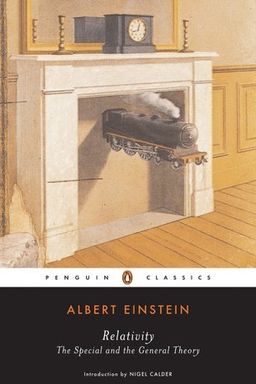
What if the world you move through every day—its solid distances, ticking clocks, and shining stars—were not fixed realities but relative illusions shaped by your perspective? In Relativity: The Special and the General Theory, Albert Einstein invites you to rethink the very fabric of reality. He argues that space, time, motion, and even gravity are not absolute features of the universe but relationships that depend on how and where we observe them.
Einstein’s contention—one that changed the course of physics—is that the laws governing nature must remain consistent for all observers, regardless of how fast they move or where they are located. That deceptively simple requirement upended centuries of classical mechanics built by Newton and Galileo and forced scientists to adopt a new model of the universe: one that treats time as flexible, space as curved, and gravity as the geometry of spacetime itself.
From Everyday Motion to Cosmic Principles
Einstein begins his journey simply—with trains, clocks, and rods—to help ordinary readers sense how motion changes our understanding of space and time. Picture a man on a moving train and a woman standing on the platform. When lightning strikes at two points along the track, both witnesses see different events because of their motion. For the woman, the strikes are simultaneous; for the man, they are not. From this simple thought experiment, Einstein shows that simultaneity—something we take for granted—depends on one’s state of motion. Time, therefore, is not universal but relative.
This idea, distilled from his special theory of relativity (1905), implies astonishing consequences: moving clocks tick more slowly, moving rulers shrink in length, and nothing—no matter how much energy you add—can exceed the speed of light. In essence, each observer lives in their own blend of space and time—their own spacetime frame—where distances and durations differ depending on their relative velocity.
When Gravity Becomes Geometry
But Einstein did not stop there. A decade later, he extended relativity to include acceleration and gravity, launching his general theory of relativity (1915). Here, he replaced the notion of gravity as an invisible force pulling objects together with the idea that massive bodies bend the geometry of spacetime itself. The Earth orbits the sun not because it is “pulled” by a force, but because space-time is curved around the sun, guiding the planet along its bent path—like a marble rolling on a stretched rubber sheet distorted by a heavy ball in the center.
In this model, gravity and acceleration become two sides of the same coin. Einstein illustrates this with his famous “elevator thought experiment”: an observer inside a windowless elevator cannot distinguish whether the pull they feel is due to gravity or the elevator’s acceleration. This principle of equivalence lies at the heart of general relativity and reveals why gravity and motion are fundamentally linked.
A Universe of Curved Space and Dynamic Time
Einstein’s equations transformed how scientists view the cosmos. Time itself slows down near massive bodies, light bends as it passes stars, and the universe’s large-scale structure is shaped by the mass and energy within it. These predictions—once purely theoretical—were later confirmed by the bending of starlight during the 1919 solar eclipse, advancing Einstein to global fame. Later, his equations would predict black holes, the expansion of the universe, and even gravitational waves—ripples in spacetime confirmed a century later.
For readers, Einstein’s book is both a guide to these groundbreaking scientific principles and a philosophical reflection on knowledge itself. He insists that true understanding emerges not from authority or common sense, but from carefully rethinking how we define reality. As he humorously notes in his preface, elegance of expression should be left to the tailor and cobbler; clarity is the greater virtue when explaining ideas that reorder the cosmos.
Why It Matters to You
You may never measure the curvature of space or compute a Lorentz transformation, but Einstein’s work affects your world daily. GPS satellites account for relativistic time dilation to give you accurate location data. The light you see from stars bends through warped cosmic geometry. Even the notion of cosmological beginnings—the Big Bang itself—comes from Einstein’s field equations.
Reading Relativity is not about mastering physics formulas; it’s about learning how questioning assumptions can transform our deepest beliefs about reality. Einstein models intellectual courage—how to recognize when “common sense” fails, and how curiosity and clear thinking can reveal the hidden logic of the universe. By the end, you might not just understand space and time differently—you might see thought itself as a creative force, capable of bending the boundaries of what we think is possible.