
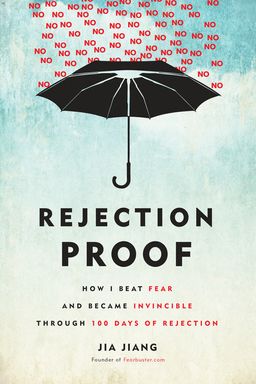
Rejection Proof cover

Rejection Proof

by Jia Jiang

Rejection Proof by Jia Jiang reveals the hidden power of embracing rejection. Through his 100-day rejection journey, Jiang demonstrates how facing rejection can lead to personal growth, greater self-confidence, and remarkable success. Learn to transform ''no'' into a stepping stone towards achieving your dreams.

Becoming Rejection Proof: Transforming Fear into Freedom

Have you ever avoided asking for something simply because you feared hearing “no”? In Rejection Proof: How I Beat Fear and Became Invincible Through 100 Days of Rejection, Jia Jiang takes aim at one of the most universal human experiences—the fear of rejection—and argues that it holds far more power over our lives than we realize. But what if rejection isn’t a verdict on your worth, but rather a tool for learning, growth, and even success? Jiang contends that it’s possible not only to overcome this fear but to transform it into courage and connection.

Driven by a lifelong dream to be an entrepreneur, Jiang quit his job to build a start-up—only to be rejected by an investor. The pain of that “no” sent him spiraling, until he discovered Rejection Therapy, a social experiment by Jason Comely that encourages people to seek out rejection to desensitize themselves to it. Inspired, Jiang decided to get rejected every day for 100 days. The result wasn’t humiliation—it was transformation. His experiment took him from awkward asks (borrowing $100 from a security guard) to viral fame (requesting custom-made Olympic donuts from a Krispy Kreme employee named Jackie Braun). Along the way, he learned that human interactions, not just fear, drive rejection—and that sometimes, daring requests open doors bigger than we could imagine.

From Fear to Curiosity

Jiang’s journey begins not just with fear but with biology. Rejection, he discovers through research, activates the same pain centers in the brain as physical injury. It’s not just uncomfortable—it literally hurts. Evolution has wired us to fear exclusion because, for ancient humans, being rejected by the tribe often meant death. But Jiang shows that in modern life, this instinct is outdated. The same fear that once kept us alive now confines us, preventing risks that lead to innovation and fulfillment. The key is not suppression of fear, but transformation—learning to interpret “no” differently.

The Experiment That Changed Everything

Across 100 days, Jiang approaches strangers with bizarre or uncomfortable requests: playing soccer in a stranger’s yard, giving a safety announcement on a plane, or asking Costco managers to let him speak on their intercom. Each encounter becomes a lesson. When he asks politely, smiles, and expresses warmth, the “no” softens—or turns into “yes.” When he flees after a rejection, the learning stops; when he stays curious and asks “why,” insights emerge. From a Domino’s employee, he learns confidence matters. From Jackie Braun’s donut miracle, he learns people often say yes simply because the idea delights them. What began as a desensitization challenge evolves into a crash course on persuasion, empathy, communication, and personal growth.

Why Rejection Matters More Than Success

Behind Jiang’s story is a broader argument: rejection is not failure—it’s feedback. In business and life, success often depends not on avoiding rejections but on what you do after receiving them. His insights echo those of psychologists like Carol Dweck (on growth mindset) and authors like Theodore Rubin (Compassion and Self-Care), emphasizing that attitude determines meaning. Jiang’s experiences show rejection is rarely personal—it’s circumstantial, influenced by timing, mood, context, and culture. A “no” from Texas might be a “yes” in New York. In fact, rejection is often just an opinion, not truth.

Toward a Rejection-Proof Life

The deeper message of Rejection Proof is that courage functions like a muscle—you must exercise it consistently to keep it strong. By facing rejection deliberately, Jiang reclaims his confidence, improves his communication, and even transforms his relationships—his wife, cofounders, and friends report new respect and warmth toward him. He discovers crucial techniques that apply to leadership, creativity, and self-worth: asking “why,” offering alternatives, collaborating instead of contending, and detaching from outcomes. Beyond psychology, Jiang’s experiment reveals something profoundly human: craving connection, we often mistake silence for rejection and never realize how open people can be when approached sincerely.

Ultimately, Jiang’s 100-day odyssey becomes a map for living fearlessly. It teaches that rejection, rather than closing doors, can open them—to empathy, meaning, and freedom. If we stop asking for approval and start asking for opportunity, the world transforms from intimidating to inviting. In Jiang’s words, “Maybe rejection isn’t the end of the story. Maybe it’s the beginning.”


The Science and Psychology of Rejection

Why does rejection feel so painful, even when the stakes are small? Jiang traces this discomfort to biology and evolution. When his wife was curtly dismissed by a clerk in Italy, her emotional pain equaled physical distress. Later, Jiang discovered studies from the University of Michigan showing that social rejection triggers the same brain regions associated with physical injury—the brain releases opioids, its natural painkillers, in response. In other words, our fear of rejection isn’t just emotional—it’s physiological.

The Evolutionary Fear of Isolation

From cavemen to office workers, belonging has meant survival. Early humans who were ostracized faced predators and starvation. Fear of social exclusion became genetically ingrained—the psychological equivalent of avoiding snakes or fire. Jiang shows that although this mechanism once kept tribes cohesive, in modern life it hampers innovation. By fearing “no,” we avoid asking, speaking, or taking bold steps. This fear is now maladaptive—a vestigial trait like the appendix. He compares this with modern phobias, noting research that shows people react faster to threats like spiders than neutral objects, a reflex built for safety but now outdated.

Pain, Fear, and Personal Meaning

Jiang reframes rejection’s pain as meaningful. Just as fear warns us of danger, rejection reminds us of vulnerability—and invites growth. Like psychologist Brené Brown’s distinction between sympathy and empathy, Jiang learns to climb into rejection’s ‘hole’ and explore it rather than escape. Facing rejection publicly—on streets, planes, and workplaces—transforms shame into curiosity. His discovery parallels Viktor Frankl’s insight in Man’s Search for Meaning: suffering becomes purposeful when we find meaning in it.

Seen through science and history, rejection is natural. Seen through modern psychology, it’s optional in how it defines us. Jiang’s lesson: understand rejection’s roots to detach from its grip. Recognizing that our fear is inherited—not personal—makes it easier to choose courage over comfort.


Rejection vs. Failure: The Hidden Difference

Most of us talk openly about failure but rarely about rejection. Jiang points out that while society celebrates those who fail and try again—entrepreneurs, athletes, creators—it stigmatizes rejection as weakness. Failure feels impersonal; rejection feels personal. When your pitch falls flat, you blame the market; when someone says no, you blame yourself. Yet Jiang argues that reframing rejection as feedback rather than judgment reveals its hidden power.

Why Rejection Hurts More Than Failure

Rejection carries inequality—it’s one person exerting power over another. When Jiang’s uncle dismissed his teenage invention of shoes with wheels, it crushed his creativity. He internalized the “no” as proof that he wasn’t good enough. Decades later, when the same idea became Heelys, he realized rejection had cost him opportunity, not virtue. Unlike failure, which can be logical, rejection often feels moral—a ruler against self-worth. Researchers show that after rejection, people either blame themselves (shame) or others (anger), both of which destroy growth.

Turning Rejection into Feedback

The cure is curiosity. Jiang’s mantra became “Ask why before goodbye.” In his experiment, asking “why” after a denial transformed hurt into learning. For instance, when a homeowner refused his offer to plant a rosebush, the man explained that his dog would dig it up—but suggested a neighbor who loved flowers. The “no” became a referral. Similarly, in failure, entrepreneurs iterate products; in rejection, we can iterate communication.

Jiang’s insight aligns with the entrepreneurial idea popularized by Eric Ries’s The Lean Startup: iteration and feedback fuel progress. The key is emotional detachment—seeing rejection not as sentence but as data. When you accept that every “no” teaches you something new, rejection becomes indistinguishable from learning.


The Toolkit for Turning No into Yes

After enduring dozens of rejections, Jiang began decoding what separated refusals from acceptances. He developed what he calls the Rejection Toolbox—a set of strategies to transform rejection into possibility. These skills, refined through practice, resemble negotiation and leadership principles used in business, psychology, and diplomacy.

Ask “Why” Before Goodbye

Never flee after a “no.” Jiang’s turning point came when he realized the security guard’s follow-up question—“Why?”—was an invitation, not condemnation. Asking why reveals reasons and hidden options. In sales, mentors echo this: objections aren’t refusals, they’re openings. When you ask “Why not?” sincerely, you convert confrontation into collaboration.

Retreat, Don’t Run

Instead of abandoning the request, scale it down. Jiang requested a McGriddles at McDonald’s after breakfast hours. The clerk refused, but he retreated—asking for “something like a McGriddles.” The concession encouraged empathy, and she improvised a honey-griddle sandwich. By pivoting, he learned what negotiator Robert Cialdini calls the “reciprocity rule”: when you concede, others do too.

Collaborate, Don’t Contend

Jiang discovered arguments repel yeses. At Amy’s Ice Cream, he proposed creating his own spicy flavor. When he treated the clerk as a partner, they brainstormed together instead of fighting rules. Result: creativity and connection. This principle applies widely—when you make others co-creators, rejection fades into rapport.

Switch Up, Don’t Give Up

Sometimes, persistence means changing context. Jiang parallels his lesson with NBA player Stephon Marbury’s career: rejected in America, he thrived in China. Altering audience or environment can transform outcomes. In rejection terms, this means asking a different person, in a different place, or at a different time. Every “no” has a hidden number—ask enough times, and you’ll find a “yes.”

By combining empathy, adaptability, and persistence, Jiang’s toolkit teaches that rejection isn’t static—it’s interactive. Master these principles, and every denial can be repositioned into discovery.


Communication: Positioning Yourself for Yes

Rejection isn’t just about what you ask—it’s about how you ask. Over time, Jiang learned that phrasing, tone, and honesty dramatically shape people’s responses. He experimented with how presentation affects outcomes, eventually revealing communication’s subtle power in human interactions.

Give Your “Why”

People don’t respond to random requests—they respond to reason. When Jiang offered $5 bills to strangers without explaining why, most declined. But when he explained that he wanted a photo with New Yorkers to capture city spirit, everyone said yes. Harvard psychologist Ellen Langer’s famous “Copy Machine” study echoes this: people comply 94% of the time when given a reason, even a weak one. Transparency and motive create trust.

Start with “I” and Acknowledge Doubt

When Jiang told a hairdresser she must be bored and offered to cut her hair, her anger erupted. He realized presuming her feelings violated empathy. By starting with “I”—“I’d love to experience your craft”—you own your perspective rather than manipulating theirs. Similarly, naming obvious objections (“I know this sounds odd”) lowers defenses and builds rapport. Companies practice this too—Domino’s revived sales by admitting its pizza “used to be terrible” before presenting improvements. Honesty disarms skepticism.

Target the Right Audience

Even the perfect message fails with the wrong receiver. Jiang’s attempt to teach at the University of Texas succeeded because he chose the communications professor open to innovation, not those on vacation. Similarly, violinist Joshua Bell’s subway performance flopped because commuters weren’t his audience. Success in persuasion, like marketing, depends on fit as much as skill. Rejection often says nothing about you—only that you asked the wrong person.

Communication founded on clarity, humility, and targeting transforms odds. Jiang’s experiments show that small linguistic shifts can change not just what people hear—but how they feel. When conversation becomes authentic, rejection loses its sting.


The Hidden Upsides of Rejection

What if rejection could be good for you? By the second half of his experiment, Jiang discovered that rejection wasn’t a dead end—it was a mirror revealing strength, clarity, and resilience. He divided rejection’s “upside” into four categories: motivation, self-improvement, worthiness, and character building.

Motivation: The Fuel of Achievement

In childhood, being the only student left ungifted by his peers made Jiang vow to prove himself. Similarly, Michael Jordan’s Hall of Fame speech listed every rejection that fueled his basketball fire. Rejection isn’t defeat—it’s challenge. Artists, athletes, and entrepreneurs—from Tom Brady’s draft snub to Steve Jobs’s early abandonment—used rejection as propulsion, not paralysis.

Self-Improvement: Turning Pain into Feedback

During his panhandling experiment, Jiang learned adaptation. When his first sign failed to attract donations, he changed phrasing and location until results improved. Like agile businesses, he iterated based on rejection feedback. Without emotional entanglement, every “no” becomes research.

Worthiness: The Badge of Creativity

Sometimes rejection signals originality. Visionaries from Galileo to Van Gogh were dismissed for ideas “ahead of their time.” Jiang observed the paradox: society praises creativity but instinctively resists it. Psychologist Jennifer Mueller’s study, “The Bias Against Creativity,” proved people unconsciously fear uncertainty. If your idea seems “stupid,” you might be onto something worth exploring.

Character Building: Courage as a Muscle

Jiang’s sidewalk speech terrified him, but he did it anyway. As strangers began listening and cheering, his fear transformed into strength. Courage, he says, isn’t innate—it’s exercised. Each rejection is a rep. If you stop practicing, fear atrophies your courage.”

Rejection’s upsides are cumulative: push through enough, and the world stops intimidating you. Instead of avoiding “no,” you start chasing truth, growth, and meaning.


Finding Meaning and Mission Through Rejection

For Jiang, rejection became not just a challenge but a catalyst for purpose. Amid fame and attention, he received hundreds of emotional emails—from cancer patients, actors, and shy parents—all describing how his courage gave them strength. That feedback turned his experiment outward: rejection wasn’t just about him anymore. It was about helping others conquer theirs.

Empathy: Pain Connects Us

Standing on streets asking for money gave Jiang empathy for panhandlers—the ultimate experts in daily rejection. After interviewing a disabled veteran named Frank, he realized that knowing rejection personally deepens compassion. Like Brené Brown’s concept of vulnerability, shared pain breaks barriers. Through empathy, rejection becomes connection.

Value: The Measure of Resolve

Casino worker John’s endless requests for Jiang to interview a female bodybuilder seemed absurd—until Jiang realized John’s persistence showed obsession and bravery. Through this, Jiang understood that what we are willing to risk rejection for reveals our deepest values. As Dostoevsky said, “The only thing I dread is not to be worthy of my sufferings.”

Mission: Finding Purpose After Rejection

Jiang’s most profound story is of Major Scotty Smiley, an army officer blinded by a bomb but refusing to quit. Smiley’s tragedy led him to help others find hope, proving that rejection by fate can birth new missions. Jiang connects this to Viktor Frankl’s insight: even when freedom is taken, meaning remains. Rejection, endured deliberately, becomes a doorway to life purpose.

In discovering empathy, value, and mission, Jiang redefines success. It’s not conquering rejection for self-esteem—it’s conquering it to serve others. Through meaning, rejection becomes redemption.


Freedom and Power: The Rejectionless Life

By the end of his journey, Jiang no longer sought acceptance from others—he accepted himself. Rejection stopped defining his worth because he detached his identity from outcomes. This, he discovered, was freedom: the ability to act without fear of approval or disapproval.

Freedom to Ask

Borrowing a gyroplane from a stranger to fly the sky, Jiang experiences liberation—wonder that existed only because he asked. The act of asking itself became joyful. He compares adults’ hesitance to his toddler son Brian’s fearless curiosity: children don’t fear “no.” Rejection removes possibilities only when we silence ourselves preemptively.

Freedom to Accept Yourself

Revisiting his uncle’s long-ago rejection, Jiang learns it wasn’t condemnation—it was opinion. Had he asked “why,” collaborated, or persisted, he might have invented Heelys. His realization: we often seek approval that we already possess inside. True courage is not asking for acceptance—it’s granting it to ourselves.

Detachment from Results

Drawing from Lao Tzu and coach John Wooden, Jiang practices effort-based success. Focus on controllables—intent, authenticity, effort—and let go of others’ opinions. Detachment doesn’t mean apathy; it means serenity. When rejection no longer feels final, life opens. Later, helping his wife Tracy land her dream job at Google despite several rejections reaffirms this lesson: outcomes change, but self-belief sustains victory.

Jiang’s 100 days restored the fearless child in him. Freedom, he writes, means “asking without fear, acting without permission, and loving without condition.” That is the rejection-proof life.

Dig Deeper

Get personalized prompts to apply these lessons to your life and deepen your understanding.

Go Deeper

Get the Full Experience

Download Insight Books for AI-powered reflections, quizzes, and more.