
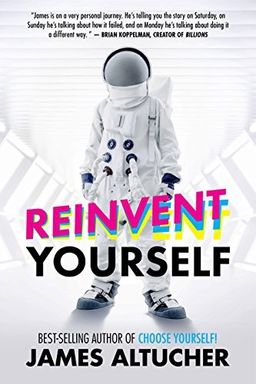
Reinvent Yourself cover

Reinvent Yourself

by James Altucher

Reinvent Yourself offers practical techniques and inspirational stories to help you continually adapt your life approach. Learn from successful leaders and artists how to redefine success in a constantly changing world. Discover the power of self-reinvention to chart your unique path and achieve personal and professional growth.

The Power and Practice of Reinvention

When was the last time you genuinely reinvented yourself—not just changed jobs or moved cities, but fully reexamined who you are and how you live? In Reinvent Yourself, James Altucher argues that reinvention isn’t just a life hack; it’s survival. He contends that we are each meant to constantly evolve, learn, and create anew—and the ability to do so repeatedly is the single most essential skill for thriving in an unstable world.

Altucher writes from painful firsthand experience. He’s lost money, family, career, reputation, and health—sometimes all at once. His solution wasn’t a five-step plan to success; it was the ongoing discipline of reinvention. You can reinvent yourself tomorrow morning, and then again five years later. But to do it well, Altucher says, you must cultivate curiosity, humility, creativity, health, gratitude, and the courage to leave your comfort zone. These are the real tools of reinvention, and they outweigh any credentials, networks, or possessions you may lose along the way.

Why Reinvention Matters More Than Ever

Altucher describes how technological and economic shifts have destroyed the illusion of stability. Gone are the days of lifelong jobs, predictable pensions, and guaranteed success through formal education. “Reliability doesn’t exist anymore,” he warns. College debt is rising, real income is falling, and automation erases traditional roles every year. Given this reality, the only secure career path is choosing yourself—creating your own opportunities through learning, experimentation, and diversification. It’s less about fighting institutions and more about independence from them.

This is what Altucher calls the “event horizon”—the point of no return for anyone hoping to rely on old assumptions. To avoid being swallowed by social and economic collapse, you must be agile enough to create several sources of income, to learn new skills every few years, and to surround yourself with people who challenge and inspire you.

The Plus, Minus, and Equal Formula

Reinvention doesn’t happen in isolation. Altucher introduces the Frank Shamrock formula for growth: the Plus, Minus, and Equal. You need mentors (your Plus) to push you higher, mentees (your Minus) to remind you of your foundation, and peers (your Equals) to challenge you and keep you grounded. This three-part learning system ensures your constant evolution. For Altucher, every reinvention—whether learning a new skill, starting a business, or rebuilding after failure—relies on this dynamic exchange.

The Emotional Engine of Reinvention

Underlying all technical principles is a deeper one: emotional discipline. Altucher reveals how gratitude, creativity, and health form the core of sustainable renewal. “Creativity is a muscle,” he says; using it daily builds self-reliance and joy. Health provides the energy for the rest, while gratitude transforms perceived losses into lessons. The amateur complains, but the master learns. And, perhaps most strikingly, laughter is the final step—Altucher reminds us that children laugh 300 times a day, while adults laugh only five. The difference between amateurs and professionals, he jokes, is that the professional learns to laugh again.

Reinventing as a Permanent Lifestyle

Reinvention is not a one-time event or a crisis response—it’s a lifestyle. Altucher warns that most people die mentally at 25 and are only buried at 75 because they stop learning. Instead, reinvention should become daily practice: discover new mentors, learn new ideas, teach others, and repeat the cycle. It’s about defining freedom differently each time, cultivating new relationships, and creating habits that compound into well-being. The core formula for happiness—freedom, relationships, competence—comes alive only through continuous renewal.

Ultimately, Reinvent Yourself asks you to treat every day as a new starting point. The past five years were your training. The next five are your transformation. Altucher insists that “today is reinvention day”—because tomorrow might be too late.


Choosing Yourself in a Broken System

Altucher’s central message—choose yourself—is both rebellion and liberation. He argues that governments, schools, and corporations are designed not to empower but to control. They funnel you into debt, create dependency, and dictate how success is measured. By rejecting that design, you free yourself to decide your own measures for success: health, creativity, relationships, and freedom.

The Collapse of Traditional Security

Income has been decreasing for decades, debt has exploded, and the supposed guarantees of education and housing have failed. Altucher’s raw advice—“don’t buy a house, don’t go to college, don’t get credit cards”—sounds radical but serves as metaphor for breaking conformity. His argument echoes thinkers like Seth Godin (Linchpin) and Tim Ferriss (The 4-Hour Workweek): stop waiting to be picked; the era of gatekeepers is gone.

Multiple Streams of Freedom

The IRS reports that most multimillionaires have seven sources of income, a statistic Altucher holds as proof that reinvention requires diversification. Job security is a myth when automation can erase it overnight. Instead, start creating small, autonomous ways to earn and learn—consulting, teaching, product creation, investments, or new skills every few years. These become safety nets and creative playgrounds. You redefine freedom as independence from any single source of control.

Personal Autonomy Through Well-Being

Freedom isn’t rebellion for rebellion’s sake; it’s mastery of well-being. Altucher defines well-being through three components: freedom, relationships, competence. Freedom comes from minimizing dependence and expectations. Relationships thrive when you engage with mentors and peers who energize you instead of drain you. Competence grows through constant learning. These, not external validation, become the metrics of meaning in an unpredictable world.

Reinvention, then, is everyday resistance against complacency. It’s the decision to learn something new rather than cling to titles or nostalgia. In a world crossing the economic “black hole event horizon,” Altucher argues, this habit of choosing yourself again and again is how you survive—and eventually thrive.


The Mentor’s Triangle: Plus, Minus, Equal

Altucher’s “Plus, Minus, Equal” model—borrowed from martial arts expert Frank Shamrock—serves as the engine of reinvention. You need three kinds of people to grow: those above you, those beside you, and those you teach. Each plays a distinct role in your evolution as a learner and leader.

Finding Your Plus: The Mentors

Mentors show what mastery looks like. Altucher insists on active research and value exchange: study everything about your chosen mentors—read their old papers, learn their influences, send useful ideas. He recounts poring through decades-old articles by potential mentors, offering detailed commentary, and earning invitations or partnerships as result. The key: give before you ask. Whether meeting in person or virtually, mentors appear when you demonstrate curiosity and usefulness.

Your Equals: The Challengers

Your peers challenge complacency. Altucher’s podcast conversations with thought leaders—from Wayne Dyer to Tony Robbins—illustrate this level. He doesn’t idolize guests but meets them as equals, asking hard questions and learning through dialogue. This horizontal exchange mirrors the scene every creative person needs: a network of individuals learning, failing, and building together.

Your Minus: The Students

Teaching reinforces mastery. Altucher mentors others through advice and feedback, establishing that “your legacy is what those you teach go on to do.” You learn by articulating what you’ve learned. Some mentees will surpass you, some will disappear, but each clarifies your values. It’s also humility in practice—understanding that growth circulates through teaching and learning endlessly.

For Altucher, the Plus-Minus-Equal approach prevents stagnation and arrogance. Without it, you risk falling into what he calls the trap of the amateur who stops learning at 25 and continues pretending until life buries them at 75.


How to Have 1,000 Mentors: Learning Everywhere

In Altucher’s reinvention model, mentors aren’t limited to the living or the nearby. You can have 1,000 mentors by learning from everyone—books, podcasts, strangers, failures. He treats mentorship as a scalable system of curiosity rather than a personal relationship. It’s a mindset that democratizes learning: wherever there’s value, there’s a potential Plus.

The Virtual Mentor System

Some mentors are better studied than met. Altucher learned from Susan Cain (Quiet), Chase Jarvis, and Robert Cialdini through their writings and podcasts instead of direct mentorship. He calls this “virtual mentoring”—absorbing dense material without the emotional drain of difficult personalities. It’s permission to learn from the best while maintaining your own psychological health.

Micro-Mentorships

Altucher argues that micro-mentorships—brief exchanges that spark insight—can change your trajectory. He references Napoleon Hill’s one-day interview with Andrew Carnegie as a lifelong mentorship. Similarly, interacting once with an expert can plant the seed of mastery. You don’t need to rely on long-term relationships; you need moments of clarity and transmission.

Deliver and Over-Deliver

If you want world-class mentors, offer world-class value. Altucher repeatedly sends ideas, introductions, or analyses with no expectation of reward. His advice: plant seeds every three months, demonstrate consistency, and over-deliver even in small gestures. He calls this the currency of mentorship—show proof of action before anyone invests in you.

Mentorship, in Altucher’s world, mirrors reinvention itself: it’s an ecosystem, not hierarchy. By learning from many, teaching some, and collaborating with peers, you create exponential growth—“the exponential life,” he calls it—where insight compounds like interest.


Negotiation and Influence as Life Skills

Altucher’s chapters on negotiation (inspired by FBI negotiator Chris Voss) and persuasion expert Robert Cialdini turn business tactics into tools for everyday freedom. They show how understanding human motives—fear, reciprocity, belonging—helps you navigate any reinvention, from career to relationship.

Influence Through Authenticity

Drawing from Cialdini, Altucher outlines seven timeless principles of influence: reciprocity, likability, consistency, social proof, authority, scarcity, and unity. He applies them firsthand when giving gifts, conducting podcast interviews, and building trust. For instance, he admits his flaws upfront (likability), shows shared values (unity), and offers something first (reciprocity). Altucher’s framing turns manipulation into connection—the art of influencing without exploitation.

Negotiation as Learning

Chris Voss’s approach reshaped Altucher’s concept of dialogue. Instead of chasing easy “yeses,” Voss teaches to seek “no”—because denial establishes control and safety, leading to genuine responses. Altucher demonstrates how questions like “How am I supposed to do that?” extract information, build empathy, and create collaboration even in conflict. Negotiation becomes inquiry, not coercion.

Communication as Survival

For Altucher, learning to influence and negotiate is how you reinvent relationships. He jokes about using Voss’s “late-night DJ voice” with his daughters during disagreements—a blend of humor and calm authority. Negotiation here is not artifice but humility: asking better questions, caring about others’ fears, and listening more deeply. In a collapsing economy, this emotional intelligence might be the most marketable skill you have.

Together, these techniques reveal that reinvention isn’t about domination—it’s about presence, understanding, and genuine persuasion, where you and others evolve together.


Creativity as Reinvention’s Daily Muscle

Altucher sees creativity not as a talent but a muscle—you exercise it daily or it atrophies. In chapters featuring Picasso, Louis C.K., and Barbara Cartland, he proves that prolific output, experimentation, and imperfection are the true routes to mastery.

Practice Over Perfection

Picasso created over 50,000 works of art—proof that mastery arises from relentless work, not divine inspiration. Altucher quotes the artist: “Action is the foundational key to all success.” As with any reinvention, the act matters more than the outcome. You can fail 80% of the time; progress emerges from the remaining 20%. Kobe Bryant missed 13,000 shots before becoming legendary. Serena Williams practiced 30 years to perfect what looked like talent. The formula stays constant: repetition creates genius.

Trouble and Imitation

Picasso’s other rule—“Unless your work gives you trouble, it is no good”—translates to reinvention itself. Every change must provoke discomfort; otherwise, you’re copying yourself instead of growing. Altucher pairs this with humility: learn the rules “like a pro, so you can break them like an artist.” Build expertise before rebellion.

Imagination and Action

Altucher adds that “Everything you can imagine is real.” He cites Elon Musk’s mantra: “I do things I can’t do—that’s how I get to do them.” Any new skill or venture begins with trying what seems impossible. Reinvention, therefore, is creative experimentation repeated until mastery emerges. Creativity isn’t artistry—it’s survival strategy.

Altucher’s conclusion: create every day, badly if you must. Because compounding 1% daily in creative effort yields 38X growth per year. Reinvention happens by turning imagination into messy, daily action.


Fear Decisions vs. Growth Decisions

Near the end of the book, Altucher distills a life-changing insight shared by a friend’s grandmother: every decision stems from either fear or growth. This deceptively simple idea becomes his litmus test for all choices—personal, financial, relational, creative.

Recognizing Fear Decisions

Fear-based decisions keep you trapped. You stay in jobs you hate, relationships that drain you, or mindsets that shrink you because you’re afraid of losing something—money, love, approval. Altucher recounts times he endured abusive bosses because he feared being fired. He kept failing by choosing “security” over truth. Fear decisions stem from scarcity; they shrink possibilities and invite regret.

Choosing Growth Decisions

Growth decisions expand you even when they hurt. Leaving a failed company, moving cities, or walking away from toxic relationships are painful choices but necessary reinventions. Altucher recalls quitting a job midweek, limping out of the building, then realizing on the walk home that his literal pain had vanished. Growth decisions fill the body with calm and curiosity—your chest expands, your ideas flow, your competence grows. They become the stories you tell proudly later.

The Physical Compass of Choice

Altucher teaches to read your body like a compass. Fear decisions feel like tension in the head—tightness, pressure, “I better do this or else.” Growth decisions feel like expansion—space in the chest, ideas in the mind, peace afterward. Both are uncomfortable, but only one moves you forward. “Fear makes decisions. Growth tells stories,” he writes. Reinvention starts when you notice which you are choosing.

This idea unites the book’s core theme: to reinvent yourself, practice courage daily. Reinvention is not about knowing what comes next—it’s about trusting that choosing growth will create what comes next.


The Daily Practice of Reinvention

Altucher closes his book with a practical blueprint—the Reinvention Guide. It’s the lifelong habit of choosing yourself every day through health, creativity, relationships, and learning. He summarizes reinvention as a five-year process that never truly ends.

The Five-Year Cycle

Year One: flailing and reading widely, developing curiosity. Year Two: finding mentors and building your scene. Year Three: competence—beginning to earn. Year Four: making a living. Year Five: creating wealth and legacy. You’ll repeat this loop for each new reinvention. As Altucher jokes, “Eventually you’re dead and then it’s hard to reinvent yourself.” But until then, you keep restarting, learning, and reemerging in new forms.

Physical, Emotional, Creative, Spiritual Practice

His famous “Daily Practice” distills reinvention into four areas: physical (sleep and exercise), emotional (avoid toxic people and gossip), creative (generate 10 ideas a day), and spiritual (gratitude and stillness). Improving each area 1% daily compounds into massive transformation over time. The effort isn’t glamorous; it’s incremental sanity.

From Zero to Freedom

Every reinvention begins at zero—no credentials, no guarantees, no titles. What matters is momentum. Within five years, 10,000 hours of deliberate practice make you world-class in any skill (a theme echoed by Angela Duckworth and Malcolm Gladwell). Altucher’s formula: read 500 books, find mentors, teach others, network intelligently, and compound learning until ideas generate income.

You don’t wait for the perfect time or title; you start today. Reinvention isn’t a leap—it’s a daily choice. Every morning, you ask: “Am I moving forward or backward?” That awareness, practiced relentlessly, turns failure into freedom.

Dig Deeper

Get personalized prompts to apply these lessons to your life and deepen your understanding.

Go Deeper

Get the Full Experience

Download Insight Books for AI-powered reflections, quizzes, and more.