
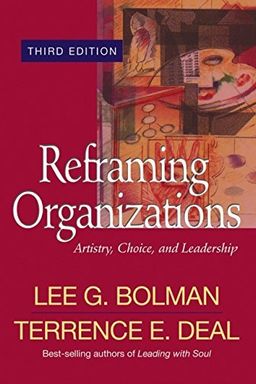
Reframing Organizations cover

Reframing Organizations

by Lee G Bolman and Terrence E Deal

Reframing Organizations offers transformative insights into structuring businesses for optimal decision-making and resilience. By exploring innovative team dynamics and ethical leadership, Bolman and Deal arm leaders with practical strategies to navigate complexity and enhance organizational success.

Seeing Organizations Through Multiple Lenses

You operate in a world that is complex, ambiguous, and overflowing with information. Reframing—the central idea of this book—means learning to see situations through multiple lenses so you can diagnose problems, make better decisions, and lead more effectively. The authors show that most managerial failure is not due to ignorance or lack of data but to blindness caused by limited perspective. They argue that organizations are multifaceted systems requiring four frames of interpretation: structural, human resource, political, and symbolic.

The Need for Reframing

A frame is a mental model—a map and filter that helps you interpret and act. The danger is when you mistake your map for the territory and become confident and wrong. Volkswagen and Wells Fargo exemplify how managers trapped in narrow frames breed disaster: VW engineers focused on technical compliance while ignoring ethical and cultural cues; Wells Fargo obsessed over sales metrics while missing perverse incentives that rewarded cheating. In both cases, reframing could have revealed cultural disequilibrium and unethical systems.

The Four Frames

The Structural frame treats organizations like machines or blueprints. You see roles, policies, and coordination mechanisms as levers to achieve goals. The Human Resource frame views organizations as families where needs, skills, and motivation matter. The Political frame treats organizations as jungles of competing interests and coalitions. The Symbolic frame perceives them as temples or theaters—systems of meaning, rituals, and shared identity. Together, these frames offer complementary insights. If you apply them sequentially, you gain richer understanding and more durable solutions.

How Reframing Works

To reframe, start by identifying your default lens. Then deliberately ask, “Is this a design problem, a people problem, a power struggle, or a meaning problem?” Generate multiple diagnoses, test with data and dissenting voices, and align responses to each diagnosis. This habit translates uncertainty into choice and clarity. Steve Jobs’ transformation at Apple shows reframing in action—shifting from pure product genius to organizational architect who blended structure and artistry to create enduring systems.

Beyond the Individual Mindset

Reframing extends beyond personal cognition to organizational culture. As societies and institutions grow more complex, single-frame management—whether purely structural or people-centered—produces partial solutions that eventually fail. Modern organizations require leaders who integrate multiple logics simultaneously: designing structure, empowering people, balancing interests, and nurturing meaning. The Kennedy High case dramatizes how this skill turns chaos into coherence—combining structure, HR, politics, and symbols to rebuild safety, morale, and shared mission.

Core Message

You escape managerial blindness not by mastering every detail but by learning to shift lenses, integrate perspectives, and design solutions that honor both facts and meanings. Reframing is the antidote to cluelessness.

This book therefore functions as both map and toolkit: it teaches you how to construct organizations that fit their environments, nurture people, manage power, and sustain purpose. Reframing is not theory for reflection; it is a discipline for action—a way of seeing more clearly so you can lead more humanely and effectively.


Understanding Bias and Sensemaking

The authors emphasize that mental shortcuts—cognitive biases—shape how you and your organization interpret events. While heuristics enable quick decision-making, they also create blind spots. Anchoring, confirmation bias, and availability heuristics cause managers to cling to first impressions, ignore contradictory data, or overreact to recent vivid events.

Why Bias Matters

You may believe you’re rational, but your mind constructs narratives consistent with prior beliefs. During the Challenger disaster, engineers and managers discounted warnings until vivid catastrophe forced a frame shift. In law enforcement, misread contexts—like the Tamir Rice shooting—show how expectation and emotion distort perception. These are not moral failures alone; they are predictable outcomes of cognition interacting with organizational systems.

Reducing Bias

To reduce bias, question dominant frames. Invite dissent, use red teams and pre-mortems, and design systems that surface disconfirming evidence. Encourage whistleblowers rather than silence them. Map feedback delays and long-term consequences using system-thinking tools (Peter Senge’s work complements this). Importantly, pair individual debiasing with organizational learning processes—open information flows, participatory decision-making, and cross-frame review.

Key Lesson

Biases cannot be eradicated, but reframing and disciplined sensemaking dramatically reduce their damage. When you institutionalize multiple perspectives, you replace arrogance with adaptive intelligence.

In practice, reframing is a cognitive shield: it counters rapid cognition with deliberate reflection. Managers who routinely compare frames—structural for facts, political for interests, symbolic for meanings—achieve judgments that are more balanced and less reactive under stress.


Designing Structure That Works

Structure converts strategy into results. If you design the wrong configuration, even talented people will flounder. The authors trace the structural frame to roots in scientific management (Taylor) and bureaucracy (Weber), refined by thinkers such as Mintzberg and Thompson. Structure defines roles, responsibilities, and coordination systems. When well aligned, it channels energy efficiently; when misfitted, it breeds confusion and conflict.

Core Principles

Organizations exist to achieve goals through division of labor and coordination. Differentiation creates specialization; integration restores coherence. Choose structure based on the environment—functional, product-based, customer, geographic, or process groups. McDonald’s uses centralized control and uniformity; Harvard thrives on decentralized autonomy. Neither is inherently better—the fit matters.

Vertical and Lateral Coordination

Vertical controls—hierarchy, rules, planning systems—suit stable conditions. Lateral coordination—networks, task forces, and matrix teams—suits turbulence. In crises such as 9/11, failure to coordinate laterally magnified damage. Mintzberg’s classic configurations (simple, machine, professional, divisional, adhocracy) help you diagnose institutional type and adapt design accordingly.

Restructuring and Change

Restructuring is risky. Dilemmas like differentiation vs. integration or tight vs. loose control reappear. Ford under Alan Mulally succeeded because structural simplification was paired with cultural and political repair—a case of integrated reframing. Conversely, Larry Summers at Harvard failed by applying top-down change in a professional bureaucracy that values autonomy.

Design Rule

Always align structure to strategy, technology, workforce, and environment. When any variable shifts, redesign rather than patch.

Structure gives clarity, but not permanence. You must treat organizational architecture as living design—continuously adjusted with feedback, informed by human, political, and symbolic realities.


People, Motivation, and Organizational Fit

The human resource frame begins with a simple truth: people are not replaceable components. If you ignore human needs, you invite sabotage, disengagement, or turnover. Organizations and people need each other. The key is alignment—matching job design to intrinsic motives.

Models of Motivation

Classic theories from Maslow, Herzberg, McClelland, and Hackman-Oldham illustrate how needs, satisfaction, and feedback drive performance. Daniel Pink modernizes this: autonomy, mastery, and purpose optimally motivate knowledge workers. Nucor’s high-commitment system and Lincoln Electric’s security-plus-incentive model show these ideas in practice.

Person-Structure Conflict

Argyris and McGregor warned that treating adults like children fuels resistance. Ben Hamper’s account of factory life depicts alienation from narrow specialization and managerial bullying. To repair this, leaders must grant responsibility and voice. Organizations like Publix and Wegmans earn loyalty through dignity, fairness, and development opportunity.

Practices That Work

Effective HR systems share coherence: selective hiring, fair rewards, investment in learning, empowerment, and cultural rituals. SRC’s open-book management and GE’s Work-Out demonstrate participative redesign that builds competence and trust. OD tools—survey feedback, T-groups, future search—turn philosophy into practice.

Key Commitment

If you invest in people pragmatically and protect their voice, you gain the most reliable performance system known: voluntary engagement.

Human resource leadership isn’t sentimentality—it’s strategic reciprocity. When structure and purpose fit human needs, you get sustainable motivation and innovation rather than fatigue and turnover.


Politics, Power, and Managerial Craft

Scarcity breeds politics. The political frame tells you that every organization is a contest for influence among actors with differing interests. Conflict is not failure—it’s normal. You must learn to map coalitions, understand power sources, and negotiate ethically.

Understanding Power

Power flows through positional authority, rewards, information, alliances, reputation, and control of meaning. Cialdini’s persuasion principles describe everyday tactics—reciprocity, social proof, authority—that sway decisions. Managers act as partisans and authorities; effectiveness requires both positional and relational leverage.

Agenda and Coalition Building

Kotter and Kanter emphasize that political leaders craft agendas combining vision and strategy. Paul Maritz at Microsoft used patient diplomacy with Dave Cutler; Aruna Roy organized villagers to pass India’s Right to Information law. These examples show moral framing plus tactical skill. Mapping terrain—identifying allies, opponents, and influencers—precedes coalition-building and negotiation.

Negotiating Ethically

Fisher and Ury’s "Getting to Yes" guides ethical bargaining: separate people from problems, focus on interests, and create value before claiming it. Four ethical guardrails—mutuality, generality, openness, and caring—keep power honorable. When combined with symbolic resonance, these principles turn action into leadership rather than manipulation.

Political Truth

Power is neither dirty nor saintly—it's capacity. Your mastery lies in mobilizing it for shared goals while preserving integrity.

When you reframe politics into a leadership craft, conflict becomes creative negotiation, not war. You earn influence by aligning moral vision with strategic choice.


Culture, Symbols, and Meaning

Organizations are not only systems—they are cultures sustained by symbols, rituals, and stories. The symbolic frame helps you lead with meaning. You learn that what matters is not just what happens but what it means.

Myths and Rituals

Founding myths—from Southwest’s napkin origin to Airbnb’s “Belong Anywhere”—bind members to shared identities. Heroes like Jim Sinegal (Costco) and Herb Kelleher (Southwest) embody culture through stories. Ceremonies—Mary Kay seminars, Medtronic’s Mission Medallion—renew communal purpose. Ritual preserves continuity when facts change.

Culture as Strategy

A well-aligned culture outperforms competitors. Nordstrom’s service ethos and BMW’s factory rituals create behavior standards beyond policy. But culture can rot—Volkswagen’s performance-driven pride turned corrupt when symbols of excellence disconnected from ethics.

Symbols of Transformation

When leading change, symbolic acts matter. FDR’s fireside chats, MLK’s “dream” narrative, and Mulally’s “One Ford” mantra exemplify leaders who use language and ceremony to turn vision into emotion. Institutional isomorphism (DiMaggio & Powell) warns that many organizations copy appearances to gain legitimacy—beware hollow ritual without substance.

Symbolic Rule

Facts persuade the mind; symbols persuade the heart. Use both to create meaning resilient enough to guide through uncertainty.

Symbolic leadership links identity and intention. Stories, rituals, and shared values make strategy emotionally real and ethically grounded.


Interpersonal Intelligence and Style

Leadership lives or dies in interaction. The authors blend Argyris’s Models I and II, emotional intelligence theory, and personality insights to teach practical communication competence. Technical skill alone rarely wins trust—you must master relationship dynamics.

Model I vs. Model II

Model I is defensive logic—“I’m right, you’re wrong.” It produces blame, rumination, and sabotage. Model II replaces control with inquiry: state your view, invite others’ perspectives, and test assumptions publicly. In the Anne Barreta story, honest questions transform hostility into dialogue.

Emotional Intelligence

Goleman’s framework—self-awareness, self-management, social awareness, relationship management—translates empathy into leadership skill. Managers with EI handle conflict constructively and inspire cooperation. Paul Maritz at Microsoft quietly protected Cutler while steering engagement—a model of interpersonal tact.

Personality and Team Fit

Awareness of styles (MBTI, Big Five) lets you harness differences rather than fight them. ENFP–ISTJ partnerships improve when members negotiate roles around strengths. Psychological safety (Amy Edmondson’s research) depends on these interpersonal practices—balancing voice and respect.

Leadership Habit

Combine advocacy with inquiry every day. Speak honestly, invite correction, and make relationships the medium of learning.

Interpersonal mastery creates trust—the most transferable capital across frames. Emotional skill makes reframing possible because people share truths only in safety.


Leading Change Integratively

Change fails when it is one-dimensional. Structural reform without human investment or cultural ritual breeds collapse. This section merges John Kotter’s eight-stage model with the four frames to design holistic transformation.

Why Programs Fail

Around half of corporate change initiatives fall short. Most ignore one or more frames: neglecting training (HR), ignoring political opposition, or skipping symbolic steps that make transitions visible. Bain studies confirm that complexity defeats linear reforms.

Integrated Cases

3M’s Six Sigma under James McNerney boosted efficiency but strangled innovation—structural overreach. Ron Johnson’s JCPenney reinvention ignored customer rituals—symbolic blind spot. Alan Mulally’s Ford turnaround succeeded because he combined all frames: reorganizing structure, empowering teams, negotiating coalitions, and embodying purpose (“One Ford”).

Applied Method

For each of Kotter’s stages (urgency, coalition, vision, obstacles, wins, anchors), ask: What design must shift? What participation is vital? Who must be persuaded? What rituals will cement change? Each question pairs a frame with an action.

Integrated Insight

True change coordinates structure, people, politics, and meaning—a choreography that transforms programs into renewed systems.

Leading change is less about big slogans and more about balanced design. When each frame reinforces the others, change takes root and becomes culture.


Ethics, Soul, and Purpose

Finally, the authors ground leadership in ethics—not compliance but organizational soul. Purpose, ritual, and justice are practical defenses against corruption. When leaders forget why they exist, systems drift toward manipulation and scandal.

When Soul Fails

Siemens’ bribery network and Wal‑Mart de Mexico’s payoffs prove that structure alone can conceal wrongdoing. Missing ethical purpose turns competence into complicity. Without rituals or values, fear drives performance instead of pride.

Examples of Purposeful Leadership

Medtronic’s mission ceremony and Southwest’s culture of love show operationalized ethics. Bill George enforced values through actions—firing violators despite cost. These examples echo the four ethical metaphors of the book: factory (excellence), family (care), jungle (justice), and temple (meaning). Together they express integrity at systemic scale.

Institutional Virtue

Building soul means embedding moral clarity in structure, incentives, and stories. Rituals remind people who they are; transparent accountability ensures congruence. Ethics becomes the unseen architecture connecting all frames—discipline, empathy, fairness, and faith.

Moral Insight

Ethics is not a constraint—it’s a creative asset. A shared moral core gives organizations endurance beyond markets or crises.

Leadership grounded in soul completes reframing: you design well, empower wisely, negotiate fairly, symbolize meaningfully, and act ethically. That integration defines the book’s ultimate message—lead with multiple lenses and one conscience.

Dig Deeper

Get personalized prompts to apply these lessons to your life and deepen your understanding.

Go Deeper

Get the Full Experience

Download Insight Books for AI-powered reflections, quizzes, and more.